



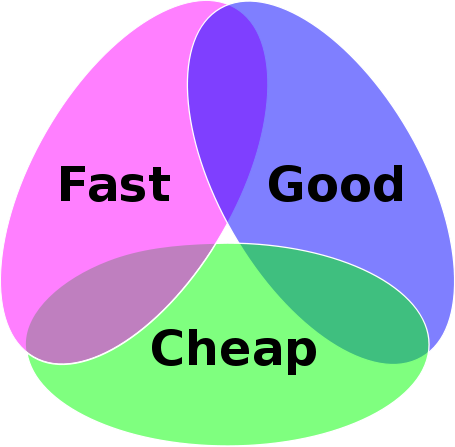
Agile MVP triangle: Fast, Good and Cheap
Last updated: July 23, 2024 Read in fullscreen view


 Recommended for you
- 01 Aug 2024
 The Standish Group report 83.9% of IT projects partially or completely fail 788/2605
 - 13 Apr 2024 Lessons on Teamwork and Leadership from Chinese story book "Journey to the West" 251/1337
- 02 Nov 2021 What is Terms of Reference (ToR)? 166/1743
- 30 Oct 2022 How Much Does MVP Development Cost in 2023? 154/414
- 09 Jan 2022 How to Bridge the Gap Between Business and IT? 148/351
- 19 Oct 2021 Software development life cycles 143/821
- 01 Sep 2022 Facts Chart: Why Do Software Projects Fail? 128/721
- 13 Oct 2021 Outsourcing Software Development: MVP, Proof of Concept (POC) and Prototyping. Which is better? 127/603
- 04 Oct 2021 Product Validation: The Key to Developing the Best Product Possible 127/435
- 07 Oct 2025 Case Study: Using the “Messaging House” Framework to Build a Digital Transformation Roadmap 121/201
- 23 Jun 2024 Best Practices for Managing Project Escalations 114/319
- 10 Apr 2021 RFP vs POC: Why the proof of concept is replacing the request for proposal 111/438
- 12 Oct 2022 14 Common Reasons Software Projects Fail (And How To Avoid Them) 109/674
- 12 Aug 2024 Understanding Google Analytics in Mumbai: A Beginner's Guide 108/215
- 02 May 2022 What Is RAID in Project Management? (With Pros and Cons) 105/948
- 01 Mar 2024 10 Project Management Myths 104/278
- 03 Apr 2022 Microsoft Solutions Framework (MSF) 103/1445
- 12 Aug 2022 What is End-to-end project management? 102/608
- 07 Jul 2021 The 5 Levels of IT Help Desk Support 102/578
- 28 Jul 2022 POC, Prototypes, Pilots and MVP: What Are the Differences? 102/843
- 08 Nov 2022 4 tips for meeting tough deadlines when outsourcing projects to software vendor 97/387
- 31 Aug 2022 What are the best practices for software contract negotiations? 97/369
- 03 Dec 2025 IT Outsourcing Solutions Explained: What, How, Why, When 97/129
- 03 Jan 2023 Organizing your agile teams? Think about M.A.T (Mastery, Autonomy, Purpose) 96/493
- 16 Feb 2021 Choose Outsourcing for Your Non Disclosure Agreement (NDA) 95/265
- 12 Dec 2021 Zero Sum Games Agile vs. Waterfall Project Management Methods 95/509
- 02 Nov 2022 Difference between Change Management and Project Management 92/324
- 05 Sep 2023 The Cold Start Problem: How to Start and Scale Network Effects 92/289
- 07 Aug 2022 Things to Consider When Choosing a Technology Partner 88/371
- 05 Mar 2021 How do you minimize risks when you outsource software development? 86/419
- 09 May 2022 Build one to throw away vs Second-system effect: What are differences? 86/397
- 01 Aug 2022 Is planning "set it and forget it" or "set it and check it"? 84/381
- 10 Apr 2024 The Parking Lot Method: Unlocking a Simple Secret to Supercharge Your Productivity 84/603
- 09 Feb 2023 The Challenge of Fixed-Bid Software Projects 83/332
- 22 May 2022 What are common mistakes that new or inexperienced managers make? 83/364
- 17 Oct 2021 Does Fast Tracking increase project cost? 80/456
- 18 Dec 2023 The Cone of Uncertainty in Scrum & Requirement Definition 80/814
- 06 Mar 2024 [SemRush] What Are LSI Keywords & Why They Don‘t Matter 80/282
- 01 Dec 2023 Laws of Project Management 78/393
- 07 Dec 2023 12 project management myths to avoid 77/269
- 14 Jun 2022 Example and Excel template of a RACI chart in Software Development 76/949
- 07 Jul 2022 Managing Project Execution Terms 75/482
- 18 Jul 2021 How To Ramp Up An Offshore Software Development Team Quickly 75/667
- 18 Oct 2021 Key Elements to Ramping Up a Large Team 74/1333
- 18 Feb 2026 "Hit and Run" Project Management: Balancing Speed with Sustainability 74/100
- 03 Nov 2022 Top questions and answers you must know before ask for software outsourcing 73/358
- 04 Oct 2022 Which ERP implementation strategy is right for your business? 70/430
- 01 May 2024 Warren Buffett’s Golden Rule for Digital Transformation: Avoiding Tech Overload 69/277
- 16 Apr 2021 Insightful Business Technology Consulting at TIGO 69/523
- 10 Jul 2025 Building AI-Driven Knowledge Graphs from Unstructured Data 68/230
- 27 Jan 2020 Should a project manager push developers to work more hours due to mistakes of manager schedule setting? 67/508
- 15 May 2022 20 Common Mistakes Made by New or Inexperienced Project Managers 63/345
- 20 Nov 2022 Software Requirements Are A Communication Problem 63/305
- 02 Dec 2021 3 Ways to Avoid Scope Creep in IT Consulting 62/271
- 06 Mar 2021 4 things you need to do before getting an accurate quote for your software development 61/758
- 24 Nov 2023 The project management paradox: Achieving MORE by doing LESS 61/291
- 01 May 2023 CTO Interview Questions 60/395
- 06 Jun 2022 Change Management at the Project Level 60/366
- 05 Jun 2023 Fractional, Part-Time (virtual) or Interim CTO: Who Will Cover Your Business Needs? 60/203
- 20 Jul 2022 Software Myths and Realities 60/1001
- 07 Oct 2022 Digital Transformation: Become a Technology Powerhouse 59/306
- 02 Jun 2024 Reviving Ancient Wisdom: The Spiritual Side of Project Management 59/317
- 26 Sep 2024 Successful Project Management Techniques You Need to Look Out For 58/455
- 28 Oct 2022 Build Operate Transfer (B.O.T) Model in Software Outsourcing 57/467
- 13 Jan 2020 Quiz: Test your understanding project cost management 55/701
- 10 May 2022 Levels of Teamwork 54/249
- 30 Nov 2023 Project Managers, Focus on Outcomes — Not Deliverables 52/213
- 09 Mar 2022 Consultant Implementation Pricing 49/261
- 01 Mar 2023 How do you deal with disputes and conflicts that may arise during a software consulting project? 47/207
- 21 Jun 2024 Dead Horses and the Escalation of Commitment 47/185
- 17 Mar 2025 IT Consultants in Digital Transformation 41/131
Software engineers are all about managing tradeoffs. the highest level tradeoff is during planning and prioritization in the form of trading off value delivered, the quality level of that value, and the time to deliver it.
Under pressure from the market and their competitors, machine builders, but actually every system developer, are looking for ways to stretch and compress the ‘magic triangle’. In other words: deliver higher quality in a shorter time at a lower cost price. Money-time-quality are inextricably linked in this triangle.
Point of the triangle, you are explicitly giving up some focus on quality and a polished experience. you're also choosing to push out time to delivery somewhat to get more value in.
This is jokingly talked about as "fast, cheap, or good. pick two. no, not that one. " alternatively described as, "nine women cannot make a baby in one month" (mythical man month), meaning that even if you did add resources in the form of extra engineers, you can quickly get to a point of diminishing returns where adding people doesn't actually speed up the delivery.
Businesses know they need to set aside a budget to ensure they get an app that will meet or exceed these minimum expectations. We even created a calculator to help companies get a sense of how much they need to budget.
Although we take a transparent approach to pricing, timescales and project management when working with clients, we know not everyone in our industry does. Some web and app development firms charge considerably more. Others charge a lot less, aiming to rush through product development so they can move onto the next paying project.
Cost
This is basically scope. it could also be labeled "features," both in terms of breadth of different features, and the depth/scope of an individual feature. i thought about calling this "user value," but quality could also be considered to deliver user value. likewise, scope could include quality/polished work. in the end, this isn't a perfect term, but i basically mean user value excluding quality/polish.
When you pay too little for something that needs more investment to ensure you get the results you actually want. App and web development is a sector where bargains aren't always what they appear and trading between constraints is not always a good way to go. Web development firms that are up-front about costs, that show how/where that budget is going to be spent, are the ones that are worth working with.
Quality
Some examples of quality are high fidelity graphic style, ux optimizations based on feedback and performance tuning. this is often subjective and can take a virtually unlimited amount of time as you polish on the far end of the diminishing returns curve. the trick is getting to 80% of max quality with 20% of the effort.
Quality is a huge concern. If the end-result is an app you aren't happy with, it could take months to fix problems, or you might need to wait until you can work with a different firm to rebuild the app. Agencies that promise cheap and quick results often compromise on quality. Even if something looks nice - which is easier to achieve than ever thanks to templates - the user experience could let you down.
Time
This is simply the time to ship - to put the software in front of real users.
App development goes through several stages. From wireframe and designs, to iterative testing, creating the front and back-end, connecting the app to any databases, APIs or other services as needed, then quality testing, further iterations and changes, as needed.
Web development company that skip some of these steps, or take shortcuts to reduce timescales throughout the process aren't doing their clients any favors. You could end with an app full of bugs. An app your users or paying customers don't want to download and use. An app that receives bad reviews on app stores, making it far less likely that new potential users will download it.
Every app comes with its own production timescale. It depends on the number of features, estimated hours - which should be illustrated in a proposal - and time for a web development firm to work with a client, communicating needs and changes throughout the project. However, a quote seems too long or too short, it probably is. Reasonable quotes should reflect the total time to build, iterate, test, improve and complete an app. Not rushing a project for a quick finish, nor dragging the work out for months and months.
Good, fast, cheap: choose wisely!
Picking the right web development firm to work with shouldn't involve compromises. Select the one that delivers the work you need at the right price, with an emphasis on quality and realistic timescales. It's also useful to take a look at the clients they've worked with, how clients rate them, the reviews, and other indicators of their ability. Here at TIGO, we provide full-cycle development from initial concept to a live application. We have all IT specialists for hire – software engineers, designers, mobile developers, QA engineers and DevOps.
Our customers get exactly what they want by communicating with engineers directly and controlling the project as if they were in the same room with the team.
 Explore more on these topics

























 Guest Blogging: The Definitive Guide

 Top Trending Topics
 Share This
 Link copied!
 Recently Updated News