



Education App Development Cost in 2026: Benchmarks and Key Cost Drivers
Last updated: March 13, 2026 Read in fullscreen view


 Recommended for you
- 14 Jan 2026
 How to Evaluate the Business and Productivity Software Company Seismic on RFP AI Agent Use Cases 247/297
 - 05 Mar 2026 Top 7 Full-Cycle Web App Development Companies for Your Business in 2026 165/215
- 17 Mar 2026 How Much Does it Cost to Build an AI Agent in 2026 161/230
- 08 Oct 2024 Vietnam: The Rising Star in Global Outsourcing – Trends and Costs for 2025 153/516
- 19 Oct 2021 Software development life cycles 143/821
- 07 Jul 2024 Top Fintech Companies in Vietnam Driving Innovation Across Digital Banking & Investment 141/275
- 11 Mar 2026 OEM, ODM, and OBM in Software Development: Choosing the Right Growth Path 140/166
- 01 Nov 2023 Difference between Vendor and Subcontractor 137/1205
- 12 May 2021 The Real Cost Between Outsourcing IT vs In-House: A Quick Comparison 133/579
- 17 Mar 2026 Top 10 Product Development Companies in Chennai 2026 (Updated) 131/148
- 16 Oct 2024 Building a Software Outsourcing Startup: Strategy Through Two Canvases 128/168
- 04 Oct 2021 Product Validation: The Key to Developing the Best Product Possible 128/436
- 13 Oct 2021 Outsourcing Software Development: MVP, Proof of Concept (POC) and Prototyping. Which is better? 128/604
- 02 Feb 2026 What Is the Total Cost of Web Development for Small & Medium Businesses? 126/159
- 10 Mar 2021 The 7 Biggest Mistakes to Avoid Before Outsourcing a Web Development Project 124/357
- 07 Oct 2025 Case Study: Using the “Messaging House” Framework to Build a Digital Transformation Roadmap 123/203
- 11 Mar 2024 Why You Should Hire Odoo Developers from Vietnam to Customize Your ERP System 122/228
- 06 Feb 2026 How Much Does a CPA Cost for a Small Business? 121/144
- 21 Aug 2025 Top 30 Oldest IT Outsourcing Companies in Vietnam 120/225
- 01 Jan 2023 Top Software Development Challenges in 2023 118/437
- 05 Aug 2025 Why Doesn’t South Korea Outsource Its IT Projects Like Other Developed Countries? 117/222
- 05 Jan 2022 What Outsourcing Engagement Model is Right For You? 116/428
- 10 Jan 2024 Facts Chart: Reasons for outsourcing 113/268
- 12 Oct 2022 14 Common Reasons Software Projects Fail (And How To Avoid Them) 110/675
- 12 Aug 2024 Understanding Google Analytics in Mumbai: A Beginner's Guide 109/216
- 19 Oct 2020 The hidden costs of outsourcing software development 107/575
- 01 Mar 2022 Top 5 reasons why outsourcing to Vietnam is a smart move 106/391
- 28 Jul 2022 POC, Prototypes, Pilots and MVP: What Are the Differences? 103/844
- 21 Oct 2021 Advantages and Disadvantages of IT Outsourcing 103/459
- 01 Jan 2023 4 New IT Outsourcing Pricing Models to consider in 2023 102/477
- 09 Sep 2022 Close Collaboration and Communication Can Overcome the Challenges of Distributed Teams 101/308
- 16 Mar 2023 10 Reasons to Choose a Best-of-Breed Tech Stack 100/314
- 24 Nov 2025 Top Blockchain Companies in Vietnam 100/145
- 10 May 2021 What are things you should look for in a good IT outsourcing company? 99/544
- 31 Oct 2025 The True ROI of Software Development Outsourcing for Tech Startups 98/178
- 03 Dec 2025 IT Outsourcing Solutions Explained: What, How, Why, When 97/129
- 31 Aug 2022 What are the best practices for software contract negotiations? 97/369
- 24 Nov 2021 What is the Actual Cost of Hiring Cheap Developers? 96/492
- 12 Dec 2021 Zero Sum Games Agile vs. Waterfall Project Management Methods 95/509
- 08 Apr 2026 Top AI Agent Development Companies for Manufacturing Industry (2026) 95/123
- 01 Sep 2019 Outsourcing Software To Vietnam: Facts, benefits and limitations 93/554
- 01 Jan 2023 Software Development Outsourcing Trends to Watch Out for in 2023 93/416
- 05 Sep 2023 The Cold Start Problem: How to Start and Scale Network Effects 92/289
- 01 Jan 2024 What The World Is Flat Means to IT Outsourcing 91/259
- 01 Apr 2021 IT Outsourcing to vietnam: Why It Is A Good Choice? 90/388
- 01 Jan 2023 Top 5 IT outsourcing countries in 2023 88/363
- 15 Aug 2021 TIGO Rate Formula - Things the partners should know 88/618
- 05 Mar 2021 How do you minimize risks when you outsource software development? 86/419
- 13 Jan 2023 What are the Hourly Rates in Offshore Software Development? 86/327
- 12 Jan 2023 Top 10 Trustworthy IT Outsourcing Companies in Vietnam 85/367
- 15 Oct 2022 Project-based team model for one-off and pilot software development projects 85/912
- 16 Dec 2021 Why outsource Python development of your project? 85/583
- 13 Oct 2021 Why Outsourcing Software Development Services Is Gaining Traction With Non-Technical Leaders? 84/399
- 06 Feb 2024 What are benefits and drawbacks of co-creating solutions with your clients? 84/306
- 24 Aug 2022 7 Ways to Improve Software Maintenance 83/386
- 19 Mar 2021 Selective Outsourcing of IT Functions - a new trend in business outsourcing 82/642
- 14 Dec 2021 The Top 10 Problems with Outsourcing Implementation and How to Solve Them 81/477
- 17 Jan 2024 What are the benefits and challenges of using multi-sourcing or single-sourcing strategies? 81/283
- 03 Oct 2020 Outsourcing Your MVP Development - Streamlined Solutions for future 80/506
- 06 Mar 2024 [SemRush] What Are LSI Keywords & Why They Don‘t Matter 80/282
- 01 Dec 2023 Laws of Project Management 78/393
- 02 Nov 2023 What are the pros and cons of iIT outsourcing? 77/290
- 03 Jan 2023 IT Outsourcing Costs: Is outsourcing really cost-effective? 77/287
- 18 Jul 2021 How To Ramp Up An Offshore Software Development Team Quickly 75/667
- 04 Apr 2024 Unlock Vietnamese-Japanese outsourcing potential 74/308
- 03 Nov 2022 Top questions and answers you must know before ask for software outsourcing 73/358
- 03 Nov 2021 7 phases of Odoo Implementation and Development: Can they be outsourced? 73/497
- 04 Jan 2021 VIETNAM AS A BIG ATTRACTIVE DESTINATION IN THE FIELD OF OUTSOURCING 72/397
- 01 Jun 2025 10 Sustainable & Unique IT Outsourcing Companies in Vietnam 72/154
- 06 Oct 2021 Intellectual property issues with outsourcing software development 71/456
- 04 Oct 2022 Which ERP implementation strategy is right for your business? 70/430
- 22 Mar 2022 8 Mistakes Marketing Agencies or Consulting Firms Make When Outsourcing Web Development 70/415
- 02 May 2021 Outsourcing Software Development: Avoid 8 Mistakes 70/207
- 21 Aug 2022 Forbes: IT Outsourcing Hotspot: Vietnam, A Small But Mighty Powerhouse 70/325
- 12 Oct 2021 Vietnam outsourcing path - the silk road connecting ASEAN with the developed countries (EU, US, Japan...) 69/410
- 01 May 2024 Warren Buffett’s Golden Rule for Digital Transformation: Avoiding Tech Overload 69/277
- 01 Jan 2024 Hiring Tech Talents in Asia: An Overview of Skills, Costs, and Potential 68/228
- 28 Oct 2022 Expect the unexpected in 2023 - How Outsourcing Can Help? 68/272
- 10 May 2021 Project Audit and Second Opinion Services 68/313
- 09 Jan 2021 How can outsourcing enable business agility? 68/258
- 17 Oct 2020 How Outsourcing can Improve Time Management for Better Business 66/364
- 15 Nov 2023 IT Staff Augmentation Types and the Best Choice for Your Business 66/278
- 30 Dec 2022 Top 6 Reasons to Partner with TIGOSOFT 64/309
- 02 Mar 2021 Estimate the Cost of Software Development 63/427
- 01 Oct 2022 Vietnam is a favorite supply of IT outsourcing services to Japan 63/299
- 11 Mar 2023 Common Pain Points in Software Development Outsourcing 62/326
- 01 Jan 2024 12 reasons for software development outsourcing 62/262
- 01 May 2023 Streamline Your Business with Outsourcing 61/266
- 01 Jan 2024 Tech Partnerships: Choosing the Right Software Outsourcing Firm in Vietnam 61/233
- 07 Nov 2024 Outsourcing Crisis Looming: Will Trump's Policies Transform the Global IT Landscape? 59/242
- 08 Aug 2021 Why Nearshore Software Development is better than In-House Development? 59/254
- 28 Oct 2022 Build Operate Transfer (B.O.T) Model in Software Outsourcing 57/467
- 01 Jan 2024 Software Outsourcing Questions for 2024 57/206
- 01 Jan 2023 Why is Vietnam the Top IT Outsourcing Destination of 2023? 56/297
- 25 Sep 2025 A Practical Guide to Secure Online Work for Outsourced Teams 56/151
- 11 Jan 2024 Entering the Japanese Market: Stacking the Deck and Setting Expectations 53/205
- 08 Feb 2022 Software Development: Fixed Cost or Opportunity Cost? 53/514
- 16 Mar 2021 Outsource Data Engineering Services - TIGO Streamlined Solutions 51/307
- 31 Dec 2021 Outsourcing Software Development to mitigate the impact of COVID-19 50/373
- 08 Jan 2024 Outsourcing on an As-Needed Basis 50/215
- 01 Feb 2023 [InfoWorld] Is your outsourcer agile enough? 49/242
- 21 Oct 2022 Outsourcing Billable Rate 46/315
- 25 Nov 2021 Low-Cost Software Development: Buy Nice or Buy Twice? 44/406
- 03 Jun 2026 Enterprise Guide to Choosing the Right Enterprise Application Development Services 34/37
- 09 Jul 2026 Improving Parent-School Communication with Technology 19/24
Education app development in 2026 requires precise financial planning rather than rough cost assumptions. Schools, EdTech startups, and corporate learning teams operate under tighter budgets, stronger accountability, and higher expectations from users who compare learning platforms with consumer-grade digital products. As a result, many organizations benchmark costs early and evaluate vendors before working with a best education app development company that understands both educational workflows and long-term platform growth.
At the same time that educational software is becoming increasingly sophisticated in its structure, there are much more advanced capabilities of a modern learning application. Other than supporting multiple user roles, adaptive content delivery, analytics, third-party integrations and AI-assisted personalization, each of these additional functions significantly add to the amount of development effort required to create such a solution and will directly drive the cost of development.
The purpose of this article is to provide realistic cost benchmarks for developing educational applications as of 2026. In addition, it identifies the various technical and organizational factors that will determine these budgets, in order that those who make the investments can plan for those investments accurately and avoid hidden costs during the development and scaling period.
Education app development cost benchmarks in 2026
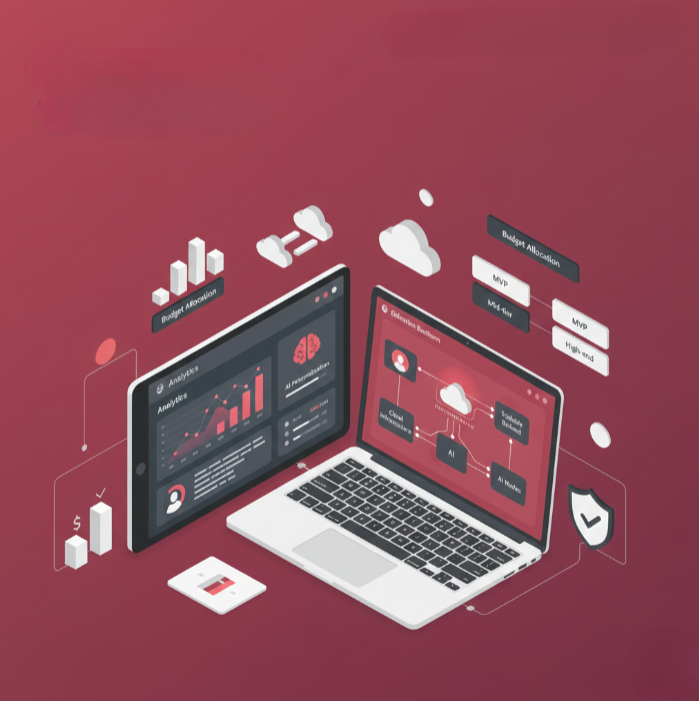
The cost of developing education apps in 2026 falls into three categories: basic, mid-tier and high-end.
A basic education app is an MVP that usually costs $40,000 to $60,000. This level is primarily designed to help you investigate whether your concept of learning and the market will work, and this generally includes things like user authentication, access to learning materials, simple assessments, and basic tracking of progress. Many businesses use this tier as a way to gain insight on which features keep individuals engaged or how long they retain their engagement prior to investing in the next tier of an app.
A mid-tier education app will typically cost from $70,000 to $120,000. This type of app will have the capability to support structured learning paths, dashboards for instructors to manage their learners’ progress, role-based permissions, analytics, a content management system, as well as integration with video and/or payment platforms.
An education platform, which generally falls into the high-end category, will generally exceed $150,000 to develop. The high-end platforms will have the ability to handle thousands of concurrent users, advanced reporting, personalized learning, operating within multiple regions, and include a continuous amount of content updates. Most businesses involved with the education space operate within this area, including universities, businesses who provide corporate-style learning, and government-sponsored educational programs.
As previously mentioned, creating scalability or advanced data complexity from the beginning of app development will dramatically increase total project costs.
Why education app budgets often grow during development
Budget overruns for education applications usually occur due to their visible features. Estimates for growth are typically underestimated based on how much more complex the system will be than originally anticipated. Also, multiple roles within an educational environment contribute to increased complexity in systems. Students, teachers, administrators, content editors, and sometimes parents will use the same system, but each has different requirements for permission levels, user interface, and workflow.
Another significant factor affecting costs is content lifecycle management. Courses progress, assessments can change, and the history of each learner must be accurate as updates are made. Achieving this can require careful data modeling and version control, depending on how the content is created and what types of failures may occur.
In addition, analytics and personalization can increase the complexity of a system's backend, especially for tracking student progress, producing recommendations, and generating reports. Many of the results require that data pipelines used by different users remain consistent, even though the interface may appear to be simple.
When these factors are overlooked in the early stages of project development, redesigns and additional development cycles will be necessary for the project team.
Core cost drivers in education app development
Learning model and app type
System architecture is defined by the learning model used. In the case of language learning applications, both adaptive difficulty and spaced repetition logic are necessary. Testing platforms for exam preparation rely on assessment engines as well as analytics from previous student performance. In addition to providing certification tracking and compliance reporting, corporate training systems also have their own unique components which must be built into the model and therefore impact the cost of development due to differing levels of difficulty during the project's lifecycle.
Platform support and device diversity
The expansion of platform types adds to both the testing and scope of an application’s development, regardless of whether a cross-platform framework is used, as the team will still have to deal with platform-specific functions and performance improvements.
Many education apps run on older devices or a mixture of computers used in a classroom so that ensuring the stability of both (older and newer) devices will add additional QA and optimization work to your team.
UX design and accessibility
The educational software industry is being shaped more and more by the need for accessibility standards. The WCAG Guidelines will have a significant impact on things like navigation logic, fonts, contrast and media handling. While designing accessibly adds costs initially, the long-term benefits are increased usage and decreased regulatory risk.
Backend architecture and scalability impact
Long-term costs will be guided by the underlying structure of your backend architecture.
Simple backends have only the basic functionality: such as user Authentication, and delivery of Content. Education platforms that scale, provide functionality to manage user Attainment Records, analytic data Pipelines, real-time collaboration, and External Integrations.
You need to account for peak usage scenarios (such as Exams and Live Sessions) before you launch a product through additional Capacity Planning. Retrofitting a system for scalability after launch typically costs more than designing for growth from the outset.
The better you structure your backend systems, the less expensive it will be to redevelop and operate them later.
AI and automation as cost multipliers
The budget for AI features is influenced by their integration into the overall learning experience.
Some common examples of basic AI features used in education are: automated grading, chat-supported learner assistance, and automatically tagging content. More complex systems include adaptive learning paths, predictive analytics, and personalized recommendations.
In addition to being considered an integral part of your solution's core system, AI can also incur significant costs due to the necessity for data preparation, model build-out, and evaluation logic and monitoring processes.
Security, privacy, and compliance requirements
Education platforms are designed for the collection and processing of sensitive user information, which sometimes includes children.
There are a number of laws affecting design, including GDPR, FERPA, and other state education laws; therefore, incorporating secure authentication, role-based access control, audit logging, and data encryption will increase development cost by changing the scope of the project.
In addition, adding security testing and documentation will increase the upfront cost but ultimately reduce (legal and operational) risk to the company.
How the development approach affects total cost
The development model impacts both budget predictability and delivery risk.
Freelancing can decrease the upfront cost of hiring, but does not offer a long-term solution. The long-term solution for a company to build a team internally, which includes recruiting and onboard employees and will carry additional costs to manage the ongoing operation.
Dedicated Education Software Development Teams can provide better estimates due to the expectation of domain-specific problems in areas such as: scale, compliance and content/workflow.
Practical strategies to control education app development cost
Cost-effective management needs a well-structured design rather than removing features from a product.
Prioritizing measurable outcomes is critical when designing for user engagement. A well-designed strategic minimum viable product (MVP) can help you validate the engagement of your users with your product. Your product architecture should allow for future scalability of your product. And finally, you can use early analytics to guide your product direction to ensure you reduce rework and stay within your long-term budgets.
How to estimate your education app budget accurately
In order for estimates to be accurate, we need clear definitions of our model, User Roles, Compliance Needs and Expected Scales prior to requesting proposals. Be sure to identify any integrations and reporting requirements as early as possible in the estimating process.
A structured Discovery Process would represent a small % of the overall project cost but will save thousands of dollars from error calculation later on in the project.
Conclusion
The cost of building an educational app in 2026 will be determined primarily by backend design elements (architecture/ data pathways/ scalable capacity), rather than how the application appears to the end user. Great investments are made when companies use their education software platform as a long-term investment strategy. Analyzing the scope of the project realistically, defining project milestones as benchmarks, and employing good technical planning will lead to having cost limitations from the outset, while also allowing organizations to achieve long-term, sustainable growth with their education application.
Yuliya Melnik
Technical writer
Yuliya Melnik is a technical writer at Cleveroad, a full-cycle web and mobile application development company. She specializes in writing about web application architecture, cloud-native engineering, SaaS platforms, and secure full-cycle product development.
 Explore more on these topics

























 Guest Blogging: The Definitive Guide

 Top Trending Topics
 Share This
 Link copied!
 Recently Updated News