



INVEST guidelines for good user story
Last updated: January 03, 2023 Read in fullscreen view


 Recommended for you
- 01 Aug 2024
 The Standish Group report 83.9% of IT projects partially or completely fail 788/2605
 - 13 Apr 2024 Lessons on Teamwork and Leadership from Chinese story book "Journey to the West" 251/1337
- 02 Nov 2021 What is Terms of Reference (ToR)? 166/1743
- 01 Dec 2022 Difference between Set-based development and Point-based development 137/499
- 21 May 2022 "Fail Fast, Fail Often, Fail Forward" is the answer to Agile practices of software success 133/1182
- 10 Apr 2022 Agile self-organizing teams: What are they? How do they work? 130/688
- 27 Oct 2020 8 principles of Agile Testing 125/1440
- 03 Jul 2022 Manifesto for Agile Software Development 119/389
- 16 Jul 2022 What are disadvantages of Agile Methodology? How to mitigate the disadvantages ? 115/511
- 28 Nov 2023 Scrum Team Failure — Scrum Anti-Patterns Taxonomy 114/369
- 23 Jun 2024 Best Practices for Managing Project Escalations 114/319
- 02 May 2022 What Is RAID in Project Management? (With Pros and Cons) 105/948
- 01 Mar 2024 10 Project Management Myths 104/278
- 03 Apr 2022 Microsoft Solutions Framework (MSF) 103/1445
- 12 Aug 2022 What is End-to-end project management? 102/608
- 03 Jan 2023 Organizing your agile teams? Think about M.A.T (Mastery, Autonomy, Purpose) 96/493
- 20 Nov 2022 Agile working method in software and football 95/435
- 02 Nov 2022 Difference between Change Management and Project Management 92/324
- 07 Oct 2020 How To Manage Expectations at Work (and Why It's Important) 90/424
- 09 May 2022 Build one to throw away vs Second-system effect: What are differences? 86/397
- 01 Jun 2022 How Your Agile Development Team is Just Like a Football Team? 84/302
- 01 Aug 2022 Is planning "set it and forget it" or "set it and check it"? 84/381
- 10 Apr 2024 The Parking Lot Method: Unlocking a Simple Secret to Supercharge Your Productivity 84/603
- 22 May 2022 What are common mistakes that new or inexperienced managers make? 83/364
- 17 Oct 2021 Does Fast Tracking increase project cost? 80/456
- 18 Dec 2023 The Cone of Uncertainty in Scrum & Requirement Definition 80/814
- 07 Dec 2023 12 project management myths to avoid 77/269
- 09 Oct 2022 Key Advantages and Disadvantages of Agile Methodology 77/781
- 14 Jun 2022 Example and Excel template of a RACI chart in Software Development 76/949
- 07 Jul 2022 Managing Project Execution Terms 75/482
- 18 Oct 2021 Key Elements to Ramping Up a Large Team 74/1333
- 18 Feb 2026 "Hit and Run" Project Management: Balancing Speed with Sustainability 74/100
- 12 Oct 2020 The Agile Manifesto - Principle #8 72/567
- 27 Jan 2020 Should a project manager push developers to work more hours due to mistakes of manager schedule setting? 67/508
- 15 May 2022 20 Common Mistakes Made by New or Inexperienced Project Managers 63/345
- 02 Dec 2021 3 Ways to Avoid Scope Creep in IT Consulting 62/271
- 24 Nov 2023 The project management paradox: Achieving MORE by doing LESS 61/291
- 06 Jun 2022 Change Management at the Project Level 60/366
- 20 Jul 2022 Software Myths and Realities 60/1001
- 05 Jun 2023 Fractional, Part-Time (virtual) or Interim CTO: Who Will Cover Your Business Needs? 60/203
- 02 Jun 2024 Reviving Ancient Wisdom: The Spiritual Side of Project Management 59/317
- 26 Sep 2024 Successful Project Management Techniques You Need to Look Out For 58/455
- 13 Jan 2020 Quiz: Test your understanding project cost management 55/701
- 01 Mar 2022 Why Does Scrum Fail in Large Companies? 54/318
- 10 May 2022 Levels of Teamwork 54/249
- 30 Nov 2023 Project Managers, Focus on Outcomes — Not Deliverables 52/213
- 10 Oct 2022 Should Your Business Go Agile? (Infographic) 48/172
- 21 Oct 2022 Virtual meeting - How does TIGO save cost, reduce complexity and improve quality by remote communication? 47/237
- 21 Jun 2024 Dead Horses and the Escalation of Commitment 47/185
- 02 Nov 2022 Frequently Asked Questions about Agile and Scrum 45/442
The INVEST criteria spell out how to create Agile user stories that deliver valuable working software early and often. They show you how to specify your requirements in ways that follow the principles and values of Agile.
The INVEST mnemonic is designed to make it easy to remember what effective Agile user stories look like. With that in mind, we’ve put together a short, simple description of each of the criteria and an explanation of why it matters.
You’ll also get examples of user stories that do and don’t meet the INVEST criteria, find out how the criteria fit with the definition of ready and learn about the origins of the criteria.
Note: If you’re working on a non-software project, just replace the phrase “working software” with “working solutions”.
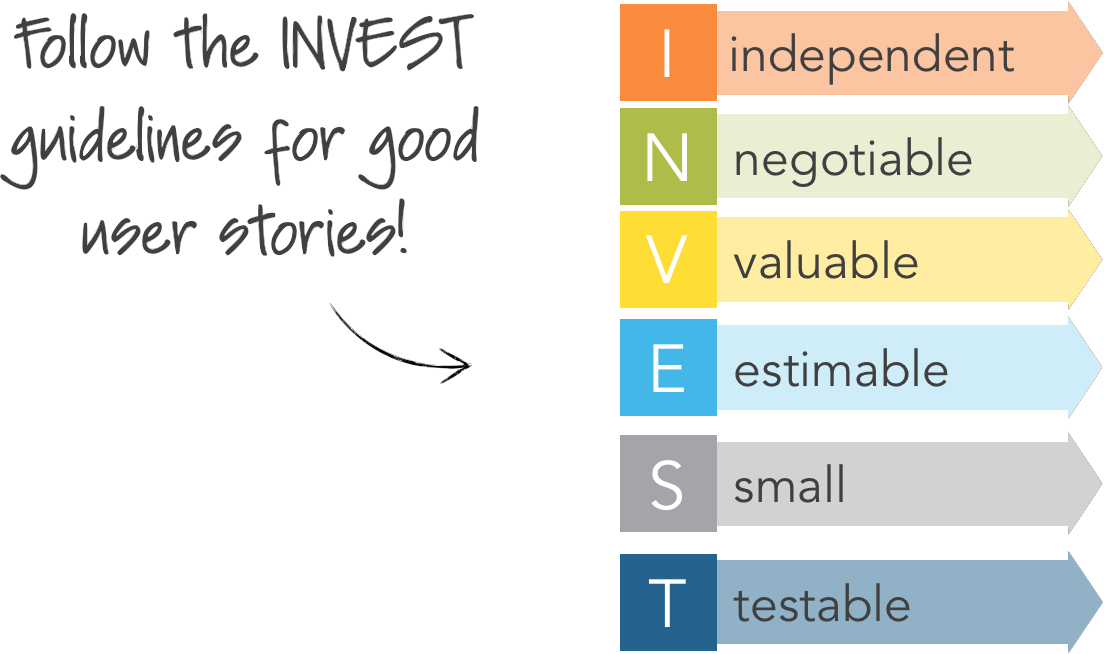
Under the INVEST criteria, good user stories are:
- Independent
- Negotiable
- Valuable
- Estimable
- Small
- Testable
Independent
The story is not dependent on other stories getting done.
Why it matters: Dependencies cause delays. You don’t get user-ready working software until both or all dependent stories are complete.
Negotiable
The story prompts but doesn’t prescribe a solution.
Why it matters: Treating the story as an evolving conversation between product owner and development team builds a shared understanding and harnesses everyone’s expertise: the product owner knows the benefits you’ll bring the users and the development team knows the best way to do this. And accepting that the story may change lets you adjust what you deliver as you learn more.
Valuable
The story makes clear the benefit it delivers the users.
Why it matters: In Agile, your goal is to deliver valuable working software. So your user stories need to explicitly state the value they’ll bring. What user needs does it meet, what risks does it mitigate, what costs does it save, what learnings does it allow? How does the story help you achieve your vision for the product?
Estimable
The story gives the development team enough detail to estimate the size of the story.
Why it matters: You need to know the size of the stories so you can plan an iteration that will deliver working software. Plus, product owners need to know the size so they can prioritise the stories that give the most value for the least effort.
Small
The story is the smallest piece of work that will deliver useful software.
Why it matters: Agile works in short iterations so you can get fast feedback from your users. If you want to deliver working software each iteration, short iterations necessarily require small stories. The smaller the story, the more likely it will be delivering value by iteration’s end.
Testable
The story is clear enough that you can assess if the story is done.
Why it matters: If there isn’t a Yes or No answer to the question, “Have each of the acceptance criteria been met?” then developers can’t write automated tests and the product owner can’t check the story when it’s up for acceptance.
 Explore more on these topics
























 Guest Blogging: The Definitive Guide

 Top Trending Topics
 Share This
 Link copied!
 Recently Updated News