


Ishikawa (fishbone) diagram in software project management
Last updated: October 21, 2025 Read in fullscreen view


 Recommended for you
- 01 Aug 2024
 The Standish Group report 83.9% of IT projects partially or completely fail 788/2605
 - 02 Nov 2023 Unlocking Success with The Amoeba Management Model: Key Lessons, Pros & Cons, and Finding the Perfect Fit 371/1059
- 09 Sep 2022 Kaizen, Kaikaku and Kakushin – what’s the difference? 360/3436
- 24 Nov 2022 Genba Genbutsu Genjitsu (3Gs), (Go to the Genba & see for yourself!) 279/3287
- 10 Nov 2021 5S methodology - the SECRET to Japanese SUCCESS 270/2017
- 01 Dec 2023 What is Amoeba Management? 262/1255
- 13 Apr 2024 Lessons on Teamwork and Leadership from Chinese story book "Journey to the West" 256/1342
- 03 Jan 2024 What is the Ringi process? 202/1219
- 07 Mar 2023 Japan’s Unusual Farming Strategy: Renting Land and Leaving It Fallow for 5 Years — Here’s the Truth… 193/316
- 02 Nov 2021 What is Terms of Reference (ToR)? 168/1745
- 18 Oct 2020 How to use the "Knowns" and "Unknowns" technique to manage assumptions 165/1259
- 30 Oct 2022 How Much Does MVP Development Cost in 2023? 154/414
- 01 Mar 2022 The Toyota Way Management Principles 150/962
- 09 Jan 2022 How to Bridge the Gap Between Business and IT? 149/352
- 02 Feb 2022 Yokoten: Best Practice Sharing from a success 137/1561
- 28 Oct 2025 The Future of Real Estate: Key Trends and Essential Lessons in Digital Transformation 136/207
- 29 Jan 2026 Honne and Tatemae: Why Do Japanese People Seem Excessively Polite and Indirect? 136/160
- 09 Sep 2022 What is 5 Whys (Five Whys)? 131/1106
- 18 Dec 2025 EOS as a Business Operating System: Powerful, but Not Always Plug-and-Play 129/182
- 01 Sep 2022 Facts Chart: Why Do Software Projects Fail? 128/721
- 19 Sep 2022 Jidoka in Software Development and Odoo ERP/MRP 125/675
- 23 Sep 2021 INFOGRAPHIC: Top 9 Software Outsourcing Mistakes 123/546
- 29 Aug 2022 Difference between Kaizen and Innovation 120/1025
- 06 Jun 2022 HEIJUNKA: The art of leveling production 120/741
- 18 Aug 2022 What are the consequences of poor requirements with software development projects? 119/387
- 11 Jan 2024 What are the Benefits and Limitations of Augmented Intelligence? 119/605
- 13 Dec 2020 Move fast, fail fast, fail-safe 118/458
- 23 Jun 2024 Best Practices for Managing Project Escalations 115/320
- 06 Feb 2021 Why fail fast and learn fast? 114/590
- 01 Oct 2020 Fail fast, learn faster with Agile methodology 113/1187
- 27 Aug 2022 Kaizen - Culture of Continuous Improvement and Lean Thinking 113/1006
- 10 Apr 2021 RFP vs POC: Why the proof of concept is replacing the request for proposal 112/439
- 15 Jul 2022 Hansei Methodology: Continuously Engaging People in Improvement 107/861
- 19 Jul 2022 The 12 Principles of Continuous Process Improvement 106/645
- 01 Jan 2023 How To Use Poka-Yoke (Mistake Proofing) Technique To Improve Software Quality 105/765
- 02 May 2022 What Is RAID in Project Management? (With Pros and Cons) 105/948
- 29 Nov 2021 Memorandum of Understanding (MOU) for Partnership Agreements 105/673
- 01 Mar 2024 10 Project Management Myths 104/278
- 03 Apr 2022 Microsoft Solutions Framework (MSF) 103/1445
- 15 Apr 2022 Total Quality Management (TQM) - Japanese-style management approach to quality improvement. 103/828
- 12 Aug 2022 What is End-to-end project management? 102/608
- 12 Mar 2022 The u-Japan concept 102/391
- 07 Jul 2021 The 5 Levels of IT Help Desk Support 102/578
- 14 Mar 2024 Why should you opt for software localization from a professional agency? 102/241
- 17 Mar 2023 Reduce waste in software development with 3M model: Muda, Mura, Muri 101/1071
- 13 Jul 2022 Applying the business mantra "HORENSO" to Achieve 360-degree Communication 101/1061
- 04 Mar 2024 Tree Ring Management: Take the Long Term View and Grow Your Business Slowly 99/543
- 09 Oct 2024 Are Expensive CRM Systems Really Worth It? 99/194
- 20 Dec 2021 What is Hybrid Mobile App Development? 98/497
- 08 Nov 2022 4 tips for meeting tough deadlines when outsourcing projects to software vendor 97/387
- 07 Nov 2022 Why Design Thinking can save the outsourcing industry 97/288
- 03 Dec 2025 IT Outsourcing Solutions Explained: What, How, Why, When 97/129
- 16 Feb 2021 Choose Outsourcing for Your Non Disclosure Agreement (NDA) 96/266
- 03 Jan 2023 Organizing your agile teams? Think about M.A.T (Mastery, Autonomy, Purpose) 96/493
- 14 Oct 2021 Advantages and Disadvantages of Time and Material Contract (T&M) 95/988
- 12 Dec 2024 Danshari: A Japanese Minimalist Philosophy for Cleaner Code and Leaner IT Operations 92/175
- 02 Nov 2022 Difference between Change Management and Project Management 92/324
- 11 Jul 2022 Lean software development - the game-changer in the digital age 89/381
- 28 Dec 2021 8 types of pricing models in software development outsourcing 89/523
- 07 Aug 2022 Things to Consider When Choosing a Technology Partner 88/371
- 08 Oct 2022 KPI - The New Leadership 87/695
- 09 May 2022 Build one to throw away vs Second-system effect: What are differences? 87/398
- 01 Aug 2022 Is planning "set it and forget it" or "set it and check it"? 84/381
- 10 Apr 2024 The Parking Lot Method: Unlocking a Simple Secret to Supercharge Your Productivity 84/604
- 22 May 2025 Role of Self-Service in CRM: Customer & Partner Portals for Automation 83/166
- 22 May 2022 What are common mistakes that new or inexperienced managers make? 83/364
- 09 Feb 2023 The Challenge of Fixed-Bid Software Projects 83/332
- 10 Nov 2022 Poor Code Indicators and How to Improve Your Code? 82/299
- 17 Oct 2021 Does Fast Tracking increase project cost? 80/456
- 10 Dec 2023 Pain points of User Acceptance Testing (UAT) 80/539
- 18 Dec 2023 The Cone of Uncertainty in Scrum & Requirement Definition 80/814
- 19 Oct 2021 Is gold plating good or bad in project management? 79/910
- 07 Dec 2023 12 project management myths to avoid 77/269
- 14 Jun 2022 Example and Excel template of a RACI chart in Software Development 76/949
- 07 Jul 2022 Managing Project Execution Terms 75/482
- 18 Oct 2021 Key Elements to Ramping Up a Large Team 75/1334
- 17 Feb 2022 Prioritizing Software Requirements with Kano Analysis 75/379
- 18 Feb 2026 "Hit and Run" Project Management: Balancing Speed with Sustainability 74/100
- 01 Jun 2020 Japan Business Review (JBR) 73/408
- 03 Nov 2022 Top questions and answers you must know before ask for software outsourcing 73/358
- 19 Apr 2021 7 Most Common Time-Wasters For Software Development 72/617
- 12 Mar 2024 How do you create FOMO in software prospects? 70/243
- 01 Mar 2023 Bug Prioritization - What are the 5 levels of priority? 69/298
- 16 Apr 2021 Insightful Business Technology Consulting at TIGO 69/523
- 10 Jul 2025 Building AI-Driven Knowledge Graphs from Unstructured Data 68/230
- 27 Jan 2020 Should a project manager push developers to work more hours due to mistakes of manager schedule setting? 67/508
- 31 Oct 2021 Tips to Fail Fast With Outsourcing 66/457
- 15 May 2022 20 Common Mistakes Made by New or Inexperienced Project Managers 63/345
- 20 Nov 2022 Software Requirements Are A Communication Problem 63/305
- 02 Dec 2021 3 Ways to Avoid Scope Creep in IT Consulting 62/271
- 24 Nov 2023 The project management paradox: Achieving MORE by doing LESS 61/291
- 06 Mar 2021 4 things you need to do before getting an accurate quote for your software development 61/758
- 06 Jun 2022 Change Management at the Project Level 60/366
- 20 Jul 2022 Software Myths and Realities 60/1001
- 06 Dec 2024 Steps For Integrating Sustainable Practices Into Business Operations 60/209
- 05 Jan 2024 Easy ASANA tips & tricks for you and your team 60/258
- 01 May 2023 CTO Interview Questions 60/395
- 05 Jun 2023 Fractional, Part-Time (virtual) or Interim CTO: Who Will Cover Your Business Needs? 60/203
- 02 Jun 2024 Reviving Ancient Wisdom: The Spiritual Side of Project Management 59/317
- 07 Oct 2022 Digital Transformation: Become a Technology Powerhouse 59/306
- 26 Sep 2024 Successful Project Management Techniques You Need to Look Out For 58/455
- 13 Jan 2020 Quiz: Test your understanding project cost management 55/701
- 10 May 2022 Levels of Teamwork 54/249
- 26 Dec 2023 Improving Meeting Effectiveness Through the Six Thinking Hats 53/329
- 30 Nov 2023 Project Managers, Focus on Outcomes — Not Deliverables 52/213
- 09 Mar 2022 Consultant Implementation Pricing 49/261
- 11 Jan 2022 Lean Thinking and Lean Transformation 47/308
- 01 Mar 2023 How do you deal with disputes and conflicts that may arise during a software consulting project? 47/207
- 21 Jun 2024 Dead Horses and the Escalation of Commitment 47/185
- 06 Nov 2019 How to Access Software Project Size? 42/299
- 17 Mar 2025 IT Consultants in Digital Transformation 41/131
- 03 Dec 2025 Templafy Features Explained: The Ultimate Guide to Streamlined Content Management 4/173
The Ishikawa diagram, also known as a fishbone diagram, is a useful tool in project management, particularly when it comes to quality control.
This diagram was created by Professor Kaoru Ishikawa to make brainstorming sessions more effective at conducting a thorough root cause analysis.

Conducting a proper risk analysis, anticipating and solving problems are essential management skills to lead successful projects. These aspects should be taken into account as soon as the project planning phase begins. Luckily, presenting the root causes of a challenge and the ways to overcome it is the very purpose of a fishbone diagram.
Learn more about the Ishikawa diagram, how it’s used in project management and how to build your own!
An overview of the Ishikawa diagram
What are fishbone diagrams used for?
This diagram was created by Professor Kaoru Ishikawa to make brainstorming sessions more effective at conducting a thorough root cause analysis. After the project team has discussed a problem, it is used to sort all the ideas into categories.
Using this visualization allows your team to:
- Take a step back and think about a phenomenon or challenge,
- Communicate and share ideas more effectively,
- Make decisions more quickly.
Kaoru Ishikawa 11 Points
Mr. Ishikawa's philosophy of total quality management can be summarized by his 11 points:
- 1. Quality begins and ends with education.
- 2. The first step in quality is to know the requirements of the customer.
- 3. The ideal state of quality control is when quality inspection is no longer necessary.
- 4. Remove the root cause, not symptoms.
- 5. Quality control is the responsibility of all workers and all divisions.
- 6. Do not confuse means with objectives.
- 7. Put quality first and set your sights on long-term objectives.
- 8. Marketing is the entrance and exit of quality.
- 9. Top management must not show anger when facts are presented to subordinates.
- 10. Ninety-five percent of the problem in a company can be solved by the seven tools of quality.
- 11. Data without dispersion information are false data.
How does a Ishikawa diagram work?
What makes this tool a favorite of project managers and quality professionals is its ease of use. It is simply read from left to right and can be used to collaborate with others on problem-solving.
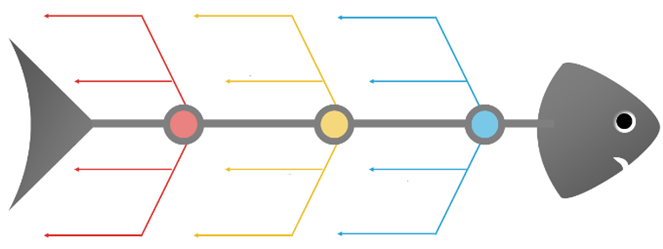
This visual representation resembles fishbones and helps analyze the causes and consequences of a given problem. Therefore, some may call it a cause and effect diagram:
- The fishbones are oriented on the left-hand side and represent the causes,
- The head of the fish represents the final effect of the problem.
An Ishikawa diagram is a diagram that shows the causes of an event and is often used in manufacturing and product development to outline the different steps in a process, demonstrate where quality control issues might arise, and determine which resources are required at specific times.
Easier Root Cause Analysis for Remote Teams
One of the main challenges remote teams face when conducting root cause analysis is coordinating and communicating effectively. It can be difficult, primarily if team members are spread across different time zones.
Another challenge is ensuring that tasks or follow-ups are assigned to the correct person or team. In a remote setup, it’s easy to forget who’s responsible for what and to track tasks that aren’t assigned right away. However, there are tools like SafetyCulture that can help with this issue.
 Explore more on these topics




























 Guest Blogging: The Definitive Guide

 Top Trending Topics
 Share This
 Link copied!
 Recently Updated News