



Living Documents vs. Static Documents: A Modern BA/PM Perspective
Last updated: September 29, 2025 Read in fullscreen view


 Recommended for you
- 01 Aug 2024
 The Standish Group report 83.9% of IT projects partially or completely fail 725/2529
 - 13 Apr 2024 Lessons on Teamwork and Leadership from Chinese story book "Journey to the West" 172/1245
- 02 Nov 2021 What is Terms of Reference (ToR)? 140/1710
- 01 Dec 2022 Difference between Set-based development and Point-based development 127/486
- 21 May 2022 "Fail Fast, Fail Often, Fail Forward" is the answer to Agile practices of software success 120/1169
- 10 Apr 2022 Agile self-organizing teams: What are they? How do they work? 114/660
- 27 Oct 2020 8 principles of Agile Testing 111/1423
- 03 Jul 2022 Manifesto for Agile Software Development 109/376
- 13 Oct 2021 What is Bug Convergence? Why is it important for User Acceptance Testing (UAT)? 103/866
- 08 Dec 2021 What Are The 4 Types of Maintenance Strategies? 102/1281
- 28 Oct 2023 The GOLDEN Rules of Software Engineering 102/674
- 23 Jun 2024 Best Practices for Managing Project Escalations 100/304
- 16 Jul 2022 What are disadvantages of Agile Methodology? How to mitigate the disadvantages ? 98/492
- 13 May 2022 IT Training and Development: The most effective options for upskilling IT staff 96/1329
- 28 Nov 2023 Scrum Team Failure — Scrum Anti-Patterns Taxonomy 95/346
- 03 Apr 2022 Microsoft Solutions Framework (MSF) 93/1423
- 19 Jul 2022 The 12 Principles of Continuous Process Improvement 91/625
- 02 May 2022 What Is RAID in Project Management? (With Pros and Cons) 88/926
- 03 Jan 2023 Organizing your agile teams? Think about M.A.T (Mastery, Autonomy, Purpose) 87/480
- 12 Aug 2022 What is End-to-end project management? 87/583
- 01 Mar 2024 10 Project Management Myths 87/252
- 02 Dec 2022 3 Levels of Quality in KANO Analysis Model 87/1256
- 20 Nov 2022 Agile working method in software and football 85/425
- 11 Oct 2021 10 Myths About Low-End Project Management Software 83/417
- 10 Oct 2023 Exploratory Testing: A Creative and Adaptive Approach to Software Quality 82/162
- 05 May 2021 TIGO Magic Scale - PoC tool for you to apply dichotomous thinking before submitting RFP 81/410
- 05 Jun 2023 Bespoke Solution: Annual Maintenance Contract (AMC) Software 79/268
- 31 Oct 2025 Cloud-Based Testing for Retail: Faster, Smarter, Scalable 78/160
- 01 Jun 2022 How Your Agile Development Team is Just Like a Football Team? 74/292
- 17 Oct 2021 Does Fast Tracking increase project cost? 73/446
- 20 Oct 2025 How to Automate API Testing for Faster Release Cycles? 73/169
- 11 Jul 2022 Lean software development - the game-changer in the digital age 72/357
- 18 Dec 2023 The Cone of Uncertainty in Scrum & Requirement Definition 72/801
- 02 Nov 2022 Difference between Change Management and Project Management 72/303
- 07 Oct 2020 How To Manage Expectations at Work (and Why It's Important) 71/403
- 14 Oct 2021 Stream Story - Low land stream or fast moving stream? 70/694
- 09 May 2022 Build one to throw away vs Second-system effect: What are differences? 69/380
- 07 Jul 2022 Managing Project Execution Terms 69/476
- 10 Apr 2024 The Parking Lot Method: Unlocking a Simple Secret to Supercharge Your Productivity 68/579
- 22 May 2022 What are common mistakes that new or inexperienced managers make? 68/348
- 09 Oct 2022 Key Advantages and Disadvantages of Agile Methodology 65/769
- 27 Jan 2020 Should a project manager push developers to work more hours due to mistakes of manager schedule setting? 64/504
- 12 Oct 2020 The Agile Manifesto - Principle #8 62/556
- 18 Oct 2021 Key Elements to Ramping Up a Large Team 60/1311
- 14 Jun 2022 Example and Excel template of a RACI chart in Software Development 60/926
- 07 Dec 2023 12 project management myths to avoid 57/249
- 06 Jun 2022 Change Management at the Project Level 55/360
- 20 Jul 2022 Software Myths and Realities 55/990
- 18 Feb 2026 "Hit and Run" Project Management: Balancing Speed with Sustainability 54/75
- 02 Dec 2021 3 Ways to Avoid Scope Creep in IT Consulting 53/262
- 01 Oct 2020 Handling tight project deadlines as a business analyst 53/380
- 02 Jun 2024 Reviving Ancient Wisdom: The Spiritual Side of Project Management 52/304
- 01 Aug 2022 Is planning "set it and forget it" or "set it and check it"? 51/339
- 24 Nov 2023 The project management paradox: Achieving MORE by doing LESS 51/281
- 15 May 2022 20 Common Mistakes Made by New or Inexperienced Project Managers 50/332
- 26 Sep 2024 Successful Project Management Techniques You Need to Look Out For 49/445
- 05 Jun 2023 Fractional, Part-Time (virtual) or Interim CTO: Who Will Cover Your Business Needs? 48/190
- 13 Jan 2020 Quiz: Test your understanding project cost management 47/686
- 30 Nov 2023 Project Managers, Focus on Outcomes — Not Deliverables 46/207
- 01 Mar 2022 Why Does Scrum Fail in Large Companies? 44/308
- 03 Nov 2022 Questions and answers about Kano Model 43/934
- 10 Oct 2022 Should Your Business Go Agile? (Infographic) 41/165
- 10 May 2022 Levels of Teamwork 41/235
- 11 Jan 2022 Lean Thinking and Lean Transformation 41/301
- 05 Feb 2024 Bespoke Solution: Visitor Management System for Corporate 41/300
- 21 Oct 2022 Virtual meeting - How does TIGO save cost, reduce complexity and improve quality by remote communication? 40/224
- 21 Jun 2024 Dead Horses and the Escalation of Commitment 36/173
- 02 Nov 2022 Frequently Asked Questions about Agile and Scrum 35/432
In an era where AI evolves by the hour, technology updates follow continuous delivery cycles, and everything operates under the Lean mindset—fast, lean, and agile—rigid, unchanging documentation can no longer keep pace with project teams.
This is precisely when a living document becomes an extension of collective intelligence, enabling Business Analysts (BAs) and Project Managers (PMs) to instantly capture changes, quickly adapt to new requirements, and communicate seamlessly across all project phases.
When AI can rewrite an entire design in seconds, a static document that exists for weeks without updates becomes… outdated the moment it’s completed.
What is a Living Document?
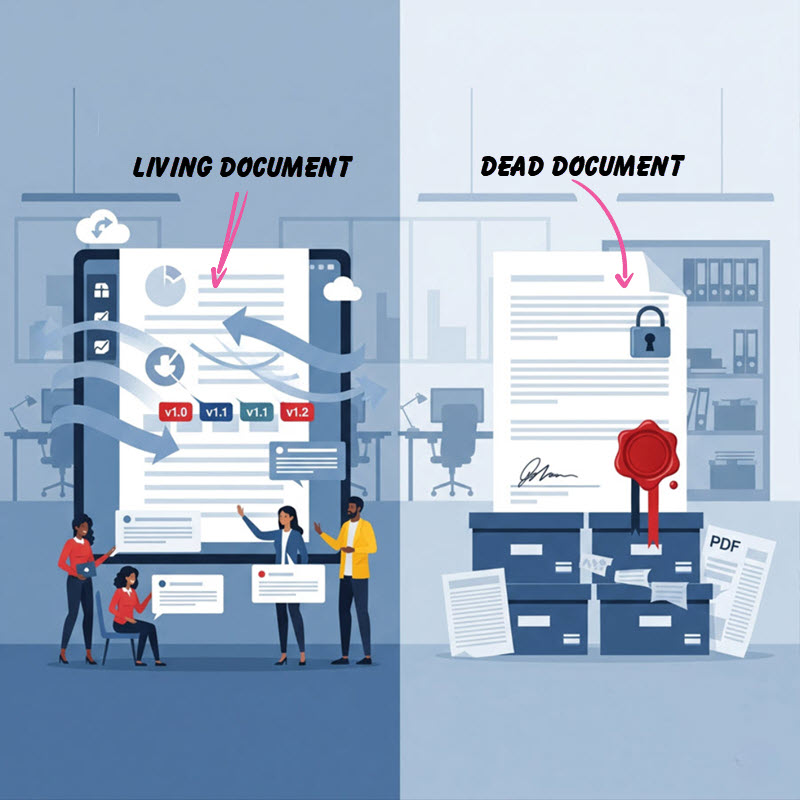
A living document is a type of documentation that can be continuously updated throughout the lifecycle of a project or product. It’s a dynamic entity, reflecting changes, adjustments, or improvements in real-time or by project phase.
Examples:
- Product backlog in Agile
- Miro boards or Confluence pages updated incrementally
- Business Requirements Documents (BRD) with version updates
What is a Static Document?
A static document (sometimes called a snapshot document) does not change after it is released. It’s a fixed record representing the state of an object at a specific moment.
Examples:
- PDF of a system specification
- Technical agreements
- Handover documents
Quick Comparison: Pros & Cons
| Criteria | Living Document | Static Document |
|---|---|---|
| Update Frequency | High, easily modified, frequently updated | Unchanged after completion |
| Reliability | Version control needed; can be confusing if unmanaged | Highly reliable; fixed |
| Flexibility | Very flexible; suitable for Agile environments | Less flexible; suited for Waterfall projects |
| Control | Requires version management and edit permissions | Easy to control due to static nature |
| Maintenance Cost | Higher, continuous upkeep required | Lower, minimal updates |
| Legal Value | Low, can change | Can serve as evidence, official approval |
When to Use Living Documents
Living documents are ideal when:
- Projects follow Agile or Hybrid Agile
- Requirements change frequently
- Multi-party collaboration and direct editing are needed
- Managing backlog, epics, stories, or strategic product roadmaps
When to Use Static Documents
Static documents shine when:
- Formal approvals and commitments are required
- Handover, acceptance, audits, or legal checks are needed
- Large, complex projects require clear snapshots at key milestones
Common Issues & Recommendations
- Confusion between living and static documents
- BAs/PMs unsure which documents are editable
- Poor internal communication leads to version control issues
- Clearly label each document as “LIVING” or “FINAL”
- Use version control tools (Confluence, Git, Google Docs)
- For living documents: always note update date and editor
- For static documents: publish as PDF, store with fixed version, include e-signature if needed
Hybrid Approach: Living + Static Documents
A skilled BA or PM knows not only how to select the right type of documentation but also how to combine both to optimize analysis and delivery:
- Use living documents to develop ideas and adapt quickly
- Use static documents to record history, establish boundaries, and communicate decisions clearly
Conclusion: The “Document Layering” Mindset
In the age of digital transformation and remote work, the ability to distinguish and manage these two types of documents is the “document layering mindset”—a crucial soft skill for modern BAs and PMs.
"Documents are not just content—they are a communication policy between stakeholders."
— TIGO Solutions BA/PM Training Workshop
If you notice your documents are always ignored, misunderstood, or never updated, ask yourself: are you using a living document for a dead purpose, or a static document for a living project?
📘 Recommended Standard Documents for BA/PM
| No | Document Name | Purpose | Recommended Format |
|---|---|---|---|
| 1 | Business Requirements Document (BRD) | Gather and present business requirements | .docx / Confluence page |
| 2 | Functional Specification Document (FSD) | Detail system functionality | .docx / Markdown |
| 3 | Stakeholder Map | List stakeholders and influence | .pptx / diagram .png |
| 4 | RACI Matrix | Assign responsibilities (Responsible, Accountable, Consulted, Informed) | .xls |
| 5 | Use Case Diagram | Model user and system behavior | .drawio / Lucidchart |
| 6 | Wireframe / Prototype | Illustrate initial interface | .figma / .xd |
| 7 | Project Charter | Project kickoff, initial approval | .docx |
| 8 | Meeting Notes Template | Document meetings, assign tasks | .docx / Google Docs |
| 9 | Traceability Matrix | Link requirements to tests and deployment results | .xls |
| 10 | Risk Log Template | List risks, likelihood, and mitigation | .xls |
✅ TIGO BA/PM Document Quality Checklist
I. Content
- Clear objectives aligned with project requirements
- Logical structure with proper sections
- Technical concepts clearly explained when needed
- Illustrative examples or visuals included
II. Clarity & Consistency
- Avoid vague terms
- Use consistent technical terminology
- Clear headings for easy reference
III. Feasibility & Usability
- Have both living (editable) and static (PDF if needed) versions
- Compatible with internal processes and roles
- Transferable to third parties if required
IV. Security & Governance
- Controlled editing permissions
- Version history or change log available
- Clearly assigned document owner
V. Integration & Scalability
- Integrable with project management systems (Jira, Trello, Notion)
- Format suitable for long-term storage
- Links to related documents when necessary (BRD ↔ FSD ↔ Test Cases)
Thu Hang
TIGO CONSULTING
 Explore more on these topics
















 Guest Blogging: The Definitive Guide

 Top Trending Topics
 Share This
 Link copied!
 Recently Updated News