


Mastering the Dynamic Squad Model: A Modern Approach to Agile Teams
Last updated: December 20, 2025 Read in fullscreen view


 Recommended for you
- 01 Aug 2024
 The Standish Group report 83.9% of IT projects partially or completely fail 788/2605
 - 05 Oct 2025 The New Facebook Algorithm: A Paradigm Shift in Content Discovery 268/330
- 13 Apr 2024 Lessons on Teamwork and Leadership from Chinese story book "Journey to the West" 256/1342
- 21 Dec 2023 Top 12 Low-Code Platforms To Use in 2024 213/1509
- 02 Nov 2021 What is Terms of Reference (ToR)? 168/1745
- 18 Oct 2020 How to use the "Knowns" and "Unknowns" technique to manage assumptions 165/1259
- 03 Oct 2025 Top CMS Trends 2026: The Future of Digital Content Management 164/194
- 20 Dec 2025 The Future of IT Consulting: Key Trends for 2026–2030 154/196
- 25 Mar 2026 Token Bills: The "Cost Shock" After the AI Boom in Companies 154/175
- 31 Dec 2025 10 Skills to Make You "Irreplaceable" in the Next 3 Years (even if AI changes everything) 152/182
- 19 Oct 2021 Software development life cycles 143/821
- 26 Mar 2026 What Is a System Integrator (SI)? Why the Software Subscription Model Is Becoming the New Standard 137/171
- 18 Jul 2024 The 8 Best ways to Innovate your SAAS Business Model in 2024 136/391
- 04 Oct 2021 Product Validation: The Key to Developing the Best Product Possible 128/436
- 13 Oct 2021 Outsourcing Software Development: MVP, Proof of Concept (POC) and Prototyping. Which is better? 127/603
- 23 Sep 2021 INFOGRAPHIC: Top 9 Software Outsourcing Mistakes 123/546
- 07 Oct 2025 Case Study: Using the “Messaging House” Framework to Build a Digital Transformation Roadmap 123/203
- 18 Aug 2022 What are the consequences of poor requirements with software development projects? 119/387
- 11 Jan 2024 What are the Benefits and Limitations of Augmented Intelligence? 119/605
- 13 Dec 2020 Move fast, fail fast, fail-safe 118/458
- 04 Mar 2026 CRM Trends Shaping Customer Engagement in 2026 117/145
- 23 Jun 2024 Best Practices for Managing Project Escalations 115/320
- 06 Feb 2021 Why fail fast and learn fast? 114/590
- 01 Oct 2020 Fail fast, learn faster with Agile methodology 113/1187
- 20 Feb 2025 How Machine Learning is Shaping the Future of Digital Advertising 111/233
- 12 Oct 2022 14 Common Reasons Software Projects Fail (And How To Avoid Them) 110/675
- 12 Aug 2024 Understanding Google Analytics in Mumbai: A Beginner's Guide 109/216
- 27 Jul 2024 Positive Psychology in the Digital Age: Future Directions and Technologies 107/535
- 16 Aug 2022 What is a Headless CMS? 106/392
- 02 May 2022 What Is RAID in Project Management? (With Pros and Cons) 105/948
- 01 Mar 2024 10 Project Management Myths 104/278
- 02 Dec 2024 The Intersection of AI and Business Analytics: Key Concepts to Master in Your Business Analytics Course 103/398
- 03 Apr 2022 Microsoft Solutions Framework (MSF) 103/1445
- 28 Jul 2022 POC, Prototypes, Pilots and MVP: What Are the Differences? 103/844
- 14 Mar 2024 Why should you opt for software localization from a professional agency? 102/241
- 03 Jan 2024 Why Partnership is important for Growth? 102/260
- 12 Aug 2022 What is End-to-end project management? 102/608
- 16 Sep 2022 Examples Of Augmented Intelligence In Today’s Workplaces Shaping the Business as Usual 99/535
- 11 Oct 2022 Why choose Billable Viable Product (BVP) over Minimum Viable Product (MVP) 98/440
- 31 Aug 2022 What are the best practices for software contract negotiations? 97/369
- 03 Jan 2023 Organizing your agile teams? Think about M.A.T (Mastery, Autonomy, Purpose) 96/493
- 18 Jan 2024 Self-healing code is the future of software development 95/312
- 12 Dec 2021 Zero Sum Games Agile vs. Waterfall Project Management Methods 95/509
- 14 Oct 2021 Advantages and Disadvantages of Time and Material Contract (T&M) 95/988
- 20 Aug 2025 What Is Agentic AI? The Next Phase of Artificial Intelligence 94/253
- 25 Sep 2024 Enhancing Decision-Making Skills with an MBA: Data-Driven Approaches for Business Growth 93/300
- 05 Sep 2023 The Cold Start Problem: How to Start and Scale Network Effects 92/289
- 02 Nov 2022 Difference between Change Management and Project Management 92/324
- 25 Jan 2025 The Decline of Traditional SaaS and the Rise of AI-first Applications 91/196
- 28 Dec 2021 8 types of pricing models in software development outsourcing 88/522
- 08 Oct 2022 KPI - The New Leadership 87/695
- 09 May 2022 Build one to throw away vs Second-system effect: What are differences? 87/398
- 23 Jun 2025 AI Avatars in the Metaverse: How Digital Beings Are Redefining Identity and Social Interaction 87/274
- 05 Mar 2021 How do you minimize risks when you outsource software development? 86/419
- 01 Aug 2022 Is planning "set it and forget it" or "set it and check it"? 84/381
- 10 Apr 2024 The Parking Lot Method: Unlocking a Simple Secret to Supercharge Your Productivity 84/604
- 22 May 2022 What are common mistakes that new or inexperienced managers make? 83/364
- 10 Nov 2022 Poor Code Indicators and How to Improve Your Code? 82/299
- 30 Jul 2024 The Future of IT Consulting: Trends and Opportunities 81/292
- 06 Mar 2024 [SemRush] What Are LSI Keywords & Why They Don‘t Matter 80/282
- 17 Oct 2021 Does Fast Tracking increase project cost? 80/456
- 10 Dec 2023 Pain points of User Acceptance Testing (UAT) 80/539
- 18 Dec 2023 The Cone of Uncertainty in Scrum & Requirement Definition 80/814
- 31 Dec 2023 Software Development Outsourcing Trends to Watch Out for in 2024 79/308
- 19 Oct 2021 Is gold plating good or bad in project management? 79/910
- 01 Dec 2023 Laws of Project Management 78/393
- 22 Nov 2024 The Role of AI in Enhancing Business Efficiency and Decision-Making 78/273
- 18 Aug 2024 The Future of Web Development: Emerging Trends and Technologies Every Developer Should Know 77/272
- 07 Dec 2023 12 project management myths to avoid 77/269
- 31 Dec 2022 The New Normal for Software Development 76/429
- 14 Jun 2022 Example and Excel template of a RACI chart in Software Development 76/949
- 07 Jul 2022 Managing Project Execution Terms 75/482
- 17 Feb 2022 Prioritizing Software Requirements with Kano Analysis 75/379
- 18 Oct 2021 Key Elements to Ramping Up a Large Team 75/1334
- 18 Jul 2021 How To Ramp Up An Offshore Software Development Team Quickly 75/667
- 10 Sep 2024 Leading Remote Teams in Hybrid Work Environments 75/219
- 18 Feb 2026 "Hit and Run" Project Management: Balancing Speed with Sustainability 74/100
- 27 Feb 2025 How AI Agents are Changing Software Development? 73/310
- 19 Dec 2023 How AI is Transforming Software Development? 73/366
- 03 Nov 2023 Why Is Billable Viable Product An Alternative To Minimum Viable Product? 72/263
- 19 Apr 2021 7 Most Common Time-Wasters For Software Development 72/617
- 04 Oct 2022 Which ERP implementation strategy is right for your business? 70/430
- 12 Mar 2024 How do you create FOMO in software prospects? 70/243
- 01 Mar 2023 Bug Prioritization - What are the 5 levels of priority? 69/298
- 01 May 2024 Warren Buffett’s Golden Rule for Digital Transformation: Avoiding Tech Overload 69/277
- 27 Jan 2020 Should a project manager push developers to work more hours due to mistakes of manager schedule setting? 67/508
- 31 Oct 2021 Tips to Fail Fast With Outsourcing 66/457
- 09 Oct 2024 Short-Form Video Advertising: The Secret to Captivating Your Audience 66/198
- 15 May 2022 20 Common Mistakes Made by New or Inexperienced Project Managers 63/345
- 02 Dec 2021 3 Ways to Avoid Scope Creep in IT Consulting 62/271
- 24 Nov 2023 The project management paradox: Achieving MORE by doing LESS 61/291
- 06 Jun 2022 Change Management at the Project Level 60/366
- 05 Jan 2024 Easy ASANA tips & tricks for you and your team 60/258
- 05 Jun 2023 Fractional, Part-Time (virtual) or Interim CTO: Who Will Cover Your Business Needs? 60/203
- 20 Jul 2022 Software Myths and Realities 60/1001
- 26 Nov 2024 Harnessing Time Management Skills for Remote Team Effectiveness 60/280
- 15 Aug 2025 Quantum Technology: Global Challenges and Opportunities for Innovators 60/191
- 02 Jun 2024 Reviving Ancient Wisdom: The Spiritual Side of Project Management 59/317
- 26 Sep 2024 Successful Project Management Techniques You Need to Look Out For 58/455
- 28 Oct 2022 Build Operate Transfer (B.O.T) Model in Software Outsourcing 57/467
- 13 Jan 2020 Quiz: Test your understanding project cost management 55/701
- 10 May 2022 Levels of Teamwork 54/249
- 26 Dec 2023 Improving Meeting Effectiveness Through the Six Thinking Hats 53/329
- 30 Nov 2023 Project Managers, Focus on Outcomes — Not Deliverables 52/213
- 10 Sep 2024 AI in Email Marketing: Personalization and Automation 51/228
- 21 Jun 2024 Dead Horses and the Escalation of Commitment 47/185
- 31 Dec 2022 Future of Software Development Trends and Predictions 46/197
- 06 Nov 2019 How to Access Software Project Size? 42/299
In today’s fast-paced software world, traditional hierarchical teams often struggle with slow delivery, context switching, and low adaptability. Enter the Dynamic Squad Model—a modern, flexible approach to organizing development teams around specific goals that maximizes focus, efficiency, and innovation.
What is a Dynamic Squad?
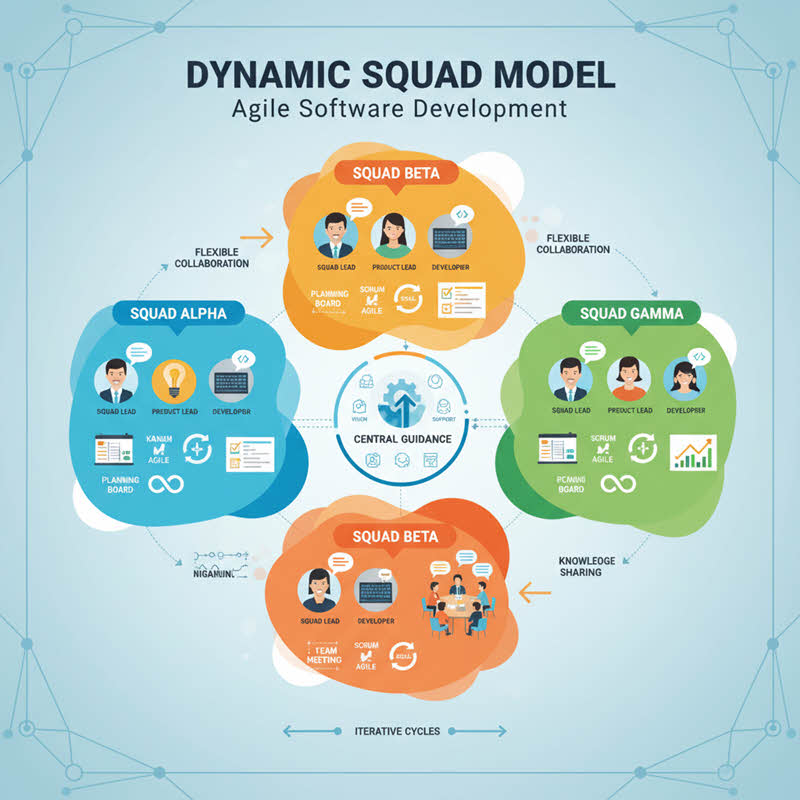
A Dynamic Squad is a small, cross-functional team dedicated to achieving a specific goal. Unlike traditional static teams, squad size, composition, and lifespan are dynamic—adjusted based on the task or project. The model emphasizes focused work, ownership, and agility.
👤Key Roles in a Squad
Each squad typically includes:
- Developers: Focused on a single squad at a time for deep work.
- Squad Lead: Guides day-to-day execution and coordination.
- Product Lead: Provides vision, prioritization, and product guidance.
- Project Manager: Oversees delivery plans and ensures alignment with organizational goals.
Depending on organizational needs, leadership roles like Squad Lead and Product Lead may serve multiple squads simultaneously.
Life Cycle of a Squad
The Dynamic Squad operates in three phases:
- Create: Leadership appoints squad members, defines goals, and allocates resources.
- Function: The squad analyzes requirements, develops solutions, and executes work using Agile methodologies like Kanban or Scrum. Regular ceremonies (daily standups, retrospectives) ensure alignment and progress.
- Dissolve: Once goals are achieved, the squad conducts a retrospective to capture lessons learned and releases members back to the resource pool for future assignments.
Why Adopt the Dynamic Squad Model?
Benefits
- Goal-focused delivery: Teams concentrate on outcomes rather than tasks.
- Reduced context switching: Developers work on one goal at a time, improving productivity and time-to-market.
- Agility and adaptability: Quickly adjust to changing priorities, business demands, or new opportunities.
- Enhanced morale: Members experience variety without being overburdened by multiple concurrent projects.
- Ownership and accountability: Squad members take responsibility for their deliverables.
Challenges
- Cultural shift: Transitioning from hierarchical teams requires mindset change.
- Scaling complexity: Larger organizations need continuous learning and adaptation to implement successfully.
Best Practices for Empowered Squads
Experience shows that simply reorganizing teams isn’t enough. To get the most out of squads:
1. Define Product Team Topology
Split responsibilities thoughtfully across product managers and domains—by functionality, customer segments, or strategic goals. Avoid overly narrow domains; aim for roles that allow strategic vision and depth.
2. Maintain Engineering Structure
Keep specialized teams (backend, frontend, AI, DevOps) intact for architectural integrity and domain expertise. Engineers are mapped to cross-functional squads but remain connected to their core teams. This hybrid approach allows:
- Smooth knowledge sharing
- Easier resource reallocation
- Reduced disruption during change
3. Promote Autonomy with Alignment
Squads should operate independently while maintaining alignment with organizational goals. Full autonomy isn’t feasible, but strive for ~80% independence, making dependencies the exception rather than the rule.
4. Iterative Implementation
Start small—pilot one or two squads to minimize resistance and allow iterative improvement. Scale gradually based on lessons learned.
5. Clear Leadership and Resource Allocation
Product and engineering leaders jointly decide squad composition and resource movement. This ensures strategic flexibility while maintaining stability and quality.
Real-World Impact
In practice, organizations that adopt the Dynamic Squad Model often see:
- Faster delivery: Teams reduce time-to-market by up to 50%.
- Higher team satisfaction: Structured, focused work boosts morale.
- Increased innovation: Cross-functional, empowered teams cut through bureaucracy and deliver value faster.
The model works well for startups, large companies developing next-gen products, and teams leveraging emerging technologies in dynamic environments.
Conclusion
The Dynamic Squad Model is more than just a team structure—it’s a cultural shift toward goal-oriented, agile, and empowered teams. By combining the right mix of autonomy, alignment, and expertise, project managers can transform their organization into a more innovative, productive, and adaptable machine.
 Explore more on these topics
























 Guest Blogging: The Definitive Guide

 Top Trending Topics
 Share This
 Link copied!
 Recently Updated News