

Next-Generation AI Agents Explained: OpenClaw, NanoClaw, IronClaw and the Rise of Agent Architectures
Last updated: March 07, 2026 Read in fullscreen view


 Recommended for you
- 05 Oct 2025
 The New Facebook Algorithm: A Paradigm Shift in Content Discovery 298/360
 - 21 Dec 2023 Top 12 Low-Code Platforms To Use in 2024 226/1527
- 23 Dec 2025 Microsoft Power Automate vs. n8n: What’s the Real Difference? 221/352
- 29 Oct 2024 Top AI Tools and Frameworks You’ll Master in an Artificial Intelligence Course 189/596
- 01 Dec 2025 Manufacturing 4.0: AI Agents Enabling Self-Optimizing Production Systems 183/244
- 02 Dec 2025 The Question That Shook Asia: What Happens When We Ask AI to Choose Between a Mother and a Wife? 180/222
- 31 Dec 2025 10 Skills to Make You "Irreplaceable" in the Next 3 Years (even if AI changes everything) 176/210
- 05 Jun 2025 How AI-Driven Computer Vision Is Changing the Face of Retail Analytics 172/296
- 25 Mar 2026 Token Bills: The "Cost Shock" After the AI Boom in Companies 170/196
- 20 Dec 2025 The Future of IT Consulting: Key Trends for 2026–2030 169/212
- 09 Jul 2024 What Is Artificial Intelligence and How Is It Used Today? 169/429
- 03 Oct 2025 Top CMS Trends 2026: The Future of Digital Content Management 168/202
- 23 Dec 2024 Garbage In, Megabytes Out (GIMO): How to Rise Above AI Slop and Create Real Signal 168/222
- 16 Oct 2025 AI Inference Explained Simply: What Developers Really Need to Know 163/197
- 24 Mar 2026 AI for Financial Reconciliation: Automating Finance Operations in 2026 161/192
- 06 Dec 2025 Enterprise Operations 2.0: Why AI Agents Are Replacing Traditional Automation 158/202
- 26 Mar 2026 What Is a System Integrator (SI)? Why the Software Subscription Model Is Becoming the New Standard 155/189
- 12 May 2026 Top 6 AI AR/VR Filter Tools for Mind-Blowing Videos and Photos in 2026 152/173
- 06 Nov 2025 DataOps: The Next Frontier in Agile Data Management 142/201
- 18 Jul 2024 The 8 Best ways to Innovate your SAAS Business Model in 2024 140/397
- 25 Nov 2025 How AI Agents Are Redefining Enterprise Automation and Decision-Making 135/193
- 31 Jul 2025 Top WooCommerce Pre-Order Plugins with Countdown & Discounts 133/230
- 25 Dec 2025 What Is Algorithmic Fairness? Who Determines the Value of Content: Humans or Algorithms? 130/175
- 15 Apr 2024 Weights & Biases: The AI Developer Platform 121/312
- 22 Dec 2025 The Role of Automotive Software in Building Smarter Vehicles 118/163
- 01 Jul 2025 The Hidden Costs of Not Adopting AI Agents: Risk of Falling Behind 117/266
- 20 Feb 2025 How Machine Learning is Shaping the Future of Digital Advertising 117/239
- 04 Mar 2026 CRM Trends Shaping Customer Engagement in 2026 117/148
- 16 Aug 2022 What is a Headless CMS? 115/401
- 16 Aug 2022 What is a Headless CMS? 115/401
- 17 Oct 2025 MLOps vs AIOps: What’s the Difference and Why It Matters 114/226
- 27 Jul 2024 Positive Psychology in the Digital Age: Future Directions and Technologies 112/541
- 02 Dec 2024 The Intersection of AI and Business Analytics: Key Concepts to Master in Your Business Analytics Course 108/404
- 16 Dec 2025 Reducing Cognitive Friction in Software Development: A Guide to Faster, Happier Teams 108/182
- 27 Aug 2025 How AI Consulting Is Driving Smarter Diagnostics and Hospital Operations 105/205
- 10 Nov 2025 Multi-Modal AI Agents: Merging Voice, Text, and Vision for Better CX 105/220
- 12 Jan 2026 Companies Developing Custom AI Models for Brand Creative: Market Landscape and Use Cases 104/137
- 21 Nov 2025 The Rise of AgentOps: How Enterprises Are Managing and Scaling AI Agents 103/160
- 03 Jan 2024 Why Partnership is important for Growth? 103/261
- 21 Aug 2024 What is Singularity and Its Impact on Businesses? 100/562
- 15 May 2025 AI Consulting for Small Businesses: How to Leverage AI for Growth & Efficiency 99/292
- 24 Dec 2024 Artificial Intelligence and Cybersecurity: Building Trust in EFL Tutoring 99/269
- 16 Sep 2022 Examples Of Augmented Intelligence In Today’s Workplaces Shaping the Business as Usual 99/536
- 11 Oct 2022 Why choose Billable Viable Product (BVP) over Minimum Viable Product (MVP) 99/441
- 16 Sep 2022 Examples Of Augmented Intelligence In Today’s Workplaces Shaping the Business as Usual 99/536
- 20 Aug 2025 What Is Agentic AI? The Next Phase of Artificial Intelligence 98/259
- 09 Sep 2025 Aligning BI Dashboards with KPIs: A Business + Data Collaboration Guide 98/186
- 07 Nov 2025 Online vs. Offline Machine Learning Courses in South Africa: Which One Should You Pick? 97/169
- 18 Jan 2024 Self-healing code is the future of software development 97/314
- 25 Sep 2024 Enhancing Decision-Making Skills with an MBA: Data-Driven Approaches for Business Growth 95/304
- 23 Jun 2025 AI Avatars in the Metaverse: How Digital Beings Are Redefining Identity and Social Interaction 95/283
- 06 May 2025 How Machine Learning Is Transforming Data Analytics Workflows 94/291
- 25 Jan 2025 The Decline of Traditional SaaS and the Rise of AI-first Applications 93/198
- 30 Jul 2024 The Future of IT Consulting: Trends and Opportunities 89/302
- 31 Dec 2023 Software Development Outsourcing Trends to Watch Out for in 2024 89/319
- 28 Nov 2025 How AI Will Transform Vendor Onboarding and Seller Management in 2026 89/219
- 24 Oct 2025 AI Agents in SaaS Platforms: Automating User Support and Onboarding 89/160
- 03 Nov 2023 Why Is Billable Viable Product An Alternative To Minimum Viable Product? 83/274
- 22 Nov 2024 The Role of AI in Enhancing Business Efficiency and Decision-Making 82/277
- 22 Sep 2025 Why AI Is Critical for Accelerating Drug Discovery in Pharma 82/197
- 04 Oct 2023 The Future of Work: Harnessing AI Solutions for Business Growth 81/362
- 18 Aug 2024 The Future of Web Development: Emerging Trends and Technologies Every Developer Should Know 79/274
- 31 Dec 2022 The New Normal for Software Development 76/430
- 10 Sep 2024 Leading Remote Teams in Hybrid Work Environments 76/220
- 27 Feb 2025 How AI Agents are Changing Software Development? 74/313
- 19 Dec 2023 How AI is Transforming Software Development? 74/367
- 21 Apr 2025 Agent AI in Multimodal Interaction: Transforming Human-Computer Engagement 72/267
- 09 Oct 2024 Short-Form Video Advertising: The Secret to Captivating Your Audience 69/201
- 05 Aug 2024 Affordable Tech: How Chatbots Enhance Value in Healthcare Software 65/297
- 29 May 2026 The Role of IoT in Modern Insurance App Development 64/75
- 29 Aug 2025 How AI Is Transforming Modern Management Science 60/128
- 10 Sep 2024 AI in Email Marketing: Personalization and Automation 60/237
- 25 Jun 2026 Vercel: The "Secret Weapon" for Modern, High-Performance Web Deployment 49/57
- 31 Dec 2022 Future of Software Development Trends and Predictions 48/199
- 06 Nov 2025 Top AI Development Companies in the USA to Watch in 2026 37/279
The New Wave of Agents (which I call Generation IV agents) is sweeping across organizations everywhere. This article provides a basic perspective for those who want to get started.
In November 2025, Peter Steinberger published a prototype on GitHub called OpenClaw. Within just 84 days, the project attracted 200,000 stars, becoming the fastest-growing software project in GitHub history.
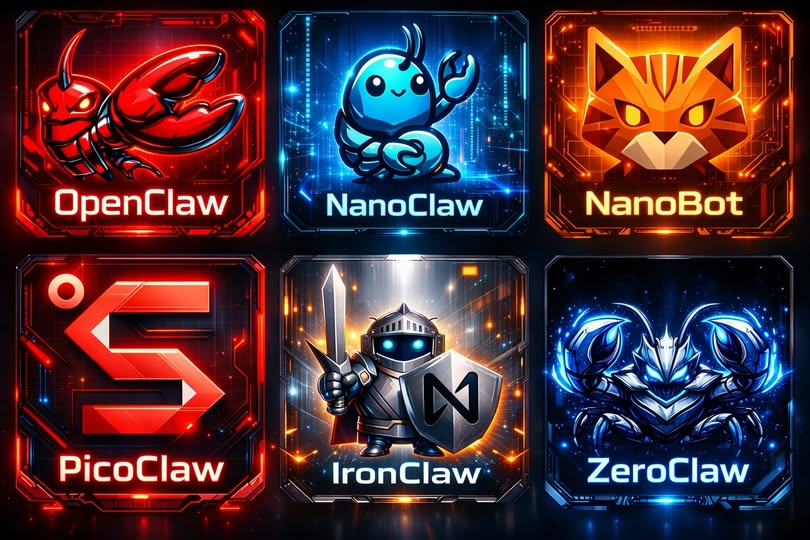
I. INTRODUCING SIX KEY PLAYERS
Right now, the whole world is talking about OpenClaw and its variations as the next generation of agents.
This article summarizes six major variants, aiming to give readers the essential information needed to decide which one to use.
1. NanoClaw – Minimalist Container Isolation System
Codebase: Only about 500 lines of TypeScript.
Design philosophy:
Minimal source code, maximum isolation. NanoClaw demonstrates that fully functional AI agents can be built with extremely small codebases.
The real innovation lies in its security model - assigning each WhatsApp group its own isolated Linux container, creating true OS-level boundaries rather than relying on application-level permission checks.
Technology stack
- TypeScript
- WhatsApp (Baileys)
- Claude Agent SDK
- SQLite
- Docker / Apple Container
Best suited for
- People who want to clearly understand what intelligent agents can do
- Those especially concerned about security and isolation
- Developers who want to inspect the entire agent stack at once
2. Nanobot – A Powerful MCP Research Tool
Codebase: Around 4,000 lines of Python, about 99% smaller than OpenClaw.
Design philosophy:
Ultra-lightweight, MCP-first architecture, research-ready.
The core design question is:
“What is the minimum amount of code required to build a fully functional, multi-platform AI agent?”
Nanobot adopts an MCP-first architecture, where:
- The agent acts as a simple orchestrator
- Core capabilities are implemented via external MCP tool servers
Technology stack
- Python
- Supports 12+ platforms
- Supports 12+ LLM providers
- MCP tool servers
Performance
- ~100MB RAM usage
- Startup time: 0.8 seconds
Best suited for
- Developers wanting to deeply understand agent architecture
- Researchers needing clean and customizable codebases
- Users who want cross-platform messaging without OpenClaw’s complexity
3. OpenClaw – The Full-Scale Giant
Codebase
- 400,000+ lines of TypeScript
- 200,000+ GitHub stars
- 5,700+ skills
Design philosophy:
Fully featured, ready to deploy immediately after installation.
OpenClaw is the pioneering project that sparked the entire “Claw ecosystem.”
It uses a three-layer hub-and-spoke architecture:
-
Gateway – acts as the central nervous system
-
Channel adapters – connect to messaging platforms
-
Agents – execute real-time AI loops
Technology stack
- TypeScript
- 11+ messaging platforms
- Multi-model search and hybrid vector search
- Claude / GPT / DeepSeek
Performance
- Startup time: ~6 seconds
- Memory usage: ~1.5GB
Cost and risks
Extremely complex - can take weeks or months to fully understand.
Andrej Karpathy described it as:
“a 400,000-line monster.”
Security concerns include:
- Data leakage incidents
- Remote Code Execution (RCE) vulnerabilities
- Supply-chain poisoning risks
Best suited for
- Teams wanting the most complete AI assistant platform available
- Those who value a large skills ecosystem and community support
4. IronClaw – The Rust Security Fortress
Codebase: Completely rewritten in Rust with five security layers.
Design philosophy
Security first.
Multi-layer defense.
Zero trust.
IronClaw was built by security researchers who reviewed the agent ecosystem and decided to “build it properly.”
It directly addresses Karpathy’s security concerns.
Five-layer security architecture
-
Network Layer
- TLS 1.3 encryption
- SSRF protection
- Rate limiting
-
Request Filtering Layer
- Endpoint allowlists
- Prompt injection detection
- Content sanitization
-
Credential Management Layer
- AES-256-GCM encryption
- Credential injection
- Sandbox environments with no direct access
-
Execution Sandbox Layer
- Dual sandbox: WASM + Docker
-
Audit Layer
- Full activity logging
- Anomaly detection
Technology stack
- Rust
- PostgreSQL + pgvector
- Hybrid search algorithm (RRF)
Performance
- Binary size: 3.4MB
- Startup time: <10ms
- Memory usage: ~7.8MB
Best suited for
- Security-first organizations
- Teams deploying production-grade systems
5. PicoClaw – Edge Computing Agent
Codebase: 95% of the code written by AI agents.
Design philosophy
Run anywhere.
On any device.
At near-zero cost.
PicoClaw asks a bold question:
“What if your AI agent could run on $10 hardware?”
Technical highlights
- Operates with <10MB memory
- Startup under 1 second on a 0.6GHz CPU
- Supports RISC-V, ARM, and x86 architectures
It can run on:
- LicheeRV-Nano
- Raspberry Pi
- old smartphones
- cloud servers
Personality system
Agent behavior is defined using seven Markdown files
- identity.md
- personality.md
- knowledge.md
- rules.md
- skills.md
- plans.md
- self.md
Development model
- AI bootstrapping
- agent-driven architecture transformation
- code optimization
- human feedback
- roadmap adjustment
Best suited for
- Edge computing and IoT deployments
- Resource-constrained environments
- Experimenting with AI agents on unusual hardware
6. ZeroClaw – Vendor-Independent Universal Agent
Codebase: 13 core components, all replaceable.
Design philosophy
Feature-oriented architecture.
Vendor independence.
The key idea:
“What if you could replace any component without changing the code?”
Core components include
- Provider – abstract LLM provider
- Channel – standardized messaging platform
- Long-term memory – abstract storage system
- Tools – plugin execution framework
Long-term memory system
Uses hybrid vector + keyword search in SQLite.
- Embeddings stored as BLOBs with cosine similarity
- FTS5 virtual table with BM25 scoring
- Configurable weighted merging
Everything runs locally in a single file, with no external vector database required.
Performance
- Binary size: 3.4MB
- Startup time: <10ms
- Runtime memory: <5MB
Best suited for
- Teams with diverse infrastructure needs
- Developers wanting easy switching between LLM providers
- Production deployments needing operational flexibility
- Those who want to avoid vendor lock-in
II. COMPARISON
1. Deployment Complexity
PicoClaw
→ ZeroClaw
→ IronClaw
→ Nanobot
→ NanoClaw
→ OpenClaw
(from simplest → most complex)
2. Long-Term Memory Systems
Simple (Markdown files)
- NanoClaw
- Nanobot
Medium (Markdown + local search)
- PicoClaw
Complex (vector + hybrid search)
- OpenClaw
- IronClaw
- ZeroClaw
3. Suitable Users
Beginners
- OpenClaw (default setup)
- Nanobot (learning architecture)
Security researchers
- IronClaw (reference security model)
- NanoClaw (isolation comparison)
Embedded system developers
- PicoClaw (edge deployment)
- ZeroClaw (general Rust solution)
Full-stack developers
- NanoClaw (minimalist implementation insight)
- OpenClaw (large-scale architecture study)
4. Deployment Environments
Cloud servers
- OpenClaw
- IronClaw
Local Mac
- NanoClaw
- OpenClaw
Raspberry Pi / Edge devices
- PicoClaw
Kubernetes clusters
- IronClaw
- ZeroClaw
Hybrid infrastructure
- ZeroClaw
 Explore more on these topics
























 Guest Blogging: The Definitive Guide

 Top Trending Topics
 Share This
 Link copied!
 Recently Updated News
 thực chiến - Kiến tạo tương lai cho các nhà sáng tạo nội dung.