

As-built Documentation in IT Projects: The Missing Link Between Acceptance and Final Settlement
Last updated: January 27, 2026 Read in fullscreen view


 Recommended for you
- 15 Feb 2024
 What is a Cut-Over in Software Development? 208/1537
 - 02 Nov 2023 Differences between software walkthrough, review, and inspection 179/2329
- 26 Dec 2025 Compliance Cost: How to Reduce It Without Risking Non-Compliance 175/233
- 18 Oct 2020 How to use the "Knowns" and "Unknowns" technique to manage assumptions 169/1264
- 30 Oct 2022 How Much Does MVP Development Cost in 2023? 157/418
- 09 Jan 2022 How to Bridge the Gap Between Business and IT? 155/358
- 19 Oct 2021 Software development life cycles 147/827
- 21 Nov 2025 The Pressure of Short-Term Funding on Small-Budget IT Projects 137/167
- 02 Jan 2024 What is User Provisioning & Deprovisioning? 136/730
- 01 Sep 2022 Facts Chart: Why Do Software Projects Fail? 134/729
- 04 Oct 2021 Product Validation: The Key to Developing the Best Product Possible 134/442
- 13 Oct 2021 Outsourcing Software Development: MVP, Proof of Concept (POC) and Prototyping. Which is better? 131/609
- 23 Sep 2021 INFOGRAPHIC: Top 9 Software Outsourcing Mistakes 129/552
- 07 Oct 2025 Case Study: Using the “Messaging House” Framework to Build a Digital Transformation Roadmap 128/208
- 18 Aug 2022 What are the consequences of poor requirements with software development projects? 126/394
- 18 Dec 2025 AI: Act Now or Wait Until You’re “Ready”? 125/165
- 10 Apr 2021 RFP vs POC: Why the proof of concept is replacing the request for proposal 124/452
- 01 Oct 2020 Fail fast, learn faster with Agile methodology 120/1194
- 13 Dec 2020 Move fast, fail fast, fail-safe 120/461
- 28 Jul 2022 POC, Prototypes, Pilots and MVP: What Are the Differences? 120/862
- 11 Jan 2024 What are the Benefits and Limitations of Augmented Intelligence? 120/606
- 06 Feb 2021 Why fail fast and learn fast? 117/595
- 12 Oct 2022 14 Common Reasons Software Projects Fail (And How To Avoid Them) 116/681
- 12 Aug 2024 Understanding Google Analytics in Mumbai: A Beginner's Guide 112/219
- 02 May 2022 What Is RAID in Project Management? (With Pros and Cons) 110/963
- 07 Jul 2021 The 5 Levels of IT Help Desk Support 104/584
- 14 Mar 2024 Why should you opt for software localization from a professional agency? 102/241
- 03 Dec 2025 IT Outsourcing Solutions Explained: What, How, Why, When 101/133
- 16 Feb 2021 Choose Outsourcing for Your Non Disclosure Agreement (NDA) 99/269
- 08 Nov 2022 4 tips for meeting tough deadlines when outsourcing projects to software vendor 99/391
- 14 Oct 2021 Advantages and Disadvantages of Time and Material Contract (T&M) 99/997
- 12 Dec 2021 Zero Sum Games Agile vs. Waterfall Project Management Methods 98/512
- 31 Aug 2022 What are the best practices for software contract negotiations? 97/371
- 28 Dec 2021 8 types of pricing models in software development outsourcing 96/530
- 05 Sep 2023 The Cold Start Problem: How to Start and Scale Network Effects 95/293
- 07 Aug 2022 Things to Consider When Choosing a Technology Partner 94/377
- 05 Mar 2021 How do you minimize risks when you outsource software development? 94/427
- 21 Oct 2025 Cloud-Native Development: Why It’s the Future of Enterprise IT 93/182
- 17 Feb 2022 Prioritizing Software Requirements with Kano Analysis 90/394
- 19 Oct 2021 Is gold plating good or bad in project management? 88/919
- 08 Oct 2022 KPI - The New Leadership 87/696
- 04 Mar 2023 [Medium] Box-Ticking: The Management Strategy That’s Killing your Productivity 87/754
- 01 Mar 2024 (AI) Artificial Intelligence Terms Every Beginner Should Know 87/421
- 06 Mar 2024 [SemRush] What Are LSI Keywords & Why They Don‘t Matter 86/288
- 01 Feb 2024 How long does it take to develop software? 86/296
- 10 Jul 2025 Building AI-Driven Knowledge Graphs from Unstructured Data 85/247
- 09 Feb 2023 The Challenge of Fixed-Bid Software Projects 85/334
- 10 Nov 2022 Poor Code Indicators and How to Improve Your Code? 85/302
- 10 Dec 2023 Pain points of User Acceptance Testing (UAT) 83/544
- 01 Dec 2023 Laws of Project Management 81/396
- 12 Mar 2024 How do you create FOMO in software prospects? 79/253
- 18 Jul 2021 How To Ramp Up An Offshore Software Development Team Quickly 76/668
- 01 Mar 2023 Bug Prioritization - What are the 5 levels of priority? 75/304
- 17 Dec 2025 Unaligned Escalation Logic: A Silent Risk in Complex Organizations 74/98
- 03 Nov 2022 Top questions and answers you must know before ask for software outsourcing 74/359
- 19 Apr 2021 7 Most Common Time-Wasters For Software Development 72/617
- 04 Oct 2022 Which ERP implementation strategy is right for your business? 71/432
- 01 May 2024 Warren Buffett’s Golden Rule for Digital Transformation: Avoiding Tech Overload 70/278
- 31 Oct 2021 Tips to Fail Fast With Outsourcing 70/461
- 16 Apr 2021 Insightful Business Technology Consulting at TIGO 70/525
- 06 Mar 2021 4 things you need to do before getting an accurate quote for your software development 69/766
- 20 Nov 2022 Software Requirements Are A Communication Problem 69/312
- 07 Oct 2022 Digital Transformation: Become a Technology Powerhouse 65/312
- 05 Jan 2024 Easy ASANA tips & tricks for you and your team 64/263
- 28 Oct 2022 Build Operate Transfer (B.O.T) Model in Software Outsourcing 62/472
- 01 May 2023 CTO Interview Questions 60/395
- 08 Jan 2024 Ask Experts: Explicitation/Implicitation and Elicitation; two commonly used but barely unraveled concepts 58/439
- 26 Dec 2023 Improving Meeting Effectiveness Through the Six Thinking Hats 54/330
- 01 Mar 2023 How do you deal with disputes and conflicts that may arise during a software consulting project? 50/211
- 09 Mar 2022 Consultant Implementation Pricing 50/263
- 06 Nov 2019 How to Access Software Project Size? 49/307
- 17 Mar 2025 IT Consultants in Digital Transformation 42/133
In traditional construction, as-built documentation s an indispensable step leading to final settlement.
In the IT domain, although this term is used less explicitly, its essence - proving how the system was actually built - is critically important.
Below is a refined and completed workflow that incorporates as-built documentation to form a closed-loop process:
As-built (What was built) → Acceptance (Confirmation) → Final Settlement (Payment calculation) → Audit (Verification)
What Is As-built Documentation?
Before reaching the “payment calculation” stage (Final Settlement), we need a complete set of documents that describe everything that was actually built.
Definition:
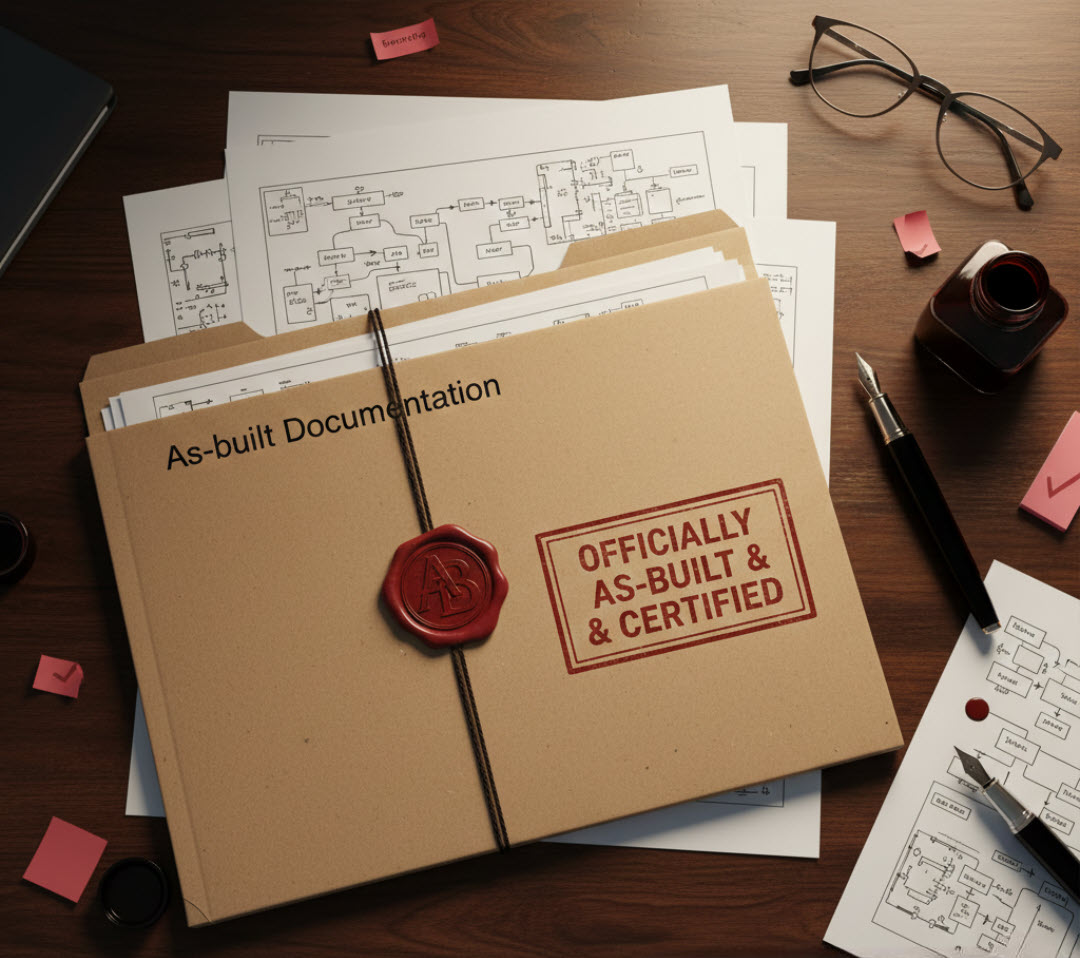
As-built documentation is a collection of documents, diagrams, or source code that reflects the actual state of a project or system at the handover point. It highlights any differences from the original design (if any).
Purpose:
To enable the project owner to clearly understand what they actually own, how the system is structured internally, and how it can be operated, maintained, or modified in the future.
Key Terminology
- As-built Documentation (or As-built Records)
- Final Settlement Dossier
- Audit File / Audit Documentation
Further reading: What are Final Settlement Dossiers and Audit Files?
The Difference Between As-built, Final Settlement, and Audit
- As-built: Answers the question “What does the actual product look like?”
(Technical focus) - Final Settlement: Answers the question “How much is the product worth?”
(Financial focus) - Audit: Answers the question “How was the product built, and are the costs reasonable?”
(Legal and compliance focus)
Comparison of the Three Types of Documentation
| Criteria | As-built Documentation | Final Settlement Dossier | Audit File |
|---|---|---|---|
| Prepared by | Implementation team / Project team | Project owner / Contractor | Independent auditor |
| Focus | Technical reality | Financial value | Compliance & transparency |
| Role | Basis for acceptance | Basis for contract closure | Basis for settlement approval |
| Timing | Immediately after implementation | After as-built & acceptance | After final settlement dossier |
As-built Documentation in IT (Software) Projects
In IT projects, as-built documentation is not a stack of A0 drawings but a set of living technical evidence - commonly referred to as As-built Documentation.
It is the most concrete proof used during project acceptance.
A typical software as-built dossier includes:
- As-built Architecture Documentation:
Infrastructure diagrams, network topology, and the actual database structure running on servers (which may differ from the initial high-level design). - Final Source Code:
All deliverable source code, packaged and tagged with the official handover version. - API Catalog & Technical Documentation:
Detailed descriptions of interfaces, endpoints, and functions for system integration. - System Configuration Documentation:
Server settings, environment variables, and real-world security configurations.
Standard IT Project Acceptance Workflow
Adding as-built documentation makes the acceptance process significantly more robust:
-
As-built Phase:
The technical team packages the code, prepares user manuals, and redraws diagrams reflecting the real system. -
Acceptance Phase (UAT):
Users test the system based on the as-built product. Acceptance is signed off once everything matches the as-built documentation. -
Final Settlement Phase:
Accounting uses the acceptance report and as-built documentation to calculate costs, man-months, and issue invoices. -
Audit Phase:
A third party reviews discrepancies, such as:
“Why does the as-built documentation show 10 features, while the settlement charges for 12?”
Acceptance is not just about test pass/fail. It is about:
- Confirming the project scope
- Confirming the actual workload delivered
- Confirming responsibilities among all parties
A Project Manager must clearly understand:
- Partial acceptance and milestone-based acceptance
- Who signs, what they sign, and which documentation the signatures are based on
🛑As-built documentation is not a “final-project task”. It is the accumulated outcome of the entire implementation process.
If a Project Manager (PM) does not understand as-built documentation, it becomes very easy to:
- Execute the project incorrectly
- Lack sufficient evidence during acceptance
- Break down at the final settlement or audit stage
Supporting Evidence Checklist
As-built Documentation (Technical Evidence)
- Actual architecture diagrams: Accurately reflect the deployed environment.
- Final functional specifications: Include all change requests made during development.
- Source code and scripts inventory (if applicable): A complete list of delivered modules.
Practical Advice
A “clean” final settlement dossier in the eyes of auditors is one that is backed by extremely detailed as-built documentation.
When you can clearly prove the actual workload - through source code and technical documents - explaining and justifying project costs becomes remarkably easy.
 Explore more on these topics

























 Guest Blogging: The Definitive Guide

 Top Trending Topics
 Share This
 Link copied!
 Recently Updated News