



HIPAA-Compliant Healthcare iOS App Development Services: A Complete Guide
Last updated: February 21, 2026 Read in fullscreen view


 Recommended for you
- 06 Mar 2026
 Next-Generation AI Agents Explained: OpenClaw, NanoClaw, IronClaw and the Rise of Agent Architectures 345/382
 - 29 Oct 2024 Top AI Tools and Frameworks You’ll Master in an Artificial Intelligence Course 183/587
- 09 Jul 2024 What Is Artificial Intelligence and How Is It Used Today? 163/416
- 23 Dec 2024 Garbage In, Megabytes Out (GIMO): How to Rise Above AI Slop and Create Real Signal 160/213
- 05 Jun 2025 How AI-Driven Computer Vision Is Changing the Face of Retail Analytics 159/282
- 16 Oct 2025 AI Inference Explained Simply: What Developers Really Need to Know 156/190
- 02 Dec 2025 The Question That Shook Asia: What Happens When We Ask AI to Choose Between a Mother and a Wife? 153/189
- 06 Nov 2025 Top 10 AI Development Companies in the USA to Watch in 2026 142/218
- 06 Dec 2025 Enterprise Operations 2.0: Why AI Agents Are Replacing Traditional Automation 138/182
- 24 Mar 2026 AI for Financial Reconciliation: Automating Finance Operations in 2026 127/154
- 25 Nov 2025 How AI Agents Are Redefining Enterprise Automation and Decision-Making 126/184
- 12 May 2026 Top 6 AI AR/VR Filter Tools for Mind-Blowing Videos and Photos in 2026 123/143
- 29 Jan 2026 Why Headless Commerce Is Shaping the Future of the Online Store 115/140
- 25 Dec 2025 What Is Algorithmic Fairness? Who Determines the Value of Content: Humans or Algorithms? 114/157
- 15 Apr 2024 Weights & Biases: The AI Developer Platform 114/305
- 01 Jul 2025 The Hidden Costs of Not Adopting AI Agents: Risk of Falling Behind 112/260
- 27 Aug 2025 How AI Consulting Is Driving Smarter Diagnostics and Hospital Operations 102/202
- 12 Jan 2026 Companies Developing Custom AI Models for Brand Creative: Market Landscape and Use Cases 99/131
- 10 Nov 2025 Multi-Modal AI Agents: Merging Voice, Text, and Vision for Better CX 98/212
- 21 Nov 2025 The Rise of AgentOps: How Enterprises Are Managing and Scaling AI Agents 98/153
- 17 Oct 2025 MLOps vs AIOps: What’s the Difference and Why It Matters 97/208
- 21 Aug 2024 What is Singularity and Its Impact on Businesses? 94/554
- 24 Dec 2024 Artificial Intelligence and Cybersecurity: Building Trust in EFL Tutoring 93/263
- 06 May 2025 How Machine Learning Is Transforming Data Analytics Workflows 92/289
- 07 Nov 2025 Online vs. Offline Machine Learning Courses in South Africa: Which One Should You Pick? 90/158
- 28 Nov 2025 How AI Will Transform Vendor Onboarding and Seller Management in 2026 81/211
- 04 Oct 2023 The Future of Work: Harnessing AI Solutions for Business Growth 77/356
- 22 Sep 2025 Why AI Is Critical for Accelerating Drug Discovery in Pharma 74/189
- 24 Oct 2025 AI Agents in SaaS Platforms: Automating User Support and Onboarding 70/141
- 21 Apr 2025 Agent AI in Multimodal Interaction: Transforming Human-Computer Engagement 67/262
- 05 Aug 2024 Affordable Tech: How Chatbots Enhance Value in Healthcare Software 60/290
- 29 Aug 2025 How AI Is Transforming Modern Management Science 57/124
- 29 May 2026 The Role of IoT in Modern Insurance App Development 53/63
- 08 Jul 2026 What is HL7 FHIR? The Benefits of HL7 FHIR in Healthcare 6/9
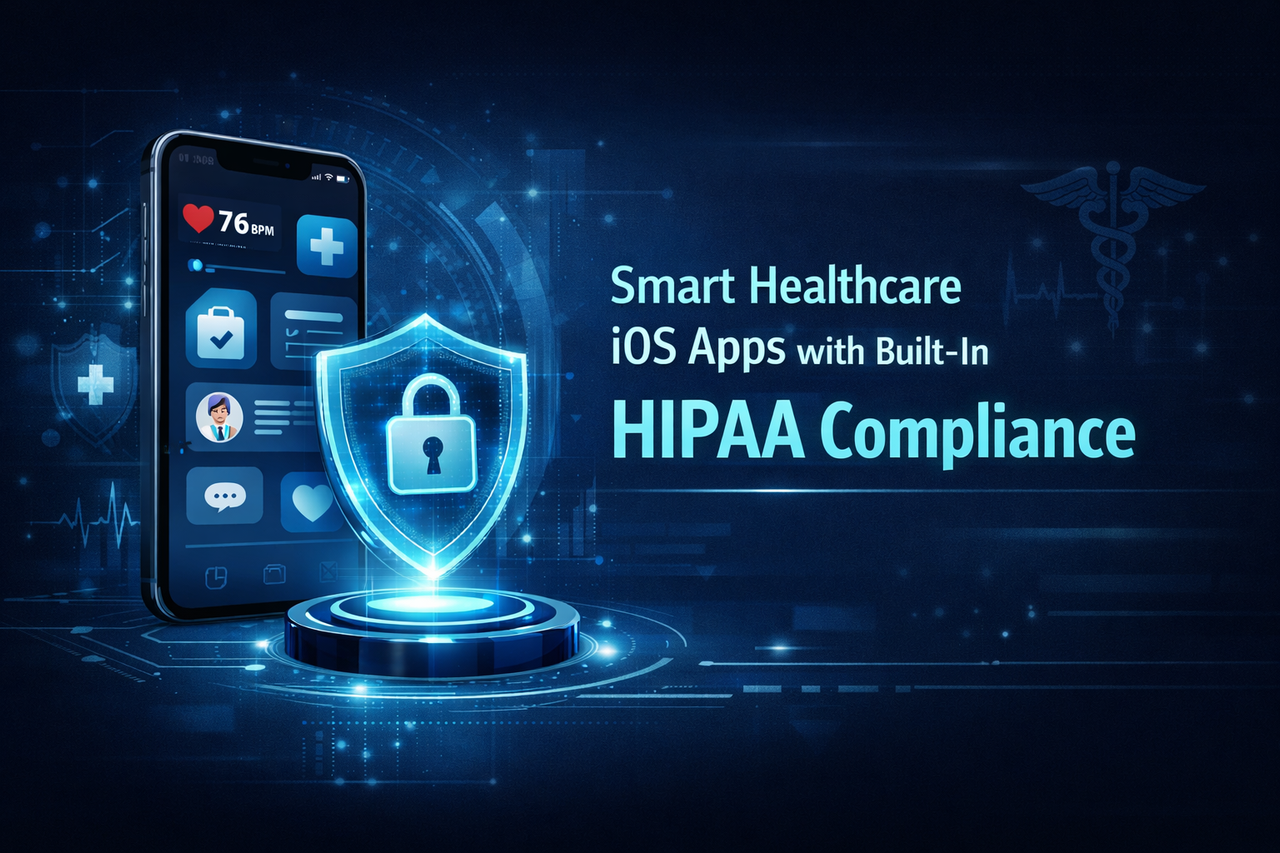
The healthcare industry is constantly faced with multiple regulations and compliance issues. It handles multiple insurance plans and diverse payments from numerous payers. According to 2025 records, healthcare breaches totaled around 71,000 records. This highlights why secure design and breach prep are essential for meeting HIPAA requirements. Furthermore, protecting patients' privacy and preventing severe consequences have become more important than ever.
Whether you are a healthcare provider or are associated with this business, it is necessary to understand why developing a secure, compliant healthcare iOS app can help you stay on the right track. An iOS app development agency can help you in this case and guide you on HIPAA-compliant app development.
What Are the HIPAA Rules and Their Impact on iOS App Development
In 1996, the HIPAA law was imposed to improve the security and timeliness of the healthcare system. The legislators were also aware that different electronic systems may expose patients' overall health information. Also, HIPAA was split into several regulations that, in different ways, protect individuals' personal health information or mitigate the consequences of breaches. This also impacts the iOS app development cost.
1. The Privacy Rule
The Privacy Rule sets the standard for the use and disclosure of protected health information. It also protects people's private health records while giving them the right to find out about the proper information. The rule is also applied to certain organizations that include multiple hospitals and insurance companies.
2. The Security Rule
The HIPAA Security Rule shows the standards for protecting electronic health data. It also regulates that any organization that collects or processes this type of information can store it properly, particularly for wellness or doctor apps. The rule also requires them to have adequate protections in place with safe storage on physical devices.
3. Breach Reporting
In case of a data breach, the HIPAA Breach Reporting app provider has to inform users about the breach and the Department of Health and Human Services (HHS).
4. The Enforcement Rule
A healthcare app development company is also aware of the HIPAA Enforcement Rule. It encompasses compliance and proper investigation provisions. This also guides the proper evaluation of civil money penalties while violating the HIPAA Administrative Simplification Rule.
Essential Features of a HIPAA-Compliant Healthcare App
When it comes to designing and developing a compliant and safe healthcare application, an iOS app development agency should follow some proper features. Those perfectly align with the HIPAA compliance while meeting user experience. Below are some perfect features that need to be integrated into the healthcare application:
1. Data Encryption
Encryption of sensitive data that should be protected from being misused.
2. Secure User Authentication
Multi-Factor Authentication (MFA) and certain Role-based Access Controls are ideal for authenticating users.
3. Audit Logs
Audit logs contain proper data access and user activity. These must be maintained in proper accordance with accurate audit and different breach notification rules.
4. Automatic Logouts
Session time-out can successfully minimize PHI exposure due to certain unattended data left on different devices.
5. User Consent Forms
Digital consent forms should be developed, informing the patients how the right amount of data will be used.
What Are the Steps to Build a HIPAA-Compliant Mobile App
In 2025, healthcare cybersecurity risks remained very high, with different breaches affecting millions of records. The data showed that the global mHealth market exceeded $40 billion. This signals that developing a HIPAA-compliant mobile app requires proper structured planning, strict security controls, and continuous compliance monitoring from day one. A healthcare app development company can develop such apps that align with your business needs, with complete data privacy protection laws.
1. Study All the HIPAA Essentials
The process starts by learning what HIPAA requires in general. The professionals must follow a proper guideline where the health information is protected, stored, and disclosed in the right manner. Additionally, technical, physical, and administrative precautions are also followed properly.
2. Clarify the Scope and Roles of Your HIPAA-compliant app
It is necessary to clarify your app's scope and what features you want within your app. Convey the details to your iOS app development agency. At this point, they can guide you to decide whether your app should be a "covered entity" or a "business associate" because the HIPAA directions are slightly different for each of the cases.
3. Partner with an iOS App Development Company
A good app development partner can help you select the right mobile app development approach. Choose a proper tech stack for different mobile devices and focus on implementing all the required security features. This may impact iOS app development cost because of encryption, user authentication, proper audit logs, and automatic logouts.
4. Test Comprehensively
Compliance and proper security testing go hand in hand when making the HIPAA-compliant software. Beyond certain functional tests, it is also important for different test for vulnerabilities, misconfigured access controls, proper encryption weaknesses, and different logging problems that the professional team follows.
5. Perform Regular HIPAA Risk Reviews
The team also performs a proper risk analysis before launching the healthcare app. This uncovers different spots where the healthcare app's security, data handling, or infrastructure could face risk.
6. Get Legal and Compliance Sign-Off
Now, it is your responsibility to connect to legal and compliance professionals who can review your healthcare app and documentation properly before making the app live. They can also guarantee that your app is HIPAA compliant.
7. Watch, Update, and Stay Compliant
HIPAA compliance is not a one-time activity; it's continuous. Once your app goes live, continue to watch your app for different exposures and regularly revise it. Also, you need to perform periodic audits and follow proper compliance.
An Overview On the HIPAA-Compliant iOS App (2025–2026 estimates)
The HIPAA compliant iOS app development cost varies based on different aspects. There are significant factors that may certain differences in the final price. Let’s have an overview.
| Key Aspects | Features | Estimated Cost |
|---|---|---|
| Project discovery & compliance scoping | Business Associate determination, BAA drafting input, data flow mapping, threat model | $3,000 – $12,000 |
| UX / UI design (HIPAA-aware) | Wireframes, accessible UI, consent screens, privacy UX | $5,000 – $25,000 |
| Core iOS development (MVP patient app) | Login, profile, appointment, secure messaging (no EHR integration) | $30,000 – $80,000 |
| Mid-level app dev (telehealth, payments, basic integrations) | Video visit, payments, push notifications, token auth, limited API integration | $80,000 – $150,000 |
| Enterprise / EHR-integrated app | FHIR/EHR integrations, SSO, enterprise RBAC, audit exports | $150,000 – $400,000+ |
| Backend & infrastructure (cloud, DB, storage) | HIPAA BAA-ready cloud setup, encrypted storage, backups | $8,000 – $60,000 |
| Legal & compliance (contracts + policies) | BAA, privacy policy, consent language, HIPAA advisory | $3,000 – $25,000 |
| Regulatory & risk management | Annual risk assessment, HIPAA gap remediation, OCR response prep | $6,000 – $40,000 / year |
| Ongoing maintenance & monitoring | Patching, monitoring, log retention, token management | 15–20% of initial build / year (~$6k–$80k/yr) |
| Cyber insurance | Annual premium to cover breach, notification, legal | $2,000 – $50,000 / year |
Conclusion
In the current digital age, where different aspects of the healthcare field are evolving, opting for HIPAA-compliant app development is the core foundation to ensure seamless and successful medical applications and business operations. When you get the chance to safeguard PHI, it means following the rules that align perfectly with your business.
Planning to develop a HIPAA-compliant healthcare app? Connect to the best iOS app development agency and continue different medical tasks successfully, ensuring patients' trust.
 Explore more on these topics




26072024043639_thumb.jpg)






















 Guest Blogging: The Definitive Guide

 Top Trending Topics
 Share This
 Link copied!
 Recently Updated News