


Why Every Enterprise Needs Digital Strategy Consulting in 2026
Last updated: March 07, 2026 Read in fullscreen view


 Recommended for you
- 05 Oct 2025
 The New Facebook Algorithm: A Paradigm Shift in Content Discovery 295/357
 - 21 Dec 2023 Top 12 Low-Code Platforms To Use in 2024 222/1522
- 31 Dec 2025 10 Skills to Make You "Irreplaceable" in the Next 3 Years (even if AI changes everything) 172/206
- 25 Mar 2026 Token Bills: The "Cost Shock" After the AI Boom in Companies 168/193
- 20 Dec 2025 The Future of IT Consulting: Key Trends for 2026–2030 167/210
- 03 Oct 2025 Top CMS Trends 2026: The Future of Digital Content Management 166/199
- 21 Nov 2025 Top 8 Cloud Transformation Companies in USA in 2026 164/220
- 30 Oct 2022 How Much Does MVP Development Cost in 2023? 157/418
- 09 Jan 2022 How to Bridge the Gap Between Business and IT? 155/358
- 26 Mar 2026 What Is a System Integrator (SI)? Why the Software Subscription Model Is Becoming the New Standard 154/188
- 18 Jul 2024 The 8 Best ways to Innovate your SAAS Business Model in 2024 138/395
- 04 Feb 2026 Top Workflow Automation Services Driving Digital Transformation 135/170
- 01 Sep 2022 Facts Chart: Why Do Software Projects Fail? 134/729
- 10 Apr 2021 RFP vs POC: Why the proof of concept is replacing the request for proposal 124/452
- 04 Mar 2026 CRM Trends Shaping Customer Engagement in 2026 117/148
- 21 Aug 2023 30 Must-Know IT Consulting Buzzwords Explained 117/148
- 20 Feb 2025 How Machine Learning is Shaping the Future of Digital Advertising 116/238
- 06 Jan 2026 Risk & Change Management Through the 3P Model 115/161
- 16 Aug 2022 What is a Headless CMS? 114/400
- 27 Jul 2024 Positive Psychology in the Digital Age: Future Directions and Technologies 112/541
- 02 Dec 2024 The Intersection of AI and Business Analytics: Key Concepts to Master in Your Business Analytics Course 108/404
- 07 Jul 2021 The 5 Levels of IT Help Desk Support 104/584
- 03 Jan 2024 Why Partnership is important for Growth? 103/261
- 03 Dec 2025 IT Outsourcing Solutions Explained: What, How, Why, When 102/134
- 15 Dec 2025 What Does ERP-Friendly Mean? A Practical Guide for Modern Enterprises 99/143
- 16 Sep 2022 Examples Of Augmented Intelligence In Today’s Workplaces Shaping the Business as Usual 99/536
- 08 Nov 2022 4 tips for meeting tough deadlines when outsourcing projects to software vendor 99/391
- 16 Feb 2021 Choose Outsourcing for Your Non Disclosure Agreement (NDA) 99/269
- 11 Oct 2022 Why choose Billable Viable Product (BVP) over Minimum Viable Product (MVP) 98/440
- 18 Jan 2024 Self-healing code is the future of software development 96/313
- 20 Aug 2025 What Is Agentic AI? The Next Phase of Artificial Intelligence 95/255
- 25 Sep 2024 Enhancing Decision-Making Skills with an MBA: Data-Driven Approaches for Business Growth 95/302
- 23 Jun 2025 AI Avatars in the Metaverse: How Digital Beings Are Redefining Identity and Social Interaction 95/282
- 07 Aug 2022 Things to Consider When Choosing a Technology Partner 94/377
- 25 Jan 2025 The Decline of Traditional SaaS and the Rise of AI-first Applications 93/198
- 30 Jul 2024 The Future of IT Consulting: Trends and Opportunities 89/301
- 31 Dec 2023 Software Development Outsourcing Trends to Watch Out for in 2024 86/316
- 09 Feb 2023 The Challenge of Fixed-Bid Software Projects 85/334
- 10 Jul 2025 Building AI-Driven Knowledge Graphs from Unstructured Data 85/247
- 22 Nov 2024 The Role of AI in Enhancing Business Efficiency and Decision-Making 82/277
- 03 Nov 2023 Why Is Billable Viable Product An Alternative To Minimum Viable Product? 81/272
- 18 Aug 2024 The Future of Web Development: Emerging Trends and Technologies Every Developer Should Know 79/274
- 10 Sep 2024 Leading Remote Teams in Hybrid Work Environments 76/220
- 31 Dec 2022 The New Normal for Software Development 76/429
- 19 Dec 2023 How AI is Transforming Software Development? 74/367
- 03 Nov 2022 Top questions and answers you must know before ask for software outsourcing 74/359
- 27 Feb 2025 How AI Agents are Changing Software Development? 74/313
- 27 May 2026 Best 5 Software Development Companies Ideal for Early-Stage Startups 71/98
- 16 Apr 2021 Insightful Business Technology Consulting at TIGO 70/525
- 06 Mar 2021 4 things you need to do before getting an accurate quote for your software development 69/766
- 20 Nov 2022 Software Requirements Are A Communication Problem 69/312
- 09 Oct 2024 Short-Form Video Advertising: The Secret to Captivating Your Audience 69/201
- 07 Oct 2022 Digital Transformation: Become a Technology Powerhouse 65/312
- 01 May 2023 CTO Interview Questions 60/395
- 10 Sep 2024 AI in Email Marketing: Personalization and Automation 59/236
- 01 Mar 2023 How do you deal with disputes and conflicts that may arise during a software consulting project? 50/211
- 09 Mar 2022 Consultant Implementation Pricing 50/263
- 31 Dec 2022 Future of Software Development Trends and Predictions 48/199
- 17 Mar 2025 IT Consultants in Digital Transformation 42/133
Why Digital Strategy Consulting Is Critical for Enterprises
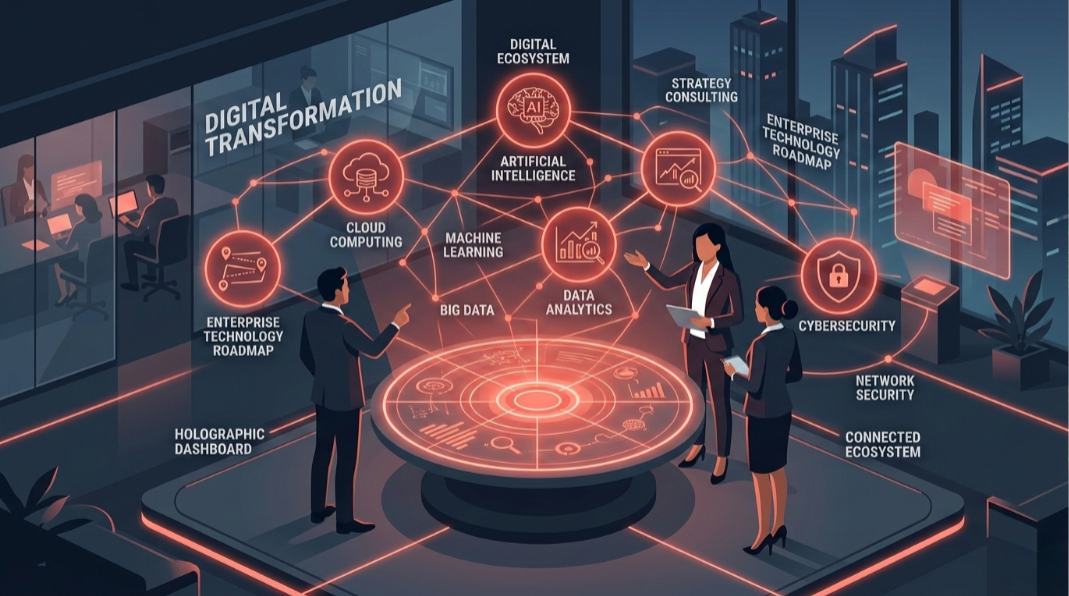
Digital transformation is a key concept revolutionizing the business industry today. Well, it is a technology-focused project that revolves around reinventing an organization’s workflows. Here, data-driven methodologies and next-gen tech stack are integrated in workflows, and their progress is tracked to achieve measurable growth.
Overall, this digital initiative is becoming increasingly important for leaders. In fact, companies worldwide have spent $1.85 trillion in 2022 towards digital transformation, and the figures for global cloud spending budgets alone surpassed $560 billion in corporations, as per a credible report by Statista. Functionally, this contributes to redesigning business processes and helps in making smarter, collaborative, and faster decisions across functions.
Hence, we can say that this concept at large is one of the core business enablers today, which is why leaders confide in digital transformation services to plan it correctly. These professionals know how to kick-start a company’s journey in the digital landscape and can guide leaders to make the right investments in next-gen technologies.
- Mainly, this falls under the umbrella term of digital strategy consulting.
- These advisory services help companies to identify and invest in exciting technologies that have the potential to drive their productivity and performance.
For businesses, this professional consultation should not be an afterthought anymore. It is because it helps a firm strategically visualize its digital roadmap, achieve its present-day goals, and plan for its future objectives and long-term growth.
That being said, this guide highlights the key reasons why digital strategy consulting is the right way to lead an enterprise in 2026 and beyond.
Understanding Digital Strategy Consulting
Today, enterprises rely on digital strategy consulting services to understand how they can move forward with integrating technology in their entire flow of networks, processes, and workflows. But this process is not a standalone project focused on technology. Instead, the idea is to integrate tech in a way that makes practical sense and adds to the company’s output and goals.
This is why, truly, this advisory service makes sense to leaders today. That being said, digital strategy consulting mainly focuses on the following key elements to bring in immense valuable business change:
- Adopting new tools, rethinking technology, data, processes, and people together to drive long-term value.
- Leveraging data and analytics smartly in the system, automating repetitive workflows, and planning a phased modernization of the legacy architecture.
- Holistically planning to break down data silos and build adaptive processes and workflows in the system.
- Finally, aligning all these changes with business goals, thereby fostering efficiency, resilience, and sustainable growth.
Necessarily, connecting all these initiatives to measurable outcomes is an essential step of the plan. It helps in avoiding costly work later, while ensuring that the plan is moving in the right direction. And if any deviations are noticed by tracking KPIs, a corrective action can be planned and implemented to ensure digital success.
That being said, this strategy encompasses various steps, which include:
- Evaluating the present-day digital maturity of the infrastructure
- Identifying gaps and loopholes
- Planning and integrating emerging technologies, such as artificial intelligence, cloud computing, automation, and advanced analytics, systematically.
- Monitoring change and KPIs to check if any further modifications are needed.
Hence, it is a detailed initiative that is tied to results, thereby enabling companies to build a cohesive digital ecosystem.
How Digital Strategy Consulting Drives Enterprise Growth and Transformation in 2026
In the present day, enterprises are redefining their relationship with technology. So, what was once considered a disruptor is now being finally viewed as a window to growth and development. Interestingly, this is where the role of digital strategy comes in.
This strategy, shared by seasoned consulting professionals, helps companies move from fragmented technologies to a value-driven tech-based transformation. With this viewpoint, this section immersively explores how digital strategy consulting is the solution for leaders who plan a holistic technological integration in their systems.
1. Integrating AI-led business Models
The first and foremost aspect of this enterprise-wide transformation is integrating an AI-led business model.
- Mainly, it involves the use of analytics, automation, and other dynamic capabilities, like personalized services being offered to users.
- Here, consultants work with leaders to identify how AI can reshape their business comprehensively.
- Moreover, this involves assessing how the current system can be integrated with modern technology, along with ensuring responsible AI governance.
Overall, this allows them to enable intelligence-driven decision-making, which dynamically adds to their growth potential in real-time.
2. Building a Data-Driven Model of Change
Today, data is of utmost importance for enterprises. It is not only an operational tool for reporting and compliance, but it is also a strategic resource that can be directly tied to better decision-making.
- Herein, consultants share their knowledge on how leadership can leverage data-driven engines to create new revenue streams by understanding what customers really want.
- Basically, it helps companies in proactive decision-making, while also supporting their agility and strategic growth.
Hence, data-driven models help an organization in forecasting user needs accurately, which contributes to their product development function in real-time.
3. Modernizing Legacy Systems to Improve Performance
Companies that need more speed, efficiency, and innovation are focusing on integrating technology in their systems.
- Herein, consulting plays a key role in helping teams modernize their systems in a structured way so as to minimize any risk of operational disruption.
- For organizations, this translates as faster time-to-market, improved customer experiences, and optimization of operational costs.
Moreover, this critical change can be highly aligned with an organization’s goals to bring in the expected output, such as scalable operations, higher agility, future-ready infrastructure, and more.
4. Focus on Strengthening Cybersecurity
Today, cybersecurity is no longer optional. Rather, it is a strategic business responsibility. This is because with the increasing risk of data breaches, the company is at greater risk of losing its reputational value, customer trust, and growth prospects, while also affecting its compliance stature.
- Here, consulting comes in as a credible solution. Mainly, it helps in minimizing security risk by identifying the elements that are most exposed to this uncertainty.
- Further, their efforts help companies in strengthening security in IT systems.
- This helps companies earn higher customer trust while keeping pace with the performance levels as expected.
This is how organizations ensure stronger data privacy, while earning higher stakeholder confidence in the long run through digital transformation services.
5. Supporting Workforce Transformation
Last but not least, digital growth is a result of how ready the talent is to use modern systems. Hence, their skills count to bring a difference in the results.
- This is where consultants can be trusted to build stronger digital capabilities across the workforce.
- Mainly, it includes training the workforce on the latest AI programs, change management, cloud, and more.
Overall, this helps personnel understand how technology can help them contribute to work more smartly, which reduces their resistance to accepting modern infrastructure.
Final Thoughts
Hence, we can say that technology in itself is not the solution for modern enterprises. However, the key to a successful digital transformation is how technology can be integrated into the system to bring desired changes.
- Delivering higher resilience and innovation, consulting plays a key role in helping management plan their complex transformation initiatives, based on their long-term vision and goals.
- Additionally, they help build integrated ecosystems where technology, data, security, and customer experience work together to deliver measurable business value.
This is why digital strategy consulting is the key to adopting technology the right way, assuring sustainable growth, competitiveness, and success in the long run.
| About the Author | Kajal Yadav | Digital content strategist | Kajal Yadav is a technical content writer exploring the dynamics of enterprise digital transformation and AI-driven strategies. With specialized knowledge, she helps businesses understand practical insights related to how leaders can improve their digital strategies and drive measurable business value by consulting digital strategy experts for this goal. |
 Explore more on these topics













26072024043639_thumb.jpg)














 Guest Blogging: The Definitive Guide

 Top Trending Topics
 Share This
 Link copied!
 Recently Updated News