

OEM, ODM, and OBM in Software Development: Choosing the Right Growth Path
Last updated: March 18, 2026 Read in fullscreen view


 Recommended for you
- 08 Oct 2024
 Vietnam: The Rising Star in Global Outsourcing – Trends and Costs for 2025 140/501
 - 17 Mar 2026 How Much Does it Cost to Build an AI Agent in 2026 135/200
- 05 Mar 2026 Top 7 Full-Cycle Web App Development Companies for Your Business in 2026 130/170
- 07 Jul 2024 Top Fintech Companies in Vietnam Driving Innovation Across Digital Banking & Investment 124/250
- 10 Mar 2021 The 7 Biggest Mistakes to Avoid Before Outsourcing a Web Development Project 120/353
- 12 May 2021 The Real Cost Between Outsourcing IT vs In-House: A Quick Comparison 116/561
- 11 Mar 2024 Why You Should Hire Odoo Developers from Vietnam to Customize Your ERP System 115/221
- 17 Mar 2026 Top 10 Product Development Companies in Chennai 2026 (Updated) 113/129
- 02 Feb 2026 What Is the Total Cost of Web Development for Small & Medium Businesses? 112/145
- 05 Jan 2022 What Outsourcing Engagement Model is Right For You? 107/419
- 01 Jan 2023 Top Software Development Challenges in 2023 107/424
- 01 Nov 2023 Difference between Vendor and Subcontractor 105/1165
- 21 Aug 2025 Top 30 Oldest IT Outsourcing Companies in Vietnam 104/208
- 06 Feb 2026 How Much Does a CPA Cost for a Small Business? 101/120
- 10 Jan 2024 Facts Chart: Reasons for outsourcing 101/255
- 19 Oct 2020 The hidden costs of outsourcing software development 98/566
- 16 Feb 2026 Education App Development Cost in 2026: Benchmarks and Key Cost Drivers 95/147
- 16 Oct 2024 Building a Software Outsourcing Startup: Strategy Through Two Canvases 95/129
- 21 Oct 2021 Advantages and Disadvantages of IT Outsourcing 90/445
- 02 Jan 2024 What is User Provisioning & Deprovisioning? 89/672
- 01 Jan 2023 4 New IT Outsourcing Pricing Models to consider in 2023 88/461
- 01 Mar 2022 Top 5 reasons why outsourcing to Vietnam is a smart move 88/373
- 24 Nov 2021 What is the Actual Cost of Hiring Cheap Developers? 87/480
- 09 Sep 2022 Close Collaboration and Communication Can Overcome the Challenges of Distributed Teams 85/289
- 10 May 2021 What are things you should look for in a good IT outsourcing company? 84/529
- 31 Oct 2025 The True ROI of Software Development Outsourcing for Tech Startups 83/162
- 03 Dec 2025 IT Outsourcing Solutions Explained: What, How, Why, When 81/111
- 05 Aug 2025 Why Doesn’t South Korea Outsource Its IT Projects Like Other Developed Countries? 81/182
- 15 Oct 2022 Project-based team model for one-off and pilot software development projects 80/903
- 13 Oct 2021 Why Outsourcing Software Development Services Is Gaining Traction With Non-Technical Leaders? 78/392
- 03 Oct 2020 Outsourcing Your MVP Development - Streamlined Solutions for future 77/502
- 06 Feb 2024 What are benefits and drawbacks of co-creating solutions with your clients? 77/299
- 01 Jan 2023 Software Development Outsourcing Trends to Watch Out for in 2023 77/398
- 24 Nov 2025 Top Blockchain Companies in Vietnam 74/118
- 12 Jan 2023 Top 10 Trustworthy IT Outsourcing Companies in Vietnam 73/355
- 16 Dec 2021 Why outsource Python development of your project? 73/571
- 15 Aug 2021 TIGO Rate Formula - Things the partners should know 72/590
- 01 Apr 2021 IT Outsourcing to vietnam: Why It Is A Good Choice? 72/369
- 03 Jan 2023 IT Outsourcing Costs: Is outsourcing really cost-effective? 72/280
- 19 Mar 2021 Selective Outsourcing of IT Functions - a new trend in business outsourcing 70/625
- 14 Dec 2021 The Top 10 Problems with Outsourcing Implementation and How to Solve Them 69/465
- 22 May 2025 Role of Self-Service in CRM: Customer & Partner Portals for Automation 69/152
- 17 Jan 2024 What are the benefits and challenges of using multi-sourcing or single-sourcing strategies? 68/266
- 01 Sep 2019 Outsourcing Software To Vietnam: Facts, benefits and limitations 68/529
- 09 Jan 2021 How can outsourcing enable business agility? 66/256
- 02 May 2021 Outsourcing Software Development: Avoid 8 Mistakes 65/202
- 10 May 2021 Project Audit and Second Opinion Services 63/308
- 12 Oct 2021 Vietnam outsourcing path - the silk road connecting ASEAN with the developed countries (EU, US, Japan...) 63/401
- 04 Apr 2024 Unlock Vietnamese-Japanese outsourcing potential 63/296
- 03 Nov 2021 7 phases of Odoo Implementation and Development: Can they be outsourced? 63/484
- 01 Jan 2023 Top 5 IT outsourcing countries in 2023 63/337
- 01 Jan 2024 What The World Is Flat Means to IT Outsourcing 62/229
- 30 Dec 2022 Top 6 Reasons to Partner with TIGOSOFT 62/307
- 01 Jun 2025 10 Sustainable & Unique IT Outsourcing Companies in Vietnam 62/144
- 03 Nov 2022 Top questions and answers you must know before ask for software outsourcing 61/346
- 13 Jan 2023 What are the Hourly Rates in Offshore Software Development? 59/299
- 04 Jan 2021 VIETNAM AS A BIG ATTRACTIVE DESTINATION IN THE FIELD OF OUTSOURCING 59/380
- 01 Oct 2022 Vietnam is a favorite supply of IT outsourcing services to Japan 59/294
- 28 Oct 2022 Expect the unexpected in 2023 - How Outsourcing Can Help? 58/262
- 17 Oct 2020 How Outsourcing can Improve Time Management for Better Business 58/345
- 01 Jan 2024 Tech Partnerships: Choosing the Right Software Outsourcing Firm in Vietnam 57/229
- 11 Mar 2023 Common Pain Points in Software Development Outsourcing 56/319
- 15 Nov 2023 IT Staff Augmentation Types and the Best Choice for Your Business 56/263
- 08 Aug 2021 Why Nearshore Software Development is better than In-House Development? 56/251
- 21 Aug 2022 Forbes: IT Outsourcing Hotspot: Vietnam, A Small But Mighty Powerhouse 56/310
- 06 Oct 2021 Intellectual property issues with outsourcing software development 55/440
- 01 Jan 2024 Hiring Tech Talents in Asia: An Overview of Skills, Costs, and Potential 55/214
- 01 Jan 2024 12 reasons for software development outsourcing 54/241
- 07 Nov 2024 Outsourcing Crisis Looming: Will Trump's Policies Transform the Global IT Landscape? 53/235
- 22 Mar 2022 8 Mistakes Marketing Agencies or Consulting Firms Make When Outsourcing Web Development 53/398
- 01 Jan 2024 Software Outsourcing Questions for 2024 51/200
- 02 Nov 2023 What are the pros and cons of iIT outsourcing? 51/255
- 02 Mar 2021 Estimate the Cost of Software Development 50/412
- 01 May 2023 Streamline Your Business with Outsourcing 50/253
- 31 Dec 2021 Outsourcing Software Development to mitigate the impact of COVID-19 47/370
- 01 Jan 2023 Why is Vietnam the Top IT Outsourcing Destination of 2023? 46/285
- 16 Mar 2021 Outsource Data Engineering Services - TIGO Streamlined Solutions 46/301
- 25 Sep 2025 A Practical Guide to Secure Online Work for Outsourced Teams 44/138
- 11 Jan 2024 Entering the Japanese Market: Stacking the Deck and Setting Expectations 43/193
- 01 Feb 2023 [InfoWorld] Is your outsourcer agile enough? 42/234
- 21 Oct 2022 Outsourcing Billable Rate 42/309
- 25 Nov 2021 Low-Cost Software Development: Buy Nice or Buy Twice? 41/399
- 08 Feb 2022 Software Development: Fixed Cost or Opportunity Cost? 40/501
- 08 Jan 2024 Outsourcing on an As-Needed Basis 36/200
In the manufacturing world, business models like OEM, ODM, and OBM have long defined how companies create and deliver value. Interestingly, these models are increasingly relevant in the software industry, where companies must decide whether to build for others, co-create, or own their products outright.
Understanding these three models can help software firms choose the right strategy for growth, scalability, and differentiation.
1. OEM (Original Equipment Manufacturer): Building Behind the Scenes
In software, the OEM model refers to companies that develop software components or full solutions that are rebranded and sold by another company.
Key characteristics:
- The client owns the brand and customer relationship
- The software provider focuses purely on development and delivery
- Limited visibility in the end market
Example:
A company builds a white-label mobile app that is later branded and sold by a fintech startup.
Pros:
- Stable revenue through contracts
- Lower marketing and branding costs
- Focus on technical execution
Cons:
- Low brand recognition
- Dependency on clients
- Limited control over product direction
→ OEM is ideal for companies that excel in engineering but prefer not to invest heavily in branding or go-to-market strategies.
2. ODM (Original Design Manufacturer): Co-Creating Value
ODM in software goes a step further. Here, the provider not only develops but also contributes to the product design, architecture, and sometimes even innovation.
Key characteristics:
- Shared input in product design and features
- Partial ownership of intellectual property (in some cases)
- Closer collaboration with clients
Example:
A SaaS development firm designs a scalable platform framework that multiple clients customize and deploy under their own brands.
Pros:
- Higher value contribution
- Opportunity to reuse core components
- Stronger client partnerships
Cons:
- More complex contracts (IP ownership, licensing)
- Requires product thinking, not just coding
- Still limited brand exposure
2. ODM (Original Design Manufacturer): Co-Creating Value
ODM in software goes a step further. Here, the provider not only develops but also contributes to the product design, architecture, and sometimes even innovation.
Key characteristics:
- Shared input in product design and features
- Partial ownership of intellectual property (in some cases)
- Closer collaboration with clients
Example:
A SaaS development firm designs a scalable platform framework that multiple clients customize and deploy under their own brands.
Pros:
- Higher value contribution
- Opportunity to reuse core components
- Stronger client partnerships
Cons:
- More complex contracts (IP ownership, licensing)
- Requires product thinking, not just coding
- Still limited brand exposure
→ ODM suits companies transitioning from pure outsourcing to more strategic, value-driven partnerships.
3. OBM (Original Brand Manufacturer): Owning the Product
OBM is where a company builds, owns, and markets its own software products. This is the most challenging - but also the most rewarding - model.
Key characteristics:
- Full ownership of product, brand, and customer experience
- Direct go-to-market strategy
- Revenue from end users (subscription, licensing, etc.)
Example:
A company develops its own project management SaaS platform and sells it globally.
Pros:
- High profit potential
- Strong brand equity
- Full control over roadmap and innovation
Cons:
- High investment in marketing, sales, and support
- Greater risk and longer time to profitability
- Requires cross-functional capabilities
→ OBM is ideal for companies aiming to build long-term assets and global brands.
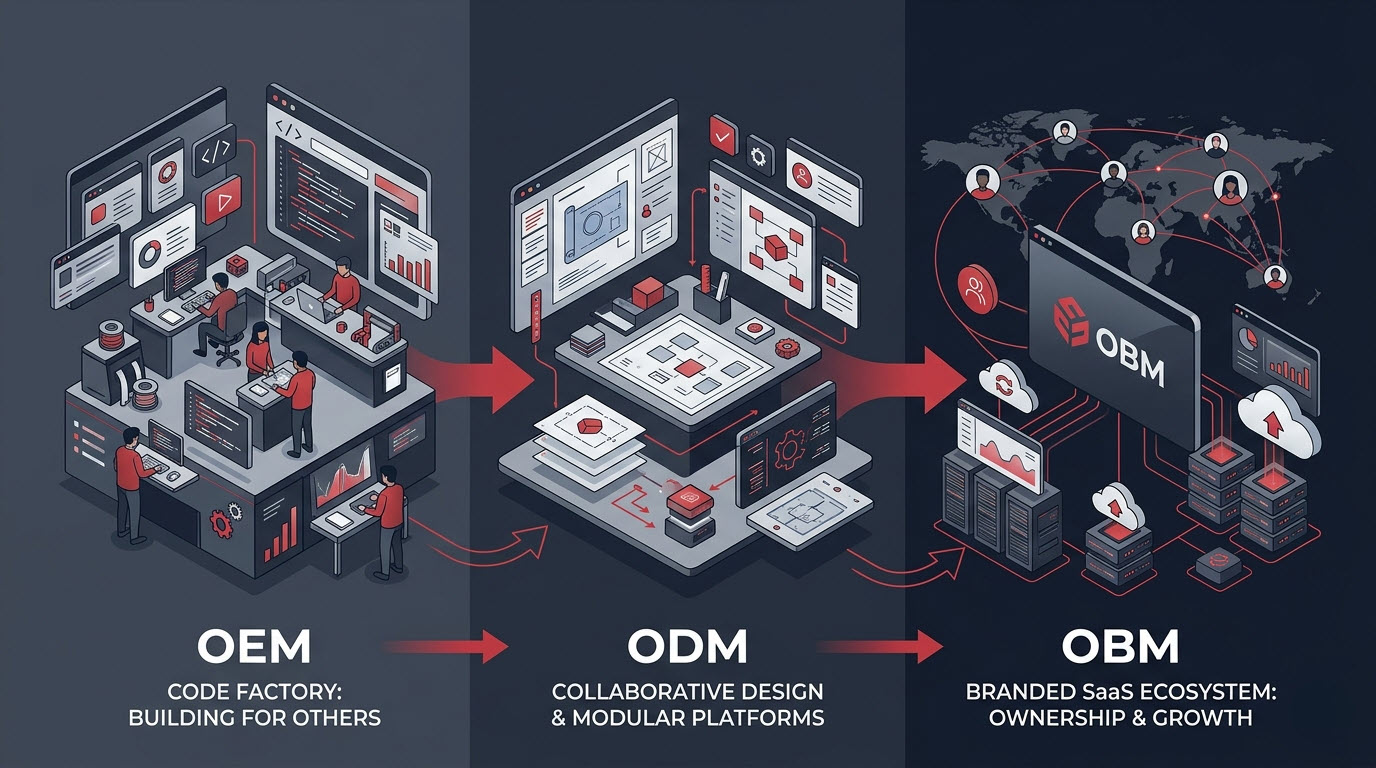
The Evolution Path: From OEM to OBM
Many software companies don’t start with OBM. Instead, they evolve:
OEM → ODM → OBM
- Start with OEM to build technical expertise and cash flow
- Move to ODM to gain product thinking and reusable assets
- Transition to OBM to capture full value and scale
This journey reflects a shift from execution → innovation → ownership.
Choosing the Right Model
There’s no one-size-fits-all answer. The right model depends on:
- Business goals: Short-term revenue vs long-term brand
- Capabilities: Engineering vs product & marketing
- Risk appetite: Stability vs scalability
- Market access: Do you have distribution channels?
In reality, many successful companies operate a hybrid model - for example, maintaining OEM contracts to fund OBM product development.
Final Thoughts
As the software industry matures, the lines between service providers and product companies are blurring. OEM, ODM, and OBM are no longer just manufacturing concepts - they are strategic choices that define how software companies grow, compete, and create value.
The key is not to choose one model forever, but to evolve deliberately - leveraging each stage to build capabilities for the next.
 Explore more on these topics
























 Guest Blogging: The Definitive Guide

 Top Trending Topics
 Share This
 Link copied!
 Recently Updated News