


AI for Financial Reconciliation: Automating Finance Operations in 2026
Last updated: March 31, 2026 Read in fullscreen view


 Recommended for you
- 06 Mar 2026
 Next-Generation AI Agents Explained: OpenClaw, NanoClaw, IronClaw and the Rise of Agent Architectures 342/379
 - 05 Oct 2025 The New Facebook Algorithm: A Paradigm Shift in Content Discovery 260/322
- 12 Jun 2025 Rule-Based vs. Data-Driven Decision Making: The Critical Shift in Fintech and AI 204/324
- 21 Dec 2023 Top 12 Low-Code Platforms To Use in 2024 203/1498
- 23 Dec 2025 Microsoft Power Automate vs. n8n: What’s the Real Difference? 201/323
- 02 Dec 2025 FIX vs. REST API: How to Choose the Right Integration Protocol for Modern Financial Systems 178/253
- 02 Oct 2022 The Real Factors Behind Bill Gates’ Success: Luck, Skills, or Connections? 176/548
- 29 Oct 2024 Top AI Tools and Frameworks You’ll Master in an Artificial Intelligence Course 176/580
- 01 Dec 2025 Manufacturing 4.0: AI Agents Enabling Self-Optimizing Production Systems 166/225
- 03 Oct 2025 Top CMS Trends 2026: The Future of Digital Content Management 158/187
- 21 Nov 2025 Top 8 Cloud Transformation Companies in USA in 2026 157/212
- 09 Jul 2024 What Is Artificial Intelligence and How Is It Used Today? 155/408
- 23 Dec 2024 Garbage In, Megabytes Out (GIMO): How to Rise Above AI Slop and Create Real Signal 155/208
- 16 Oct 2025 AI Inference Explained Simply: What Developers Really Need to Know 153/187
- 25 Mar 2026 Token Bills: The "Cost Shock" After the AI Boom in Companies 148/168
- 02 Dec 2025 The Question That Shook Asia: What Happens When We Ask AI to Choose Between a Mother and a Wife? 146/182
- 05 Jun 2025 How AI-Driven Computer Vision Is Changing the Face of Retail Analytics 146/269
- 19 Oct 2021 Software development life cycles 141/819
- 06 Nov 2025 Top 10 AI Development Companies in the USA to Watch in 2026 135/208
- 31 Dec 2025 10 Skills to Make You "Irreplaceable" in the Next 3 Years (even if AI changes everything) 134/163
- 18 Jul 2024 The 8 Best ways to Innovate your SAAS Business Model in 2024 131/386
- 06 Dec 2025 Enterprise Operations 2.0: Why AI Agents Are Replacing Traditional Automation 130/174
- 20 Dec 2025 The Future of IT Consulting: Key Trends for 2026–2030 129/169
- 06 Nov 2025 DataOps: The Next Frontier in Agile Data Management 129/188
- 06 Nov 2025 DataOps: The Next Frontier in Agile Data Management 129/188
- 02 Jan 2026 The Trust Paradox in Fintech: How Data Transparency Reduces User Anxiety in Financial Recovery 123/159
- 26 Mar 2026 What Is a System Integrator (SI)? Why the Software Subscription Model Is Becoming the New Standard 122/155
- 13 Oct 2021 Outsourcing Software Development: MVP, Proof of Concept (POC) and Prototyping. Which is better? 122/598
- 25 Nov 2025 How AI Agents Are Redefining Enterprise Automation and Decision-Making 121/179
- 04 Feb 2026 Top Workflow Automation Services Driving Digital Transformation 121/155
- 12 May 2026 Top 6 AI AR/VR Filter Tools for Mind-Blowing Videos and Photos in 2026 120/139
- 31 Jul 2025 Top WooCommerce Pre-Order Plugins with Countdown & Discounts 120/216
- 04 Oct 2021 Product Validation: The Key to Developing the Best Product Possible 120/428
- 07 Oct 2025 Case Study: Using the “Messaging House” Framework to Build a Digital Transformation Roadmap 119/198
- 03 Apr 2026 Best 10 FinTech Software Development Companies for SaaS Products 116/136
- 04 Mar 2026 CRM Trends Shaping Customer Engagement in 2026 112/139
- 25 Dec 2025 What Is Algorithmic Fairness? Who Determines the Value of Content: Humans or Algorithms? 111/153
- 01 Jul 2025 The Hidden Costs of Not Adopting AI Agents: Risk of Falling Behind 111/259
- 20 Feb 2025 How Machine Learning is Shaping the Future of Digital Advertising 110/232
- 15 Apr 2024 Weights & Biases: The AI Developer Platform 110/301
- 12 Oct 2022 14 Common Reasons Software Projects Fail (And How To Avoid Them) 106/671
- 22 Dec 2025 The Role of Automotive Software in Building Smarter Vehicles 105/147
- 15 Oct 2025 What Is Snaphunt? An In-Depth Review of the AI-Powered Hiring Platform 103/173
- 21 Aug 2023 30 Must-Know IT Consulting Buzzwords Explained 103/130
- 16 Dec 2025 Reducing Cognitive Friction in Software Development: A Guide to Faster, Happier Teams 102/174
- 27 Jul 2024 Positive Psychology in the Digital Age: Future Directions and Technologies 102/528
- 12 Aug 2024 Understanding Google Analytics in Mumbai: A Beginner's Guide 102/209
- 16 Aug 2022 What is a Headless CMS? 100/386
- 02 Dec 2024 The Intersection of AI and Business Analytics: Key Concepts to Master in Your Business Analytics Course 100/395
- 16 Aug 2022 What is a Headless CMS? 100/386
- 28 Jul 2022 POC, Prototypes, Pilots and MVP: What Are the Differences? 98/836
- 03 Jan 2024 Why Partnership is important for Growth? 98/256
- 16 Sep 2022 Examples Of Augmented Intelligence In Today’s Workplaces Shaping the Business as Usual 96/532
- 27 Aug 2025 How AI Consulting Is Driving Smarter Diagnostics and Hospital Operations 96/196
- 16 Sep 2022 Examples Of Augmented Intelligence In Today’s Workplaces Shaping the Business as Usual 96/532
- 21 Nov 2025 The Rise of AgentOps: How Enterprises Are Managing and Scaling AI Agents 96/151
- 10 Nov 2025 Multi-Modal AI Agents: Merging Voice, Text, and Vision for Better CX 95/208
- 12 Jan 2026 Companies Developing Custom AI Models for Brand Creative: Market Landscape and Use Cases 95/127
- 15 Dec 2025 What Does ERP-Friendly Mean? A Practical Guide for Modern Enterprises 95/138
- 16 Mar 2023 10 Reasons to Choose a Best-of-Breed Tech Stack 94/306
- 11 Oct 2022 Why choose Billable Viable Product (BVP) over Minimum Viable Product (MVP) 94/436
- 31 Aug 2022 What are the best practices for software contract negotiations? 93/364
- 12 Dec 2021 Zero Sum Games Agile vs. Waterfall Project Management Methods 92/505
- 20 Aug 2025 What Is Agentic AI? The Next Phase of Artificial Intelligence 92/251
- 24 Dec 2024 Artificial Intelligence and Cybersecurity: Building Trust in EFL Tutoring 92/262
- 21 Aug 2024 What is Singularity and Its Impact on Businesses? 92/551
- 06 May 2025 How Machine Learning Is Transforming Data Analytics Workflows 91/288
- 17 Oct 2025 MLOps vs AIOps: What’s the Difference and Why It Matters 91/202
- 25 Sep 2024 Enhancing Decision-Making Skills with an MBA: Data-Driven Approaches for Business Growth 91/297
- 10 Feb 2026 8 FinTech Software Development Services That Drive Digital Transformation 90/133
- 18 Jan 2024 Self-healing code is the future of software development 89/306
- 25 Jan 2025 The Decline of Traditional SaaS and the Rise of AI-first Applications 89/193
- 09 Sep 2025 Aligning BI Dashboards with KPIs: A Business + Data Collaboration Guide 87/175
- 05 Mar 2021 How do you minimize risks when you outsource software development? 86/419
- 05 Sep 2023 The Cold Start Problem: How to Start and Scale Network Effects 85/282
- 07 Nov 2025 Online vs. Offline Machine Learning Courses in South Africa: Which One Should You Pick? 84/151
- 23 Jun 2025 AI Avatars in the Metaverse: How Digital Beings Are Redefining Identity and Social Interaction 84/271
- 06 Jan 2026 Risk & Change Management Through the 3P Model 83/128
- 24 Aug 2022 7 Ways to Improve Software Maintenance 78/381
- 06 Mar 2024 [SemRush] What Are LSI Keywords & Why They Don‘t Matter 78/280
- 04 Oct 2023 The Future of Work: Harnessing AI Solutions for Business Growth 77/356
- 30 Jul 2024 The Future of IT Consulting: Trends and Opportunities 77/285
- 18 Aug 2024 The Future of Web Development: Emerging Trends and Technologies Every Developer Should Know 76/271
- 28 Nov 2025 How AI Will Transform Vendor Onboarding and Seller Management in 2026 76/206
- 31 Dec 2022 The New Normal for Software Development 75/428
- 31 Dec 2023 Software Development Outsourcing Trends to Watch Out for in 2024 75/304
- 01 Dec 2023 Laws of Project Management 74/389
- 22 Nov 2024 The Role of AI in Enhancing Business Efficiency and Decision-Making 74/268
- 10 Sep 2024 Leading Remote Teams in Hybrid Work Environments 71/214
- 27 Feb 2025 How AI Agents are Changing Software Development? 70/302
- 22 Sep 2025 Why AI Is Critical for Accelerating Drug Discovery in Pharma 70/185
- 19 Dec 2023 How AI is Transforming Software Development? 68/361
- 18 Jul 2021 How To Ramp Up An Offshore Software Development Team Quickly 68/660
- 03 Nov 2023 Why Is Billable Viable Product An Alternative To Minimum Viable Product? 67/258
- 04 Oct 2022 Which ERP implementation strategy is right for your business? 67/427
- 01 May 2024 Warren Buffett’s Golden Rule for Digital Transformation: Avoiding Tech Overload 67/275
- 24 Oct 2025 AI Agents in SaaS Platforms: Automating User Support and Onboarding 67/137
- 26 May 2026 Cost Breakdown of Insurance App Development in 2026 66/80
- 17 Jun 2021 What is IT-business alignment? 65/437
- 21 Apr 2025 Agent AI in Multimodal Interaction: Transforming Human-Computer Engagement 64/259
- 09 Oct 2024 Short-Form Video Advertising: The Secret to Captivating Your Audience 63/195
- 05 Aug 2024 Affordable Tech: How Chatbots Enhance Value in Healthcare Software 59/289
- 28 Oct 2022 Build Operate Transfer (B.O.T) Model in Software Outsourcing 57/466
- 15 Aug 2025 Quantum Technology: Global Challenges and Opportunities for Innovators 57/186
- 29 Aug 2025 How AI Is Transforming Modern Management Science 56/123
- 13 May 2026 Real AI Use Cases in Banking and Financial Services 56/64
- 29 May 2026 The Role of IoT in Modern Insurance App Development 52/62
- 19 Jun 2026 Who Offers AI Solutions Specifically Designed for Financial Services? Top Financial AI Companies in 2026 51/55
- 10 Sep 2024 AI in Email Marketing: Personalization and Automation 50/227
- 25 Jun 2026 Vercel: The "Secret Weapon" for Modern, High-Performance Web Deployment 45/49
- 31 Dec 2022 Future of Software Development Trends and Predictions 44/195
| About the Author | Anand Subramanian | Technology expert and AI enthusiast | Anand Subramanian is a technology expert and AI enthusiast currently leading the marketing function at Intellectyx, a Data, Digital, and AI solutions provider with over a decade of experience working with enterprises and government departments. |
What Is AI-Powered Financial Reconciliation?
AI-powered financial reconciliation is the use of artificial intelligence including machine learning, natural language processing, and agentic AI to automatically match, verify, and resolve financial records across multiple systems, accounts, and entities. Instead of finance teams manually comparing ledgers, bank statements, invoices, and ERP data, AI systems do this autonomously, flag exceptions, identify root causes of discrepancies, and propose or execute corrective actions in real time.
Introduction: Why Financial Reconciliation Is Broken Without AI
Financial reconciliation is one of the most time-consuming and error-prone processes in any organization. At its core, it involves matching financial transactions across two or more data sources bank statements against internal ledgers, intercompany accounts against consolidation records, accounts payable against vendor invoices, to ensure that every number ties out and every discrepancy is explained.
In a mid-sized enterprise, this process can involve hundreds of thousands of transactions per month across dozens of systems. Traditionally, this work is performed by accounting teams armed with spreadsheets, manual rules, and institutional knowledge built over years. The result is a process that is slow, expensive, inconsistent, and deeply vulnerable to human error.
Month-end close cycles that should take two to three days routinely stretch to ten or fifteen. Errors that slip through create downstream issues in financial reporting, tax filings, and audit readiness. And as transaction volumes grow driven by e-commerce, global operations, and digital payment infrastructure the manual approach simply does not scale.
AI changes this equation entirely.
How AI Automates Financial Reconciliation
1. Intelligent Transaction Matching
The foundation of reconciliation is matching finding the corresponding entry for every transaction across systems. Traditional rule-based systems match on exact values: same amount, same date, same reference number. But real-world financial data is messy. Amounts differ due to fees. Dates shift due to settlement cycles. Reference numbers are inconsistent across systems.
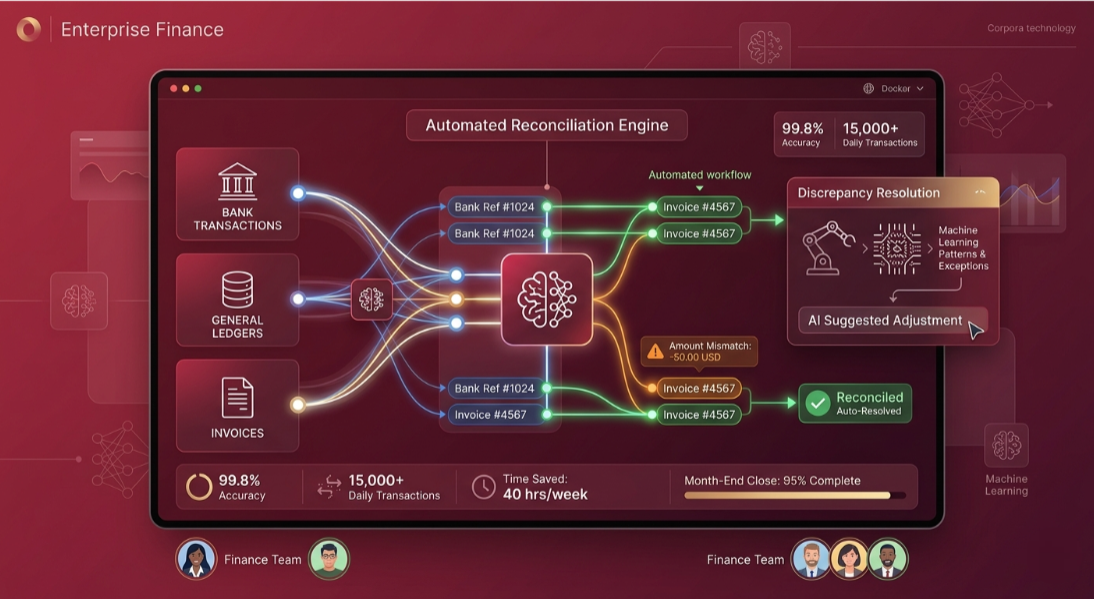
AI matching engines use machine learning to match transactions probabilistically. They learn from historical match patterns, understand contextual relationships between fields, handle partial matches, and improve accuracy over time. Match rates that previously sat at 70 to 80 percent with manual rules climb to 95 to 99 percent with AI dramatically reducing the exception queue that humans must review.
2. Exception Detection and Root Cause Analysis
Unmatched transactions exceptions are where reconciliation becomes expensive. Each exception requires a human to investigate: find the source, determine why the discrepancy exists, and decide how to resolve it. In high-volume environments, exception queues can run into thousands of items per close cycle.
AI systems classify exceptions automatically. They identify whether a discrepancy is due to a timing difference, a duplicate entry, a currency conversion issue, a system integration error, or a genuine financial discrepancy requiring escalation. By categorizing and prioritizing exceptions, AI reduces the average time to resolve each item and ensures that the most material discrepancies receive immediate human attention.
3. Automated Journal Entry and Posting
Once the cause of a discrepancy is identified, the resolution typically requires a journal entry an accounting record that corrects or explains the difference. AI systems can now draft and, within defined parameters, post these journal entries automatically. For routine, low-risk reconciling items (timing differences, standard accruals, recurring intercompany eliminations), this eliminates manual work entirely. For complex or high-value items, the AI drafts the entry for human review and approval.
4. Continuous Reconciliation (Real-Time Close)
Traditional reconciliation is periodic weekly, monthly, or quarterly. AI enables continuous reconciliation: transactions are matched and verified as they occur, exceptions are flagged immediately, and the financial close becomes a rolling process rather than a month-end crisis. Organizations adopting continuous reconciliation report close cycles shortened by 50 to 70 percent and a significant reduction in the scramble and stress associated with traditional period-end close.
5. Intercompany and Multi-Entity Reconciliation
For multinational organizations, intercompany reconciliation matching transactions between subsidiaries, business units, and legal entities is particularly complex. Differences in currencies, accounting standards, time zones, and local system configurations create massive reconciliation burdens. AI systems manage intercompany matching across all entities simultaneously, apply currency conversion logic, flag out-of-balance positions in real time, and generate elimination entries required for consolidated reporting.
Key Use Cases of AI in Finance Operations
Bank Reconciliation: AI matches bank statement transactions against general ledger entries daily, identifies uncleared items, flags unusual patterns, and generates reconciliation reports without manual intervention. Organizations processing thousands of daily transactions report 90 percent reductions in manual reconciliation effort.
Accounts Payable and Receivable Matching: AI matches purchase orders, goods receipts, and vendor invoices in three-way matching workflows, resolves discrepancies caused by quantity differences or price variances, and approves clean invoices for payment automatically. For receivables, AI matches incoming payments against open invoices even when customers pay partial amounts or reference incorrect invoice numbers.
General Ledger Reconciliation: AI continuously monitors GL account balances, flags accounts that are out of expected ranges, reconciles balance sheet accounts against supporting schedules (fixed asset registers, prepayment schedules, accrual listings), and ensures every balance is substantiated at all times not just at quarter-end.
Credit Card and Expense Reconciliation: Corporate card transactions are matched against expense reports, receipts, and policy rules automatically. Policy violations are flagged for manager review. Compliant expenses are approved and posted without manual touchpoints.
Payroll Reconciliation: AI reconciles payroll outputs against HR records, headcount data, bank payment files, and GL entries catching errors in gross-to-net calculations, benefit deductions, or tax withholdings before they become compliance issues.
Tax and Regulatory Reconciliation: AI reconciles sales tax, VAT, and withholding tax liabilities against transaction monitoring ai agent data, ensures that tax accounts in the GL match returns filed, and identifies discrepancies before regulatory filing deadlines.
Benefits of AI-Powered Financial Reconciliation
Faster Close Cycles: Organizations using AI for reconciliation automation consistently report month-end close reductions of 40 to 70 percent. What previously required ten days of intensive effort is compressed into three to four days with better accuracy.
Significant Cost Reduction: Manual reconciliation is labor-intensive. AI reduces the headcount required for reconciliation work, reallocates finance talent to higher-value analytical activities, and eliminates the cost of errors that slip through manual processes. For large enterprises, annual savings from AI-driven reconciliation run into millions of dollars.
Higher Accuracy and Audit Readiness: AI systems maintain complete, timestamped audit trails of every match decision, exception resolution, and journal entry. This makes audit preparation dramatically faster and reduces the risk of material misstatements in financial reporting.
Scalability Without Proportional Cost: As transaction volumes grow through business growth, acquisitions, or new payment channels, AI-powered reconciliation scales computationally. Adding a new entity or doubling transaction volume does not require doubling the finance team.
Real-Time Financial Visibility: Continuous reconciliation means CFOs and controllers have real-time confidence in account balances and financial positions rather than waiting for the close cycle to confirm the numbers. This improves the quality of management decisions and reduces the risk of acting on stale data.
Reduced Fraud Risk: AI reconciliation systems detect unusual transaction patterns, duplicate payments, and unauthorized entries that human reviewers under time pressure during close routinely miss. Earlier detection means earlier intervention.
Challenges and Considerations
Data Quality and Integration Complexity
AI reconciliation systems are only as good as the data they receive. Inconsistent data formats, poor master data quality, and fragmented system landscapes require significant data engineering work before AI can deliver full value. Organizations must invest in data standardization and integration infrastructure as a prerequisite.
Change Management
Finance teams with decades of experience using spreadsheet-based reconciliation processes often resist AI adoption. Successful implementation requires clear communication about role changes, investment in training, and demonstration of early wins to build internal confidence.
Configurability vs. Out-of-the-Box Solutions
No two organizations reconcile identically. AI reconciliation platforms must be configurable to match specific business rules, account structures, and reconciliation policies. Organizations should evaluate platforms on configurability, not just headline match rates demonstrated in generic demos.
Exception Handling Governance
AI systems will not match 100 percent of transactions. A governance framework for exception handling who reviews what, within what timeframe, with what escalation path must be defined before go-live. Without this, unresolved exceptions accumulate, creating the same backlogs that AI was meant to eliminate.
Regulatory and Audit Acceptance
Auditors and regulators are increasingly familiar with AI-driven financial processes, but documenting AI decision logic, match rules, and exception-handling procedures is essential. Organizations must be able to explain how the AI made each match or exception decision to satisfy audit requirements.
Leading AI Reconciliation Platforms in 2026
Several platforms have emerged as leaders in AI-powered financial reconciliation, including BlackLine, Trintech, ReconArt, and Oracle Fusion Reconciliation. Enterprise ERP providers including SAP and Oracle now embed AI reconciliation capabilities natively within their finance modules. Standalone agentic AI platforms are also entering this space, offering more flexible, workflow-driven approaches to end-to-end close automation.
Conclusion and Future Outlook
Financial reconciliation has historically been one of the most manual, labor-intensive, and error-prone functions in enterprise finance. AI is systematically eliminating these inefficiencies delivering faster closes, lower costs, higher accuracy, and real-time financial visibility.
The trajectory points clearly toward the continuous close: a world where reconciliation is not a periodic event but a permanent, automated state. Organizations that invest now in AI reconciliation infrastructure are building the foundation for a finance function that is leaner, faster, and more strategically valuable.
For CFOs, controllers, and finance transformation leaders in 2026, the question is no longer whether AI can handle financial reconciliation. The evidence is clear that it can, and does. The question is how quickly your organization can get there and how much competitive and cost advantage you are leaving on the table by waiting.
Frequently Asked Questions
What types of reconciliation can AI automate?
AI can automate bank reconciliation, accounts payable and receivable matching, general ledger reconciliation, intercompany reconciliation, payroll reconciliation, credit card and expense reconciliation, and tax account reconciliation.
How accurate is AI in financial reconciliation?
Leading AI reconciliation systems achieve match rates of 95 to 99 percent on structured financial data, compared to 70 to 80 percent for traditional rule-based systems. The remaining exceptions are flagged for human review, typically representing the most complex or ambiguous items.
How long does it take to implement AI reconciliation?
Implementation timelines vary by organization complexity. Simple bank reconciliation automation can go live in weeks. Full GL and intercompany reconciliation across a multi-entity enterprise typically takes three to nine months, depending on data quality and integration requirements.
Does AI reconciliation replace finance teams?
AI reconciliation reallocates finance talent rather than replacing it. Routine matching and exception resolution tasks are automated, freeing finance professionals to focus on analysis, business partnering, and strategic decision support. Headcount requirements for transactional reconciliation work typically decrease, while demand for finance analysts with AI oversight and data skills increases.
Is AI-powered reconciliation compliant with accounting standards?
Yes. AI reconciliation systems are designed to operate within GAAP, IFRS, and local accounting standards. They maintain full audit trails and support the documentation requirements of major audit frameworks including SOX compliance.
Anand Subramanian
Technology expert and AI enthusiast
Anand Subramanian is a technology expert and AI enthusiast currently leading the marketing function at Intellectyx, a Data, Digital, and AI solutions provider with over a decade of experience working with enterprises and government departments.
 Explore more on these topics

























 Guest Blogging: The Definitive Guide

 Top Trending Topics
 Share This
 Link copied!
 Recently Updated News