

Role of AI and Blockchain in Healthcare Mobile App Development
Last updated: April 24, 2026 Read in fullscreen view


 Recommended for you
- 05 Oct 2025
 The New Facebook Algorithm: A Paradigm Shift in Content Discovery 306/368
 - 21 Dec 2023 Top 12 Low-Code Platforms To Use in 2024 231/1532
- 02 Oct 2022 The Real Factors Behind Bill Gates’ Success: Luck, Skills, or Connections? 197/572
- 31 Dec 2025 10 Skills to Make You "Irreplaceable" in the Next 3 Years (even if AI changes everything) 188/223
- 01 Dec 2025 Manufacturing 4.0: AI Agents Enabling Self-Optimizing Production Systems 185/246
- 25 Mar 2026 Token Bills: The "Cost Shock" After the AI Boom in Companies 172/198
- 20 Dec 2025 The Future of IT Consulting: Key Trends for 2026–2030 172/216
- 03 Oct 2025 Top CMS Trends 2026: The Future of Digital Content Management 170/204
- 26 Mar 2026 What Is a System Integrator (SI)? Why the Software Subscription Model Is Becoming the New Standard 163/197
- 12 May 2026 Top 6 AI AR/VR Filter Tools for Mind-Blowing Videos and Photos in 2026 152/173
- 06 Nov 2025 DataOps: The Next Frontier in Agile Data Management 143/203
- 18 Jul 2024 The 8 Best ways to Innovate your SAAS Business Model in 2024 141/398
- 06 Nov 2023 How do you streamline requirement analysis and modeling? 131/368
- 20 Jan 2021 Fail early, fail often, fail cheap, fail safe but always fail forward 129/950
- 29 Jan 2026 Why Headless Commerce Is Shaping the Future of the Online Store 129/156
- 14 Aug 2024 Blockchain Explained: Key Advantages and Limitations You Should Know 124/183
- 20 Feb 2025 How Machine Learning is Shaping the Future of Digital Advertising 118/243
- 19 Feb 2026 HIPAA-Compliant Healthcare iOS App Development Services: A Complete Guide 118/150
- 16 Aug 2022 What is a Headless CMS? 116/402
- 16 Aug 2022 What is a Headless CMS? 116/402
- 25 Aug 2024 Mobile App Development Trends to Watch Out for 2025 116/369
- 27 Mar 2026 How Blockchain Is Transforming Digital Transactions 115/137
- 27 Jul 2024 Positive Psychology in the Digital Age: Future Directions and Technologies 114/544
- 02 Nov 2021 [Case Study] Streamlined Data Reporting using Tableau 114/417
- 11 Nov 2021 What is an IT Self-service Portal? Why is it Important to Your Business? 112/564
- 02 Dec 2024 The Intersection of AI and Business Analytics: Key Concepts to Master in Your Business Analytics Course 108/404
- 03 Jan 2024 Why Partnership is important for Growth? 103/261
- 16 Sep 2022 Examples Of Augmented Intelligence In Today’s Workplaces Shaping the Business as Usual 100/537
- 16 Sep 2022 Examples Of Augmented Intelligence In Today’s Workplaces Shaping the Business as Usual 100/537
- 20 Aug 2025 What Is Agentic AI? The Next Phase of Artificial Intelligence 100/261
- 09 Sep 2025 Aligning BI Dashboards with KPIs: A Business + Data Collaboration Guide 99/187
- 23 Jun 2025 AI Avatars in the Metaverse: How Digital Beings Are Redefining Identity and Social Interaction 99/288
- 11 Oct 2022 Why choose Billable Viable Product (BVP) over Minimum Viable Product (MVP) 99/441
- 18 Jan 2024 Self-healing code is the future of software development 98/316
- 25 Sep 2024 Enhancing Decision-Making Skills with an MBA: Data-Driven Approaches for Business Growth 95/304
- 01 Jan 2024 The pros and cons of the Centralized Enterprise Automation Operating model 94/318
- 30 Jul 2024 The Future of IT Consulting: Trends and Opportunities 93/307
- 25 Jan 2025 The Decline of Traditional SaaS and the Rise of AI-first Applications 93/199
- 23 Apr 2026 A Complete Guide to Integrating Blockchain in Mobile App Development 92/111
- 31 Dec 2023 Software Development Outsourcing Trends to Watch Out for in 2024 91/321
- 13 May 2026 Progressive Web Apps vs Native Apps: What’s the Difference? 89/115
- 01 Mar 2024 (AI) Artificial Intelligence Terms Every Beginner Should Know 88/424
- 03 Nov 2023 Why Is Billable Viable Product An Alternative To Minimum Viable Product? 84/275
- 03 Apr 2021 How digital asset management streamlines your content workflow? 83/414
- 20 Jan 2022 TIGO Self-Organization Practice: Change Management Workflow 83/555
- 22 Nov 2024 The Role of AI in Enhancing Business Efficiency and Decision-Making 83/278
- 02 Dec 2022 Success Story: Satsuki - Sales Management Software, back office app for School Subscription Management 80/320
- 18 Aug 2024 The Future of Web Development: Emerging Trends and Technologies Every Developer Should Know 80/275
- 03 Sep 2022 The secret of software success: Simplicity is the ultimate sophistication 76/281
- 31 Dec 2022 The New Normal for Software Development 76/430
- 10 Sep 2024 Leading Remote Teams in Hybrid Work Environments 76/220
- 27 Feb 2025 How AI Agents are Changing Software Development? 74/315
- 19 Dec 2023 How AI is Transforming Software Development? 74/367
- 13 Feb 2021 Why is TIGOSOFT a software house for Enterprise Application Development? 73/454
- 27 May 2026 Best 5 Software Development Companies Ideal for Early-Stage Startups 73/104
- 09 Oct 2024 Short-Form Video Advertising: The Secret to Captivating Your Audience 71/203
- 16 Jun 2022 Rapid Application Development (RAD): Pros and Cons 65/950
- 15 Aug 2025 Quantum Technology: Global Challenges and Opportunities for Innovators 65/204
- 29 May 2026 The Role of IoT in Modern Insurance App Development 64/75
- 21 Jun 2021 6 Useful Tips To Streamline Business Processes and Workflows 64/597
- 10 Sep 2024 AI in Email Marketing: Personalization and Automation 61/238
- 17 Mar 2025 Integrating Salesforce with Yardi: A Guide to Achieving Success in Real Estate Business 61/269
- 17 Apr 2026 Blockchain Integration in Real Estate Mobile App Development 60/91
- 08 Jan 2024 Ask Experts: Explicitation/Implicitation and Elicitation; two commonly used but barely unraveled concepts 60/441
- 31 Dec 2022 Future of Software Development Trends and Predictions 49/200
- 13 Jul 2026 How to Choose the Best Blockchain App Development Company in 2026? 38/48
- 16 Jul 2026 AI + Blockchain App Development: Future of Smart Applications 38/46
- 08 Jul 2026 What is HL7 FHIR? The Benefits of HL7 FHIR in Healthcare 28/32
- 04 Mar 2026 CRM Trends Shaping Customer Engagement in 2026 1/152
Mobile apps are crucial to the significant digital revolution that the healthcare sector is undergoing. Patients now call for fast, secure, and individualized medical treatment at their fingertips. This is where modern technology like blockchain and artificial intelligence (AI) come into play. These technologies may now be integrated by using a reputable custom mobile app development company to create healthcare apps that might be safer, more sensible, and more powerful.
This blog will discuss how AI and Blockchain are transforming the creation of healthcare mobile apps, in addition to their benefits, packages, and the reasons why organizations are making big investments in these technologies.
Recognizing the Increasing Demand for Intelligent Healthcare Applications
Apps for healthcare are no longer only for scheduling appointments or engaging in simple consultations. Personalized treatment plans, secure data sharing, AI-based diagnostics, and real-time monitoring are just a few of the functions to be had in cutting-edge apps.
But this development also brings with it problems like:
- Privacy and information safety troubles
- Handling large quantities of patient data
- Ensuring precise analysis and care
- Keeping all systems transparent
This is where blockchain app development and artificial intelligence come into play as revolutionary technologies.
AI's Role in the Development of Healthcare Mobile Apps
By enhancing structures' intelligence, predictability, and performance, artificial intelligence is revolutionizing the healthcare enterprise. It allows the evaluation of huge volumes of records by healthcare apps to provide insightful results.
1. AI-Powered Predictive Analytics and Diagnosis
AI can assist physicians in making a specific diagnosis by using data to read affected patients, scientific records, and signs. Even possible health risks may be detected by predictive analytics before they get worse.
For instance:
- Early identification of ailments, along with cancer
- Forecasting heart-related problems
- Finding developments in scientific data for patients
This lowers the possibility of a misdiagnosis and complements patient effects.
2. Chatbots and Digital Assistants
Advantages encompass:
- 24-hour help for patients
- Decreased burden for clinical personnel
- Quicker reaction times
3. Tailored Therapy Programs
To broaden individualized treatment regimens, AI can examine a patient's behavior, lifestyle, and medical records. Better engagement and higher restoration prices are assured as a result.
For example:
- Tailored diet plan regimens
- Customized reminders for medicines
- Monitoring health and fitness
4. Data Analysis and Medical Imaging
AI is crucial to the analysis of scientific imaging, consisting of MRIs, CT scans, and X-rays. It aids in the particularly accurate detection of anomalies.
This results in:
- Quicker analysis
- Decreased human errors
- Enhanced scientific effectiveness
5. Remote Patient Monitoring
Wearable technology may be used by AI-enabled apps to monitor patient fitness in real time. Vital signs and symptoms may be monitored by medical doctors, who can respond fast if necessary.
This is in particular useful for:
- Management of persistent illnesses
- Care for the elderly
- Recuperation following the surgical procedure
Blockchain's Role in the Development of Healthcare Mobile Apps
Blockchain ensures security, transparency, and agreement in healthcare structures, whereas AI focuses on intelligence and automation.
Because healthcare information is so sensitive, securing it is of extreme importance. Blockchain app improvement offerings are crucial in this example.
1. Secure Management of Patient Data
Blockchain may be very secure because it keeps records in a decentralized, encrypted model. Data cannot be modified or tampered with once it has been recorded.
Advantages consist of:
- Defense against information breaches
- Enhanced confidentiality for patients
- Safekeeping of medical data
2. Data Sharing and Interoperability
The absence of smooth record changes between systems is one of the main troubles in dealing with the healthcare enterprise. Blockchain makes it feasible for doctors, labs, and hospitals to share records in an obvious and secure manner.
This guarantees:
- Improved communication among healthcare vendors
- Quicker access to medical statistics
- Better decision-making
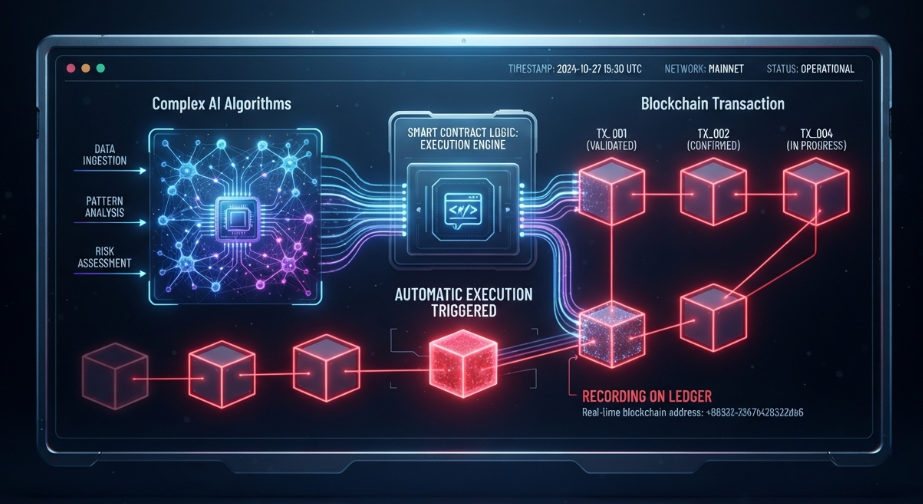
3. Healthcare Smart Contracts
Smart contracts are self-executing agreements made feasible by using blockchain technology. These have the potential to automate techniques such as payments and coverage claims.
For example:
- Automatic approval of claims
- Quicker billing strategies
- Decreased administrative duties
4. Supply Chain Management and Drug Traceability
Blockchain has the capability to display the supply of medicines from producers to customers. This ensures authenticity and aids in the eradication of fake medicinal drugs.
Principal benefits:
- Supply chain transparency
- Decreased fraud
- Enhanced safety for patients
5. Research and Clinical Trials
Clinical trial facts can be transparently and appropriately saved on blockchain. These guard against manipulation and ensure the validity of observed records.
This results in:
- A more honest look at findings
- Enhanced confidence in scientific trials
- Improved cooperation between researchers
Blockchain and AI Together: A Potent Pair
Blockchain and AI work together to supply extraordinarily smart and secure healthcare solutions.
This is how they enhance one another:
- Blockchain ensures data security, even as AI evaluates and approaches data.
- Blockchain keeps transparency, even as AI increases performance and fosters trust.
Consider a clinical app where:
- AI evaluates patient symptoms and makes healing guidelines.
- Blockchain keeps patient records secure.
- Physicians have instant access to the facts; insurance claims are dealt with without delay.
A smooth, secure, and powerful healthcare environment is produced as a result.
Key Benefits of AI & Blockchain for Healthcare Apps
-
Improved Security of Data: Blockchain ensures that patient records are protected from unwanted access.
-
Enhanced Precision: AI will increase the accuracy of diagnoses and decrease human error.
-
Improved Experience for Patients: User dissatisfaction is increased through personalized offerings and quicker responses.
-
Economy of Cost: Automation lowers administrative burden and operating costs.
-
Openness and Confidence: By providing obvious and impenetrable mechanisms, blockchain fosters agreement.
Challenges to Consider
Blockchain and AI have many advantages, but there are drawbacks as well:
- Exorbitant Development Expenses: It may be high-priced to integrate contemporary technology.
- Complicated Execution: Blockchain and AI both call for information and careful preparation.
- Adherence to Regulations: Strict records safety legal guidelines have to be adhered to by healthcare apps.
- Integration with Current Systems: It is probably challenging to integrate new technology with legacy structures.
Despite those difficulties, the long-term benefits exceed the short-term obstacles.
Future Trends in Healthcare Mobile App Development
With ongoing developments in blockchain and artificial intelligence, the future of healthcare apps is bright.
Among the brand new trends are:
- Robotic operations powered by AI
- Blockchain-driven platforms for health records
- Cutting-edge telemedicine systems
- Healthcare helpers with voice capabilities
- Real-time tracking through integration with IoT devices
Early adoption of this technology will offer companies a competitive advantage.
Final Thoughts
Healthcare custom mobile app development is transforming due to AI and Blockchain, which make apps more secure, more intelligent, and more effective. Blockchain ensures statistical security, transparency, and consideration, while AI offers intelligence, automation, and predictive abilities.
When mixed, these technologies are improving patient outcomes, streamlining operations, and converting the way healthcare services are provided. The alternatives are clearly infinite, starting from stable facts sharing to custom-designed treatments.
The long-term benefits of AI and blockchain make them a perfect investment for healthcare agencies, in spite of barriers like cost and complexity.
Staying ahead in this competitive marketplace will require operating with the specialists and utilizing technology like blockchain and artificial intelligence as the demand for smart healthcare solutions keeps rising.
Healthcare apps must develop much more sophisticated, related, and safe in the upcoming years, with the end goal to improve patient and healthcare provider experience.
 Explore more on these topics


























 Guest Blogging: The Definitive Guide

 Top Trending Topics
 Share This
 Link copied!
 Recently Updated News
 thực chiến - Kiến tạo tương lai cho các nhà sáng tạo nội dung.