Improving Parent-School Communication with Technology
Last updated: July 11, 2026 Read in fullscreen view


 Recommended for you
- 14 Jan 2026
 How to Evaluate the Business and Productivity Software Company Seismic on RFP AI Agent Use Cases 246/296
 - 02 Oct 2022 The Real Factors Behind Bill Gates’ Success: Luck, Skills, or Connections? 177/550
- 01 Dec 2025 Manufacturing 4.0: AI Agents Enabling Self-Optimizing Production Systems 166/227
- 21 Nov 2025 Top 8 Cloud Transformation Companies in USA in 2026 160/216
- 06 Nov 2025 DataOps: The Next Frontier in Agile Data Management 135/194
- 28 Oct 2025 The Future of Real Estate: Key Trends and Essential Lessons in Digital Transformation 131/202
- 04 Feb 2026 Top Workflow Automation Services Driving Digital Transformation 127/162
- 06 Nov 2023 How do you streamline requirement analysis and modeling? 125/362
- 20 Jan 2021 Fail early, fail often, fail cheap, fail safe but always fail forward 115/930
- 29 Jan 2026 Why Headless Commerce Is Shaping the Future of the Online Store 113/138
- 21 Aug 2023 30 Must-Know IT Consulting Buzzwords Explained 107/134
- 16 Aug 2022 What is a Headless CMS? 105/391
- 02 Nov 2021 [Case Study] Streamlined Data Reporting using Tableau 104/407
- 29 Nov 2021 Memorandum of Understanding (MOU) for Partnership Agreements 103/671
- 11 Nov 2021 What is an IT Self-service Portal? Why is it Important to Your Business? 101/548
- 16 Mar 2023 10 Reasons to Choose a Best-of-Breed Tech Stack 99/311
- 16 Sep 2022 Examples Of Augmented Intelligence In Today’s Workplaces Shaping the Business as Usual 98/534
- 20 Dec 2021 What is Hybrid Mobile App Development? 98/497
- 15 Dec 2025 What Does ERP-Friendly Mean? A Practical Guide for Modern Enterprises 97/140
- 07 Nov 2022 Why Design Thinking can save the outsourcing industry 95/286
- 08 Apr 2026 Top AI Agent Development Companies for Manufacturing Industry (2026) 91/119
- 09 Sep 2025 Aligning BI Dashboards with KPIs: A Business + Data Collaboration Guide 90/178
- 06 Jan 2026 Risk & Change Management Through the 3P Model 86/131
- 12 May 2025 Tech for Non-Techies: How to Understand IT Without Writing a Single Line of Code 85/138
- 24 Aug 2022 7 Ways to Improve Software Maintenance 82/385
- 01 Jan 2024 The pros and cons of the Centralized Enterprise Automation Operating model 81/305
- 02 Dec 2022 Success Story: Satsuki - Sales Management Software, back office app for School Subscription Management 78/317
- 03 Apr 2021 How digital asset management streamlines your content workflow? 76/404
- 20 Jan 2022 TIGO Self-Organization Practice: Change Management Workflow 76/547
- 03 Sep 2022 The secret of software success: Simplicity is the ultimate sophistication 74/279
- 04 Apr 2025 To Act or Not to Act – A Manager’s Persistent Dilemma 71/186
- 13 Feb 2021 Why is TIGOSOFT a software house for Enterprise Application Development? 70/450
- 03 May 2024 The Iceberg of Ignorance 68/496
- 06 Dec 2024 Steps For Integrating Sustainable Practices Into Business Operations 60/209
- 15 Aug 2025 Quantum Technology: Global Challenges and Opportunities for Innovators 60/190
- 05 Oct 2021 Shiny Object Syndrome: Why Your Business Isn't "Going Digital" 59/440
- 21 Jun 2021 6 Useful Tips To Streamline Business Processes and Workflows 59/590
- 16 Jun 2022 Rapid Application Development (RAD): Pros and Cons 57/938
- 01 May 2023 Understanding Business as Usual (BAU) and How to Transition 37/1158
- 03 Dec 2025 Templafy Features Explained: The Ultimate Guide to Streamlined Content Management 4/173
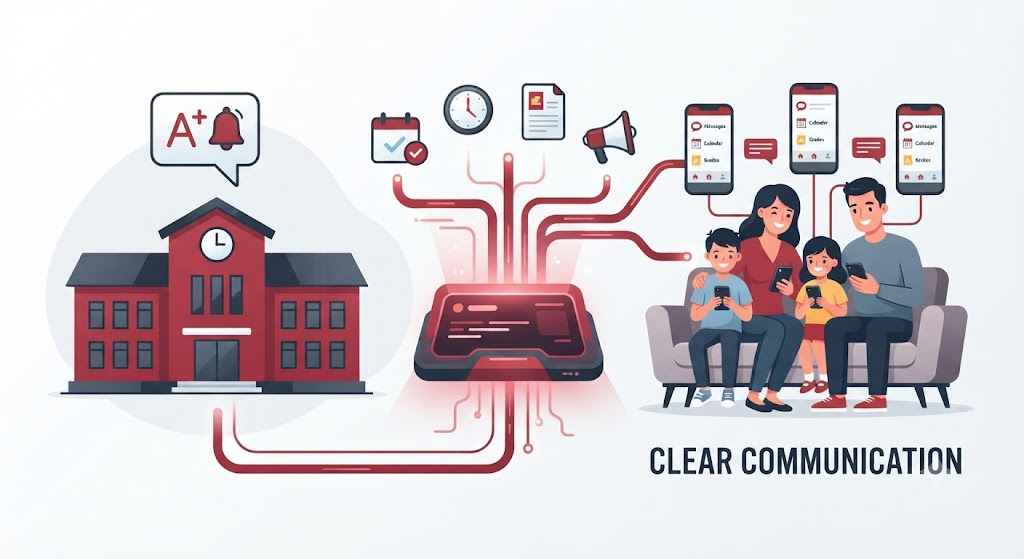
Parent school communication does more than just affect timetables , reminders, and that kind of stuff. It also ends up shaping trust, student accountability, how connected families actually feel, and even how fast schools deal with problems when they show up. If communication stays clear and consistent , parents usually feel genuinely informed, and students tend to thrive in a learning setting that feels more woven together. Because of that, lots of schools now end up investing in digital systems and in school management software development, so updates arrive more quickly and in a way that is easy, accessible, and reliable to use. But if communication gets scattered, those smaller issues can turn into real confusion, and then frustration follows, pretty quickly.
Schools are also leaning into technology more and more, mainly to improve the day to day communication workflows. Newer tools can send out updates sooner, lower the administrative burden, and keep parents plus educators on the same wavelength. For schools dealing with busy households, multilingual communities, and hybrid learning models, digital communication is basically becoming a routine part of operations, like it or not.
Still, it’s worth saying this plainly, technology by itself will not magically fix communication issues. Just adding more channels does not automatically make things clearer. The point is not only digitization. The real target is structured communication, meaning it is accessible and truly meaningful, not just delivered.
Why parent-school communication breaks down
A lot of communication trouble in education comes less from a lack of effort, more from being inconsistent. Schools typically run on several channels at once - teachers push updates through apps, offices lean on email , principals put announcements on their websites, and sometimes notices still get sent home on paper. Parents are then expected to keep track of all of it, usually not really knowing which way matters most, or which one to treat as the “real” message.
And yeah this is where the friction shows up. One message gets lost, another repeats, and some things get read the wrong way. Teachers end up spending extra time untangling the details, while office staff deal with questions that could have been avoided. Parents can end up feeling overwhelmed even while communication is happening all the time.
It gets even messier in diverse communities too, because families might use different languages, have different schedules, and don’t share the same digital access. Without a clear structure, communication turns into noise. Not clarity.
What technology improves in communication
Digital tools sort of add structure to school comms. Like, instead of messages all over the place, schools can centralize updates, choose communication types, and make sure parents understand where to look for info. Attendance alerts, homework updates, event reminders, and those emergency notices can all sit in one shared system.
That usually cuts down on how much we depend on paper notices and informal channels. Plus, it gives staff more say over timing and distribution, so everything feels a bit more organized. Communication also gets more predictable, and honestly, it’s easier for people to manage.
On top of that technology expands reach and adds transparency. Messages go out fast, you can track engagement, and translation can happen when it’s needed. Still, more communication is not automatically better. The main thing is relevance and clarity not just quantity, because too much noise can drown the useful stuff.
Key features that improve engagement
Not all tools help communication the same, no matter how “advanced” they claim to be. The most useful setups feel structured but also sort of easy to work with for people.
Message segmentation is key, like really. Schools should send focused updates, rather than broadcasting everything to everybody, because that turns into noise. Class level messages, grade level messages and school wide messages should be kept clearly apart, or it gets messy fast.
Two way messaging tends to raise engagement too. Parents should be able to reply, ask questions, or send a quick check-in without jumping to a different platform , and not having to wait until office hours. Still, the whole thing needs to stay organized and secure.
A centralized parent portal then adds extra clarity. Parents can find attendance, schedules, announcements, and academic updates in a single place, instead of searching around through different tools, and hoping they find the right thing.
How technology supports staff
Communication tools are not only for parents. They help too, in a kind of quiet way… maybe less in one place more in another. Also it cuts down the workload for teachers and administrators which is, honestly pretty helpful.
Teachers can send updates faster, reuse templates, and not constantly toggle between a bunch of different apps. Administrators can post announcements once and distribute them automatically. Office staff end up spending less time on the same recurring questions.
All of this reduces the hands on effort, so school staff can focus more on teaching and student support, not so much on administrative coordination , which takes longer than it should.
Accessibility is critical
Even strong systems fail if they are somehow difficult to use, you know. Parents need mobile access, clear wayfinding, and straightforward notification controls. Messages should be easy to read and able to take action on , not just there. If the platforms seem overly involved, families might simply sidestep them and go back to informal chat channels.
Device access also counts. A lot of parents depend on smartphones, shared devices, or spotty connectivity. So the system has to still function well under these circumstances, even then.
Digital confidence really differs too. The best communication tools are straightforward enough that every parent can use them, consistently, again and again.
Common mistakes in implementation
One common mistake is treating communication tools as a full solution, rather than a structured system, you know. Without clear rules even decent platforms end up feeling a bit noisy and confusing.
Over-communication is also the thing. When there are too many notifications, attention gets diluted, and eventually parents start ignoring the important updates.
And finally, schools often do not really adapt after implementation. These communication systems should keep moving forward based on feedback from parents and staff, so they stay useful as time goes on.
What effective communication looks like
When technology is put into play well, communication gets a bit easier, not heavier. Parents know exactly where to look for those new updates. Teachers can pass along information quickly and in a more organized way. Administrators keep everything consistent, and yes, students end up with better alignment between what happens at school and what is expected at home.
Like, for example, a parent could get an attendance update, review assignments inside the same portal, then reply to a school message without jumping between different tools, all day. And those small tweaks, just they make the routine feel smoother for everyone, involved, in the end.
Final thoughts
Improving parent school communication is not only about picking up new tools. It ’s more about making things clearer, more structured, and a bit more consistent too, even if that sounds obvious, it still matters. Technology helps , by putting information in one place, cutting down on the fragmentation, and making it easier to handle messages without so much back and forth. And when technology is paired with clear processes it can help schools build firmer ties between parents, teachers, and students.
Honestly, the best schools are not always the ones with the most tools. They’re the ones with communication systems that really match what happens every day and how work flows , through their routines.
Yuliya Melnik
Technical writer
Yuliya Melnik is a technical writer at Cleveroad, a web and mobile application development company. She focuses on technology trends in education, software development, and digital transformation, creating clear and engaging content that helps readers understand complex topics in a simple way.
 Explore more on these topics

























 Guest Blogging: The Definitive Guide

 Top Trending Topics
 Share This
 Link copied!
 Recently Updated News