AI + Blockchain App Development: Future of Smart Applications
Last updated: July 18, 2026 Read in fullscreen view


 Recommended for you
- 05 Oct 2025
 The New Facebook Algorithm: A Paradigm Shift in Content Discovery 274/336
 - 21 Dec 2023 Top 12 Low-Code Platforms To Use in 2024 216/1512
- 23 Dec 2025 Microsoft Power Automate vs. n8n: What’s the Real Difference? 212/338
- 14 Aug 2024 From Steel to Software: The Reluctant Evolution of Japan's Tech Corporates 195/740
- 01 Dec 2025 Manufacturing 4.0: AI Agents Enabling Self-Optimizing Production Systems 171/232
- 05 Mar 2026 Top 7 Full-Cycle Web App Development Companies for Your Business in 2026 166/216
- 03 Oct 2025 Top CMS Trends 2026: The Future of Digital Content Management 164/194
- 17 Mar 2026 How Much Does it Cost to Build an AI Agent in 2026 163/232
- 25 Mar 2026 Token Bills: The "Cost Shock" After the AI Boom in Companies 161/184
- 31 Dec 2025 10 Skills to Make You "Irreplaceable" in the Next 3 Years (even if AI changes everything) 157/187
- 08 Oct 2024 Vietnam: The Rising Star in Global Outsourcing – Trends and Costs for 2025 156/519
- 20 Dec 2025 The Future of IT Consulting: Key Trends for 2026–2030 155/197
- 11 Mar 2026 OEM, ODM, and OBM in Software Development: Choosing the Right Growth Path 146/173
- 19 Oct 2021 Software development life cycles 144/822
- 07 Jul 2024 Top Fintech Companies in Vietnam Driving Innovation Across Digital Banking & Investment 143/279
- 26 Mar 2026 What Is a System Integrator (SI)? Why the Software Subscription Model Is Becoming the New Standard 142/176
- 06 Nov 2025 DataOps: The Next Frontier in Agile Data Management 139/198
- 28 Oct 2025 The Future of Real Estate: Key Trends and Essential Lessons in Digital Transformation 138/209
- 18 Jul 2024 The 8 Best ways to Innovate your SAAS Business Model in 2024 136/391
- 12 May 2021 The Real Cost Between Outsourcing IT vs In-House: A Quick Comparison 136/582
- 12 May 2026 Top 6 AI AR/VR Filter Tools for Mind-Blowing Videos and Photos in 2026 136/156
- 17 Mar 2026 Top 10 Product Development Companies in Chennai 2026 (Updated) 132/149
- 16 Oct 2024 Building a Software Outsourcing Startup: Strategy Through Two Canvases 132/172
- 02 Feb 2026 What Is the Total Cost of Web Development for Small & Medium Businesses? 130/163
- 04 Oct 2021 Product Validation: The Key to Developing the Best Product Possible 130/438
- 13 Oct 2021 Outsourcing Software Development: MVP, Proof of Concept (POC) and Prototyping. Which is better? 129/606
- 16 Feb 2026 Education App Development Cost in 2026: Benchmarks and Key Cost Drivers 129/187
- 21 Apr 2026 Vibe Coding vs. Expert Shopify Development: What AI Tools Can (and Can't) Do? 129/154
- 06 Nov 2023 How do you streamline requirement analysis and modeling? 127/364
- 31 Jul 2025 Top WooCommerce Pre-Order Plugins with Countdown & Discounts 127/224
- 07 Oct 2025 Case Study: Using the “Messaging House” Framework to Build a Digital Transformation Roadmap 126/206
- 10 Mar 2021 The 7 Biggest Mistakes to Avoid Before Outsourcing a Web Development Project 126/359
- 21 Aug 2025 Top 30 Oldest IT Outsourcing Companies in Vietnam 125/230
- 06 Feb 2026 How Much Does a CPA Cost for a Small Business? 123/146
- 05 Aug 2025 Why Doesn’t South Korea Outsource Its IT Projects Like Other Developed Countries? 122/228
- 11 Mar 2024 Why You Should Hire Odoo Developers from Vietnam to Customize Your ERP System 122/228
- 20 Jan 2021 Fail early, fail often, fail cheap, fail safe but always fail forward 121/937
- 29 Jan 2026 Why Headless Commerce Is Shaping the Future of the Online Store 120/147
- 14 Aug 2024 Blockchain Explained: Key Advantages and Limitations You Should Know 119/178
- 01 Jan 2023 Top Software Development Challenges in 2023 119/438
- 05 Jan 2022 What Outsourcing Engagement Model is Right For You? 118/430
- 04 Mar 2026 CRM Trends Shaping Customer Engagement in 2026 117/145
- 22 Dec 2025 The Role of Automotive Software in Building Smarter Vehicles 116/158
- 10 Jan 2024 Facts Chart: Reasons for outsourcing 114/269
- 20 Feb 2025 How Machine Learning is Shaping the Future of Digital Advertising 113/235
- 12 Oct 2022 14 Common Reasons Software Projects Fail (And How To Avoid Them) 111/676
- 19 Oct 2020 The hidden costs of outsourcing software development 110/578
- 12 Aug 2024 Understanding Google Analytics in Mumbai: A Beginner's Guide 110/217
- 27 Jul 2024 Positive Psychology in the Digital Age: Future Directions and Technologies 109/538
- 27 Mar 2026 How Blockchain Is Transforming Digital Transactions 109/131
- 16 Aug 2022 What is a Headless CMS? 108/394
- 02 Nov 2021 [Case Study] Streamlined Data Reporting using Tableau 108/411
- 16 Aug 2022 What is a Headless CMS? 108/394
- 28 Jul 2022 POC, Prototypes, Pilots and MVP: What Are the Differences? 107/848
- 01 Jan 2023 4 New IT Outsourcing Pricing Models to consider in 2023 106/481
- 01 Mar 2022 Top 5 reasons why outsourcing to Vietnam is a smart move 106/391
- 29 Nov 2021 Memorandum of Understanding (MOU) for Partnership Agreements 106/676
- 16 Dec 2025 Reducing Cognitive Friction in Software Development: A Guide to Faster, Happier Teams 104/177
- 02 Dec 2024 The Intersection of AI and Business Analytics: Key Concepts to Master in Your Business Analytics Course 103/398
- 21 Oct 2021 Advantages and Disadvantages of IT Outsourcing 103/459
- 11 Nov 2021 What is an IT Self-service Portal? Why is it Important to Your Business? 102/550
- 09 Sep 2022 Close Collaboration and Communication Can Overcome the Challenges of Distributed Teams 102/309
- 16 Mar 2023 10 Reasons to Choose a Best-of-Breed Tech Stack 102/316
- 03 Jan 2024 Why Partnership is important for Growth? 102/260
- 24 Nov 2025 Top Blockchain Companies in Vietnam 100/145
- 20 Dec 2021 What is Hybrid Mobile App Development? 100/499
- 10 May 2021 What are things you should look for in a good IT outsourcing company? 99/546
- 16 Sep 2022 Examples Of Augmented Intelligence In Today’s Workplaces Shaping the Business as Usual 99/535
- 16 Sep 2022 Examples Of Augmented Intelligence In Today’s Workplaces Shaping the Business as Usual 99/535
- 01 Jan 2024 What The World Is Flat Means to IT Outsourcing 99/267
- 31 Oct 2025 The True ROI of Software Development Outsourcing for Tech Startups 98/178
- 03 Dec 2025 IT Outsourcing Solutions Explained: What, How, Why, When 98/130
- 11 Oct 2022 Why choose Billable Viable Product (BVP) over Minimum Viable Product (MVP) 98/440
- 24 Nov 2021 What is the Actual Cost of Hiring Cheap Developers? 98/494
- 07 Nov 2022 Why Design Thinking can save the outsourcing industry 97/288
- 31 Aug 2022 What are the best practices for software contract negotiations? 97/371
- 01 Sep 2019 Outsourcing Software To Vietnam: Facts, benefits and limitations 97/558
- 12 Dec 2021 Zero Sum Games Agile vs. Waterfall Project Management Methods 96/510
- 18 Jan 2024 Self-healing code is the future of software development 95/312
- 20 Aug 2025 What Is Agentic AI? The Next Phase of Artificial Intelligence 94/254
- 25 Jan 2025 The Decline of Traditional SaaS and the Rise of AI-first Applications 93/198
- 25 Sep 2024 Enhancing Decision-Making Skills with an MBA: Data-Driven Approaches for Business Growth 93/300
- 09 Sep 2025 Aligning BI Dashboards with KPIs: A Business + Data Collaboration Guide 93/181
- 05 Sep 2023 The Cold Start Problem: How to Start and Scale Network Effects 93/291
- 01 Jan 2023 Software Development Outsourcing Trends to Watch Out for in 2023 93/416
- 01 Jan 2023 Top 5 IT outsourcing countries in 2023 92/367
- 01 Apr 2021 IT Outsourcing to vietnam: Why It Is A Good Choice? 91/389
- 15 Aug 2021 TIGO Rate Formula - Things the partners should know 90/620
- 05 Mar 2021 How do you minimize risks when you outsource software development? 89/422
- 05 Aug 2024 Revisiting the Mistake That Halted Japan's Software Surge 89/436
- 23 Jun 2025 AI Avatars in the Metaverse: How Digital Beings Are Redefining Identity and Social Interaction 89/276
- 15 Oct 2022 Project-based team model for one-off and pilot software development projects 86/913
- 13 Jan 2023 What are the Hourly Rates in Offshore Software Development? 86/327
- 23 Apr 2026 A Complete Guide to Integrating Blockchain in Mobile App Development 86/103
- 12 Jan 2023 Top 10 Trustworthy IT Outsourcing Companies in Vietnam 85/367
- 16 Dec 2021 Why outsource Python development of your project? 85/583
- 01 Jan 2024 The pros and cons of the Centralized Enterprise Automation Operating model 85/309
- 24 Aug 2022 7 Ways to Improve Software Maintenance 84/387
- 13 Oct 2021 Why Outsourcing Software Development Services Is Gaining Traction With Non-Technical Leaders? 84/399
- 19 Mar 2021 Selective Outsourcing of IT Functions - a new trend in business outsourcing 82/644
- 06 Mar 2024 [SemRush] What Are LSI Keywords & Why They Don‘t Matter 82/284
- 17 Jan 2024 What are the benefits and challenges of using multi-sourcing or single-sourcing strategies? 82/284
- 30 Jul 2024 The Future of IT Consulting: Trends and Opportunities 82/293
- 22 Nov 2024 The Role of AI in Enhancing Business Efficiency and Decision-Making 81/276
- 03 Oct 2020 Outsourcing Your MVP Development - Streamlined Solutions for future 81/507
- 14 Dec 2021 The Top 10 Problems with Outsourcing Implementation and How to Solve Them 81/477
- 03 Jan 2023 IT Outsourcing Costs: Is outsourcing really cost-effective? 81/291
- 03 Apr 2021 How digital asset management streamlines your content workflow? 80/411
- 31 Dec 2023 Software Development Outsourcing Trends to Watch Out for in 2024 80/310
- 01 Dec 2023 Laws of Project Management 79/394
- 02 Dec 2022 Success Story: Satsuki - Sales Management Software, back office app for School Subscription Management 79/319
- 04 Apr 2025 To Act or Not to Act – A Manager’s Persistent Dilemma 79/195
- 20 Jan 2022 TIGO Self-Organization Practice: Change Management Workflow 79/550
- 02 Nov 2023 What are the pros and cons of iIT outsourcing? 77/290
- 18 Aug 2024 The Future of Web Development: Emerging Trends and Technologies Every Developer Should Know 77/272
- 10 Sep 2024 Leading Remote Teams in Hybrid Work Environments 76/220
- 03 Nov 2023 Why Is Billable Viable Product An Alternative To Minimum Viable Product? 76/267
- 31 Dec 2022 The New Normal for Software Development 76/429
- 18 Jul 2021 How To Ramp Up An Offshore Software Development Team Quickly 76/668
- 04 Apr 2024 Unlock Vietnamese-Japanese outsourcing potential 75/309
- 03 Nov 2021 7 phases of Odoo Implementation and Development: Can they be outsourced? 74/498
- 27 Feb 2025 How AI Agents are Changing Software Development? 74/311
- 01 Jun 2025 10 Sustainable & Unique IT Outsourcing Companies in Vietnam 74/156
- 22 Mar 2022 8 Mistakes Marketing Agencies or Consulting Firms Make When Outsourcing Web Development 74/419
- 03 Sep 2022 The secret of software success: Simplicity is the ultimate sophistication 74/279
- 21 Aug 2022 Forbes: IT Outsourcing Hotspot: Vietnam, A Small But Mighty Powerhouse 74/329
- 04 Jan 2021 VIETNAM AS A BIG ATTRACTIVE DESTINATION IN THE FIELD OF OUTSOURCING 74/399
- 20 Apr 2026 Role of AI and Blockchain in Healthcare Mobile App Development 74/91
- 03 Nov 2022 Top questions and answers you must know before ask for software outsourcing 73/358
- 19 Dec 2023 How AI is Transforming Software Development? 73/366
- 28 Oct 2022 Expect the unexpected in 2023 - How Outsourcing Can Help? 71/275
- 12 Oct 2021 Vietnam outsourcing path - the silk road connecting ASEAN with the developed countries (EU, US, Japan...) 71/412
- 06 Oct 2021 Intellectual property issues with outsourcing software development 71/456
- 02 May 2021 Outsourcing Software Development: Avoid 8 Mistakes 70/207
- 04 Oct 2022 Which ERP implementation strategy is right for your business? 70/430
- 13 Feb 2021 Why is TIGOSOFT a software house for Enterprise Application Development? 70/450
- 17 Oct 2020 How Outsourcing can Improve Time Management for Better Business 69/367
- 10 May 2021 Project Audit and Second Opinion Services 69/315
- 01 May 2024 Warren Buffett’s Golden Rule for Digital Transformation: Avoiding Tech Overload 69/277
- 09 Oct 2024 Short-Form Video Advertising: The Secret to Captivating Your Audience 68/200
- 01 Jan 2024 Hiring Tech Talents in Asia: An Overview of Skills, Costs, and Potential 68/228
- 09 Jan 2021 How can outsourcing enable business agility? 68/258
- 15 Nov 2023 IT Staff Augmentation Types and the Best Choice for Your Business 66/279
- 01 Oct 2022 Vietnam is a favorite supply of IT outsourcing services to Japan 64/300
- 02 Mar 2021 Estimate the Cost of Software Development 63/427
- 01 Jan 2024 Tech Partnerships: Choosing the Right Software Outsourcing Firm in Vietnam 63/235
- 01 Jan 2024 12 reasons for software development outsourcing 62/266
- 01 May 2023 Streamline Your Business with Outsourcing 62/267
- 11 Mar 2023 Common Pain Points in Software Development Outsourcing 62/327
- 21 Jun 2021 6 Useful Tips To Streamline Business Processes and Workflows 60/591
- 06 Dec 2024 Steps For Integrating Sustainable Practices Into Business Operations 60/209
- 29 May 2026 The Role of IoT in Modern Insurance App Development 60/70
- 07 Nov 2024 Outsourcing Crisis Looming: Will Trump's Policies Transform the Global IT Landscape? 59/242
- 25 Sep 2025 A Practical Guide to Secure Online Work for Outsourced Teams 59/154
- 28 Oct 2022 Build Operate Transfer (B.O.T) Model in Software Outsourcing 59/469
- 08 Aug 2021 Why Nearshore Software Development is better than In-House Development? 59/254
- 16 Jun 2022 Rapid Application Development (RAD): Pros and Cons 58/940
- 01 Jan 2024 Software Outsourcing Questions for 2024 57/206
- 01 Jan 2023 Why is Vietnam the Top IT Outsourcing Destination of 2023? 56/297
- 08 Feb 2022 Software Development: Fixed Cost or Opportunity Cost? 55/516
- 17 Apr 2026 Blockchain Integration in Real Estate Mobile App Development 55/86
- 10 Sep 2024 AI in Email Marketing: Personalization and Automation 54/231
- 08 Jan 2024 Outsourcing on an As-Needed Basis 51/216
- 16 Mar 2021 Outsource Data Engineering Services - TIGO Streamlined Solutions 51/307
- 31 Dec 2021 Outsourcing Software Development to mitigate the impact of COVID-19 50/373
- 01 Feb 2023 [InfoWorld] Is your outsourcer agile enough? 50/243
- 31 Dec 2022 Future of Software Development Trends and Predictions 47/198
- 21 Oct 2022 Outsourcing Billable Rate 46/316
- 25 Jun 2026 Vercel: The "Secret Weapon" for Modern, High-Performance Web Deployment 45/50
- 25 Nov 2021 Low-Cost Software Development: Buy Nice or Buy Twice? 44/406
- 03 Jun 2026 Enterprise Guide to Choosing the Right Enterprise Application Development Services 34/37
- 13 Jul 2026 Why Every AI Initiative Needs Regular Audits 10/14
- 03 Dec 2025 Templafy Features Explained: The Ultimate Guide to Streamlined Content Management 6/175
- 13 Jul 2026 How to Choose the Best Blockchain App Development Company in 2026? 1/9
Artificial Intelligence (AI) and blockchain are two of the most transformative technologies shaping the digital economy. Yet it’s not just about tech on paper; AI lets machines analyze data, handle repetitive choices, and make customer experiences feel smoother. Meanwhile, blockchain brings visibility, decentralization, and stronger safeguards. Put them side by side, and you start seeing the next wave of smart applications that can tackle tricky business problems across many sectors.
In healthcare and finance, and even supply chain and real estate, companies are leaning harder into combining AI with blockchain to craft intelligent, secure, and scalable digital solutions. And if a business wants to stay ahead, it’s now common to invest in Blockchain App Development Services that also include AI capabilities. This helps with automation, fraud reduction, prescriptive reporting - plus better oversight of trustworthy data, not just storage.
In this article , we’ll dig into how AI and blockchain end up complementing each other, what they look like in real deployments, the main advantages, the usual development headaches, and why teaming up with experienced developers matters if you want future-ready applications.
Why AI and Blockchain Are a Powerful Combination
Although AI and blockchain serve different purposes, their strengths perfectly complement each other.
AI relies on large amounts of quality data to train models and generate accurate predictions. Blockchain, on the other hand, creates an immutable and transparent record of data, ensuring its authenticity and integrity.
When combined, businesses gain:
- Secure and tamper-proof data for AI models
- Automated decision-making through smart contracts
- Improved trust in AI-generated outcomes
- Enhanced privacy for sensitive information
- Transparent auditing of AI activities
This synergy enables organizations to create intelligent applications that are not only smart but also trustworthy and secure.
Key Benefits of AI-Powered Blockchain Applications
1. Enhanced Data Security
AI systems really need dependable datasets to work properly; otherwise, things get weird. With blockchain, every transaction and data record is tucked away in a secure way, and it cannot be changed without some kind of consensus happening first. So, data tampering becomes less of a thing, and people have more trust in AI-driven choices, even when those decisions are kind of critical.
2. Intelligent Automation
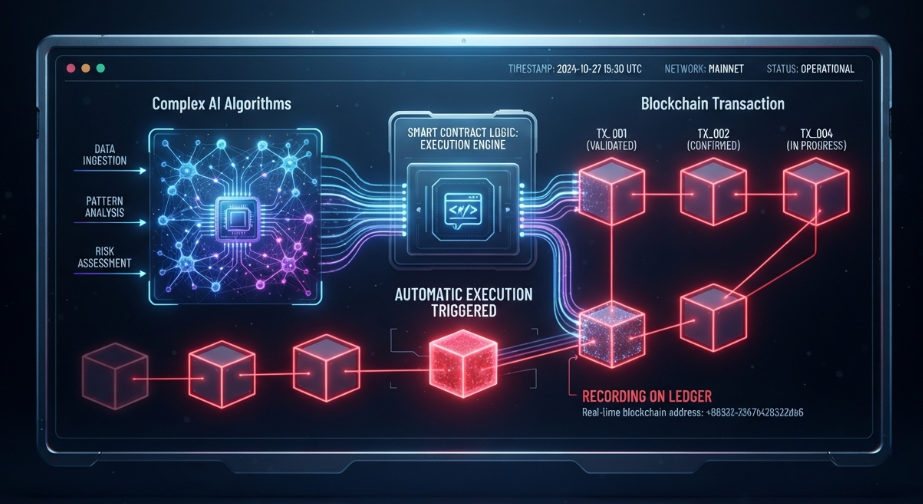
Smart contracts can auto-execute preset actions once specific conditions are satisfied. Then when AI is added, the whole thing gets a bit more perceptive; it can judge intricate situations before it kicks off an automated work stream.
For instance, an insurance provider might use AI to estimate damage from a claim and blockchain smart contracts to release the payment right away once verification is done, all without extra back and forth.
3. Better Fraud Detection
Financial institutions lose billions each year because fraud kind of happens more often than people would like. AI algorithms are able to spot odd transaction patterns, and then blockchain gives that transparent record of the transactions so tracing the fraudulent activities becomes way easier. When these two things work together, the result is, well, it boosts cybersecurity quite a bit and it also cuts down financial risks overall.
4. Improved Transparency
One of the biggest concerns around AI is the lack of transparency in decision-making, like you can’t always see why a system chose a particular output. Blockchain helps here by keeping a permanent audit trail of AI inputs, outputs, and the model updates, so organizations can check how those decisions were really made.
This matters even more in industries with strict regulatory needs, where documentation and evidence kind of can’t be fuzzy.
5. Faster Business Processes
AI is doing the analyzing part, while blockchain steps in by getting rid of intermediaries through a decentralized kind of verification. Because of that combination, there is generally less waiting time, less paperwork, and fewer operational expenses. So, workflows can move faster, or at least more smoothly.
Industries Transforming with AI and Blockchain
Healthcare
Healthcare organizations handle huge amounts of sensitive patient data. AI supports clinical review of medical records, helps predict disease patterns, and even assists doctors during diagnosis. Blockchain, instead of just “storing,” securely keeps patient information and it also allows only authorized healthcare providers to access it in a controlled, managed way.
Benefits include:
- Secure electronic medical records
- Faster insurance claim processing
- Drug supply chain tracking
- AI-assisted diagnostics
- Improved patient privacy
Financial Services
Banks and fintech companies are rapidly adopting AI-powered blockchain platforms to improve security and customer experience.
Applications include:
- Fraud detection
- Digital identity verification
- Automated lending
- Cryptocurrency trading
- Risk assessment
- Regulatory compliance
Supply Chain Management
Supply chains often suffer from limited visibility and counterfeit products.
AI predicts inventory demand, delivery delays, and logistics performance, while blockchain records every movement of goods from manufacturers to customers.
Businesses gain:
- End-to-end transparency
- Real-time shipment tracking
- Reduced counterfeit products
- Better inventory planning
- Improved supplier accountability
Real Estate
Real estate transactions are messy, with lots of different people involved, plus all that extensive documentation. Like somehow, everyone needs their part, and the forms just keep piling up. AI then helps with property valuation in a more streamlined way, also with market forecasting, and blockchain handles the digital ownership records, along with smart contracts. In the end, it trims a lot of the paperwork, makes deals faster, and adds a bit more confidence between buyers and sellers.
Retail and E-commerce
Retailers often lean on AI for a more personalized shopping experience, like suggesting items you might actually want and estimating or forecasting customer demand. Then blockchain steps in to verify product authenticity, run loyalty programs, and keep digital payments secure and accounted for.
When these tools work together, customers tend to trust the process more, while the business side gets its operations optimized, more or less.
Popular AI + Blockchain Use Cases
AI-Powered Smart Contracts
Traditional smart contracts just do predefined instructions, and that’s sort of it. AI adds adaptive decision-making, like when it looks at external data first before it actually triggers the contract to run. You can see it in places like Dynamic insurance settlements, automated loan approvals, intelligent subscription management, and predictive maintenance contracts.
Decentralized AI Marketplaces
With blockchain, you can build safer marketplaces, where developers can share AI models along with datasets, but without leaning on centralized platforms. Then businesses can buy verified AI algorithms while still keeping ownership rights and the transparency piece too.
Secure Digital Identity
AI can enhance biometric authentication using facial recognition plus behavioral analysis, but also in a way that feels smoother, like it “gets it” faster, and blockchain then securely stores the identity credentials so they’re not just sitting around loosely. When you put both together, it lowers identity theft a bit, and it helps onboarding run more easily for financial institutions and government agencies.
Predictive Supply Chain Analytics
With AI, you can forecast demand swings and also potential shipping delays; meanwhile, blockchain helps validate logistics data right away, in real time. As a result, the firms can tune inventory management more precisely, while keeping full transparency throughout the whole supply chain.
Intelligent Healthcare Platforms
AI helps physicians spot disease patterns, and blockchain keeps patient records protected so only approved users can access them. That tends to raise treatment quality, and it also supports compliance with healthcare regulations without too much drama.
Challenges in AI + Blockchain Development
Although the technology offers tremendous potential, there are still a few problems that should be handled properly. It sounds easy on paper, but in practice it gets messy.
Scalability
AI systems can ingest huge datasets, and blockchain networks, meanwhile, have a more limited transaction pace. So, developers need to pick scalable blockchain platforms, then tune the AI processing side to keep the overall performance actually steady. Otherwise, you get delays, and it feels kind of laggy.
Data Privacy
Customer details are sensitive, and they must follow requirements like GDPR and HIPAA. Usually, teams rely on encryption plus permissioned blockchain networks, along with privacy-preserving AI approaches that help shield individual data. It’s not only compliance; it’s also protection.
Integration Complexity
Linking AI engines to decentralized blockchain networks calls for specialized technical know-how. That means working through APIs, smart contracts, and cloud infrastructure, plus machine learning frameworks and blockchain protocols that all have to cooperate, more or less. The integration part is often where the real friction shows up.
Development Costs
Building intelligent decentralized applications kind of needs investment in AI model development, blockchain infrastructure, smart contract development, and cloud services as well. Also, don’t forget security testing and compliance, because those things matter.
Working with experienced blockchain app development service providers can help cut out expensive implementation mistakes a lot, and it also speeds up deployment, honestly.
Best Practices for Building AI-Powered Blockchain Applications
Organizations that are thinking about developing AI-blockchain solutions should probably stick to a few good best practices, even if it’s tempting to jump straight into the tech. For starters, it helps to define clear business goals before selecting the technologies. Next, picking the right blockchain platform really matters; you should look at scalability plus security requirements.
On the AI side, build your models using verified datasets of good quality, not just something you found quickly. Also, keep cybersecurity as a kind of permanent focus throughout the whole development cycle, because it tends to pop up in unexpected places. Don’t forget to run regular smart contract audits; that step is less glamorous, but it saves headaches later. In parallel, make sure everything aligns with relevant industry regulations, you know, the usual compliance maze.
When you’re designing the application, plan for future scalability from day one, rather than patching it later. And after deployment, continuously monitor how the AI model's performance is doing so you can catch drift or weird behavior early. Overall, following these steps tends to boost reliability, and it supports better long-term outcomes.
Why Businesses Should Invest Now
AI coupled with blockchain adoption is speeding up across almost every industry, and yeah, it feels like it’s happening faster than expected. The companies that jump in early tend to collect a few competitive edge things like better operational efficiency, less fraud exposure, and more customer trust. On top of that, they usually end up with lower operating costs, stronger regulatory compliance, and stronger automation too, plus some brand new revenue avenues, which sounds simple, but it matters.
As AI models become more capable and blockchain networks keep leveling up their scalability, the appetite for smart decentralized apps will likely rise again and again. If a business waits, it can end up behind competitors who are already using these tools to streamline operations and to deliver more inventive customer experiences.
Choosing the Right Development Partner
Building AI-powered blockchain applications needs know-how across a lot of areas, like blockchain architecture, machine learning, cloud computing, cybersecurity, UI/UX design, and also DevOps. It’s kind of a mashup, really, and you don’t want to miss any part, because the whole thing depends on it.
When you’re picking a technology partner, check for groups that can provide an end to end blockchain advisory, plus real AI integration know-how. Also see if they do smart contract development, and cross platform application building, not just a single chain or one small module. Beyond that, ask about security reviews and compliance support, plus ongoing maintenance, upgrades and steady enhancements.
With a seasoned team, you can move from a business concept into something scalable and secure and, at the same time, keep the development risk as low as possible.
If you plan on launching an innovative decentralized platform, then it’s smart to hire blockchain application developers who have proven experience in both AI and the blockchain ecosystem. This kind of expertise usually means faster building, a more optimized system design, and dependable long-range performance.
Conclusion
The convergence of AI and blockchain really feels like the next big step in digital transformation, you know. AI brings intelligence, automation, and those predictive abilities, while blockchain backs up transparency, security, and a kind of trust. Put them together and businesses can end up with smart applications that are more efficient, more reliable,and even more scalable than before.
So whether you’re working on decentralized finance platforms, intelligent healthcare systems, automated supply chains, or secure digital identity services, mixing AI with blockchain can, basically, tap into a lot of reliable and secure solutions.
And as enterprises keep moving toward digital innovation, investing in professional blockchain app development services starts to matter a lot, for real. Also, if you decide to hire blockchain application developers who have hands-on experience in emerging technologies, you can boost the chances of success, cut down development risks, and speed up the time to market.
Honestly, the future seems to belong to technologies; decentralized applications and AI, when combined with blockchain, is paving the way toward that future.
 Explore more on these topics

























 Guest Blogging: The Definitive Guide

 Top Trending Topics
 Share This
 Link copied!
 Recently Updated News