


Artificial Intelligence vs. Machine Learning: A Deep Dive into Their Applications and Use Cases
Last updated: October 18, 2025 Read in fullscreen view


 Recommended for you
- 06 Mar 2026
 Next-Generation AI Agents Explained: OpenClaw, NanoClaw, IronClaw and the Rise of Agent Architectures 344/381
 - 05 Oct 2025 The New Facebook Algorithm: A Paradigm Shift in Content Discovery 265/327
- 21 Dec 2023 Top 12 Low-Code Platforms To Use in 2024 208/1504
- 23 Dec 2025 Microsoft Power Automate vs. n8n: What’s the Real Difference? 204/328
- 17 Jul 2023 What Is SSL? A Simple Explanation Even a 10-Year-Old Can Understand 183/278
- 29 Oct 2024 Top AI Tools and Frameworks You’ll Master in an Artificial Intelligence Course 183/587
- 17 Oct 2022 What is the difference between low-end, mid-end and high-end solutions of project management software? 183/1657
- 14 Aug 2024 From Steel to Software: The Reluctant Evolution of Japan's Tech Corporates 175/720
- 20 Mar 2022 What is a Multi-Model Database? Pros and Cons? 167/1391
- 09 Jul 2024 What Is Artificial Intelligence and How Is It Used Today? 163/416
- 03 Oct 2025 Top CMS Trends 2026: The Future of Digital Content Management 162/191
- 23 Dec 2024 Garbage In, Megabytes Out (GIMO): How to Rise Above AI Slop and Create Real Signal 159/212
- 05 Jun 2025 How AI-Driven Computer Vision Is Changing the Face of Retail Analytics 159/282
- 20 Jan 2022 Difference between Bug, Defect, Error, Fault & Failure 157/1516
- 18 Mar 2022 Difference between Project Management and Management Consulting 157/517
- 16 Oct 2025 AI Inference Explained Simply: What Developers Really Need to Know 156/190
- 25 Mar 2026 Token Bills: The "Cost Shock" After the AI Boom in Companies 152/172
- 02 Dec 2025 The Question That Shook Asia: What Happens When We Ask AI to Choose Between a Mother and a Wife? 152/188
- 13 Oct 2025 Dora AI: Turn Prompts Into Pixel-Perfect Websites-No Code, No Limits 151/214
- 30 Oct 2022 How Much Does MVP Development Cost in 2023? 149/406
- 31 Dec 2025 10 Skills to Make You "Irreplaceable" in the Next 3 Years (even if AI changes everything) 148/178
- 20 Dec 2025 The Future of IT Consulting: Key Trends for 2026–2030 146/186
- 12 Dec 2025 FlexClip AI Video Magic Review: Professional AI-Powered Video Editing 146/190
- 03 Aug 2022 What Are OLAs? SLAs vs OLAs vs UCs: What’s The Difference? 146/1235
- 09 Jan 2022 How to Bridge the Gap Between Business and IT? 143/346
- 19 Oct 2021 Software development life cycles 143/821
- 06 Nov 2025 Top 10 AI Development Companies in the USA to Watch in 2026 142/218
- 06 Dec 2025 Enterprise Operations 2.0: Why AI Agents Are Replacing Traditional Automation 138/182
- 07 Dec 2021 What's the difference between soft freeze, hard freeze and customization freeze? 132/1401
- 18 Jul 2024 The 8 Best ways to Innovate your SAAS Business Model in 2024 132/387
- 26 Mar 2026 What Is a System Integrator (SI)? Why the Software Subscription Model Is Becoming the New Standard 128/161
- 01 Sep 2022 Facts Chart: Why Do Software Projects Fail? 127/720
- 24 Mar 2026 AI for Financial Reconciliation: Automating Finance Operations in 2026 126/152
- 25 Nov 2025 How AI Agents Are Redefining Enterprise Automation and Decision-Making 126/184
- 13 Oct 2021 Outsourcing Software Development: MVP, Proof of Concept (POC) and Prototyping. Which is better? 126/602
- 16 Oct 2024 7 Game-Changing Features of InstaDoodle: The Ultimate AI Doodle Video Maker 125/193
- 21 Apr 2026 Vibe Coding vs. Expert Shopify Development: What AI Tools Can (and Can't) Do? 124/148
- 12 May 2026 Top 6 AI AR/VR Filter Tools for Mind-Blowing Videos and Photos in 2026 122/142
- 31 Jul 2025 Top WooCommerce Pre-Order Plugins with Countdown & Discounts 122/218
- 05 Jul 2020 What is Sustaining Software Engineering? 122/1467
- 13 Nov 2021 What Is Bleeding Edge Technology? Are bleeding edge technologies cheaper? 122/690
- 04 Oct 2021 Product Validation: The Key to Developing the Best Product Possible 122/430
- 03 Jul 2022 What is the difference between Project Proposal and Software Requirements Specification (SRS) in software engineering? 121/1162
- 07 Oct 2025 Case Study: Using the “Messaging House” Framework to Build a Digital Transformation Roadmap 121/200
- 21 Jun 2022 Difference between Quality and Grade 119/948
- 10 Apr 2022 Difference Between Forward and Backward Reasoning in AI 119/1854
- 02 Jan 2024 What is User Provisioning & Deprovisioning? 116/707
- 22 Dec 2025 The Role of Automotive Software in Building Smarter Vehicles 116/158
- 04 Mar 2026 CRM Trends Shaping Customer Engagement in 2026 116/143
- 15 Aug 2024 Digital Governance vs IT Governance: What’s the Difference and Why It Matters 114/189
- 25 Dec 2025 What Is Algorithmic Fairness? Who Determines the Value of Content: Humans or Algorithms? 114/157
- 15 Apr 2024 Weights & Biases: The AI Developer Platform 113/304
- 01 Jul 2025 The Hidden Costs of Not Adopting AI Agents: Risk of Falling Behind 112/260
- 10 Apr 2021 RFP vs POC: Why the proof of concept is replacing the request for proposal 111/438
- 15 Sep 2022 CRM vs CDP: What's the difference? 110/411
- 20 Feb 2025 How Machine Learning is Shaping the Future of Digital Advertising 110/232
- 02 May 2022 Difference between CapEx vs. OpEx: Two Ways to Finance Your Software Project 109/1731
- 12 Oct 2022 14 Common Reasons Software Projects Fail (And How To Avoid Them) 108/673
- 15 Aug 2023 Production-Ready vs Feature-Complete: What’s the Difference? 108/360
- 12 Aug 2024 Understanding Google Analytics in Mumbai: A Beginner's Guide 106/213
- 27 Jul 2024 Positive Psychology in the Digital Age: Future Directions and Technologies 105/533
- 16 Aug 2022 What is a Headless CMS? 105/391
- 16 Dec 2025 Reducing Cognitive Friction in Software Development: A Guide to Faster, Happier Teams 104/176
- 27 Aug 2025 How AI Consulting Is Driving Smarter Diagnostics and Hospital Operations 102/202
- 07 Jul 2021 The 5 Levels of IT Help Desk Support 102/578
- 05 May 2022 DAM vs. CMS: What's the difference? 101/597
- 22 Sep 2022 Why is it important to have a “single point of contact (SPoC)” on an IT project? 101/1091
- 03 Jan 2024 Why Partnership is important for Growth? 101/259
- 02 Dec 2024 The Intersection of AI and Business Analytics: Key Concepts to Master in Your Business Analytics Course 101/396
- 06 Jun 2024 Software Upgrade vs Software Update: What is the difference? 100/356
- 28 Jul 2022 POC, Prototypes, Pilots and MVP: What Are the Differences? 100/840
- 02 Nov 2021 Difference between an ESTIMATE and a QUOTE 99/454
- 12 Jan 2026 Companies Developing Custom AI Models for Brand Creative: Market Landscape and Use Cases 99/131
- 21 Nov 2025 The Rise of AgentOps: How Enterprises Are Managing and Scaling AI Agents 98/153
- 16 Sep 2022 Examples Of Augmented Intelligence In Today’s Workplaces Shaping the Business as Usual 98/534
- 08 Nov 2022 4 tips for meeting tough deadlines when outsourcing projects to software vendor 97/387
- 10 Nov 2025 Multi-Modal AI Agents: Merging Voice, Text, and Vision for Better CX 97/210
- 17 Oct 2025 MLOps vs AIOps: What’s the Difference and Why It Matters 97/208
- 03 Dec 2025 IT Outsourcing Solutions Explained: What, How, Why, When 96/128
- 09 Dec 2021 Customer Service vs Technical Support: What’s The Difference? 96/417
- 12 Dec 2021 Zero Sum Games Agile vs. Waterfall Project Management Methods 95/509
- 31 Aug 2022 What are the best practices for software contract negotiations? 95/366
- 10 Apr 2022 What is predictive analytics? Why it matters? 94/275
- 30 Jan 2022 What Does a Sustaining Engineer Do? 94/729
- 11 Oct 2022 Why choose Billable Viable Product (BVP) over Minimum Viable Product (MVP) 94/436
- 18 Oct 2024 IT Governance, IT Management and IT Outsourcing: What’s the Difference? 94/149
- 20 Aug 2025 What Is Agentic AI? The Next Phase of Artificial Intelligence 94/253
- 21 Aug 2024 What is Singularity and Its Impact on Businesses? 94/553
- 18 Jan 2024 Self-healing code is the future of software development 93/310
- 16 Feb 2021 Choose Outsourcing for Your Non Disclosure Agreement (NDA) 93/263
- 25 Sep 2024 Enhancing Decision-Making Skills with an MBA: Data-Driven Approaches for Business Growth 92/299
- 24 Dec 2024 Artificial Intelligence and Cybersecurity: Building Trust in EFL Tutoring 92/262
- 06 May 2025 How Machine Learning Is Transforming Data Analytics Workflows 92/289
- 05 Sep 2023 The Cold Start Problem: How to Start and Scale Network Effects 91/288
- 31 Dec 2021 What is a Data Pipeline? 91/296
- 25 Jan 2022 What is the difference between Outsourcing and Outstaffing? 90/456
- 25 Jan 2025 The Decline of Traditional SaaS and the Rise of AI-first Applications 90/195
- 07 Nov 2025 Online vs. Offline Machine Learning Courses in South Africa: Which One Should You Pick? 89/157
- 05 Aug 2024 Revisiting the Mistake That Halted Japan's Software Surge 87/434
- 25 Apr 2021 What is outstaffing? 86/356
- 05 Mar 2021 How do you minimize risks when you outsource software development? 86/419
- 10 Nov 2021 PoC vs. Prototype vs. MVP: What’s the difference? 85/920
- 24 Nov 2021 What is the difference between off-the-shelf software and customized software? 85/566
- 23 Jun 2025 AI Avatars in the Metaverse: How Digital Beings Are Redefining Identity and Social Interaction 85/272
- 07 Aug 2022 Things to Consider When Choosing a Technology Partner 84/367
- 09 Feb 2023 The Challenge of Fixed-Bid Software Projects 80/329
- 30 Jul 2024 The Future of IT Consulting: Trends and Opportunities 80/290
- 28 Nov 2025 How AI Will Transform Vendor Onboarding and Seller Management in 2026 80/210
- 06 Mar 2024 [SemRush] What Are LSI Keywords & Why They Don‘t Matter 79/281
- 01 Dec 2023 Laws of Project Management 78/393
- 01 Mar 2023 What is Unit Testing? Pros and cons of Unit Testing? 77/503
- 18 Aug 2024 The Future of Web Development: Emerging Trends and Technologies Every Developer Should Know 77/272
- 22 Nov 2024 The Role of AI in Enhancing Business Efficiency and Decision-Making 77/272
- 04 Oct 2023 The Future of Work: Harnessing AI Solutions for Business Growth 77/356
- 31 Dec 2022 The New Normal for Software Development 76/429
- 31 Dec 2023 Software Development Outsourcing Trends to Watch Out for in 2024 75/304
- 10 Sep 2024 Leading Remote Teams in Hybrid Work Environments 75/218
- 27 Feb 2025 How AI Agents are Changing Software Development? 73/310
- 22 Sep 2025 Why AI Is Critical for Accelerating Drug Discovery in Pharma 73/188
- 18 Jul 2021 How To Ramp Up An Offshore Software Development Team Quickly 73/665
- 03 Nov 2022 Top questions and answers you must know before ask for software outsourcing 72/357
- 19 Dec 2023 How AI is Transforming Software Development? 72/365
- 03 Nov 2023 Why Is Billable Viable Product An Alternative To Minimum Viable Product? 71/262
- 01 Apr 2022 Dedicated Team vs. Extended Team: What’s the difference? 71/397
- 17 Jun 2021 What is IT-business alignment? 70/442
- 04 Oct 2022 Which ERP implementation strategy is right for your business? 70/430
- 16 Apr 2021 Insightful Business Technology Consulting at TIGO 69/523
- 01 Feb 2022 Outstaffing Vs. Outsourcing: What’s The Difference? 69/657
- 01 May 2024 Warren Buffett’s Golden Rule for Digital Transformation: Avoiding Tech Overload 69/277
- 10 Jul 2025 Building AI-Driven Knowledge Graphs from Unstructured Data 68/230
- 24 Oct 2025 AI Agents in SaaS Platforms: Automating User Support and Onboarding 68/139
- 21 Apr 2025 Agent AI in Multimodal Interaction: Transforming Human-Computer Engagement 66/261
- 09 Oct 2024 Short-Form Video Advertising: The Secret to Captivating Your Audience 66/198
- 27 May 2026 Best 5 Software Development Companies Ideal for Early-Stage Startups 61/87
- 20 Nov 2022 Software Requirements Are A Communication Problem 61/303
- 05 Aug 2024 Affordable Tech: How Chatbots Enhance Value in Healthcare Software 60/290
- 06 Mar 2021 4 things you need to do before getting an accurate quote for your software development 60/757
- 15 Aug 2025 Quantum Technology: Global Challenges and Opportunities for Innovators 60/190
- 07 Oct 2022 Digital Transformation: Become a Technology Powerhouse 59/306
- 01 May 2023 CTO Interview Questions 59/394
- 17 Mar 2025 Integrating Salesforce with Yardi: A Guide to Achieving Success in Real Estate Business 58/265
- 29 Aug 2025 How AI Is Transforming Modern Management Science 57/124
- 28 Oct 2022 Build Operate Transfer (B.O.T) Model in Software Outsourcing 57/467
- 29 May 2026 The Role of IoT in Modern Insurance App Development 53/63
- 10 Sep 2024 AI in Email Marketing: Personalization and Automation 50/227
- 09 Mar 2022 Consultant Implementation Pricing 49/261
- 01 Mar 2023 How do you deal with disputes and conflicts that may arise during a software consulting project? 47/207
- 31 Dec 2022 Future of Software Development Trends and Predictions 46/197
- 25 Jun 2026 Vercel: The "Secret Weapon" for Modern, High-Performance Web Deployment 45/50
- 17 Mar 2025 IT Consultants in Digital Transformation 41/131
Artificial Intelligence vs. Machine Learning: A Deep Dive into Their Applications and Use Cases
With the rapid developments in AI and ML today, the danger of conflating these two is at an all-time high. They are the cornerstone of the innovations of our time, from the simpler implementations like the virtual assistants on our smartphones to the more complex self-driving vehicle algorithms. As much as they are related, the difference is there. Grasping their differences is important for a technology expert, a company executive and even a person who is thinking of taking up a specialized Artificial Intelligence Course or a Machine Learning Course.
In this article, I will explain the fundamental differences between AI and ML and outline their distinctive applications along with related use cases, so that the impact they have to us in our life can be truly appreciated.
Unpacking the Concepts: AI vs. ML
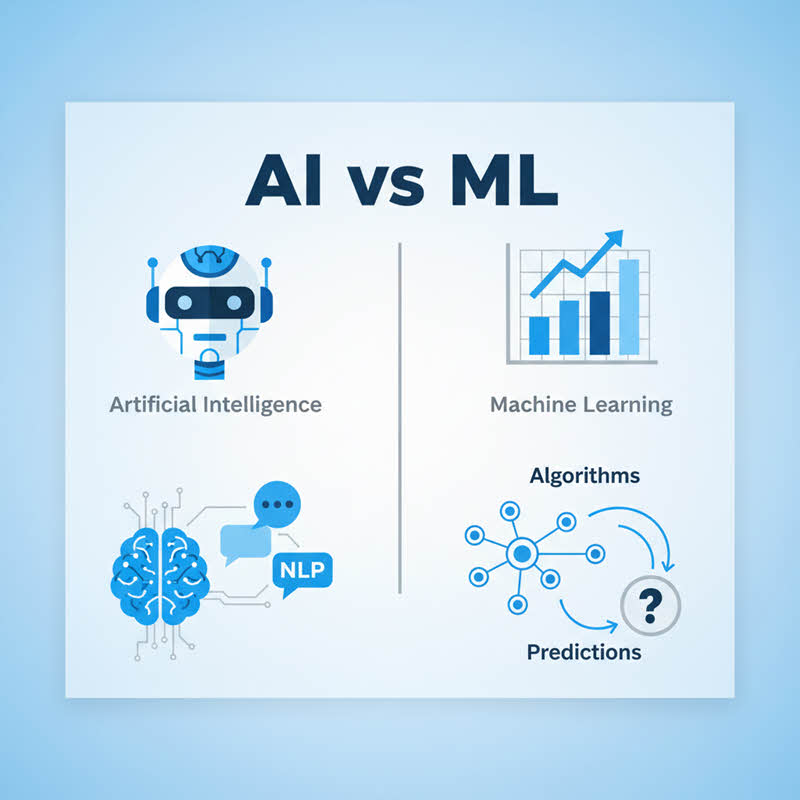
Artificial Intelligence is the more general, overarching field. It is the science of making machines or systems that perform tasks that typically require human intelligence. These tasks include learning, reasoning, problem-solving, perception, and even language understanding. Consider AI the end-goal—building intelligent agents that operate independently and make decisions.
Machine Learning is a specific and very useful subset of AI. It is a means of creating artificial intelligence. Instead of being programmed a certain way with certain rules for every situation, ML systems are built to learn from data. The more data, the more they improve, over time. This learning capacity is the game changer. It enables machines to determine patterns, predictions, and learn from new data without continually having to be told what to do by humans.
The analogy that can help clarify what we mean by AI/ML is simply this: AI is the umbrella, and ML is a very substantial, high tech tool under the umbrella. You can have AI, and not be able to do ML (e.g. rule-based expert systems), but you can't have ML without it being an offshoot of AI. For anyone entering a career in this area, understanding this relationship is your first, best step. It is a foundational point made in any respectable artificial intelligence course.
Applications and Use Cases of Artificial Intelligence
There is a wide variety of AI use cases and capabilities that are not limited to predictive modeling. Ultimately, it is about creating a smart solution to help address some of the biggest challenges across the globe. Below we highlight some of the most frequently noted use cases and those being used in real life now.
1. Natural Language Processing (NLP)
NLP is the branch of AI that enables computers to understand, interpret, and generate human language.
- Use Case: Virtual Assistants and Chatbots. Virtual assistants like Siri, Google Assistant, and Amazon Alexa use natural language processing (NLP) to "hear" our command, understand the intent of the user and respond with the appropriate response. Similarly, chatbots on websites utilize NLP to answer customer support cases, process orders, and provide information in spoken form.
- Use Case: Machine Translation. Programs like Google Translate use AI to process the inputs of one language to interpret the syntax and context translating this into an accurate target language.
2. Computer Vision
This area of AI demonstrates the ability for machines to "see" and understand visual inputs from images or video. It is an essential part of a large variety of technologies in use today.
- Use Case: Autonomous vehicles. Self-driving cars or trucks are heavily dependent on computer vision. The system is using real-time video data from cameras to understand the "world" around it; for example, identifying pedestrians, traffic signs, other cars, lane markings all in order to make driving decisions.
- Use Case: Medical imaging analysis. AI systems are learning to analyze medical images like x-rays, MRIs, and CT scans and find subtle patterns that likely indicate something such as cancer, often faster, and better, than a human radiologist.
3. Robotics
AI in robotics is about fashioning robots that can remark their atmosphere, learn from it, and make verdicts to perform tasks.
- Use Case: Manufacturing and Logistics. Occasionally, robots powered by artificial intelligence will do repetitive and precise tasks in factories with tasks such as welding and assembly and even quality control. In logistics, robots operate autonomously in warehouses to refine and transport packages, improving efficiency.
- Use Case: Surgical Robots. In health care, robotic systems relying on AI can help surgeons by offering a steady hand, increased precision, and perform minimally invasive procedures.
Applications and Use Cases of Machine Learning
While AI is the brain, Machine Learning is the learning engine. Machine Learning applications focus on analyzing data, recognizing patterns and making predictions. This is where a good Machine Learning Course is worth its weight in gold, because it's all about building and training models.
1. Predictive Analytics
This is one of the most mutual and powerful submissions of ML. It involves using numerical algorithms to analyze historical data and forecast future outcomes.
- Use Case: Fraud Detection. Financial entities utilize ML to monitor every transaction in real-time. The models use large data sets from the past when fraudulent activity occurred to find unusual patterns such as a purchase that was unusually large for one individual purchasing or a transaction that occurred in a new area, and flagged as suspected fraud.
- Use Case: Credit Risk Assessment. Banks and lending companies use ML to check the creditworthiness of an applicant for a loan. The algorithm takes into account a person's financial history of payment and request for loans which were used to ascertain and determine the likelihood of default which aids in deciding the extent to which they play an influential role in a lending decision that is fair lending decisions.
2. Recommendation Engines
These organizations use ML to analyze user behaviour and predilections to suggest products, contented, or services they might like.
- Use Case: E-commerce. When you shop on Amazon and see "Customers who bought this item also bought..." information it is an output of a ML recommendation engine. The recommendation engine looks at all the items you have purchased in the past and what you browsed when you shopped and provides recommendations on related or relevant items, which increases their sales tremendously.
- Use Case: Entertainment. Similarly, streaming sites like Netflix and Spotify utilize complex ML algorithms to suggest movies or shows or music that are based on everything you have viewed or listened to, in addition to similar viewer’s preferences. The recommendations make your experience more personalized and are critical to the user's ability to stay engaged and return to the site.
3. Spam Filters and Cybersecurity
ML algorithms are repetitively at work in arrears the scenes to protect us from uninvited content and malicious attacks.
- Use Case: Email Spam Filtering. An excellent example of a supervised ML model is your email service's spam filter. It is trained, using labelled emails indicating spam or not spam (as millions of spam emails are) to learn how to discern junk mail. It is trained to automatically recognize the qualities of spam, such as specific keywords, sender domain(s), and types of attachments to recognize junk mail, and it moves them to a junk mail folder.
- Use Case: Network Security. ML models are also being used to identify anomalies in network traffic for the possibility of a cyber-attack. They learn "normal" behaviour of the network and become aware and can identify relatively quickly, when something abnormal is occurring simply when a large number of login attempts are not normal, or data access is not normal.
The Symbiosis: When AI and ML Work Together
It is important to understand that, in many cases, AI and ML do not exist in privacy; they work collaboratively. A smart home assistant is an excellent example. It has one general goal an intelligent assistant that will respond to your questions, control devices, and manage your schedule which is a defined Artificial Intelligence task. The underlying engine that allows it to recognize your voice and learn your likes/dislikes is Machine Learning.
Similarly, a self-driving car is an artificial intelligence system. The system relies on multiple ML models to accomplish its various tasks, using a computer vision model to recognize objects that are present, a predictive model that forecasts other driver's actions, and a reinforcement learning model to train itself to be a better driver. The Artificial Intelligence Course that you may take will look at the broad strokes of the overall system, and a Machine Learning Course will teach you how to build and tune the individual components.
Final Thoughts: Choosing Your Path
The difference between AI and ML is more than just a difference in terminology; it represents a distinction in the different levels of complexity in the technology and degree of specialization in terms of careers. Having taken an Artificial Intelligence Course will give you a broad overview of the principles of intelligent systems, while training in a Machine Learning Course will gain you the practical ability, technical skill, and hands-on experience required to build the data-driven models for many of today’s most innovative applications.
There is an increasing demand and need for workers, candidates, professionals, etc., to find and develop talented individuals for roles where both AI and ML are required. Whether intentional or not, fittingly the push towards developing capabilities related to Artificial intelligence and Machine Learning (ML) is turning into an equivalent cultural and technological challenge. You may want to design true human-like intelligent autonomous machines and systems, or simply build a better spam filter. But it all starts with a solid education. The future is built on these systems and technologies. The first step towards participation, acceptance, and engagement is understanding the constructive qualities distinctive to Artificial Intelligence (AI) and Machine Learning (ML).
 Explore more on these topics



















 Guest Blogging: The Definitive Guide

 Top Trending Topics
 Share This
 Link copied!
 Recently Updated News