

CI/CD Quiz — Real Interview Scenarios
Last updated: September 17, 2025 Read in fullscreen view


 Recommended for you
- 23 Dec 2025
 Microsoft Power Automate vs. n8n: What’s the Real Difference? 217/347
 - 15 Feb 2024 What is a Cut-Over in Software Development? 207/1536
- 14 Aug 2024 From Steel to Software: The Reluctant Evolution of Japan's Tech Corporates 203/749
- 02 Nov 2023 Differences between software walkthrough, review, and inspection 179/2329
- 18 Oct 2020 How to use the "Knowns" and "Unknowns" technique to manage assumptions 168/1263
- 19 Oct 2021 Software development life cycles 145/823
- 21 Apr 2026 Vibe Coding vs. Expert Shopify Development: What AI Tools Can (and Can't) Do? 139/164
- 04 Oct 2021 Product Validation: The Key to Developing the Best Product Possible 134/442
- 13 Oct 2021 Outsourcing Software Development: MVP, Proof of Concept (POC) and Prototyping. Which is better? 130/608
- 23 Sep 2021 INFOGRAPHIC: Top 9 Software Outsourcing Mistakes 129/552
- 31 Jul 2025 Top WooCommerce Pre-Order Plugins with Countdown & Discounts 129/226
- 07 Oct 2025 Case Study: Using the “Messaging House” Framework to Build a Digital Transformation Roadmap 127/207
- 18 Aug 2022 What are the consequences of poor requirements with software development projects? 126/394
- 11 Jan 2024 What are the Benefits and Limitations of Augmented Intelligence? 120/606
- 13 Dec 2020 Move fast, fail fast, fail-safe 120/461
- 01 Oct 2020 Fail fast, learn faster with Agile methodology 119/1193
- 22 Dec 2025 The Role of Automotive Software in Building Smarter Vehicles 118/163
- 28 Jul 2022 POC, Prototypes, Pilots and MVP: What Are the Differences? 117/859
- 06 Feb 2021 Why fail fast and learn fast? 116/594
- 12 Oct 2022 14 Common Reasons Software Projects Fail (And How To Avoid Them) 116/681
- 12 Aug 2024 Understanding Google Analytics in Mumbai: A Beginner's Guide 112/219
- 02 May 2022 What Is RAID in Project Management? (With Pros and Cons) 110/963
- 16 Dec 2025 Reducing Cognitive Friction in Software Development: A Guide to Faster, Happier Teams 107/181
- 14 Mar 2024 Why should you opt for software localization from a professional agency? 102/241
- 14 Oct 2021 Advantages and Disadvantages of Time and Material Contract (T&M) 99/997
- 12 Dec 2021 Zero Sum Games Agile vs. Waterfall Project Management Methods 98/512
- 31 Aug 2022 What are the best practices for software contract negotiations? 97/371
- 05 Aug 2024 Revisiting the Mistake That Halted Japan's Software Surge 97/444
- 28 Dec 2021 8 types of pricing models in software development outsourcing 96/530
- 05 Sep 2023 The Cold Start Problem: How to Start and Scale Network Effects 95/293
- 21 Oct 2025 Cloud-Native Development: Why It’s the Future of Enterprise IT 93/182
- 05 Mar 2021 How do you minimize risks when you outsource software development? 93/426
- 17 Feb 2022 Prioritizing Software Requirements with Kano Analysis 90/394
- 19 Oct 2021 Is gold plating good or bad in project management? 88/919
- 08 Oct 2022 KPI - The New Leadership 87/696
- 10 Nov 2022 Poor Code Indicators and How to Improve Your Code? 85/302
- 01 Feb 2024 How long does it take to develop software? 85/295
- 06 Mar 2024 [SemRush] What Are LSI Keywords & Why They Don‘t Matter 85/287
- 10 Dec 2023 Pain points of User Acceptance Testing (UAT) 83/544
- 01 Dec 2023 Laws of Project Management 81/396
- 12 Mar 2024 How do you create FOMO in software prospects? 78/252
- 18 Jul 2021 How To Ramp Up An Offshore Software Development Team Quickly 76/668
- 01 Mar 2023 Bug Prioritization - What are the 5 levels of priority? 75/304
- 19 Apr 2021 7 Most Common Time-Wasters For Software Development 72/617
- 04 Oct 2022 Which ERP implementation strategy is right for your business? 71/432
- 31 Oct 2021 Tips to Fail Fast With Outsourcing 70/461
- 01 May 2024 Warren Buffett’s Golden Rule for Digital Transformation: Avoiding Tech Overload 70/278
- 05 Jan 2024 Easy ASANA tips & tricks for you and your team 63/262
- 28 Oct 2022 Build Operate Transfer (B.O.T) Model in Software Outsourcing 62/472
- 26 Dec 2023 Improving Meeting Effectiveness Through the Six Thinking Hats 54/330
- 06 Nov 2019 How to Access Software Project Size? 49/307
- 25 Jun 2026 Vercel: The "Secret Weapon" for Modern, High-Performance Web Deployment 49/57
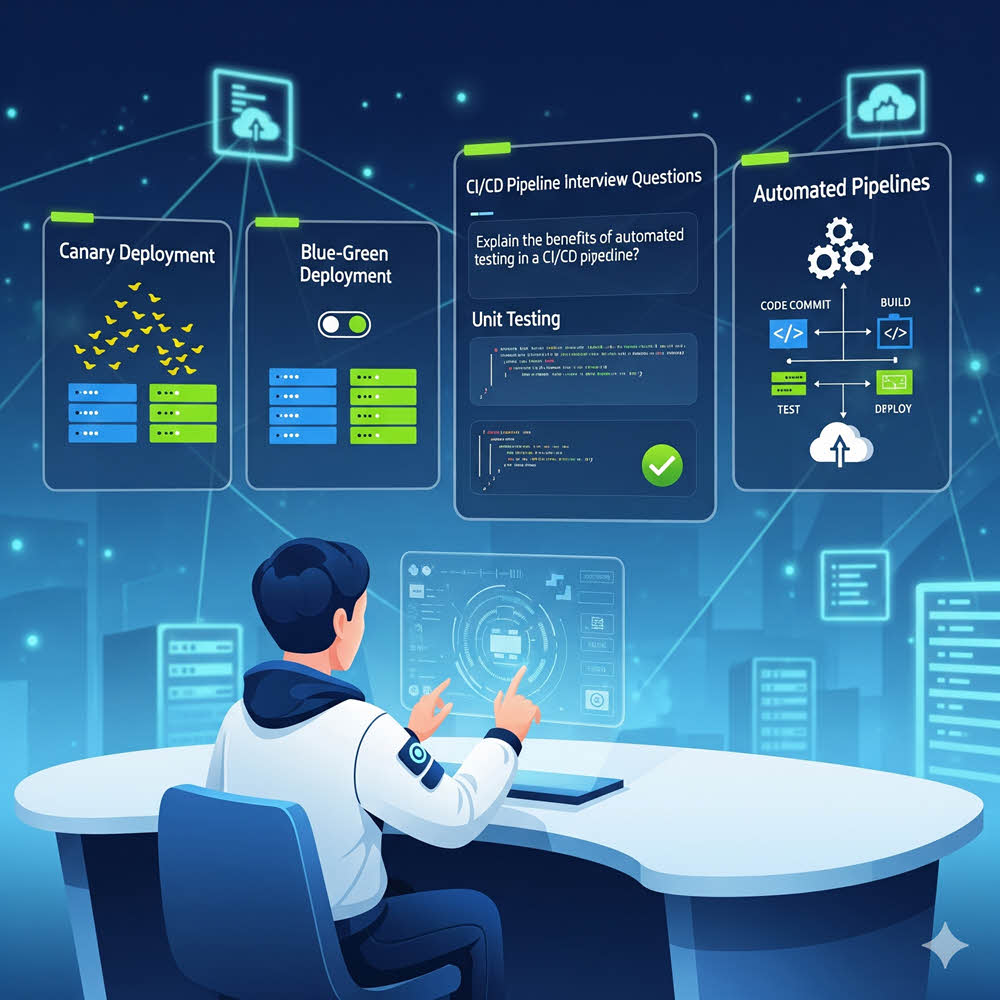
Have you ever spent hours preparing for a DevOps or Software Engineer interview, only to feel unsure when faced with real-world CI/CD scenario questions? In reality, mastering the theory alone isn’t enough. In deep technical interviews, employers don’t just want to know that you understand pipelines, deployments, or testing—they want to assess your ability to apply that knowledge to real situations, make quick decisions, and minimize risks in production.
This article gives you a practical “cheat code”: a CI/CD scenario-based quiz to help you practice, evaluate your problem-solving skills, choose the right deployment strategy (Canary, Blue-Green, Rolling Update), optimize pipelines, and manage secrets securely. These skills not only help you pass interviews but also form a crucial foundation if you aim for a CTO role, where you’ll make strategic technical decisions, design resilient systems, and lead DevOps teams effectively.
Welcome to the CI/CD Knowledge Quiz!
This is not just a regular quiz, but an opportunity for you to:
- Test your understanding of Continuous Integration and Continuous Deployment.
- Review practical deployment strategies such as Canary, Blue-Green, Rolling Update, and Secrets Management.
- Practice for DevOps and Software Engineering interviews.
Answer each question and see the result immediately after selecting your choice.
Are you ready? Let’s get started!
| Term | Explanation |
|---|---|
| CI/CD | Continuous Integration / Continuous Deployment – A software engineering practice that automates code integration, testing, and delivery to production. |
| Pipeline | A sequence of automated steps (build, test, deploy) that moves code from development to production. |
| Build | The process of compiling source code into executable form, including dependencies and configurations. |
| Unit Test | A type of test that validates individual functions or modules to ensure correctness. |
| Integration Test | Tests that validate how different modules or services work together. |
| Deployment | The act of delivering an application or update to a specific environment (staging, production, etc.). |
| Rollback | The process of reverting to a previous stable version when deployment fails. |
| Canary Deployment | Gradual release of a new version to a small subset of users to minimize risks before full rollout. |
| Blue-Green Deployment | A release strategy using two environments: one active (Blue) and one idle (Green). Traffic switches instantly to the new version. |
| Staging Environment | A pre-production environment that mirrors production for final testing before release. |
| Production Environment | The live environment where end-users interact with the application. |
| Automation | The practice of using scripts and tools to eliminate manual steps in CI/CD pipelines. |
| Version Control (Git) | A system for tracking changes in source code and enabling collaboration (e.g., Git, GitHub, GitLab). |
| Artifact | A built output of the CI/CD pipeline (e.g., .jar, .exe, Docker image) ready for deployment. |
| Docker | A platform for packaging applications into lightweight, portable containers. |
| Kubernetes (K8s) | An orchestration platform that manages containerized applications at scale. |
| Monitoring | Tools and practices for observing system health, performance, and errors after deployment. |
| Logging | Capturing and storing system/application logs to diagnose issues. |
| SLA (Service Level Agreement) | A formal commitment that defines expected service performance, availability, and reliability. |
| Downtime | The period when a system or service is unavailable to users. |
 Explore more on these topics
















 Guest Blogging: The Definitive Guide
 Top Trending Topics
 Share This
 Link copied!
 Recently Updated News