




Why AI Is Critical for Accelerating Drug Discovery in Pharma
Last updated: April 24, 2026 Read in fullscreen view


 Recommended for you
- 06 Mar 2026
 Next-Generation AI Agents Explained: OpenClaw, NanoClaw, IronClaw and the Rise of Agent Architectures 352/392
 - 29 Oct 2024 Top AI Tools and Frameworks You’ll Master in an Artificial Intelligence Course 185/590
- 02 Dec 2025 The Question That Shook Asia: What Happens When We Ask AI to Choose Between a Mother and a Wife? 165/201
- 23 Dec 2024 Garbage In, Megabytes Out (GIMO): How to Rise Above AI Slop and Create Real Signal 164/218
- 05 Jun 2025 How AI-Driven Computer Vision Is Changing the Face of Retail Analytics 164/287
- 09 Jul 2024 What Is Artificial Intelligence and How Is It Used Today? 164/418
- 16 Oct 2025 AI Inference Explained Simply: What Developers Really Need to Know 162/196
- 06 Nov 2025 Top 10 AI Development Companies in the USA to Watch in 2026 153/229
- 06 Dec 2025 Enterprise Operations 2.0: Why AI Agents Are Replacing Traditional Automation 147/191
- 24 Mar 2026 AI for Financial Reconciliation: Automating Finance Operations in 2026 146/176
- 25 Nov 2025 How AI Agents Are Redefining Enterprise Automation and Decision-Making 132/190
- 15 Apr 2024 Weights & Biases: The AI Developer Platform 118/309
- 25 Dec 2025 What Is Algorithmic Fairness? Who Determines the Value of Content: Humans or Algorithms? 117/160
- 01 Jul 2025 The Hidden Costs of Not Adopting AI Agents: Risk of Falling Behind 113/262
- 17 Oct 2025 MLOps vs AIOps: What’s the Difference and Why It Matters 104/215
- 27 Aug 2025 How AI Consulting Is Driving Smarter Diagnostics and Hospital Operations 102/202
- 10 Nov 2025 Multi-Modal AI Agents: Merging Voice, Text, and Vision for Better CX 101/215
- 12 Jan 2026 Companies Developing Custom AI Models for Brand Creative: Market Landscape and Use Cases 100/132
- 21 Nov 2025 The Rise of AgentOps: How Enterprises Are Managing and Scaling AI Agents 99/154
- 21 Aug 2024 What is Singularity and Its Impact on Businesses? 95/556
- 24 Dec 2024 Artificial Intelligence and Cybersecurity: Building Trust in EFL Tutoring 95/265
- 06 May 2025 How Machine Learning Is Transforming Data Analytics Workflows 92/289
- 07 Nov 2025 Online vs. Offline Machine Learning Courses in South Africa: Which One Should You Pick? 92/163
- 01 Mar 2024 (AI) Artificial Intelligence Terms Every Beginner Should Know 85/419
- 28 Nov 2025 How AI Will Transform Vendor Onboarding and Seller Management in 2026 84/214
- 17 Jun 2021 What is IT-business alignment? 79/451
- 04 Oct 2023 The Future of Work: Harnessing AI Solutions for Business Growth 78/359
- 24 Oct 2025 AI Agents in SaaS Platforms: Automating User Support and Onboarding 76/147
- 21 Apr 2025 Agent AI in Multimodal Interaction: Transforming Human-Computer Engagement 71/266
- 03 May 2024 The Iceberg of Ignorance 69/497
- 27 May 2026 Best 5 Software Development Companies Ideal for Early-Stage Startups 67/93
- 05 Oct 2021 Shiny Object Syndrome: Why Your Business Isn't "Going Digital" 63/444
- 05 Aug 2024 Affordable Tech: How Chatbots Enhance Value in Healthcare Software 62/292
- 29 Aug 2025 How AI Is Transforming Modern Management Science 59/126
- 08 Jan 2024 Ask Experts: Explicitation/Implicitation and Elicitation; two commonly used but barely unraveled concepts 55/436
- 01 May 2023 Understanding Business as Usual (BAU) and How to Transition 52/1174
Why AI Is Critical for Accelerating Drug Discovery in Pharma
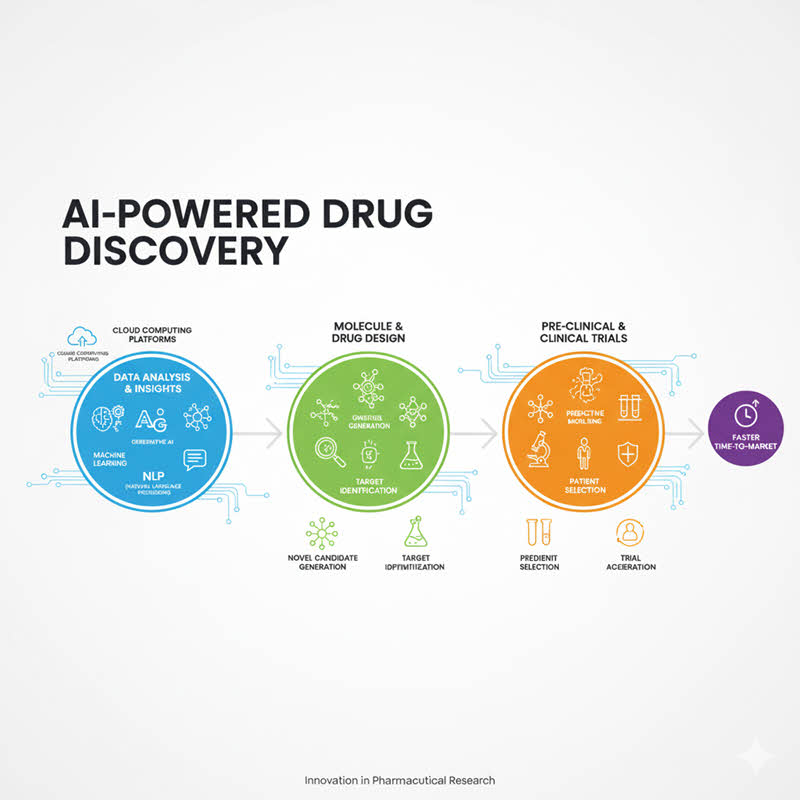
The drug discovery process, for more than a decade, has been revolutionary yet quite time-consuming for the pharmaceutical leaders and biomedical experts. With ample studies in its development & clinical trials, it has taken an average of 10–15 years for a single drug to be approved by bodies such as EMA, FDA, and CDSCO. Even then, the success rate in this lengthy process has been considerably low.
This being said, bringing a medication to market takes a huge toll on a pharma company’s time, money, and clinical expertise. To modernize this process, many new technologies have been introduced. Among them, generative AI drug discovery methods help achieve faster medicine discovery. So, what once took years of research can now be achieved in a shorter span of time.
For pharma leaders, this implies a significant reduction in their R&D investments, better success rates in trials, and quicker market launch. What’s more, personalized medicine has also refined clinical trial designs that have given better results. Hence, leaders consider AI as a leading innovator that is changing the landscape of the industry.
This article explores AI’s role in drug discovery, the technologies that are in use, and the benefits for pharma companies, while figuring out what lies ahead in this sector.
How AI Transforms Drug Discovery
In real-world practice, biotech leaders are confidently positioning artificial intelligence as a technological lead in modern clinical testing and processes.
Keeping that in mind, let’s explore closely how this technology is reshaping the landscape of drug discovery processes in the pharma sector.
1. Data-Driven Target Identification
- ML algorithms can analyze a huge volume of genomic and biological data, assisting biomedical experts in the identification of molecules that can interact with disease-related proteins.
- These potential drug targets also help in predicting the medication’s responsiveness among the patients.
2. Drug Candidate Screening
- Through AI-powered virtual screening of genomic data, pharma companies can get a quicker analysis of drug candidates.
- This process is speedy and improves the accuracy of selecting the right candidates who will most likely adapt to the drug. Therefore, it reduces the company's investment in clinical trials.
3. Acceleration in Drug Design
- Generative AI drug discovery processes adopted by leading biomedical firms help in lead optimization (fine-tuning molecule properties) and the creation of new molecules.
- These help in instilling innovation in medical developments by addressing the creation of a cure for rare diseases, while reducing the cost and time of pharma companies in doing so.
4. Predictive Modeling for Clinical Trials
- In addition to the previous remarkable development, AI models help in predicting the following molecular properties:
- Pharmacodynamics (how a drug reacts in a patient) and
- Pharmacokinetics (how a drug moves through the body)
- This scientifically helps in predicting trial’s progress reports, which assists companies in achieving clinical trial success in a shorter span of time.
Key AI Technologies in Pharma
Reinforcing the role of AI in accelerating drug discovery, let’s gather a better understanding of the key technologies that are contributing to this process.
| Technologies | Description |
|---|---|
| Machine Learning |
|
| Deep Learning |
|
| Generative AI |
|
| Natural Language Processing |
|
| Cloud Computing |
|
Focusing on leveraging these technologies, many pharma companies have considered hiring an expert generative AI development company. You might wonder why biotech leaders would consider this a worthy investment. This is so because they can help you train AI models for your company’s specific disease-related study and research. Moreover, these professionals can streamline your R&D workflows, helping to optimally utilize your resources.
Moving forward, the next section discusses the business impact associated with utilizing modern technologies in the clinical processes.
Conclusion
Artificial Intelligence technologies are always learning and adapting. What’s more, technologies like TrialGPT can scan medical candidate summaries to match clinical trial eligibility, thereby optimizing the study’s success rates. In pharma, the scope of personalized medicine is expansive, too.
As leaders realize AI’s potential, much more than just speedier drug discovery processes can be achieved through adopting custom AI tools. Consulting with an expert generative AI development company can assist your medical research teams to create more such innovation-led developments, boosting your ROI. Hence, AI’s potential can be enhanced significantly by this master move, thereby adding value to your services comprehensively.
 Explore more on these topics

























 Guest Blogging: The Definitive Guide

 Top Trending Topics
 Share This
 Link copied!
 Recently Updated News