

Data Mesh vs. Data Fabric: Which Governance Model Fits a Hybrid Enterprise?
Last updated: September 26, 2025 Read in fullscreen view


 Recommended for you
- 23 Dec 2025
 Microsoft Power Automate vs. n8n: What’s the Real Difference? 208/333
 - 17 Jul 2023 What Is SSL? A Simple Explanation Even a 10-Year-Old Can Understand 186/281
- 17 Oct 2022 What is the difference between low-end, mid-end and high-end solutions of project management software? 183/1657
- 20 Mar 2022 What is a Multi-Model Database? Pros and Cons? 169/1393
- 20 Jan 2022 Difference between Bug, Defect, Error, Fault & Failure 159/1518
- 18 Mar 2022 Difference between Project Management and Management Consulting 157/517
- 30 Oct 2022 How Much Does MVP Development Cost in 2023? 154/413
- 03 Aug 2022 What Are OLAs? SLAs vs OLAs vs UCs: What’s The Difference? 149/1239
- 09 Jan 2022 How to Bridge the Gap Between Business and IT? 148/351
- 07 Dec 2021 What's the difference between soft freeze, hard freeze and customization freeze? 134/1403
- 01 Sep 2022 Facts Chart: Why Do Software Projects Fail? 128/721
- 31 Jul 2025 Top WooCommerce Pre-Order Plugins with Countdown & Discounts 125/222
- 05 Jul 2020 What is Sustaining Software Engineering? 124/1469
- 03 Jul 2022 What is the difference between Project Proposal and Software Requirements Specification (SRS) in software engineering? 124/1165
- 13 Nov 2021 What Is Bleeding Edge Technology? Are bleeding edge technologies cheaper? 123/691
- 21 Jun 2022 Difference between Quality and Grade 121/951
- 10 Apr 2022 Difference Between Forward and Backward Reasoning in AI 121/1856
- 02 Jan 2024 What is User Provisioning & Deprovisioning? 120/712
- 15 Aug 2024 Digital Governance vs IT Governance: What’s the Difference and Why It Matters 118/194
- 22 Dec 2025 The Role of Automotive Software in Building Smarter Vehicles 116/158
- 15 Sep 2022 CRM vs CDP: What's the difference? 112/413
- 10 Apr 2021 RFP vs POC: Why the proof of concept is replacing the request for proposal 111/438
- 15 Aug 2023 Production-Ready vs Feature-Complete: What’s the Difference? 111/363
- 02 May 2022 Difference between CapEx vs. OpEx: Two Ways to Finance Your Software Project 110/1734
- 16 Dec 2025 Reducing Cognitive Friction in Software Development: A Guide to Faster, Happier Teams 104/177
- 22 Sep 2022 Why is it important to have a “single point of contact (SPoC)” on an IT project? 103/1095
- 07 Jul 2021 The 5 Levels of IT Help Desk Support 102/578
- 05 May 2022 DAM vs. CMS: What's the difference? 102/598
- 06 Jun 2024 Software Upgrade vs Software Update: What is the difference? 100/356
- 02 Nov 2021 Difference between an ESTIMATE and a QUOTE 99/454
- 09 Dec 2021 Customer Service vs Technical Support: What’s The Difference? 99/420
- 18 Oct 2024 IT Governance, IT Management and IT Outsourcing: What’s the Difference? 98/153
- 03 Dec 2025 IT Outsourcing Solutions Explained: What, How, Why, When 97/129
- 08 Aug 2022 Difference between Power BI and Datazen 97/429
- 08 Nov 2022 4 tips for meeting tough deadlines when outsourcing projects to software vendor 97/387
- 10 Apr 2022 What is predictive analytics? Why it matters? 96/277
- 30 Jan 2022 What Does a Sustaining Engineer Do? 96/731
- 16 Feb 2021 Choose Outsourcing for Your Non Disclosure Agreement (NDA) 95/265
- 28 Jul 2025 Data Modernization for SMBs: Small Steps, Big Impact 93/244
- 31 Dec 2021 What is a Data Pipeline? 92/297
- 25 Jan 2022 What is the difference between Outsourcing and Outstaffing? 92/458
- 10 Nov 2021 PoC vs. Prototype vs. MVP: What’s the difference? 88/924
- 07 Aug 2022 Things to Consider When Choosing a Technology Partner 88/371
- 25 Apr 2021 What is outstaffing? 88/358
- 24 Nov 2021 What is the difference between off-the-shelf software and customized software? 86/567
- 01 Mar 2024 (AI) Artificial Intelligence Terms Every Beginner Should Know 85/419
- 09 Feb 2023 The Challenge of Fixed-Bid Software Projects 83/332
- 01 Mar 2023 What is Unit Testing? Pros and cons of Unit Testing? 77/503
- 01 Apr 2022 Dedicated Team vs. Extended Team: What’s the difference? 74/400
- 03 Nov 2022 Top questions and answers you must know before ask for software outsourcing 73/358
- 04 Apr 2025 To Act or Not to Act – A Manager’s Persistent Dilemma 73/189
- 01 Feb 2022 Outstaffing Vs. Outsourcing: What’s The Difference? 70/658
- 16 Apr 2021 Insightful Business Technology Consulting at TIGO 69/523
- 10 Jul 2025 Building AI-Driven Knowledge Graphs from Unstructured Data 68/230
- 20 Nov 2022 Software Requirements Are A Communication Problem 63/305
- 06 Mar 2021 4 things you need to do before getting an accurate quote for your software development 61/758
- 01 May 2023 CTO Interview Questions 60/395
- 15 Aug 2025 Quantum Technology: Global Challenges and Opportunities for Innovators 60/191
- 07 Oct 2022 Digital Transformation: Become a Technology Powerhouse 59/306
- 08 Jan 2024 Ask Experts: Explicitation/Implicitation and Elicitation; two commonly used but barely unraveled concepts 53/434
- 09 Mar 2022 Consultant Implementation Pricing 49/261
- 01 Mar 2023 How do you deal with disputes and conflicts that may arise during a software consulting project? 47/207
- 25 Jun 2026 Vercel: The "Secret Weapon" for Modern, High-Performance Web Deployment 45/50
- 17 Mar 2025 IT Consultants in Digital Transformation 41/131
| About the Author | Anand Subramanian | Technology expert and AI enthusiast |
Anand Subramanian is a technology expert and AI enthusiast currently leading the marketing function at Intellectyx, a Data, Digital, and AI solutions provider with over a decade of experience working with enterprises and government departments. |
In boardrooms across industries, data is no longer a back-office function. It has become a competitive asset that drives strategy, customer engagement, product development, and innovation. Yet enterprises face a persistent challenge: while cloud adoption accelerates, legacy systems remain deeply embedded. Hybrid enterprises, operating across both cloud and on-premises environments, are forced to rethink how they manage and govern their data. Two governance models dominate the conversation today: Data Mesh and Data Fabric.
Both approaches promise to address complexity, improve access, and maximize the value of enterprise data. But they do so in fundamentally different ways. Deciding which model fits your organization is not simply a matter of preference, it is a question of strategy, maturity, and business outcomes.
This article explores the nuances of each approach, the real-world trade-offs, and how hybrid enterprises can determine the right fit.
The Hybrid Enterprise Reality
For many organizations, “going cloud” is not as simple as it sounds. A global bank might run modern analytics workloads in the cloud while keeping customer transaction records on mainframes for compliance. A manufacturing company may rely on IoT sensor data from the edge, stored in a cloud platform, but still operate critical ERP systems on-premises.
This hybrid reality is not temporary, it is the new normal. Gartner estimates that by 2026, over 80 percent of enterprises will continue to operate hybrid infrastructures. That means governance models must account for distributed data sources, fragmented ownership, and varying compliance requirements.
What Is Data Mesh?
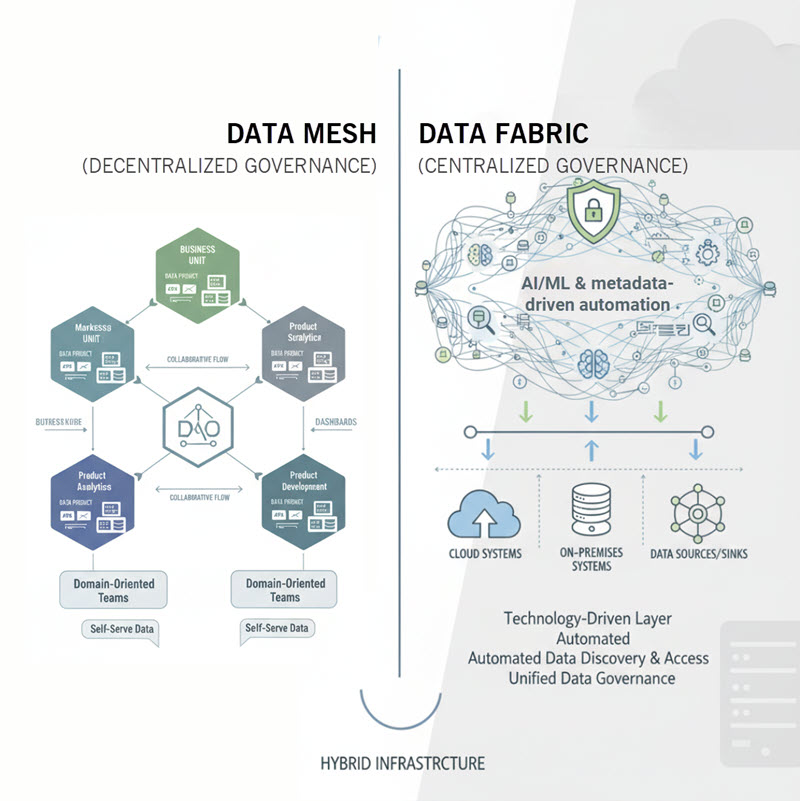
Data Mesh is a decentralized governance model that treats data as a product. Instead of centralizing ownership under IT or a data team, it distributes accountability to domain experts across the organization.
The philosophy is simple: those who understand the data best should be responsible for its quality, availability, and usability. In a Data Mesh, each domain team (such as sales, marketing, supply chain, or finance) owns and serves data as a product, complete with documentation, APIs, and service-level agreements.
Key Pillars of Data Mesh:
- Domain Ownership – Business units own their data products.
- Self-Serve Infrastructure – A central platform team provides tools for teams to manage and publish data.
- Federated Governance – Governance policies exist but are enforced in a distributed way.
- Data as a Product – Data is treated like a product with quality standards and discoverability.
This approach aims to overcome the bottlenecks of centralized data teams, which often struggle to keep up with demand from multiple business units.
What Is Data Fabric?
Data Fabric, on the other hand, is a more technology-driven architecture. It leverages AI (Artificial Intelligence), metadata, and automation to weave together a unified layer across disparate data systems. Think of it as a connective tissue that enables consistent access, governance, and integration across cloud and on-premises systems.
Where Data Mesh emphasizes organizational change and domain accountability, Data Fabric focuses on creating a smart data layer that automates data discovery, integration, and governance.
Key Capabilities of Data Fabric:
- Metadata-Driven Integration – Uses metadata to automate data discovery and lineage.
- Unified Data Access – Provides consistent access regardless of where data resides.
- AI and Automation – Automates data preparation, cataloging, and governance.
- End-to-End Governance – Centralized governance policies are applied uniformly across environments.
Data Fabric is less about changing organizational structures and more about embedding intelligence into the data stack.
Comparing the Two Approaches
While both models seek to address complexity, their starting points are very different.
| Aspect | Data Mesh | Data Fabric |
|---|---|---|
| Focus | Organizational and cultural change | Technology-driven automation |
| Governance | Federated, domain-owned | Centralized, metadata-driven |
| Ownership | Distributed across domains | Central IT or platform governance |
| Strengths | Empowers business teams, scales with demand | Automates integration, ensures consistency |
| Challenges | Requires cultural shift, risk of inconsistency | Heavy reliance on advanced tools, higher upfront investment |
Where Data Mesh Excels
Data Mesh is most effective in enterprises that are:
- Domain-rich – Organizations with multiple business units generating unique data.
- Innovation-focused – Companies that need to move fast and allow teams to experiment.
- Struggling with bottlenecks – When centralized IT cannot keep pace with data requests.
For example, a large retail chain with different product categories may benefit from Data Mesh. Each category team can manage its own sales, customer, and inventory data products, freeing the central team from being a gatekeeper.
Where Data Fabric Excels
Data Fabric is most effective in enterprises that are:
- Highly regulated – Industries like healthcare or banking, where governance and compliance must be airtight.
- Technology-driven – Organizations already investing heavily in AI, metadata management, and automation.
- Hybrid-heavy – Companies with complex architectures that span multiple clouds and on-premises environments.
For instance, a pharmaceutical company managing research data across global sites can leverage Data Fabric to ensure unified governance, while scientists access data seamlessly without worrying about where it resides.
The Governance Question in Hybrid Enterprises
Hybrid enterprises face the dual challenge of distribution and control. On one side, they want to empower business units to act on data. On the other, they need consistent policies for security, compliance, and trust.
This is where the governance trade-offs between Data Mesh and Data Fabric become critical.
- Data Mesh Governance: Strong on accountability but risks fragmentation if standards are not enforced. It requires a well-defined federated governance council.
- Data Fabric Governance: Strong on consistency but can feel restrictive if business units lack autonomy. It requires sophisticated metadata management tools and automation.
Case Study Scenarios
Scenario 1: A Global Logistics Firm
The firm operates in 40 countries, with regional teams managing their own data for shipments, customs, and warehouses. They need flexibility at the regional level but also global visibility.
Fit: Data Mesh, supported by a light Data Fabric layer for global reporting.
Scenario 2: A Multinational Bank
The bank must comply with regulations across multiple jurisdictions. Data must be consistently governed with strict lineage and audit trails.
Fit: Data Fabric, as it ensures uniform governance while supporting hybrid systems.
Scenario 3: A Healthcare Startup
The company is scaling quickly and needs both agility in developing new products and assurance that patient data is secure.
Fit: A hybrid model Data Mesh for innovation teams and Data Fabric for compliance-sensitive operations.
Moving Beyond “Either-Or”
Enterprises should resist the urge to view Data Mesh and Data Fabric as mutually exclusive. In practice, many hybrid organizations adopt elements of both.
- Mesh-Fabric Convergence: Use Data Fabric’s intelligent layer for automated governance and metadata management, while enabling domain teams to own and deliver data products through a Data Mesh approach.
- Balanced Governance: Establish a federated governance council that defines policies, and use Data Fabric tools to enforce them automatically.
- Phased Adoption: Start with a Data Fabric foundation to ensure compliance, then layer Data Mesh practices to empower domain teams.
How to Decide for Your Enterprise
When evaluating which model fits, hybrid enterprises should consider three key questions:
- Where is governance breaking down today? If bottlenecks are organizational, Data Mesh may help. If the challenge is technical complexity, Data Fabric may be the answer.
- What is the level of data maturity? Enterprises with a strong data culture can embrace Mesh faster. Those still building maturity may benefit from Fabric’s automation.
- What are the regulatory and compliance demands? Highly regulated industries will lean toward Fabric, while innovation-driven industries may find Mesh more suitable.
Taking Action
Hybrid enterprises cannot afford to delay governance decisions. The cost of poor governance is staggering. According to Gartner, poor data quality costs organizations an average of $12.9 million annually. The choice between Data Mesh and Data Fabric is not just a technology debate, it is a financial one.
Here are actionable steps to take:
- Run a Governance Assessment: Identify bottlenecks, compliance gaps, and ownership issues.
- Pilot Both Approaches: Start with a limited domain using Mesh principles and a Fabric pilot for integration.
- Establish a Governance Council: Define policies that can work across both models.
- Invest in Metadata Management: Regardless of model, metadata is the backbone of governance.
- Measure ROI: Track improvements in data accessibility, compliance, and business outcomes.
Final Thoughts
Data Mesh and Data Fabric represent two distinct but complementary visions for data governance in hybrid enterprises. One empowers business domains, the other leverages automation and intelligence. The right choice depends on your organization’s maturity, industry, and strategic priorities.
The most forward-thinking enterprises will not choose one over the other. They will craft a governance model that blends the strengths of both, creating a scalable, resilient, and intelligent data ecosystem.
The time to act is now. Hybrid enterprises that delay risk drowning in fragmented systems, compliance failures, and missed opportunities. Begin with an honest assessment of your governance gaps and take the first step toward building a future-ready data strategy.
Anand Subramanian
Technology expert and AI enthusiast
Anand Subramanian is a technology expert and AI enthusiast currently leading the marketing function at Intellectyx, a Data, Digital, and AI solutions provider with over a decade of experience working with enterprises and government departments.
 Explore more on these topics
























 Guest Blogging: The Definitive Guide

 Top Trending Topics
 Share This
 Link copied!
 Recently Updated News