

Does Lean ERP truly make businesses more streamlined, or does it only add more complexity to the process?
Last updated: October 25, 2025 Read in fullscreen view


 Recommended for you
- 05 Oct 2025
 The New Facebook Algorithm: A Paradigm Shift in Content Discovery 294/356
 - 21 Dec 2023 Top 12 Low-Code Platforms To Use in 2024 221/1520
- 23 Dec 2025 Microsoft Power Automate vs. n8n: What’s the Real Difference? 217/347
- 31 Dec 2025 10 Skills to Make You "Irreplaceable" in the Next 3 Years (even if AI changes everything) 169/203
- 25 Mar 2026 Token Bills: The "Cost Shock" After the AI Boom in Companies 167/190
- 03 Oct 2025 Top CMS Trends 2026: The Future of Digital Content Management 166/199
- 20 Dec 2025 The Future of IT Consulting: Key Trends for 2026–2030 163/206
- 26 Mar 2026 What Is a System Integrator (SI)? Why the Software Subscription Model Is Becoming the New Standard 151/185
- 19 Oct 2021 Software development life cycles 145/823
- 18 Dec 2025 EOS as a Business Operating System: Powerful, but Not Always Plug-and-Play 142/195
- 18 Jul 2024 The 8 Best ways to Innovate your SAAS Business Model in 2024 137/392
- 04 Oct 2021 Product Validation: The Key to Developing the Best Product Possible 134/442
- 13 Oct 2021 Outsourcing Software Development: MVP, Proof of Concept (POC) and Prototyping. Which is better? 130/608
- 31 Jul 2025 Top WooCommerce Pre-Order Plugins with Countdown & Discounts 129/226
- 07 Oct 2025 Case Study: Using the “Messaging House” Framework to Build a Digital Transformation Roadmap 127/207
- 21 Jan 2026 Best Manufacturing ERP Software in India 119/155
- 23 May 2022 4 Strategies of Odoo ERP Implementation 119/412
- 22 Dec 2025 The Role of Automotive Software in Building Smarter Vehicles 118/163
- 04 Mar 2026 CRM Trends Shaping Customer Engagement in 2026 117/148
- 28 Jul 2022 POC, Prototypes, Pilots and MVP: What Are the Differences? 117/859
- 12 Oct 2022 14 Common Reasons Software Projects Fail (And How To Avoid Them) 116/681
- 20 Feb 2025 How Machine Learning is Shaping the Future of Digital Advertising 116/238
- 13 Jan 2025 Why Businesses Are Choosing Microsoft Dynamics 365 Business Central Over NetSuite 113/245
- 16 Aug 2022 What is a Headless CMS? 113/399
- 12 Aug 2024 Understanding Google Analytics in Mumbai: A Beginner's Guide 112/219
- 27 Jul 2024 Positive Psychology in the Digital Age: Future Directions and Technologies 110/539
- 16 Dec 2025 Reducing Cognitive Friction in Software Development: A Guide to Faster, Happier Teams 107/181
- 02 Dec 2024 The Intersection of AI and Business Analytics: Key Concepts to Master in Your Business Analytics Course 105/400
- 09 Oct 2024 Are Expensive CRM Systems Really Worth It? 104/199
- 03 Jan 2024 Why Partnership is important for Growth? 102/260
- 16 Sep 2022 Examples Of Augmented Intelligence In Today’s Workplaces Shaping the Business as Usual 99/536
- 12 Dec 2021 Zero Sum Games Agile vs. Waterfall Project Management Methods 98/512
- 11 Oct 2022 Why choose Billable Viable Product (BVP) over Minimum Viable Product (MVP) 98/440
- 31 Aug 2022 What are the best practices for software contract negotiations? 97/371
- 18 Jan 2024 Self-healing code is the future of software development 96/313
- 05 Jun 2023 Bespoke Solution: Annual Maintenance Contract (AMC) Software 96/289
- 05 Sep 2023 The Cold Start Problem: How to Start and Scale Network Effects 95/293
- 20 Aug 2025 What Is Agentic AI? The Next Phase of Artificial Intelligence 95/255
- 25 Sep 2024 Enhancing Decision-Making Skills with an MBA: Data-Driven Approaches for Business Growth 95/302
- 23 Jun 2025 AI Avatars in the Metaverse: How Digital Beings Are Redefining Identity and Social Interaction 94/281
- 15 Jun 2022 ERP Implementation Strategies: Big Bang and Phased rollout 94/607
- 05 Mar 2021 How do you minimize risks when you outsource software development? 93/426
- 04 Apr 2025 To Act or Not to Act – A Manager’s Persistent Dilemma 93/209
- 25 Jan 2025 The Decline of Traditional SaaS and the Rise of AI-first Applications 93/198
- 30 Jul 2024 The Future of IT Consulting: Trends and Opportunities 88/300
- 31 Dec 2023 Software Development Outsourcing Trends to Watch Out for in 2024 86/316
- 22 May 2025 Role of Self-Service in CRM: Customer & Partner Portals for Automation 85/169
- 06 Mar 2024 [SemRush] What Are LSI Keywords & Why They Don‘t Matter 85/287
- 01 Dec 2023 Laws of Project Management 81/396
- 19 Jul 2022 Odoo vs Sage Comparison 81/387
- 22 Nov 2024 The Role of AI in Enhancing Business Efficiency and Decision-Making 81/276
- 03 Nov 2023 Why Is Billable Viable Product An Alternative To Minimum Viable Product? 79/270
- 18 Aug 2024 The Future of Web Development: Emerging Trends and Technologies Every Developer Should Know 79/274
- 31 Dec 2022 The New Normal for Software Development 76/429
- 18 Jul 2021 How To Ramp Up An Offshore Software Development Team Quickly 76/668
- 10 Sep 2024 Leading Remote Teams in Hybrid Work Environments 76/220
- 27 Feb 2025 How AI Agents are Changing Software Development? 74/312
- 19 Dec 2023 How AI is Transforming Software Development? 74/367
- 04 Oct 2022 Which ERP implementation strategy is right for your business? 71/432
- 01 May 2024 Warren Buffett’s Golden Rule for Digital Transformation: Avoiding Tech Overload 70/278
- 09 Oct 2024 Short-Form Video Advertising: The Secret to Captivating Your Audience 69/201
- 02 Oct 2025 Why Digital Transformation Fails: ERP Lessons, Outsourcing Strategies, and Adaptive Development Insights 65/107
- 28 Oct 2022 Build Operate Transfer (B.O.T) Model in Software Outsourcing 62/472
- 02 Jan 2022 ERP Implementation Cost and Duration—A Tale of Two Companies (Part 2) 59/324
- 10 Sep 2024 AI in Email Marketing: Personalization and Automation 58/235
- 05 Feb 2024 Bespoke Solution: Visitor Management System for Corporate 58/322
- 04 Jan 2022 Freedom of ERP Deployment Choice—A Tale of Two Companies (Part 4) 53/273
- 03 Jan 2022 ERP System Scalability—A Tale of Two Companies (Part 3) 52/350
- 25 Jun 2026 Vercel: The "Secret Weapon" for Modern, High-Performance Web Deployment 49/57
- 31 Dec 2022 Future of Software Development Trends and Predictions 48/199
- 01 Jan 2022 Planning for Successful ERP Implementation Projects (Part 1) 45/266
In many developing economies across ASEAN and East Asia, businesses often fall into the illusion that ERP is a “magic tool” or a “hidden gem” that can instantly deliver digital transformation success. In reality, the abundance of new technologies drives many managers into the shiny object syndrome—chasing trends instead of solving core problems. The result: ERP projects become more complex, employees feel burdened with extra work instead of relief, and a range of hidden costs begin to surface, like the unseen part of an iceberg.
What companies truly need is not another software layer, but a strategy of radical focus—eliminating waste, standardizing processes, and addressing bottlenecks at the root. This is the essence of Lean ERP: instead of adding complexity, it streamlines operations, creates intelligence, and drives sustainable value.
Lean ERP is an ERP deployment approach based on Lean principles, focusing on waste elimination, streamlined processes, and real value creation rather than added complexity. Unlike traditional ERP that often leads to shiny object syndrome, Lean ERP enables businesses to achieve sustainable efficiency with optimized cost and resources.
What is Lean ERP?
Lean ERP is not a standalone software but a business philosophy and strategy. It uses Enterprise Resource Planning (ERP) systems as tools to apply Lean principles such as:
- Creating customer value
- Eliminating waste
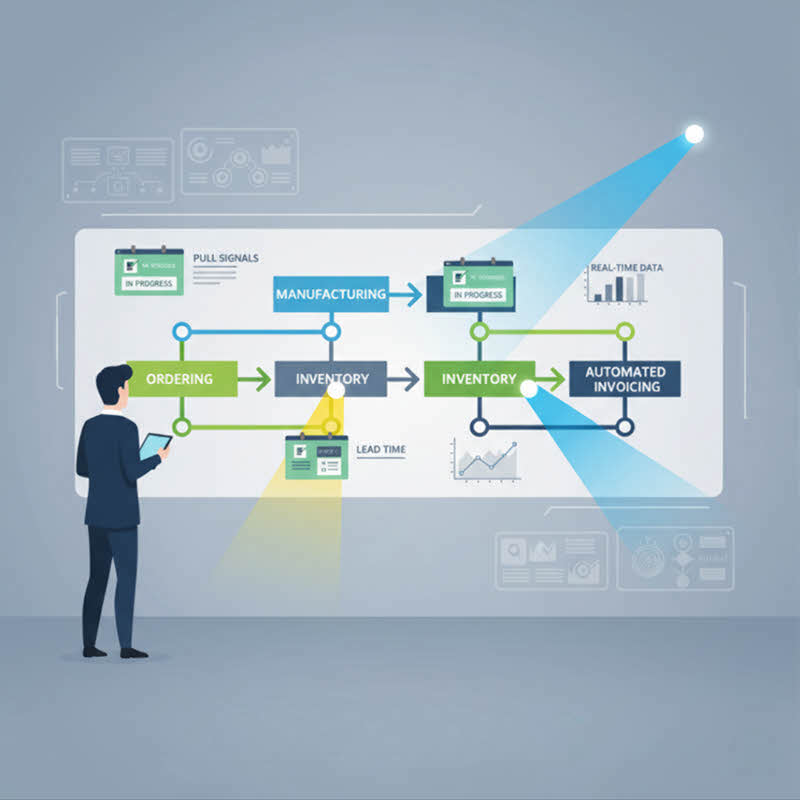
- Pull production (produce based on real demand)
- Continuous improvement
Instead of forcing business processes to follow ERP, Lean ERP fine-tunes ERP configurations to support real-world operations.
Why Should Companies in ASEAN and East Asia Care About Lean ERP? (GEO Optimization)
In ASEAN and East Asian markets, businesses often face:
- High inventory costs due to inaccurate forecasts
- Complex ERP customizations that delay go-live
- Global supply chain disruptions requiring faster response
Lean ERP provides real-time visibility, reduces unnecessary stock, and helps manufacturers and distributors adapt to sudden market shifts — a key advantage in competitive economies across ASEAN and East Asia.
Lean vs. ERP: Why the Historical Clash?
- ERP = forecast-driven (push model)
- Lean = demand-driven (pull model)
This mismatch caused excess inventory and poor responsiveness. But with modern cloud ERP and real-time data, ERP can now support Kanban, JIT, and pull signals.
Top 5 Benefits of Lean ERP
- Inventory Optimization – real-time ERP data supports minimal stock without losing service level.
- Agile Supply Chain – ERP with pull signals enables faster demand response.
- Reduced IT Waste – Lean-driven Value Stream Mapping avoids unnecessary ERP customizations.
- Operational Performance – ERP measures, Lean improves KPIs like OEE, lead time, and first-pass yield.
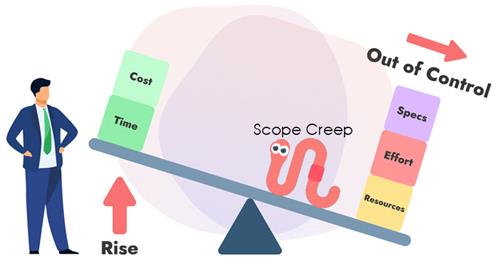
- Higher ERP Success Rate – Lean process standardization reduces scope creep and ensures smoother go-live.
Common Mistakes to Avoid
- Treating ERP as a “magic solution” without process redesign.
- Over-customization to preserve old habits.
- Poor-quality data feeding into ERP (garbage in, garbage out).
How to Implement Lean ERP: Step-by-Step Roadmap
- Value Stream Mapping (VSM) – identify waste and bottlenecks.
- Standard Work – document rules and workflows.
- Fit-to-Standard ERP Configuration – minimize custom code.
- Pull Mechanisms – set Kanban, reorder points, demand-driven MRP.
- Pilot Deployment – test in one plant/line, measure KPIs.
- Capability Building – train IT and operations teams on Lean.
Key KPIs for Lean ERP
- Inventory Turns
- Lead Time (Order-to-Delivery)
- First Pass Yield / Defect Rate
- On-time Delivery (%)
- ERP Change Request Resolution Time
- User Adoption & Data Accuracy
Future Trends Impacting Lean ERP
- Cloud ERP and microservices increase system flexibility.
- AI-augmented planning enhances demand forecasting and pull-based production.
- Real-time analytics enables faster decisions, especially in dynamic markets across ASEAN and East Asia.
FAQs
Q1: What is Lean ERP in simple terms?
Lean ERP means using ERP systems to eliminate waste and run operations based on actual customer demand.
Q2: Can ERP and Lean work together?
Yes. Modern ERP systems can be configured to support Lean practices such as Kanban, Just-In-Time, and demand-driven MRP.
Q3: What industries benefit most from Lean ERP?
Manufacturing, logistics, healthcare, and retail companies in fast-growing economies across ASEAN and East Asia benefit the most.
Conclusion
Lean ERP is not about technology alone — it’s about mindset, culture, and continuous improvement. Companies that redesign processes first, then configure ERP accordingly, will gain faster time-to-value, lower inventory costs, and higher ERP adoption rates.
 Explore more on these topics





















 Guest Blogging: The Definitive Guide

 Top Trending Topics
 Share This
 Link copied!
 Recently Updated News