



Overview of Knowledge Management Models and Their Applications in the Manufacturing Industry
Last updated: November 04, 2025 Read in fullscreen view


 Recommended for you
- 12 Jun 2025
 Rule-Based vs. Data-Driven Decision Making: The Critical Shift in Fintech and AI 219/341
 - 18 Oct 2020 How to use the "Knowns" and "Unknowns" technique to manage assumptions 167/1261
- 06 Nov 2025 DataOps: The Next Frontier in Agile Data Management 139/198
- 23 Sep 2021 INFOGRAPHIC: Top 9 Software Outsourcing Mistakes 125/548
- 18 Aug 2022 What are the consequences of poor requirements with software development projects? 122/390
- 11 Jan 2024 What are the Benefits and Limitations of Augmented Intelligence? 119/605
- 13 Dec 2020 Move fast, fail fast, fail-safe 119/460
- 06 Feb 2021 Why fail fast and learn fast? 116/592
- 01 Oct 2020 Fail fast, learn faster with Agile methodology 115/1189
- 19 Sep 2023 PACER Thinking: Why Smart People Forget What They Read 115/205
- 16 Mar 2023 10 Reasons to Choose a Best-of-Breed Tech Stack 102/316
- 14 Mar 2024 Why should you opt for software localization from a professional agency? 102/241
- 08 Aug 2022 Difference between Power BI and Datazen 100/434
- 14 Oct 2021 Advantages and Disadvantages of Time and Material Contract (T&M) 98/992
- 28 Jul 2025 Data Modernization for SMBs: Small Steps, Big Impact 95/246
- 28 Dec 2021 8 types of pricing models in software development outsourcing 92/526
- 08 Oct 2022 KPI - The New Leadership 87/696
- 01 Mar 2024 (AI) Artificial Intelligence Terms Every Beginner Should Know 85/419
- 24 Aug 2022 7 Ways to Improve Software Maintenance 85/388
- 19 Oct 2021 Is gold plating good or bad in project management? 84/915
- 17 Feb 2022 Prioritizing Software Requirements with Kano Analysis 83/387
- 10 Nov 2022 Poor Code Indicators and How to Improve Your Code? 82/299
- 10 Dec 2023 Pain points of User Acceptance Testing (UAT) 80/541
- 19 Apr 2021 7 Most Common Time-Wasters For Software Development 72/617
- 12 Mar 2024 How do you create FOMO in software prospects? 72/246
- 01 Mar 2023 Bug Prioritization - What are the 5 levels of priority? 71/300
- 31 Oct 2021 Tips to Fail Fast With Outsourcing 68/459
- 05 Jan 2024 Easy ASANA tips & tricks for you and your team 60/258
- 08 Jan 2024 Ask Experts: Explicitation/Implicitation and Elicitation; two commonly used but barely unraveled concepts 55/436
- 26 Dec 2023 Improving Meeting Effectiveness Through the Six Thinking Hats 54/330
- 06 Nov 2019 How to Access Software Project Size? 45/303
- 13 Jul 2026 Why Every AI Initiative Needs Regular Audits 18/23
In today’s volatile market environment, businesses striving for sustainable growth must pursue continuous and radical innovation. To achieve this, organizations need a solid foundation of knowledge—supported by individuals who constantly share, refine, and develop their expertise. Therefore, managing organizational knowledge effectively is a critical factor for success, especially for manufacturing enterprises where product quality, process efficiency, and operational optimization are top priorities (such as in textiles, pharmaceuticals, or footwear).
Knowledge Management (KM) has become a strategic focus for many companies seeking to build competitive advantage and achieve superior results. Take Apple, for example—a global leader in innovation. Behind its market success lies a sophisticated knowledge management system that governs how creative insights and technical know-how are generated, shared, and protected. In technology-driven industries, intellectual capital and creative knowledge are key assets that define long-term success.
While many enterprises now recognize the strategic importance of KM, the challenge lies in designing and implementing systems that fit their unique context. Effective KM requires not only awareness but also tailored frameworks aligned with the organization’s structure and culture.
This article reviews some of the most well-known knowledge management models and discusses how they can be practically applied in real-world manufacturing environments. Business leaders can use these models as references to design effective systems for knowledge creation, storage, and transfer within their organizations.
Prominent Knowledge Management Models
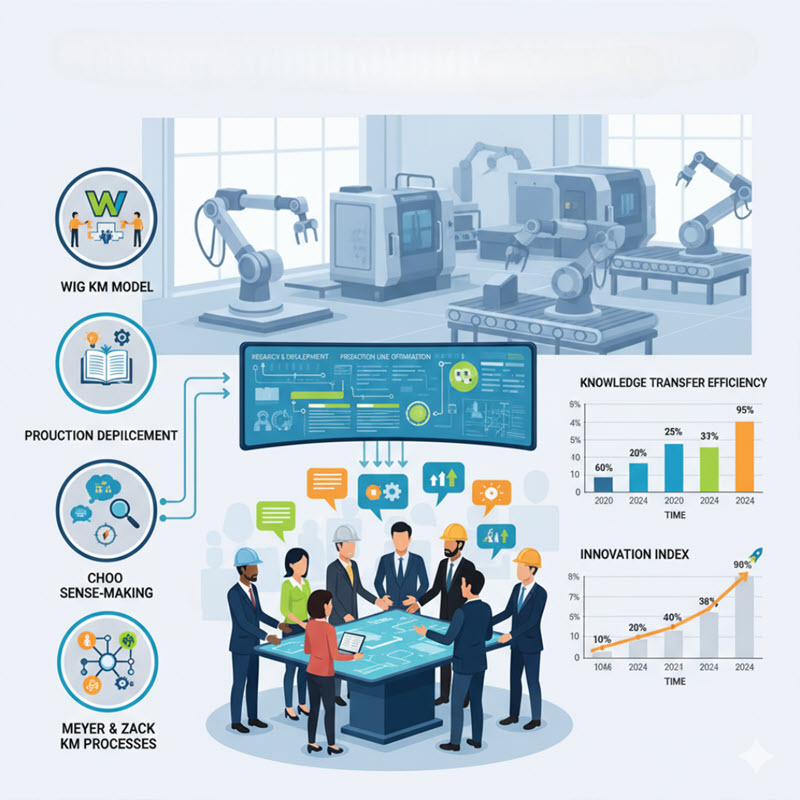
Knowledge management has been studied for decades, resulting in several foundational frameworks—among them Wiig’s Model (1993), Choo’s Model (1998), and Meyer & Zack’s Model (1996). Each provides valuable insights into how organizations can manage, utilize, and expand their knowledge base.
1. Wiig’s Knowledge Management Model (1993)
Wiig’s model describes KM as a cyclical process of building, capturing, compiling, and applying knowledge.
Knowledge Building
The process begins with the creation and accumulation of knowledge. Employees gain knowledge through formal education, personal experience, and on-the-job learning. They also acquire tacit knowledge from peers and mentors, forming the foundation of the organization’s intellectual capital.
Knowledge Capturing
Next, knowledge must be made explicit—documented through manuals, process guides, or training materials. For example, a company might formalize customer proposal workflows or sales scripts into written procedures, ensuring easy access and replication across teams.
Knowledge Compiling and Storing
Captured knowledge is then stored systematically in organizational databases or digital platforms. In the digital age, this step is more efficient than ever—companies use video libraries, internal wikis, and e-learning platforms to organize, secure, and distribute valuable know-how.
Knowledge Application
Finally, knowledge is applied to practical tasks. Employees use organizational know-how to perform effectively and make better decisions. Through ongoing feedback, the system evolves—processes are refined, and knowledge continues to grow through collective experience.
Choo’s Knowledge Management Model (1998)
Choo’s model takes a dynamic perspective, focusing on sense-making, knowledge creation, and decision-making—three interrelated processes that drive organizational learning and adaptation (Neto et al., 2009).
Sense-Making
This stage ensures that organizations can adapt and thrive amid change. By collecting and analyzing data about markets, customers, competitors, and suppliers, businesses form an understanding of external shifts. This awareness triggers new learning, enabling teams to recognize when and how to evolve.
Knowledge Creation
Choo views knowledge creation as the conversion of experience into shared understanding through dialogue and collaboration. Continuous innovation in customer engagement, design, and operations stems from this process. The goal is to turn collective learning into new capabilities, products, and customer value.
Decision-Making
The final stage involves strategic decision-making—selecting the best course of action based on the accumulated knowledge. Decisions are influenced by both the organization’s perception of change (sense-making) and its creative capacity (knowledge creation). Once a decision is implemented, the learning cycle restarts, driving continuous improvement.
Choo’s framework emphasizes that effective knowledge management fosters adaptability, innovation, and resilience.
Meyer & Zack Knowledge Management Model (1996)
Meyer and Zack propose a comprehensive, end-to-end framework that maps the full lifecycle of knowledge—from data collection to dissemination.
Data and Information Acquisition
At this stage, organizations collect high-quality, reliable data as the raw material for future knowledge. For example, in a bakery, procurement staff must gather supplier data such as flour quality, cost, and delivery schedules. Similarly, sales teams collect customer insights that inform marketing and product development.
Knowledge Refinement and Filtering
The collected information is then filtered and structured. This can be done through logical categorization, physical reorganization, or standardization. The goal is to remove redundant or irrelevant information, keeping only what adds value for decision-making.
Storage and Retrieval
After refinement, knowledge is stored in digital repositories—custom databases, intranets, or cloud-based systems. This ensures that when experienced employees leave, their expertise is preserved and accessible to future staff.
Distribution
This phase involves making knowledge accessible to employees who need it. Examples include employee handbooks, onboarding guides, and specialized process manuals. Properly managed access ensures both knowledge sharing and security.
Utilization and Feedback
Finally, knowledge is transferred and applied through training and communication. Employees use and refine organizational knowledge in real work contexts, providing feedback to improve accuracy and relevance. This cyclical process ensures continuous knowledge evolution.
The Meyer & Zack model stands out for offering a holistic view of KM that spans the entire organization.
Knowledge Management Applications in Manufacturing
KM is a cornerstone of sustainable business development across industries—but it holds special significance in manufacturing, where efficiency, quality, and innovation directly impact competitiveness.
Addressing the Skills Gap
Modern manufacturing faces a widening skills gap between experienced workers and new entrants. Many veteran employees—who represent about 25% of the workforce—are nearing retirement, taking decades of tacit knowledge with them. Meanwhile, younger employees often lack hands-on expertise.
A 2018 Deloitte study estimated that this talent shortage could leave 2.4 million manufacturing positions unfilled by 2028, resulting in a potential economic loss of $2.5 trillion. Positions requiring advanced technical or digital skills are particularly hard to fill.
Bridging this gap requires robust KM systems that capture, preserve, and transfer expertise effectively.
Practical KM Approaches for Manufacturing Firms
1. Internal Knowledge Transfer and Training
Manufacturing firms should foster continuous learning and mentorship. Senior employees act as internal trainers, passing down technical know-how to junior staff. Documenting these sessions—through videos or manuals—ensures that critical knowledge is stored and accessible.
External experts can also be brought in to accelerate learning and address skill deficiencies that would otherwise take years to develop internally.
2. Communities of Practice
Communities of Practice (CoP) allow employees to share both theoretical and practical knowledge. These groups discuss challenges, best practices, and lessons learned—strengthening organizational collaboration and innovation.
Regular skill competitions or workshops can further identify skill gaps and promote professional development.
3. Digital Knowledge Systems
A centralized digital repository allows organizations to store and retrieve knowledge efficiently. Many global manufacturers now use AI-enabled knowledge bases and cloud storage to document workflows, optimize production, and accelerate product development cycles.
Such systems not only preserve institutional memory but also support faster onboarding and continuous process improvement.
Building Long-Term Value through Knowledge
In manufacturing, continuous process innovation is the key to long-term success—enhancing product quality, reducing defects, shortening development cycles, and minimizing costs. Effective knowledge management enables all of these outcomes.
Moreover, KM is most powerful when aligned with competency frameworks and learning cultures. Identifying skill gaps, promoting open knowledge sharing, and encouraging lifelong learning together form the backbone of a knowledge-driven enterprise.
Conclusion
Knowledge management is no longer optional—it is a strategic necessity for both manufacturing and service sectors. In a rapidly changing world, organizations that can capture, share, and apply knowledge effectively will adapt faster and outperform their competitors. By building a strong knowledge foundation, companies can sustain innovation, resilience, and long-term growth.
📋 Knowledge Management Key Terms and English Definitions
| Term | English Definition |
| Knowledge Management (KM) | A strategic focus on systematically acquiring, storing, sharing, and using knowledge within an organization to achieve competitive advantage and superior results. |
| Sustainable Growth | The pursuit of long-term business expansion and profitability that does not negatively impact future generations or resources. |
| Continuous and Radical Innovation | The ongoing process of developing new products, processes, or business models, ranging from incremental improvements (continuous) to fundamental breakthroughs (radical). |
| Organizational Knowledge | The collective wisdom, expertise, and information held by an organization, forming a solid foundation for its operations and decisions. |
| Intellectual Capital | The intangible assets of a company, including human capital (employee knowledge), structural capital (processes/systems), and relational capital (customer/supplier relationships). |
| Creative Knowledge | Knowledge that leads to new insights, ideas, products, or solutions, often stemming from dialogue and collaboration. |
| Tacit Knowledge | Personal, experience-based knowledge that is difficult to articulate, formalize, and transfer (e.g., intuition, know-how, skills). |
| Explicit Knowledge | Knowledge that is documented, codified, and easily transferable (e.g., manuals, procedures, databases). |
| Skills Gap | The disparity between the skills required for specific jobs and the actual skills possessed by the workforce, often due to retirement or technological change. |
| Communities of Practice (CoP) | Groups of employees who share a common concern or passion for something they do, and interact regularly to share knowledge, best practices, and lessons learned. |
| Digital Knowledge Systems | Centralized digital repositories or platforms (wikis, cloud systems, AI-enabled databases) used to store, organize, and retrieve explicit organizational knowledge efficiently. |
| Competency Frameworks | Structured models that define the specific skills, behaviors, and knowledge required for effective performance in various roles within an organization. |
| Learning Cultures | An organizational environment that values and actively promotes continuous learning, open knowledge sharing, and lifelong development among employees. |
| Knowledge Building | The initial stage of KM involving the creation and accumulation of knowledge through various means (education, experience, peer learning). |
| Knowledge Capturing | The process of converting tacit knowledge into explicit, documented forms for organizational use. |
| Knowledge Application | The practical utilization of organizational knowledge by employees to perform tasks and make better decisions. |
| Sense-Making | The process by which an organization collects and interprets information about its external environment to adapt and thrive amidst change. |
 Explore more on these topics




























 Guest Blogging: The Definitive Guide

 Top Trending Topics
 Share This
 Link copied!
 Recently Updated News
