
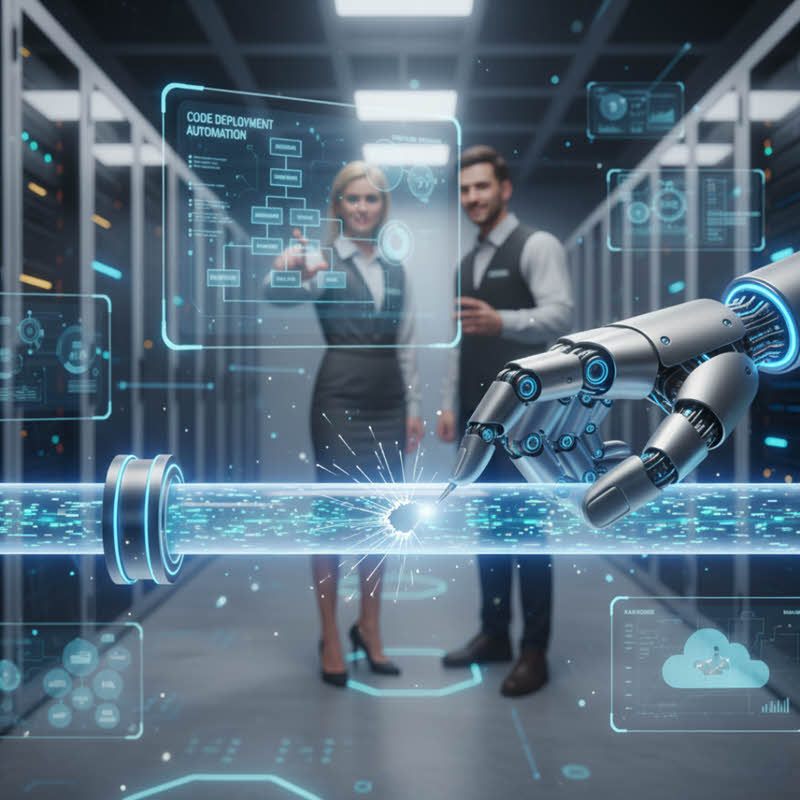
AI Agents in DevOps: From Automated Runbooks to Self-Healing Pipelines
Last updated: November 28, 2025 Read in fullscreen view


 Recommended for you
- 06 Mar 2026
 Next-Generation AI Agents Explained: OpenClaw, NanoClaw, IronClaw and the Rise of Agent Architectures 366/406
 - 05 Oct 2025 The New Facebook Algorithm: A Paradigm Shift in Content Discovery 302/364
- 21 Dec 2023 Top 12 Low-Code Platforms To Use in 2024 227/1528
- 23 Dec 2025 Microsoft Power Automate vs. n8n: What’s the Real Difference? 222/355
- 14 Aug 2024 From Steel to Software: The Reluctant Evolution of Japan's Tech Corporates 208/755
- 29 Oct 2024 Top AI Tools and Frameworks You’ll Master in an Artificial Intelligence Course 190/597
- 01 Dec 2025 Manufacturing 4.0: AI Agents Enabling Self-Optimizing Production Systems 184/245
- 02 Dec 2025 The Question That Shook Asia: What Happens When We Ask AI to Choose Between a Mother and a Wife? 183/225
- 31 Dec 2025 10 Skills to Make You "Irreplaceable" in the Next 3 Years (even if AI changes everything) 179/213
- 05 Jun 2025 How AI-Driven Computer Vision Is Changing the Face of Retail Analytics 175/299
- 09 Jul 2024 What Is Artificial Intelligence and How Is It Used Today? 170/432
- 20 Dec 2025 The Future of IT Consulting: Key Trends for 2026–2030 170/213
- 25 Mar 2026 Token Bills: The "Cost Shock" After the AI Boom in Companies 170/196
- 23 Dec 2024 Garbage In, Megabytes Out (GIMO): How to Rise Above AI Slop and Create Real Signal 169/224
- 03 Oct 2025 Top CMS Trends 2026: The Future of Digital Content Management 168/202
- 16 Oct 2025 AI Inference Explained Simply: What Developers Really Need to Know 163/197
- 06 Dec 2025 Enterprise Operations 2.0: Why AI Agents Are Replacing Traditional Automation 158/202
- 26 Mar 2026 What Is a System Integrator (SI)? Why the Software Subscription Model Is Becoming the New Standard 156/190
- 12 May 2026 Top 6 AI AR/VR Filter Tools for Mind-Blowing Videos and Photos in 2026 152/173
- 19 Oct 2021 Software development life cycles 148/828
- 18 Dec 2025 EOS as a Business Operating System: Powerful, but Not Always Plug-and-Play 147/201
- 21 Apr 2026 Vibe Coding vs. Expert Shopify Development: What AI Tools Can (and Can't) Do? 143/168
- 06 Nov 2025 DataOps: The Next Frontier in Agile Data Management 143/202
- 18 Jul 2024 The 8 Best ways to Innovate your SAAS Business Model in 2024 140/397
- 04 Oct 2021 Product Validation: The Key to Developing the Best Product Possible 136/444
- 25 Nov 2025 How AI Agents Are Redefining Enterprise Automation and Decision-Making 136/194
- 31 Jul 2025 Top WooCommerce Pre-Order Plugins with Countdown & Discounts 133/230
- 13 Oct 2021 Outsourcing Software Development: MVP, Proof of Concept (POC) and Prototyping. Which is better? 133/614
- 25 Dec 2025 What Is Algorithmic Fairness? Who Determines the Value of Content: Humans or Algorithms? 130/175
- 07 Oct 2025 Case Study: Using the “Messaging House” Framework to Build a Digital Transformation Roadmap 128/208
- 29 Jan 2026 Why Headless Commerce Is Shaping the Future of the Online Store 127/154
- 28 Jul 2022 POC, Prototypes, Pilots and MVP: What Are the Differences? 122/866
- 15 Apr 2024 Weights & Biases: The AI Developer Platform 121/312
- 20 Feb 2025 How Machine Learning is Shaping the Future of Digital Advertising 118/241
- 22 Dec 2025 The Role of Automotive Software in Building Smarter Vehicles 118/163
- 01 Jul 2025 The Hidden Costs of Not Adopting AI Agents: Risk of Falling Behind 117/266
- 12 Oct 2022 14 Common Reasons Software Projects Fail (And How To Avoid Them) 116/682
- 16 Aug 2022 What is a Headless CMS? 115/401
- 16 Aug 2022 What is a Headless CMS? 115/401
- 17 Oct 2025 MLOps vs AIOps: What’s the Difference and Why It Matters 114/227
- 27 Jul 2024 Positive Psychology in the Digital Age: Future Directions and Technologies 112/541
- 12 Aug 2024 Understanding Google Analytics in Mumbai: A Beginner's Guide 112/219
- 02 Dec 2024 The Intersection of AI and Business Analytics: Key Concepts to Master in Your Business Analytics Course 108/404
- 16 Dec 2025 Reducing Cognitive Friction in Software Development: A Guide to Faster, Happier Teams 108/184
- 27 Aug 2025 How AI Consulting Is Driving Smarter Diagnostics and Hospital Operations 105/205
- 21 Nov 2025 The Rise of AgentOps: How Enterprises Are Managing and Scaling AI Agents 105/162
- 10 Nov 2025 Multi-Modal AI Agents: Merging Voice, Text, and Vision for Better CX 105/220
- 12 Jan 2026 Companies Developing Custom AI Models for Brand Creative: Market Landscape and Use Cases 104/137
- 03 Jan 2024 Why Partnership is important for Growth? 103/261
- 21 Aug 2024 What is Singularity and Its Impact on Businesses? 100/562
- 15 May 2025 AI Consulting for Small Businesses: How to Leverage AI for Growth & Efficiency 99/292
- 20 Aug 2025 What Is Agentic AI? The Next Phase of Artificial Intelligence 99/260
- 24 Dec 2024 Artificial Intelligence and Cybersecurity: Building Trust in EFL Tutoring 99/269
- 16 Sep 2022 Examples Of Augmented Intelligence In Today’s Workplaces Shaping the Business as Usual 99/536
- 09 Sep 2025 Aligning BI Dashboards with KPIs: A Business + Data Collaboration Guide 99/187
- 16 Sep 2022 Examples Of Augmented Intelligence In Today’s Workplaces Shaping the Business as Usual 99/536
- 11 Oct 2022 Why choose Billable Viable Product (BVP) over Minimum Viable Product (MVP) 99/441
- 12 Dec 2021 Zero Sum Games Agile vs. Waterfall Project Management Methods 98/512
- 18 Jan 2024 Self-healing code is the future of software development 98/315
- 07 Nov 2025 Online vs. Offline Machine Learning Courses in South Africa: Which One Should You Pick? 98/170
- 05 Aug 2024 Revisiting the Mistake That Halted Japan's Software Surge 98/447
- 05 Sep 2023 The Cold Start Problem: How to Start and Scale Network Effects 97/295
- 31 Aug 2022 What are the best practices for software contract negotiations? 97/371
- 23 Jun 2025 AI Avatars in the Metaverse: How Digital Beings Are Redefining Identity and Social Interaction 96/284
- 05 Mar 2021 How do you minimize risks when you outsource software development? 95/428
- 25 Sep 2024 Enhancing Decision-Making Skills with an MBA: Data-Driven Approaches for Business Growth 95/304
- 06 May 2025 How Machine Learning Is Transforming Data Analytics Workflows 94/291
- 25 Jan 2025 The Decline of Traditional SaaS and the Rise of AI-first Applications 93/198
- 30 Jul 2024 The Future of IT Consulting: Trends and Opportunities 91/305
- 31 Dec 2023 Software Development Outsourcing Trends to Watch Out for in 2024 90/320
- 24 Oct 2025 AI Agents in SaaS Platforms: Automating User Support and Onboarding 90/161
- 28 Nov 2025 How AI Will Transform Vendor Onboarding and Seller Management in 2026 89/219
- 06 Mar 2024 [SemRush] What Are LSI Keywords & Why They Don‘t Matter 89/293
- 03 Nov 2023 Why Is Billable Viable Product An Alternative To Minimum Viable Product? 83/274
- 22 Sep 2025 Why AI Is Critical for Accelerating Drug Discovery in Pharma 83/198
- 22 Nov 2024 The Role of AI in Enhancing Business Efficiency and Decision-Making 82/277
- 01 Dec 2023 Laws of Project Management 81/396
- 04 Oct 2023 The Future of Work: Harnessing AI Solutions for Business Growth 81/362
- 18 Aug 2024 The Future of Web Development: Emerging Trends and Technologies Every Developer Should Know 80/275
- 18 Jul 2021 How To Ramp Up An Offshore Software Development Team Quickly 77/669
- 31 Dec 2022 The New Normal for Software Development 76/430
- 10 Sep 2024 Leading Remote Teams in Hybrid Work Environments 76/220
- 27 Feb 2025 How AI Agents are Changing Software Development? 74/313
- 04 Oct 2022 Which ERP implementation strategy is right for your business? 74/435
- 19 Dec 2023 How AI is Transforming Software Development? 74/367
- 21 Apr 2025 Agent AI in Multimodal Interaction: Transforming Human-Computer Engagement 72/268
- 27 May 2026 Best 5 Software Development Companies Ideal for Early-Stage Startups 72/100
- 09 Oct 2024 Short-Form Video Advertising: The Secret to Captivating Your Audience 70/202
- 01 May 2024 Warren Buffett’s Golden Rule for Digital Transformation: Avoiding Tech Overload 70/278
- 05 Aug 2024 Affordable Tech: How Chatbots Enhance Value in Healthcare Software 66/298
- 15 Aug 2025 Quantum Technology: Global Challenges and Opportunities for Innovators 65/203
- 28 Oct 2022 Build Operate Transfer (B.O.T) Model in Software Outsourcing 64/474
- 29 May 2026 The Role of IoT in Modern Insurance App Development 64/75
- 17 Mar 2025 Integrating Salesforce with Yardi: A Guide to Achieving Success in Real Estate Business 61/269
- 29 Aug 2025 How AI Is Transforming Modern Management Science 60/128
- 10 Sep 2024 AI in Email Marketing: Personalization and Automation 60/237
- 25 Jun 2026 Vercel: The "Secret Weapon" for Modern, High-Performance Web Deployment 49/58
- 31 Dec 2022 Future of Software Development Trends and Predictions 48/199
- 06 Nov 2025 Top AI Development Companies in the USA to Watch in 2026 44/288
- 09 Oct 2024 Are Expensive CRM Systems Really Worth It? 2/201
- 24 Mar 2026 AI for Financial Reconciliation: Automating Finance Operations in 2026 2/194
- 04 Mar 2026 CRM Trends Shaping Customer Engagement in 2026 1/150
| About the Author | Anand Subramanian | Technology expert and AI enthusiast |
Anand Subramanian is a technology expert and AI enthusiast currently leading the marketing function at Intellectyx, a Data, Digital, and AI solutions provider with over a decade of experience working with enterprises and government departments. |
The DevOps landscape is in the middle of a seismic transformation. Teams that once relied heavily on manual interventions and static scripts are now turning to intelligent systems that can think, adapt, and act with autonomy. Among the most promising advancements are AI agents, which are reshaping how enterprises approach automation. They are not just tools to reduce toil but autonomous assistants that drive efficiency, resilience, and continuous improvement across the entire software delivery lifecycle.
If you have already implemented automated runbooks or basic incident response playbooks, you are only scratching the surface. AI agents are here to push DevOps to its next frontier: self-healing pipelines that can detect, diagnose, and resolve issues in real time without waiting for human intervention.
In this article, we will dive deep into what this shift means, where AI agents fit in, how enterprises can benefit from them, and the practical steps you can take to bring this future into your DevOps workflows today.
The Shift from Automation to Intelligence
Traditional DevOps automation has revolved around scripting repetitive tasks. Automated runbooks are a great example: they provide pre-defined steps to resolve common issues such as restarting a service, clearing cache, or scaling a cluster. While these scripts reduce manual effort, they are still rigid.
Here is the problem: runbooks assume predictable failures. In reality, modern distributed systems create unpredictable conditions that no static script can fully capture. Infrastructure fails in unusual ways. Performance bottlenecks show up suddenly. Security threats emerge without warning.
This is where AI agents bring in intelligence. Instead of being limited to predefined if-then steps, they use contextual data, learn from history, and reason through anomalies to take adaptive action. The result is not just faster resolution but proactive prevention of issues.
What AI Agents Bring to DevOps
AI agents are autonomous systems designed to observe, analyze, and act within DevOps environments. Unlike static automation, they can operate across multiple dimensions of a pipeline, continuously learning and improving with every iteration. Let us explore the areas where they make the biggest impact:
1. Intelligent Incident Response
Instead of waking up engineers at 2 AM with a pager alert, AI agents can automatically investigate the root cause of a failure. For example, if a service goes down, the agent can analyze logs, correlate metrics, and compare patterns with past incidents. It can then decide whether to restart the service, roll back the deployment, or scale resources.
2. Continuous Observability and Monitoring
Most DevOps teams rely on dashboards that require human interpretation. AI agents can go further by ingesting logs, metrics, and traces at scale and detecting anomalies that humans might miss. They can raise intelligent alerts only when truly necessary, reducing alert fatigue.
3. Self-Healing Pipelines
Imagine a CI/CD pipeline where an agent detects a failing test, identifies a misconfiguration, applies a fix, and reruns the pipeline without waiting for human approval. This is the direction enterprises are moving toward. Self-healing pipelines reduce downtime and accelerate releases.
4. Security and Compliance Enforcement
AI agents can continuously monitor code changes and infrastructure configurations to ensure compliance with policies. If a vulnerability is detected, they can block deployments, suggest patches, or even apply fixes autonomously.
5. Cost Optimization in Cloud Environments
Cloud costs often spiral because of over-provisioning or idle resources. AI agents can monitor usage patterns and automatically rightsize instances, shut down unused resources, or move workloads to cheaper options.
Real-World Scenarios of AI Agents in Action
To move from theory to reality, let us look at a few scenarios where enterprises are already leveraging AI agents in their DevOps practices:
- Database Recovery: When a database node crashes, instead of waiting for an engineer, an AI agent can detect the issue, spin up a replacement, reroute traffic, and update DNS entries.
- Anomaly Detection in Deployments: During a rollout, if latency spikes or error rates increase, the agent can automatically pause the rollout, analyze logs, and roll back to the previous stable version.
- Security Breach Response: If unusual login patterns are detected, such as multiple failed login attempts from different locations, the agent can block access, enforce MFA, and alert the security team.
- Pipeline Optimization: AI agents can track build times across multiple projects, identify bottlenecks, and automatically reconfigure jobs to optimize execution time.
These scenarios highlight a critical point: AI agents are not replacing DevOps engineers. Instead, they are amplifying human capabilities by handling repetitive or high-speed tasks, allowing teams to focus on strategic improvements.
Why Enterprises Should Pay Attention Now
The rise of AI agents in DevOps is not a distant future scenario. Early adopters are already reporting measurable results:
- Reduced MTTR (Mean Time to Resolution): Enterprises are seeing up to 60% faster recovery times when AI agents handle incident responses.
- Improved Developer Productivity: With fewer interruptions from alerts and manual fixes, developers spend more time building features.
- Enhanced Reliability: Self-healing pipelines reduce downtime and ensure a smoother customer experience.
- Lower Operational Costs: Automated resource optimization leads to significant savings in cloud bills.
In competitive markets where software reliability is directly tied to customer retention, the cost of ignoring AI-driven automation is far greater than the cost of adoption.
Why Enterprises Should Pay Attention Now
The rise of AI agents in DevOps is not a distant future scenario. Early adopters are already reporting measurable results:
- Reduced MTTR (Mean Time to Resolution): Enterprises are seeing up to 60% faster recovery times when AI agents handle incident responses.
- Improved Developer Productivity: With fewer interruptions from alerts and manual fixes, developers spend more time building features.
- Enhanced Reliability: Self-healing pipelines reduce downtime and ensure a smoother customer experience.
- Lower Operational Costs: Automated resource optimization leads to significant savings in cloud bills.
In competitive markets where software reliability is directly tied to customer retention, the cost of ignoring AI-driven automation is far greater than the cost of adoption.
How to Get Started with AI Agents in DevOps
If your organization is considering AI agents in DevOps, here are practical steps to begin:
- Identify High-Toil Areas: Start with tasks that are repetitive and prone to errors. Incident response and monitoring are often great entry points.
- Implement in a Controlled Scope: Deploy AI agents in non-critical environments or specific stages of the pipeline before scaling across production.
- Set Guardrails: Define clear policies on what actions AI agents can take autonomously versus those requiring human approval.
- Leverage Existing Tools: Many monitoring and AIOps platforms already offer AI-driven capabilities. You do not need to reinvent the wheel.
- Iterate and Expand: As trust builds, gradually expand the scope of autonomy from automated suggestions to fully self-healing systems.
The Human Element: DevOps Engineers as AI Collaborators
A common fear is that AI agents will replace DevOps roles. The truth is the opposite. AI agents excel at pattern recognition, anomaly detection, and repetitive fixes, but they lack the creativity, judgment, and context that human engineers bring.
The future DevOps engineer will not be just a script writer or pipeline operator. Instead, they will act as architects of autonomous systems, trainers of AI models, and strategists who align AI capabilities with business goals. By offloading toil to AI agents, engineers free themselves to focus on higher-value activities such as improving system design, ensuring compliance, and enhancing developer experience.
Looking Ahead: From Self-Healing to Self-Optimizing Systems
The next stage of AI-driven DevOps goes beyond self-healing pipelines. Imagine a system that not only fixes itself but also learns how to prevent future issues and optimize performance proactively. For example:
- Predicting and preventing deployment failures before they occur.
- Automatically tuning infrastructure configurations for optimal performance.
- Adjusting release strategies based on historical adoption patterns.
This is not science fiction. With AI agents continuously learning from the massive data streams generated by modern systems, the vision of self-optimizing pipelines is well within reach.
Final Thoughts and Call to Action
AI agents in DevOps are no longer an experimental concept. They are rapidly becoming essential for enterprises that want to stay ahead in a world where speed, reliability, and resilience are competitive advantages. The journey from automated runbooks to self-healing pipelines is happening right now, and organizations that act early will have the upper hand.
If you are leading a DevOps team today, ask yourself:
- Where do we still spend time firefighting instead of innovating?
- Which parts of our pipeline remain brittle despite automation?
- How much could we gain by letting AI agents handle the toil?
The answers to these questions could shape the future of your software delivery. Do not wait until your competitors are already running self-healing pipelines. Begin experimenting with AI agents today, even in small ways, and position your team to thrive in the era of intelligent DevOps.
Anand Subramanian
Technology expert and AI enthusiast
Anand Subramanian is a technology expert and AI enthusiast currently leading the marketing function at Intellectyx, a Data, Digital, and AI solutions provider with over a decade of experience working with enterprises and government departments.
 Explore more on these topics
























 Guest Blogging: The Definitive Guide

 Top Trending Topics
 Share This
 Link copied!
 Recently Updated News
 thực chiến - Kiến tạo tương lai cho các nhà sáng tạo nội dung.