


What AI Can Teach Us About Extending the Life of Old Software
Last updated: December 07, 2025 Read in fullscreen view


 Recommended for you
- 06 Mar 2026
 Next-Generation AI Agents Explained: OpenClaw, NanoClaw, IronClaw and the Rise of Agent Architectures 344/381
 - 29 Oct 2024 Top AI Tools and Frameworks You’ll Master in an Artificial Intelligence Course 183/587
- 02 Oct 2022 The Real Factors Behind Bill Gates’ Success: Luck, Skills, or Connections? 177/550
- 14 Aug 2024 From Steel to Software: The Reluctant Evolution of Japan's Tech Corporates 175/720
- 09 Jul 2024 What Is Artificial Intelligence and How Is It Used Today? 163/416
- 05 Jun 2025 How AI-Driven Computer Vision Is Changing the Face of Retail Analytics 159/282
- 23 Dec 2024 Garbage In, Megabytes Out (GIMO): How to Rise Above AI Slop and Create Real Signal 159/212
- 16 Oct 2025 AI Inference Explained Simply: What Developers Really Need to Know 156/190
- 02 Dec 2025 The Question That Shook Asia: What Happens When We Ask AI to Choose Between a Mother and a Wife? 152/188
- 06 Nov 2025 Top 10 AI Development Companies in the USA to Watch in 2026 142/218
- 06 Dec 2025 Enterprise Operations 2.0: Why AI Agents Are Replacing Traditional Automation 138/182
- 25 Nov 2025 How AI Agents Are Redefining Enterprise Automation and Decision-Making 126/184
- 09 Oct 2025 Data, Users, APIs: The 3 Pillars of Effective Digital Transformation 126/165
- 24 Mar 2026 AI for Financial Reconciliation: Automating Finance Operations in 2026 126/152
- 21 Apr 2026 Vibe Coding vs. Expert Shopify Development: What AI Tools Can (and Can't) Do? 124/148
- 06 Nov 2023 How do you streamline requirement analysis and modeling? 124/361
- 25 Dec 2025 What Is Algorithmic Fairness? Who Determines the Value of Content: Humans or Algorithms? 114/157
- 15 Apr 2024 Weights & Biases: The AI Developer Platform 113/304
- 20 Jan 2021 Fail early, fail often, fail cheap, fail safe but always fail forward 113/927
- 01 Jul 2025 The Hidden Costs of Not Adopting AI Agents: Risk of Falling Behind 112/260
- 02 Nov 2021 [Case Study] Streamlined Data Reporting using Tableau 103/406
- 27 Aug 2025 How AI Consulting Is Driving Smarter Diagnostics and Hospital Operations 102/202
- 19 Apr 2024 What is Skills-Based Approach & Why Does it Matter? 101/257
- 11 Nov 2021 What is an IT Self-service Portal? Why is it Important to Your Business? 101/548
- 12 Jan 2026 Companies Developing Custom AI Models for Brand Creative: Market Landscape and Use Cases 99/131
- 21 Nov 2025 The Rise of AgentOps: How Enterprises Are Managing and Scaling AI Agents 98/153
- 10 Nov 2025 Multi-Modal AI Agents: Merging Voice, Text, and Vision for Better CX 97/210
- 17 Oct 2025 MLOps vs AIOps: What’s the Difference and Why It Matters 97/208
- 21 Aug 2024 What is Singularity and Its Impact on Businesses? 94/553
- 06 May 2025 How Machine Learning Is Transforming Data Analytics Workflows 92/289
- 24 Dec 2024 Artificial Intelligence and Cybersecurity: Building Trust in EFL Tutoring 92/262
- 07 Nov 2025 Online vs. Offline Machine Learning Courses in South Africa: Which One Should You Pick? 89/157
- 05 Aug 2024 Revisiting the Mistake That Halted Japan's Software Surge 87/434
- 05 Sep 2024 The Inverted Approach: A Guide to Identifying Software Risks with Reverse Brainstorming 83/341
- 01 Jan 2024 The pros and cons of the Centralized Enterprise Automation Operating model 81/305
- 08 May 2024 Time Unlocked: Mastering the Pomodoro Technique Against Parkinson's Law 80/327
- 28 Nov 2025 How AI Will Transform Vendor Onboarding and Seller Management in 2026 80/210
- 02 Dec 2022 Success Story: Satsuki - Sales Management Software, back office app for School Subscription Management 78/317
- 04 Oct 2023 The Future of Work: Harnessing AI Solutions for Business Growth 77/356
- 03 Apr 2021 How digital asset management streamlines your content workflow? 76/404
- 20 Jan 2022 TIGO Self-Organization Practice: Change Management Workflow 76/547
- 03 Sep 2022 The secret of software success: Simplicity is the ultimate sophistication 74/278
- 22 Sep 2025 Why AI Is Critical for Accelerating Drug Discovery in Pharma 73/188
- 13 Feb 2021 Why is TIGOSOFT a software house for Enterprise Application Development? 70/450
- 04 Apr 2025 To Act or Not to Act – A Manager’s Persistent Dilemma 70/185
- 03 May 2024 The Iceberg of Ignorance 68/496
- 24 Oct 2025 AI Agents in SaaS Platforms: Automating User Support and Onboarding 68/139
- 21 Apr 2025 Agent AI in Multimodal Interaction: Transforming Human-Computer Engagement 66/261
- 05 Aug 2024 Affordable Tech: How Chatbots Enhance Value in Healthcare Software 60/290
- 21 Jun 2021 6 Useful Tips To Streamline Business Processes and Workflows 59/590
- 05 Oct 2021 Shiny Object Syndrome: Why Your Business Isn't "Going Digital" 59/440
- 29 Aug 2025 How AI Is Transforming Modern Management Science 57/124
- 16 Jun 2022 Rapid Application Development (RAD): Pros and Cons 56/936
- 01 May 2023 Understanding Business as Usual (BAU) and How to Transition 34/1154
Old software programs are a reliable company resource, running critical operations for decades. Yet with changes in time, these systems have been facing certain challenges. Some of these include the necessity for interconnectedness of systems, or data security threats, among others. So, this silent backbone needs care and technological updates to perform equally well today.
A commonly recommended solution to help this case is adopting modern software product engineering solutions. These integrate AI in all phases of development and updates, driving business ROI. While traditional companies still consider the high cost of this investment, they must not overlook the challenges that can bring forth compliance troubles and data-related distress for the leaders.
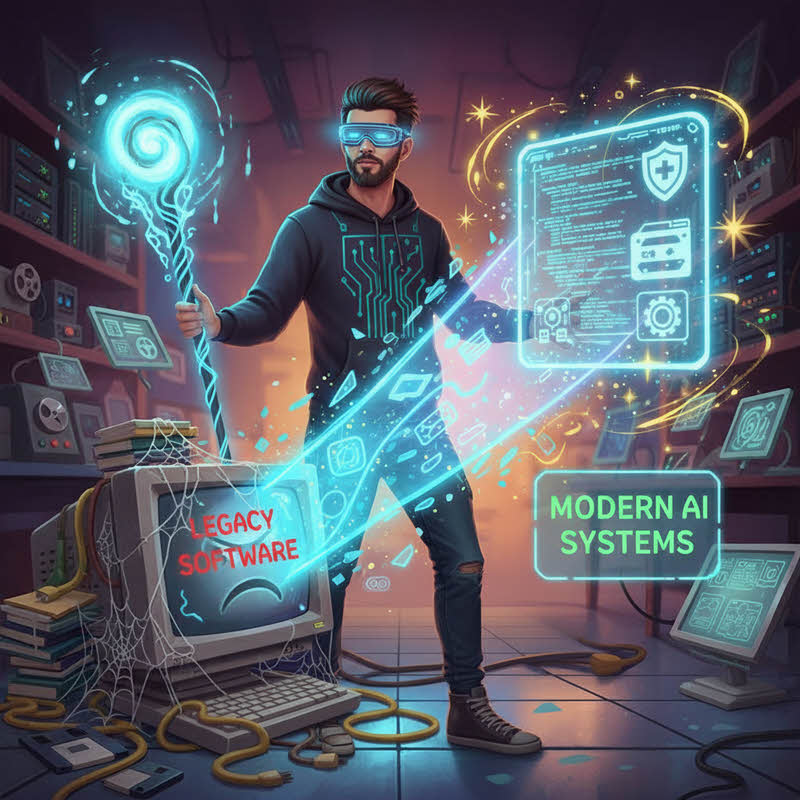
Hence, AI is being positioned to reshape the legacy systems and assist in their modernization process. Future-proofing them for tomorrow, this can be considered a strategic win for an organization. This article examines how incorporating AI in the legacy software modernization process can help companies extend the life of these critical programs.
Challenges with Old Software
While the contribution of legacy systems cannot be neglected, there are many challenges that occur while managing these old and redundant systems. Let’s address them in detail before we uncover the role of modernization and AI in resolving them.
Outdated Technology
Oftentimes, old applications operate utilizing frameworks that are no longer widely supported by their vendors. This implies a lack of updates, which slows down performance and innovation, making them hard to integrate with modern tech.
Security Vulnerabilities and Compliance Gaps
Today, legacy systems are the weakest links in company networks, exposing sensitive data to cyber threat situations. This is due to their lack of security patches, which increases the risk of breaches. It also eventually leads to non-compliance.
Performance and Scalability Issues
As data becomes complex and high in volume, old software programs fail to manage it properly. This again interconnects with critical security risks, slower processing time, and even downtime. It thus affects the scalability and performance of the enterprise systems.
High Maintenance Costs
Old software needs constant maintenance and technical support, which increases a company's operational costs.
Given the impact of these critical challenges on security, performance, and cost, businesses must be keen on finding an effective solution. We recommend that you consider the prospects of investing in legacy software modernization services. Emerging as a novel solution, these are offered by a seasoned team of experts who can help in setting the roadmap for updating your software programs, while focusing on operational continuity. In this context, let’s understand the essence of software modernization and how it incorporates AI to resolve the mentioned challenges.
Role of AI in Software Modernization
At its core, the modernization process encompasses updating legacy software programs by leveraging modern technologies like artificial intelligence. What’s more, it assists in making old systems more secure, scalable, and cost-efficient.
Moving forward, this section explores the role of AI in this transformation process.
AI for Code Analysis and Refactoring
AI tools like ML and predictive maintenance, used by experts, facilitate the identification of errors and inconsistencies in existing code sources. This becomes the basis for its refinements and improvement in the refactoring process.
Predictive Maintenance to Identify Potential Failures
AI-assisted tools like predictive maintenance track software performance in real-time. Thus, by understanding data patterns, issues can be detected and resolved before system failure occurs.
AI-Driven Testing and Bug Detection
By leveraging automation in legacy modernization, AI enables the identification of anomalies in software code. These then assist in intelligent and faster bug detection.
Intelligent Automation
Owing to automation, a proactive approach has been established in system monitoring. This helps measure its performance. Moreover, compliance updates are also incorporated through this measure, freeing up personnel time for strategic and more complex events.
AI Techniques for Extending Software Life
As businesses progress in the fast-paced industry, old systems are being continually updated, using legacy software modernization services. This helps overcome many hurdles while adding AI-powered competencies to business functions. But how exactly does this framework extend software life?
Let’s find out:
Anomaly Detection
ML models can analyze huge volumes of data, assisting in detecting performance issues. These may include sudden slowdowns in factories or suspicious transactions being incurred in system records.
Code Comprehension and Documentation
NLP technologies assist in reading and understanding legacy code. This enables companies to identify issues and rewrite the code, thereby adding to the competencies of the system.
AI-powered Migration Assistants
AI tools facilitate the migration of legacy systems into cloud environments by automatically identifying system dependencies. This is followed by experts recommending compatible ways of migration, which also minimize human effort in re-architecting.
Generative AI for Code Enhancement
Gen AI is a futuristic technology that can rewrite old legacy codes to further facilitate performance optimization.
Benefits of Using AI in Software Product Engineering Solutions
Given the competence of modern software product engineering solutions, businesses must be keen to adopt this investment. Yet, fundamentally, they also need to analyze the measurable values of this investment. In this context, this section briefly examines the benefits of using AI in legacy software programs.
Reduced Operational Cost and Personnel Efforts
The automation of code refactoring, system testing, and migration helps in saving company costs and minimizing human efforts.
Faster Business Systems
By adopting AI, systems become faster, secure, and operationally exceptional. This helps leaders in meeting changing user requirements quickly in the fast-paced industry.
Improved Security and Compliance
Security features embedded in updated software programs help companies prevent cyber threats. What’s more, it also helps ensure compliance with norms that are mandatory to follow.
Hence, with the power of AI technologies, systems can be optimized to deliver better returns for the business.
Best Practices Of Legacy Software Modernization Services
Given the significant cost and impact of software product engineering solutions, companies are recommended to follow certain practices to get the most out of this investment.
- Audit high-priority areas and create pilot projects to work on migrating them first. This prioritization will allow enterprises to measure performance strategically while investing a small portion of their cost on these migrations.
- Employee training is also necessary to manage modern systems.
- AI systems must be leveraged for continuous monitoring of the new frameworks. This can guide the flow of iterations and further developments needed in the software programs.
Final Thoughts: What Lies Ahead
So is your organization all set to embrace AI to transform your legacy systems?
This being said, the power of predictive and smart AI tools is not only focused on performance optimization, but also delivers secure and compliant systems. Legacy modernization furthermore helps in extending the life of old software programs by updating and making them competitive in today’s digital age. Adding to this potential, legacy software modernization services club technical expertise and guidance on how to move forward on this important journey.
Hence, companies must consider this opportunity an enabler of innovation and tech.
| About the Author | Linda William | Technology enthusiast and writer | Linda William is a seasoned content strategist exploring artificial intelligence and its pivotal role in legacy software modernization. Assisting brands with this knowledge, she helps in simplifying complex concepts related to how AI can help in extending the life of redundant old software programs in a company. |
 Explore more on these topics























 Guest Blogging: The Definitive Guide

 Top Trending Topics
 Share This
 Link copied!
 Recently Updated News