



Online vs. Classroom Machine Learning Courses: Which One Delivers Better Results?
Last updated: October 13, 2025 Read in fullscreen view


 Recommended for you
- 06 Mar 2026
 Next-Generation AI Agents Explained: OpenClaw, NanoClaw, IronClaw and the Rise of Agent Architectures 361/401
 - 05 Oct 2025 The New Facebook Algorithm: A Paradigm Shift in Content Discovery 294/356
- 21 Dec 2023 Top 12 Low-Code Platforms To Use in 2024 221/1520
- 29 Oct 2024 Top AI Tools and Frameworks You’ll Master in an Artificial Intelligence Course 189/594
- 02 Dec 2025 The Question That Shook Asia: What Happens When We Ask AI to Choose Between a Mother and a Wife? 176/216
- 05 Jun 2025 How AI-Driven Computer Vision Is Changing the Face of Retail Analytics 171/295
- 31 Dec 2025 10 Skills to Make You "Irreplaceable" in the Next 3 Years (even if AI changes everything) 169/203
- 25 Mar 2026 Token Bills: The "Cost Shock" After the AI Boom in Companies 167/190
- 23 Dec 2024 Garbage In, Megabytes Out (GIMO): How to Rise Above AI Slop and Create Real Signal 166/220
- 03 Oct 2025 Top CMS Trends 2026: The Future of Digital Content Management 166/199
- 09 Jul 2024 What Is Artificial Intelligence and How Is It Used Today? 165/423
- 20 Dec 2025 The Future of IT Consulting: Key Trends for 2026–2030 163/206
- 16 Oct 2025 AI Inference Explained Simply: What Developers Really Need to Know 163/197
- 24 Mar 2026 AI for Financial Reconciliation: Automating Finance Operations in 2026 157/188
- 06 Dec 2025 Enterprise Operations 2.0: Why AI Agents Are Replacing Traditional Automation 153/197
- 26 Mar 2026 What Is a System Integrator (SI)? Why the Software Subscription Model Is Becoming the New Standard 151/185
- 18 Jul 2024 The 8 Best ways to Innovate your SAAS Business Model in 2024 137/392
- 25 Nov 2025 How AI Agents Are Redefining Enterprise Automation and Decision-Making 134/192
- 25 Dec 2025 What Is Algorithmic Fairness? Who Determines the Value of Content: Humans or Algorithms? 129/174
- 15 Apr 2024 Weights & Biases: The AI Developer Platform 120/311
- 04 Mar 2026 CRM Trends Shaping Customer Engagement in 2026 117/148
- 20 Feb 2025 How Machine Learning is Shaping the Future of Digital Advertising 116/238
- 17 Oct 2025 MLOps vs AIOps: What’s the Difference and Why It Matters 114/226
- 01 Jul 2025 The Hidden Costs of Not Adopting AI Agents: Risk of Falling Behind 113/262
- 16 Aug 2022 What is a Headless CMS? 113/399
- 27 Jul 2024 Positive Psychology in the Digital Age: Future Directions and Technologies 110/539
- 02 Dec 2024 The Intersection of AI and Business Analytics: Key Concepts to Master in Your Business Analytics Course 105/400
- 10 Nov 2025 Multi-Modal AI Agents: Merging Voice, Text, and Vision for Better CX 104/218
- 27 Aug 2025 How AI Consulting Is Driving Smarter Diagnostics and Hospital Operations 103/203
- 12 Jan 2026 Companies Developing Custom AI Models for Brand Creative: Market Landscape and Use Cases 103/135
- 21 Nov 2025 The Rise of AgentOps: How Enterprises Are Managing and Scaling AI Agents 102/159
- 03 Jan 2024 Why Partnership is important for Growth? 102/260
- 16 Sep 2022 Examples Of Augmented Intelligence In Today’s Workplaces Shaping the Business as Usual 99/536
- 11 Oct 2022 Why choose Billable Viable Product (BVP) over Minimum Viable Product (MVP) 98/440
- 24 Dec 2024 Artificial Intelligence and Cybersecurity: Building Trust in EFL Tutoring 98/268
- 21 Aug 2024 What is Singularity and Its Impact on Businesses? 98/560
- 15 May 2025 AI Consulting for Small Businesses: How to Leverage AI for Growth & Efficiency 98/291
- 07 Nov 2025 Online vs. Offline Machine Learning Courses in South Africa: Which One Should You Pick? 97/169
- 18 Jan 2024 Self-healing code is the future of software development 96/313
- 25 Sep 2024 Enhancing Decision-Making Skills with an MBA: Data-Driven Approaches for Business Growth 95/302
- 20 Aug 2025 What Is Agentic AI? The Next Phase of Artificial Intelligence 95/255
- 23 Jun 2025 AI Avatars in the Metaverse: How Digital Beings Are Redefining Identity and Social Interaction 94/281
- 06 May 2025 How Machine Learning Is Transforming Data Analytics Workflows 94/291
- 25 Jan 2025 The Decline of Traditional SaaS and the Rise of AI-first Applications 93/198
- 30 Jul 2024 The Future of IT Consulting: Trends and Opportunities 88/300
- 28 Nov 2025 How AI Will Transform Vendor Onboarding and Seller Management in 2026 88/218
- 24 Oct 2025 AI Agents in SaaS Platforms: Automating User Support and Onboarding 87/158
- 31 Dec 2023 Software Development Outsourcing Trends to Watch Out for in 2024 86/316
- 22 Sep 2025 Why AI Is Critical for Accelerating Drug Discovery in Pharma 82/197
- 22 Nov 2024 The Role of AI in Enhancing Business Efficiency and Decision-Making 81/276
- 04 Oct 2023 The Future of Work: Harnessing AI Solutions for Business Growth 80/361
- 18 Aug 2024 The Future of Web Development: Emerging Trends and Technologies Every Developer Should Know 79/274
- 03 Nov 2023 Why Is Billable Viable Product An Alternative To Minimum Viable Product? 79/270
- 31 Dec 2022 The New Normal for Software Development 76/429
- 10 Sep 2024 Leading Remote Teams in Hybrid Work Environments 76/220
- 01 May 2023 Understanding Business as Usual (BAU) and How to Transition 75/1199
- 19 Dec 2023 How AI is Transforming Software Development? 74/367
- 27 Feb 2025 How AI Agents are Changing Software Development? 74/312
- 21 Apr 2025 Agent AI in Multimodal Interaction: Transforming Human-Computer Engagement 71/266
- 03 May 2024 The Iceberg of Ignorance 71/500
- 09 Oct 2024 Short-Form Video Advertising: The Secret to Captivating Your Audience 69/201
- 05 Aug 2024 Affordable Tech: How Chatbots Enhance Value in Healthcare Software 64/295
- 05 Oct 2021 Shiny Object Syndrome: Why Your Business Isn't "Going Digital" 63/444
- 15 Aug 2025 Quantum Technology: Global Challenges and Opportunities for Innovators 63/197
- 29 Aug 2025 How AI Is Transforming Modern Management Science 60/128
- 17 Mar 2025 Integrating Salesforce with Yardi: A Guide to Achieving Success in Real Estate Business 60/267
- 10 Sep 2024 AI in Email Marketing: Personalization and Automation 58/235
- 31 Dec 2022 Future of Software Development Trends and Predictions 48/199
- 06 Nov 2025 Top AI Development Companies in the USA to Watch in 2026 19/260
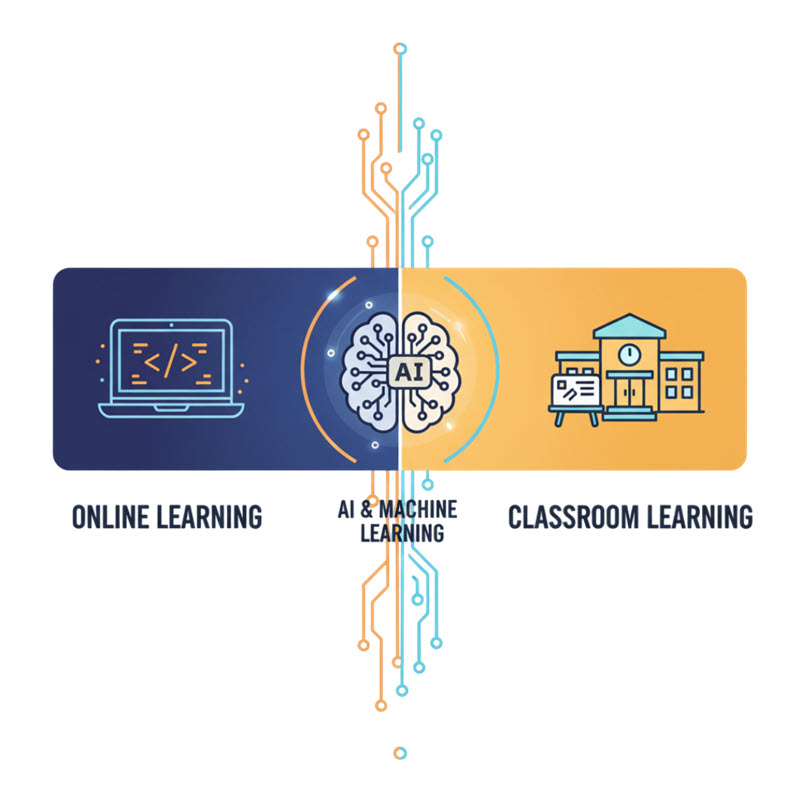
The age of Artificial Intelligence has arrived, and at its core is Machine Learning (ML). Whether it is alerting us to fresh content on a streaming service or constructing elaborate financial models, ML is the engine behind many of the technologies that define modern society. As a result, it has led to a remarkable demand for skilled Machine Learning professionals, prompting many to pursue the necessary education. For students pursuing data science or a Machine Learning engineering position, their first big decision is not what to learn, but where and in what manner, and deciding whether to take traditional Classroom Machine Learning Courses or non-traditional Online Machine Learning Courses.
This isn't strictly a matter of good or bad, it is an examination of two disparate pedagogical approaches. Each offers eventual learning the necessary skills to understand algorithms, deploy them, and advance to optimization models. Quite frankly, the format that results in "better results" is not fixed. It depends entirely on your learning style, other constraints, professional aims, and the quality and performance of the specific program. With that said, let's detail the pros, cons, and useful metrics of either path, so you can determine the appropriate path to pursue learning deep learning in Machine Learning.
The Case for Classroom Machine Learning Courses
Conventional, face-to-face learning, typically taught at universities, colleges, or boot camps, derives its value from the structured environment and immersion.
One of the most significant advantages of a classroom experience is the Direct Instructor Interaction. In real time, you can get feedback on your code, answers to complex conceptual questions, and discussions that may surprise and expand your thinking. This unplanned discourse can prove valuable in moments of confusion when you are struggling to understand something complex like the iterations or architecture of neural networks or advanced optimization approaches. It may help alleviate the frustration of working on a challenging issue for hours without any resolution.
Additionally, the classroom learning experience in Machine Learning creates Networking and Community opportunities. Learning alongside a small set of your peers creates a built-in support system. Working in groups is a lot easier, and you are building professional relationships that will set you apart from other graduates for job referrals, collaborations, or ongoing advices for many years. Being focused and engaged in a learning environment reduces external distractions and helps the educator maintain a disciplined pace, which should factor into better completion rates. In-person learning is often crucial for learners who struggle with motivation or accountability since the schedule is clearly set for all.
The Appeal of Online Machine Learning Courses
For working people or those with family obligations, the flexibility to learn at any time and any place is a real Concession. You can absorb lectures on your lunch break, during a commute, or late at night--you get to have a demanding curriculum fulfil your existing life. This is also due to the Cost-effectiveness of many online options. Without the usability of physical spaces, the requirement to travel, or administrative on-campus costs, some of the best Machine Learning Courses in the world on Udacity, Coursera or edX are quite often available to you for a fraction of the price of a traditional university program.
Another strong aspect of course content is Self-Paced Learning. If you are a quicker learner, you have the chance to learn quicker. If there is a concept or topic--for example, the math behind Support Vector Machines, you can pause a lecture and rewind to watch it a few times, and even return a week later to watch it again until you feel comfortable with the content.
Finally, you also may have access, sometimes at very little cost, to Diverse Content & Providers. In addition to potentially learning specialized topics like "Natural Language Processing with Python" and "Generative AI" from the world's leading programs from wherever you live, it could also include multiple versions of a course.
Measuring "Better Results": Key Metrics
To exactly assess which format will deliver better results, we have to set aside the influences of comfort and expediency and measure outcomes.
Retention of Knowledge is critical. Both formats focus closely on practice, yet the frequency and depth of practical projects and laboratories are the distinctions that matter. A classroom program may provide a more intense and real-time experience with feedback on a capstone project, thus aiding in deeper understanding. Conversely, an online specialization, particularly with a robust series of classes, often collaboratively built for industry tools and datasets, could create an equally impressive portfolio, perhaps even more so.
Career Outcomes is the ultimate measure. Although both paths lead to jobs, in the past the degree from a university or a recognized boot camp certificate (and often classroom-based learning) weighed heavier and implied rigor in preparation with a certain more traditional employer. Online is quickly levelling that playing field. Employers tend to focus on a body's ability to demonstrate their portfolio and perform in an interview more than the name on a certificate. If a course online enables you to create several strong and interactive examples from projects, the objective "outcome" is better in landing jobs in the field.
The last metric, which is typically ignored, is the Completion Rate. Online classes allow for a high degree of flexibility, but inflexibility can lead to astoundingly low completion rates, often below 10-15%! The absence of any external accountability leads to course drop out. In contrast, due to both a monetary and time commitment from the student, in a Classroom Machine Learning Course that student will push themselves to see the Class through to the end, thus maximizing the odds they'll receive all the intended skills and then get the final credential.
Hybrid and Blended Approaches: The Best of Both Worlds
There is an emerging strong middle ground in Hybrid and Blended courses in Machine Learning. The Hybrid and Blended formats attempt to replicate the structure and social aspects of the classroom to the flexibility and access of learning online. For example, a course may still ask students to access all the core lectures (videos, or readings) online when they choose and only meet in-person or live-virtual for lab work only, group work, and presenting project results. This format is the most efficient use of instructor's time while still giving real-time assistance, support, and community learning opportunity, resulting in quality learning and higher completion rates.
Final Thoughts
Choosing between online machine learning courses and traditional classroom courses is a personal decision based on your aspirations. If you have you have a job and are self-disciplined, prefer to go through a cheaper option, and at the same time want to take your course at your own pace, being able to have a world class education in the form of a best rated online machine learning course may be the best option.
If you prefer structure, would like more opportunities to meet others face to face, and would like to have a little more accountability to finish a course, then choosing a classroom based experience for machine learning may be a better experience for you. In the end, it is not about the format of the course. The best course is a course that you finish, that you actively engage with, and that comes to assist you in your career of advancement to one in the field of machine learning!
 Explore more on these topics

























 Guest Blogging: The Definitive Guide

 Top Trending Topics
 Share This
 Link copied!
 Recently Updated News