


What Is Platform Engineering — and How Do You Know If Your Organization Is Ready for It?
Last updated: October 16, 2025 Read in fullscreen view


 Recommended for you
- 14 Jan 2026
 How to Evaluate the Business and Productivity Software Company Seismic on RFP AI Agent Use Cases 248/299
 - 23 Dec 2025 Microsoft Power Automate vs. n8n: What’s the Real Difference? 212/338
- 15 Feb 2024 What is a Cut-Over in Software Development? 202/1530
- 02 Nov 2023 Differences between software walkthrough, review, and inspection 170/2317
- 18 Oct 2020 How to use the "Knowns" and "Unknowns" technique to manage assumptions 167/1261
- 19 Oct 2021 Software development life cycles 144/822
- 18 Dec 2025 EOS as a Business Operating System: Powerful, but Not Always Plug-and-Play 131/184
- 04 Oct 2021 Product Validation: The Key to Developing the Best Product Possible 130/438
- 13 Oct 2021 Outsourcing Software Development: MVP, Proof of Concept (POC) and Prototyping. Which is better? 129/606
- 21 Jun 2022 Difference between Quality and Grade 129/959
- 31 Jul 2025 Top WooCommerce Pre-Order Plugins with Countdown & Discounts 127/224
- 07 Oct 2025 Case Study: Using the “Messaging House” Framework to Build a Digital Transformation Roadmap 127/207
- 23 Sep 2021 INFOGRAPHIC: Top 9 Software Outsourcing Mistakes 125/548
- 18 Aug 2022 What are the consequences of poor requirements with software development projects? 122/390
- 11 Jan 2024 What are the Benefits and Limitations of Augmented Intelligence? 119/605
- 13 Dec 2020 Move fast, fail fast, fail-safe 119/460
- 22 Dec 2025 The Role of Automotive Software in Building Smarter Vehicles 117/159
- 06 Feb 2021 Why fail fast and learn fast? 116/592
- 01 Oct 2020 Fail fast, learn faster with Agile methodology 115/1189
- 12 Oct 2022 14 Common Reasons Software Projects Fail (And How To Avoid Them) 112/677
- 12 Aug 2024 Understanding Google Analytics in Mumbai: A Beginner's Guide 110/217
- 28 Jul 2022 POC, Prototypes, Pilots and MVP: What Are the Differences? 109/850
- 02 May 2022 What Is RAID in Project Management? (With Pros and Cons) 107/954
- 16 Dec 2025 Reducing Cognitive Friction in Software Development: A Guide to Faster, Happier Teams 104/177
- 09 Oct 2024 Are Expensive CRM Systems Really Worth It? 103/198
- 08 Apr 2026 Top AI Agent Development Companies for Manufacturing Industry (2026) 103/131
- 14 Mar 2024 Why should you opt for software localization from a professional agency? 102/241
- 14 Oct 2021 Advantages and Disadvantages of Time and Material Contract (T&M) 98/992
- 31 Aug 2022 What are the best practices for software contract negotiations? 97/371
- 12 Dec 2021 Zero Sum Games Agile vs. Waterfall Project Management Methods 96/510
- 21 Oct 2025 Cloud-Native Development: Why It’s the Future of Enterprise IT 93/182
- 05 Sep 2023 The Cold Start Problem: How to Start and Scale Network Effects 93/291
- 28 Dec 2021 8 types of pricing models in software development outsourcing 92/526
- 05 Mar 2021 How do you minimize risks when you outsource software development? 91/424
- 08 Oct 2022 KPI - The New Leadership 87/696
- 19 Oct 2021 Is gold plating good or bad in project management? 84/915
- 17 Feb 2022 Prioritizing Software Requirements with Kano Analysis 83/387
- 10 Nov 2022 Poor Code Indicators and How to Improve Your Code? 82/299
- 06 Mar 2024 [SemRush] What Are LSI Keywords & Why They Don‘t Matter 82/284
- 06 Oct 2025 AI Agents in DevOps: From Automated Runbooks to Self-Healing Pipelines 81/197
- 10 Dec 2023 Pain points of User Acceptance Testing (UAT) 80/541
- 01 Feb 2024 How long does it take to develop software? 80/290
- 01 Dec 2023 Laws of Project Management 79/394
- 18 Jul 2021 How To Ramp Up An Offshore Software Development Team Quickly 76/668
- 19 Apr 2021 7 Most Common Time-Wasters For Software Development 72/617
- 12 Mar 2024 How do you create FOMO in software prospects? 72/246
- 01 Mar 2023 Bug Prioritization - What are the 5 levels of priority? 71/300
- 04 Oct 2022 Which ERP implementation strategy is right for your business? 70/430
- 01 May 2024 Warren Buffett’s Golden Rule for Digital Transformation: Avoiding Tech Overload 69/277
- 31 Oct 2021 Tips to Fail Fast With Outsourcing 68/459
- 28 Oct 2022 Build Operate Transfer (B.O.T) Model in Software Outsourcing 60/470
- 05 Jan 2024 Easy ASANA tips & tricks for you and your team 60/258
- 17 Mar 2025 Integrating Salesforce with Yardi: A Guide to Achieving Success in Real Estate Business 60/267
- 26 Dec 2023 Improving Meeting Effectiveness Through the Six Thinking Hats 54/330
- 25 Jun 2026 Vercel: The "Secret Weapon" for Modern, High-Performance Web Deployment 49/54
- 06 Nov 2019 How to Access Software Project Size? 45/303
The purpose of this article is to explain what platform engineering is, what business problems it solves, and how to determine whether your organization is ready to adopt it.
If you work in DevOps or are simply exploring DevOps tooling workflows, this is a conversation worth joining!
Why Developers Need Platform Engineering
Let’s be honest — most developers hate doing anything that’s not coding. Managing infrastructure, creating and configuring repositories, handling CI/CD pipelines — all of these feel like distractions from what they really love: writing great code.
But what if there was a way to remove that burden and let developers focus entirely on delivering value through software?
That’s exactly what platform engineering and self-service developer platforms are designed to do.
What Is Platform Engineering?
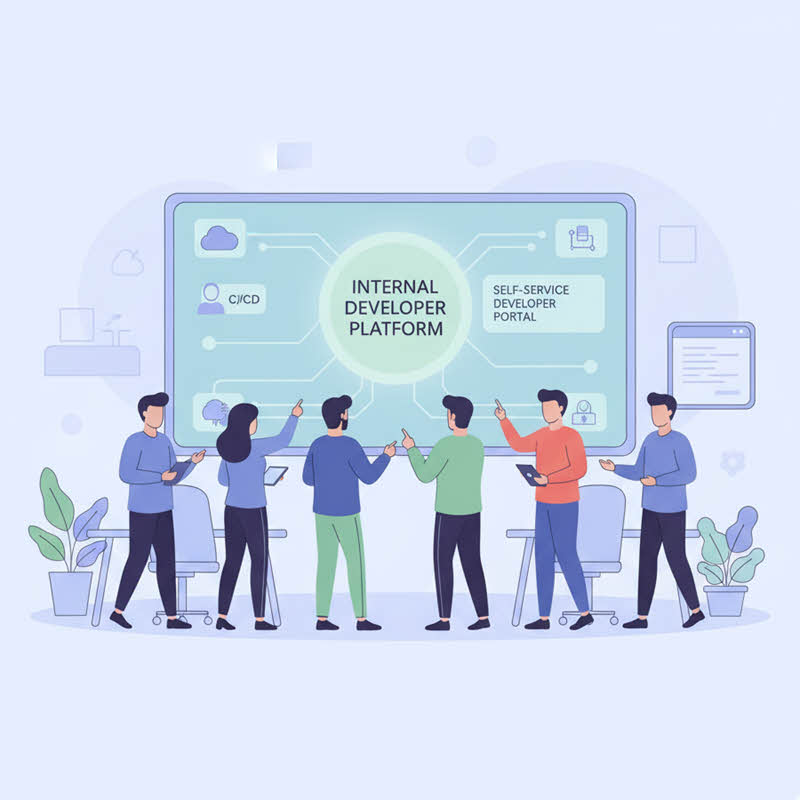
Platform engineering is the process of building toolchains and workflows that empower developers with self-service capabilities. It enables them to manage the entire software lifecycle independently.
These toolchains and workflows together form what’s known as a platform, whose core is called the Internal Developer Platform (IDP).
This internal developer platform combines infrastructure, tools, and automation that developers need to deploy and manage applications more efficiently — without depending on operations teams.
In simple terms, an IDP is made up of the technologies and environments developers use every day, abstracted to fit their needs.
A platform engineering team typically builds and maintains these systems, treating developers as internal customers and the platform itself as an internal product.
Today, platform engineering best practices are gaining massive attention. Cloud providers like AWS and Azure are releasing new services to support platform engineering, while consulting firms such as Accenture are offering Platform Engineering-as-a-Service. The field is growing rapidly.
Why All the Hype?
To understand the excitement around platform engineering, we have to go back to the rise of DevOps.
Fifteen years ago, DevOps was revolutionary — it promised to break down silos between operations and development and accelerate software delivery.
For many organizations, DevOps delivered what it promised. But others struggled to achieve meaningful outcomes.
Why? Because of recurring anti-patterns — inefficient processes that hurt DevOps efficiency and slow down innovation.
One of the most common anti-patterns is when developers spend too much time managing infrastructure. This is where DevOps infrastructure abstraction becomes critical — allowing developers to work without worrying about what’s happening behind the scenes.
When DevOps Fails: Developers Drowning in Infrastructure Work
In many companies, small DevOps teams try to build and maintain their own platforms. They piece together tools, manage pipelines, and design workflows manually — effectively reinventing the wheel.
The result? Slower delivery, inconsistent results, and burnout.
This failure pattern is exactly what platform engineering best practices aim to prevent.
How Internal Developer Platforms Fill the Infrastructure Gap
If you’re familiar with ITIL’s Service Catalog, then you already understand part of the concept.
Both the ITIL service catalog and internal developer platforms act as centralized resources for managing and delivering services inside an organization.
An ITIL service catalog gives an overview of available IT services, their descriptions, and SLAs.
Likewise, an IDP (such as Backstage or Humanitec) serves as a self-service portal for developers to access tools, environments, and data pipelines.
When comparing internal platforms vs service catalog, the difference lies in automation — the IDP doesn’t just describe services; it executes them.
Both approaches improve visibility, standardization, and efficiency across teams.
Following the “Golden Path” with a Product Mindset
Platform engineering simplifies DevOps through a concept called the golden path DevOps — a pre-defined set of tools and workflows that help developers work faster without reinventing processes.
Golden paths promote consistency, scalability, and security across development environments.
To make this work, think of your internal platform as a product, and your development teams as customers.
Apply product management principles to platform design:
- Understand the needs of your internal users.
- Collect feedback and prioritize new features based on impact.
- Maintain a roadmap and continuously iterate based on usage insights.
This mindset ensures your platform engineering team roles evolve strategically — focusing on long-term value rather than one-off tool integration.
When Should You Adopt Platform Engineering?
A common question is when to adopt platform engineering.
As a general rule, organizations with 20 or more developers are ready to benefit from it.
Most DevOps engineers are already familiar with the required toolchains — like Terraform, Kubernetes, or GitOps — meaning the learning curve is relatively short.
If your team is evaluating platform engineering readiness assessment, start by analyzing pain points in your current DevOps workflows:
- Are developers slowed down by repetitive setup tasks?
- Do you have multiple CI/CD systems with little standardization?
- Is infrastructure management creating bottlenecks?
Answering these questions can help you identify whether your organization is ready to make the shift.
Here are a few actionable steps you can take:
- Run a pilot project to explore the feasibility of platform engineering best practices in your environment.
- Evaluate your internal developer platform against current DevOps workflows to identify gaps.
- Join communities like platformengineering.org to connect with peers.
- Invest in training to upskill your team on DevOps tooling workflow and platform operations.
- Document your own golden path DevOps strategy to guide future scalability.
Final Thoughts
Platform Engineering isn’t just another buzzword. It’s the next evolution of DevOps — combining infrastructure abstraction, golden paths, and internal developer platforms to make software delivery faster, safer, and more developer-friendly.
- Explore whether there will be a demand for Platform Engineering in the near future and prepare for it.
- Consider running a repeatable pilot Platform Engineering project.
- Continue to deepen your knowledge through blog posts (like this one) and books on Platform Engineering.
- Join user groups, conferences, and Slack communities—you can find these communities at www.platformengineering.org.
- Last but not least, enroll in some Platform Engineering training courses!
If your organization is serious about scaling development efficiency, now is the time to start exploring the platform engineering readiness assessment and move toward a self-service future.
Pham Dinh Truong
TIGO CONSULTING
 Explore more on these topics























 Guest Blogging: The Definitive Guide

 Top Trending Topics
 Share This
 Link copied!
 Recently Updated News
