

MLOps vs AIOps: What’s the Difference and Why It Matters
Last updated: October 28, 2025 Read in fullscreen view


 Recommended for you
- 06 Mar 2026
 Next-Generation AI Agents Explained: OpenClaw, NanoClaw, IronClaw and the Rise of Agent Architectures 365/405
 - 14 Aug 2024 From Steel to Software: The Reluctant Evolution of Japan's Tech Corporates 208/755
- 17 Jul 2023 What Is SSL? A Simple Explanation Even a 10-Year-Old Can Understand 198/293
- 29 Oct 2024 Top AI Tools and Frameworks You’ll Master in an Artificial Intelligence Course 190/597
- 01 Dec 2025 Manufacturing 4.0: AI Agents Enabling Self-Optimizing Production Systems 184/245
- 02 Dec 2025 The Question That Shook Asia: What Happens When We Ask AI to Choose Between a Mother and a Wife? 182/224
- 05 Jun 2025 How AI-Driven Computer Vision Is Changing the Face of Retail Analytics 175/299
- 20 Mar 2022 What is a Multi-Model Database? Pros and Cons? 175/1404
- 09 Jul 2024 What Is Artificial Intelligence and How Is It Used Today? 170/432
- 23 Dec 2024 Garbage In, Megabytes Out (GIMO): How to Rise Above AI Slop and Create Real Signal 168/223
- 21 Nov 2025 Top 8 Cloud Transformation Companies in USA in 2026 166/222
- 16 Oct 2025 AI Inference Explained Simply: What Developers Really Need to Know 163/197
- 06 Dec 2025 Enterprise Operations 2.0: Why AI Agents Are Replacing Traditional Automation 158/202
- 12 May 2026 Top 6 AI AR/VR Filter Tools for Mind-Blowing Videos and Photos in 2026 152/173
- 21 Apr 2026 Vibe Coding vs. Expert Shopify Development: What AI Tools Can (and Can't) Do? 143/168
- 06 Nov 2025 DataOps: The Next Frontier in Agile Data Management 143/202
- 02 Jan 2024 What is User Provisioning & Deprovisioning? 139/736
- 13 Nov 2021 What Is Bleeding Edge Technology? Are bleeding edge technologies cheaper? 137/708
- 03 Jul 2022 What is the difference between Project Proposal and Software Requirements Specification (SRS) in software engineering? 135/1176
- 04 Feb 2026 Top Workflow Automation Services Driving Digital Transformation 135/170
- 25 Nov 2025 How AI Agents Are Redefining Enterprise Automation and Decision-Making 135/193
- 25 Dec 2025 What Is Algorithmic Fairness? Who Determines the Value of Content: Humans or Algorithms? 130/175
- 05 Jul 2020 What is Sustaining Software Engineering? 129/1475
- 15 Apr 2024 Weights & Biases: The AI Developer Platform 121/312
- 21 Aug 2023 30 Must-Know IT Consulting Buzzwords Explained 119/150
- 06 Jan 2026 Risk & Change Management Through the 3P Model 118/164
- 01 Jul 2025 The Hidden Costs of Not Adopting AI Agents: Risk of Falling Behind 117/266
- 16 Aug 2022 What is a Headless CMS? 115/401
- 22 Sep 2022 Why is it important to have a “single point of contact (SPoC)” on an IT project? 112/1110
- 10 Apr 2022 What is predictive analytics? Why it matters? 111/292
- 16 Mar 2023 10 Reasons to Choose a Best-of-Breed Tech Stack 109/323
- 10 Nov 2025 Multi-Modal AI Agents: Merging Voice, Text, and Vision for Better CX 105/220
- 27 Aug 2025 How AI Consulting Is Driving Smarter Diagnostics and Hospital Operations 105/205
- 21 Nov 2025 The Rise of AgentOps: How Enterprises Are Managing and Scaling AI Agents 104/161
- 12 Jan 2026 Companies Developing Custom AI Models for Brand Creative: Market Landscape and Use Cases 104/137
- 15 Dec 2025 What Does ERP-Friendly Mean? A Practical Guide for Modern Enterprises 100/144
- 21 Aug 2024 What is Singularity and Its Impact on Businesses? 100/562
- 30 Jan 2022 What Does a Sustaining Engineer Do? 100/735
- 24 Dec 2024 Artificial Intelligence and Cybersecurity: Building Trust in EFL Tutoring 99/269
- 09 Sep 2025 Aligning BI Dashboards with KPIs: A Business + Data Collaboration Guide 99/187
- 15 May 2025 AI Consulting for Small Businesses: How to Leverage AI for Growth & Efficiency 99/292
- 16 Sep 2022 Examples Of Augmented Intelligence In Today’s Workplaces Shaping the Business as Usual 99/536
- 07 Nov 2025 Online vs. Offline Machine Learning Courses in South Africa: Which One Should You Pick? 98/170
- 05 Aug 2024 Revisiting the Mistake That Halted Japan's Software Surge 98/447
- 25 Apr 2021 What is outstaffing? 97/369
- 31 Dec 2021 What is a Data Pipeline? 95/300
- 06 May 2025 How Machine Learning Is Transforming Data Analytics Workflows 94/291
- 24 Oct 2025 AI Agents in SaaS Platforms: Automating User Support and Onboarding 90/161
- 28 Nov 2025 How AI Will Transform Vendor Onboarding and Seller Management in 2026 89/219
- 24 Aug 2022 7 Ways to Improve Software Maintenance 89/392
- 22 Sep 2025 Why AI Is Critical for Accelerating Drug Discovery in Pharma 83/198
- 01 Mar 2023 What is Unit Testing? Pros and cons of Unit Testing? 81/509
- 04 Oct 2023 The Future of Work: Harnessing AI Solutions for Business Growth 81/362
- 21 Apr 2025 Agent AI in Multimodal Interaction: Transforming Human-Computer Engagement 72/268
- 05 Aug 2024 Affordable Tech: How Chatbots Enhance Value in Healthcare Software 66/298
- 29 May 2026 The Role of IoT in Modern Insurance App Development 64/75
- 17 Mar 2025 Integrating Salesforce with Yardi: A Guide to Achieving Success in Real Estate Business 61/269
- 29 Aug 2025 How AI Is Transforming Modern Management Science 60/128
- 06 Nov 2025 Top AI Development Companies in the USA to Watch in 2026 44/288
- 13 Jul 2026 Why Every AI Initiative Needs Regular Audits 39/46
- 24 Mar 2026 AI for Financial Reconciliation: Automating Finance Operations in 2026 1/193
| About the Author | Anand Subramanian | Technology expert and AI enthusiast |
Anand Subramanian is a technology expert and AI enthusiast currently leading the marketing function at Intellectyx, a Data, Digital, and AI solutions provider with over a decade of experience working with enterprises and government departments. |
Artificial Intelligence has moved from experimental to essential. Across industries, organizations are scaling AI-driven solutions to improve decision-making, streamline operations, and enhance customer experiences. But with this rapid adoption comes a pressing challenge: how to deploy, manage, and operationalize these AI systems effectively.
That is where two critical disciplines come into play: MLOps and AIOps. While they sound similar, their purposes, processes, and impacts differ significantly. Understanding these differences is not just a technical necessity; it is a strategic advantage for any enterprise planning to modernize its data and AI infrastructure.
This article breaks down MLOps and AIOps, explores where they intersect, and explains why knowing the difference could determine whether your AI initiatives scale successfully or stall in experimentation.
Understanding MLOps: The Engine Behind Scalable AI Models
MLOps, short for Machine Learning Operations, is the practice of managing and automating the lifecycle of machine learning models. It extends DevOps principles to the world of AI, focusing on how to build, train, deploy, and monitor ML models in production.
At its core, MLOps ensures that the insights your data scientists generate do not remain confined to Jupyter notebooks. Instead, they evolve into production-grade applications that continuously learn and improve.
Key Pillars of MLOps
Automation of the ML Lifecycle
From data ingestion and model training to deployment and retraining, MLOps introduces automation pipelines that replace manual, error-prone processes.
Model Versioning and Governance
MLOps ensures every model version, training dataset, and configuration is tracked. This transparency supports reproducibility, auditing, and regulatory compliance.
Continuous Integration and Continuous Deployment (CI/CD)
Just as DevOps enables rapid software delivery, MLOps enables continuous model delivery. Models can be updated and rolled out with minimal downtime.
Monitoring and Feedback Loops
Once in production, MLOps systems monitor model performance, data drift, and prediction accuracy. When performance drops, retraining workflows can trigger automatically.
Why Enterprises Need MLOps
Without MLOps, data science efforts often become bottlenecks. Models take months to deploy, and when they do, they break because of shifting data patterns. MLOps prevents this by bringing order and scalability to the chaos of AI experimentation.
It transforms AI from a one-off project into a repeatable, measurable process, ensuring every model is production-ready, compliant, and delivering business value. For enterprises looking to accelerate their ML initiatives, the right strategy might be to hire MLOps engineers teams who can build and maintain these MLOps pipelines effectively.
Understanding AIOps: Intelligence for IT Operations
While MLOps focuses on operationalizing machine learning models, AIOps (Artificial Intelligence for IT Operations) focuses on applying AI to optimize IT infrastructure and operations.
Coined by Gartner, AIOps combines machine learning, big data, and automation to improve how enterprises manage complex IT environments. In essence, it brings intelligence to the world of monitoring, alerting, and incident management.
Key Pillars of AIOps
Data Aggregation from IT Systems
AIOps ingests vast amounts of data from logs, metrics, events, and traces across systems, applications, and networks.
Noise Reduction and Correlation
Instead of drowning IT teams in thousands of alerts, AIOps filters out noise and identifies meaningful patterns, showing which alerts truly matter.
Root Cause Analysis and Prediction
AIOps uses anomaly detection and correlation to pinpoint the root cause of incidents and predict potential outages before they occur.
Automation and Self-Healing
With AIOps, repetitive manual tasks like restarting services, adjusting resources, or rolling back deployments can be automated based on predictive insights.
Why Enterprises Need AIOps
Today’s IT ecosystems are hybrid, dynamic, and sprawling. Traditional monitoring tools cannot handle the volume, velocity, and variety of operational data being generated.
AIOps empowers IT teams with proactive insights and automated remediation. Instead of reacting to problems, organizations can predict and prevent them, reducing downtime, optimizing performance, and improving user experiences. Businesses that are serious about scaling operational intelligence often hire AIOps engineers specialists to integrate these platforms seamlessly across their cloud and on-prem environments.
MLOps vs AIOps: The Core Difference
Although both MLOps and AIOps use AI and automation, their objectives and domains are very different.
| Aspect | MLOps | AIOps |
|---|---|---|
| Primary Focus | Operationalizing machine learning models | Applying AI to manage IT operations |
| Goal | Accelerate model deployment and maintain ML performance | Improve IT efficiency and reduce downtime |
| Users | Data scientists, ML engineers, DevOps teams | IT operations teams, site reliability engineers |
| Core Functionality | Model training, versioning, deployment, and monitoring | Anomaly detection, event correlation, and automated remediation |
| Output | Production-ready AI models | Self-healing, intelligent IT systems |
| Tech Stack | ML pipelines, data versioning tools, CI/CD frameworks | Observability platforms, log analyzers, automation tools |
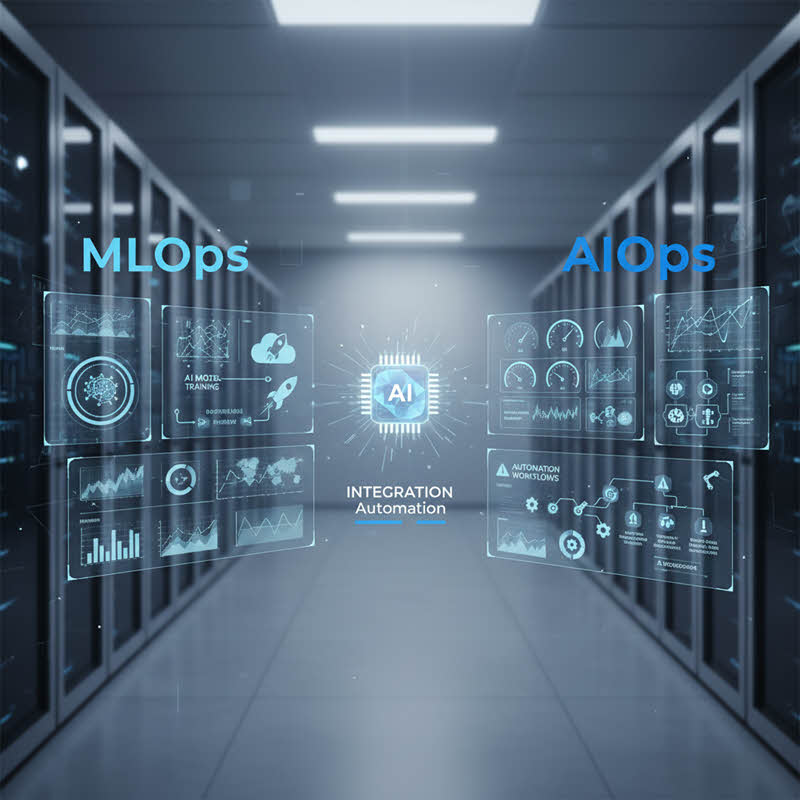
In short, MLOps manages the AI models, while AIOps uses AI to manage IT systems.
Think of MLOps as building the car (the model) and AIOps as maintaining the road and traffic systems (the infrastructure) that keep everything running smoothly. Both are vital, but they serve distinct functions in an enterprise’s digital transformation journey.
How MLOps and AIOps Work Together
Although different in purpose, MLOps and AIOps are increasingly interdependent in mature enterprise environments.
Imagine a global bank that deploys AI models to detect fraud (MLOps). Those models run on a hybrid infrastructure spanning on-prem servers and cloud environments. If system performance drops, model accuracy might degrade. Here’s where AIOps comes in: it ensures that the infrastructure supporting the model is healthy, resilient, and optimized.
Together, they create a closed feedback loop:
- MLOps manages the intelligence (the AI models).
- AIOps manages the environment (the IT systems running those models).
As AI adoption scales, this synergy becomes non-negotiable. Enterprises that align both disciplines gain faster model delivery, more reliable infrastructure, and a more agile innovation pipeline.
Why the Difference Matters for Your Business
Understanding the distinction between MLOps and AIOps is more than academic, it directly impacts your organization’s ability to scale AI and automation. Here’s why it matters:
- Investment Alignment: Many organizations mistakenly invest in AIOps when they actually need MLOps, or vice versa. Knowing the difference ensures you fund the right capabilities. If your bottleneck lies in deploying machine learning models faster, MLOps is the answer. If your challenge is IT noise, downtime, or inefficiency, you need AIOps.
- Cross-Team Collaboration: When MLOps and AIOps teams work together, data flows more freely between data science and IT operations. This reduces silos and accelerates digital transformation.
- Risk Reduction and Governance: MLOps enforces governance across models, while AIOps improves visibility into system health. Together, they reduce both operational and compliance risks, especially in regulated industries like finance, healthcare, and telecom.
- Better ROI from AI Investments: AI initiatives fail when models never reach production or when production environments collapse under complexity. By combining MLOps and AIOps, enterprises ensure both innovation and stability, translating into measurable business outcomes.
Real-World Examples of MLOps and AIOps in Action
MLOps Example: Predictive Maintenance in Manufacturing
A global automotive company uses MLOps pipelines to build and deploy predictive maintenance models. These models analyze sensor data to forecast equipment failures before they occur.
- Without MLOps: Each model took months to deploy and often failed due to inconsistent environments.
- With MLOps: Automated pipelines reduced deployment time to days and improved prediction accuracy through continuous retraining.
AIOps Example: IT Infrastructure Optimization in Telecom
A telecom provider uses AIOps to monitor millions of events per day from network devices and applications.
- Without AIOps: The IT team was flooded with false alerts, leading to longer downtimes.
- With AIOps: The system automatically correlates alerts, identifies root causes, and initiates fixes, reducing outages by 40%.
Implementing MLOps and AIOps: Where to Start
If your organization is planning to adopt either (or both), here’s a roadmap to start effectively:
For MLOps
- Audit Your Current ML Lifecycle – Identify where bottlenecks occur: model training, deployment, or monitoring.
- Build an End-to-End ML Pipeline – Automate data ingestion, versioning, and deployment.
- Integrate CI/CD for Models – Treat ML models like software releases.
- Monitor Models in Production – Track drift, accuracy, and fairness continuously.
For AIOps
- Aggregate Observability Data – Bring together logs, metrics, and traces across systems.
- Apply AI Models for Noise Reduction – Focus human attention only on high-impact issues.
- Automate Common Resolutions – Build scripts or workflows for recurring incidents.
- Adopt Continuous Learning – Use historical data to refine future incident predictions.
Both disciplines benefit from a clear strategy, cross-functional collaboration, and the right technology stack.
The Future: Convergence of MLOps and AIOps
As AI matures, the boundary between MLOps and AIOps is blurring. Enterprises want autonomous systems that not only deploy AI models but also self-optimize their underlying infrastructure.
Imagine a system where:
- MLOps continuously refine fraud detection models.
- AIOps ensures that the system scales and heals itself automatically.
- Together, they form a self-learning, self-operating AI ecosystem.
This convergence is the next evolution in AI-driven enterprises, where operations and intelligence are no longer separate functions but parts of a unified strategy.
Final Thoughts: Choosing the Right Path
Whether your focus is building smarter models or running smarter systems, understanding MLOps and AIOps is crucial.
- If you are struggling to move models from lab to production, start with MLOps.
- If your IT operations are reactive and fragmented, invest in AIOps.
- And if you aim for an intelligent, resilient, and self-optimizing enterprise, bring both together.
Organizations that master this balance will not only deploy AI faster but will also sustain it with the resilience, scalability, and governance modern business demands.
Anand Subramanian
Technology expert and AI enthusiast
Anand Subramanian is a technology expert and AI enthusiast currently leading the marketing function at Intellectyx, a Data, Digital, and AI solutions provider with over a decade of experience working with enterprises and government departments.
 Explore more on these topics
























 Guest Blogging: The Definitive Guide

 Top Trending Topics
 Share This
 Link copied!
 Recently Updated News
 thực chiến - Kiến tạo tương lai cho các nhà sáng tạo nội dung.