



What is the Data, Information, Knowledge, Wisdom (DIKW) Pyramid?
Last updated: December 09, 2022 Read in fullscreen view


 Recommended for you
- 18 Oct 2020
 How to use the "Knowns" and "Unknowns" technique to manage assumptions 163/1257
 - 30 Oct 2022 How Much Does MVP Development Cost in 2023? 149/406
- 09 Jan 2022 How to Bridge the Gap Between Business and IT? 143/346
- 19 Oct 2021 Software development life cycles 143/821
- 01 Sep 2022 Facts Chart: Why Do Software Projects Fail? 127/720
- 13 Oct 2021 Outsourcing Software Development: MVP, Proof of Concept (POC) and Prototyping. Which is better? 126/602
- 04 Oct 2021 Product Validation: The Key to Developing the Best Product Possible 122/430
- 07 Oct 2025 Case Study: Using the “Messaging House” Framework to Build a Digital Transformation Roadmap 121/200
- 11 Jan 2024 What are the Benefits and Limitations of Augmented Intelligence? 119/605
- 13 Dec 2020 Move fast, fail fast, fail-safe 117/456
- 18 Aug 2022 What are the consequences of poor requirements with software development projects? 116/384
- 06 Feb 2021 Why fail fast and learn fast? 113/588
- 01 Oct 2020 Fail fast, learn faster with Agile methodology 112/1186
- 10 Apr 2021 RFP vs POC: Why the proof of concept is replacing the request for proposal 111/438
- 12 Oct 2022 14 Common Reasons Software Projects Fail (And How To Avoid Them) 108/673
- 12 Aug 2024 Understanding Google Analytics in Mumbai: A Beginner's Guide 106/213
- 07 Jul 2021 The 5 Levels of IT Help Desk Support 102/578
- 14 Mar 2024 Why should you opt for software localization from a professional agency? 100/239
- 28 Jul 2022 POC, Prototypes, Pilots and MVP: What Are the Differences? 100/840
- 23 Sep 2021 INFOGRAPHIC: Top 9 Software Outsourcing Mistakes 98/521
- 08 Nov 2022 4 tips for meeting tough deadlines when outsourcing projects to software vendor 97/387
- 08 Aug 2022 Difference between Power BI and Datazen 96/428
- 03 Dec 2025 IT Outsourcing Solutions Explained: What, How, Why, When 96/128
- 12 Dec 2021 Zero Sum Games Agile vs. Waterfall Project Management Methods 95/509
- 31 Aug 2022 What are the best practices for software contract negotiations? 95/366
- 16 Feb 2021 Choose Outsourcing for Your Non Disclosure Agreement (NDA) 93/263
- 28 Jul 2025 Data Modernization for SMBs: Small Steps, Big Impact 93/243
- 14 Oct 2021 Advantages and Disadvantages of Time and Material Contract (T&M) 92/985
- 05 Sep 2023 The Cold Start Problem: How to Start and Scale Network Effects 91/288
- 05 Mar 2021 How do you minimize risks when you outsource software development? 86/419
- 08 Oct 2022 KPI - The New Leadership 85/692
- 28 Dec 2021 8 types of pricing models in software development outsourcing 85/519
- 07 Aug 2022 Things to Consider When Choosing a Technology Partner 84/367
- 09 Feb 2023 The Challenge of Fixed-Bid Software Projects 80/329
- 06 Mar 2024 [SemRush] What Are LSI Keywords & Why They Don‘t Matter 79/281
- 10 Nov 2022 Poor Code Indicators and How to Improve Your Code? 79/296
- 19 Oct 2021 Is gold plating good or bad in project management? 78/909
- 01 Dec 2023 Laws of Project Management 78/393
- 10 Dec 2023 Pain points of User Acceptance Testing (UAT) 77/535
- 17 Feb 2022 Prioritizing Software Requirements with Kano Analysis 75/379
- 18 Jul 2021 How To Ramp Up An Offshore Software Development Team Quickly 73/665
- 19 Apr 2021 7 Most Common Time-Wasters For Software Development 72/617
- 03 Nov 2022 Top questions and answers you must know before ask for software outsourcing 72/357
- 04 Oct 2022 Which ERP implementation strategy is right for your business? 70/430
- 01 May 2024 Warren Buffett’s Golden Rule for Digital Transformation: Avoiding Tech Overload 69/277
- 16 Apr 2021 Insightful Business Technology Consulting at TIGO 69/523
- 01 Mar 2023 Bug Prioritization - What are the 5 levels of priority? 68/297
- 10 Jul 2025 Building AI-Driven Knowledge Graphs from Unstructured Data 68/230
- 12 Mar 2024 How do you create FOMO in software prospects? 67/240
- 31 Oct 2021 Tips to Fail Fast With Outsourcing 65/456
- 20 Nov 2022 Software Requirements Are A Communication Problem 61/303
- 05 Jan 2024 Easy ASANA tips & tricks for you and your team 60/258
- 06 Mar 2021 4 things you need to do before getting an accurate quote for your software development 60/757
- 07 Oct 2022 Digital Transformation: Become a Technology Powerhouse 59/306
- 01 May 2023 CTO Interview Questions 59/394
- 28 Oct 2022 Build Operate Transfer (B.O.T) Model in Software Outsourcing 57/467
- 26 Dec 2023 Improving Meeting Effectiveness Through the Six Thinking Hats 53/329
- 09 Mar 2022 Consultant Implementation Pricing 49/261
- 01 Mar 2023 How do you deal with disputes and conflicts that may arise during a software consulting project? 47/207
- 17 Mar 2025 IT Consultants in Digital Transformation 41/131
- 06 Nov 2019 How to Access Software Project Size? 39/296
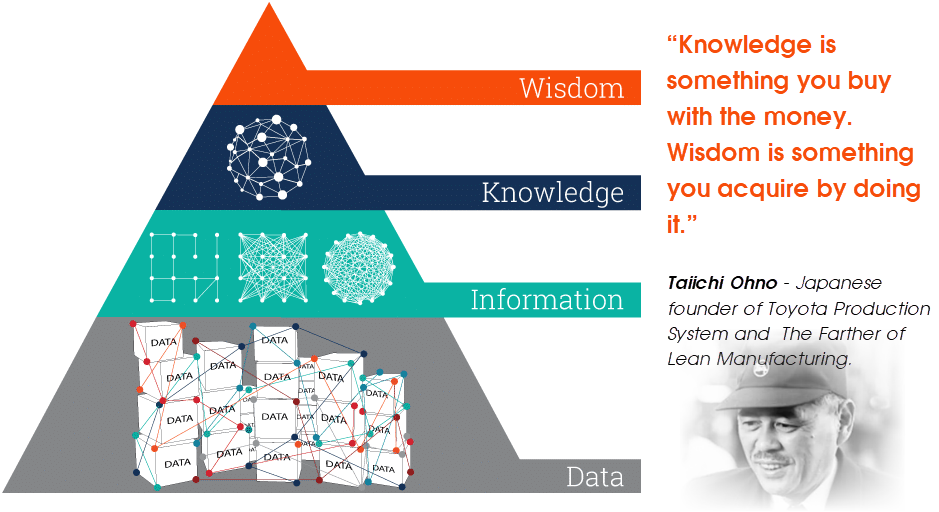
Knowledge Pyramid, Wisdom Hierarchy and Information Hierarchy are some of the names referring to the popular representation of the relationships between data, information, knowledge and wisdom in the Data, Information, Knowledge, Wisdom (DIKW) Pyramid.
Like other hierarchy models, the Knowledge Pyramid has rigidly set building blocks – data comes first, information is next, then knowledge follows and finally wisdom is on the top.
Each step up the pyramid answers questions about the initial data and adds value to it. The more questions we answer, the higher we move up the pyramid. In other words, the more we enrich our data with meaning and context, the more knowledge and insights we get out of it. At the top of the pyramid, we have turned the knowledge and insights into a learning experience that guides our actions.
How To Scale Data Up The Knowledge Pyramid
So, let’s have a look at the individual components of the Knowledge Pyramid and how we move from one to the next.
Data
Data is a collection of facts in a raw or unorganized form such as numbers or characters.
However, without context, data can mean little. For example, 12012012 is just a sequence of numbers without apparent importance. But if we view it in the context of ‘this is a date’, we can easily recognize 12th of January, 2012. By adding context and value to the numbers, they now have more meaning.
In this way, we have transformed the raw sequence of numbers into:
Information
Information is the next building block of the DIKW Pyramid. This is data that has been “cleaned” of errors and further processed in a way that makes it easier to measure, visualize and analyze for a specific purpose.
Depending on this purpose, data processing can involve different operations such as combining different sets of data (aggregation), ensuring that the collected data is relevant and accurate (validation), etc. For example, we can organize our data in a way that exposes relationships between various seemingly disparate and disconnected data points. More specifically, we can analyze the Dow Jones index performance by creating a graph of data points for a particular period of time, based on the data at each day’s closing.
By asking relevant questions about ‘who’, ‘what’, ‘when’, ‘where’, etc., we can derive valuable information from the data and make it more useful for us.
But when we get to the question of ‘how’, this is what makes the leap from information to
Knowledge
“How” is the information, derived from the collected data, relevant to our goals? “How” are the pieces of this information connected to other pieces to add more meaning and value? And, maybe most importantly, “how” can we apply the information to achieve our goal?
When we don’t just view information as a description of collected facts, but also understand how to apply it to achieve our goals, we turn it into knowledge. This knowledge is often the edge that enterprises have over their competitors. As we uncover relationships that are not explicitly stated as information, we get deeper insights that take us higher up the DIKW pyramid.
But only when we use the knowledge and insights gained from the information to take proactive decisions, we can say that we have reached the final – ‘wisdom’ – step of the Knowledge Pyramid.
Wisdom
Wisdom is the top of the DIKW hierarchy and to get there, we must answer questions such as ‘why do something’ and ‘what is best’. In other words, wisdom is knowledge applied in action.
We can also say that, if data and information are like a look back to the past, knowledge and wisdom are associated with what we do now and what we want to achieve in the future.
How Enterprises And Organizations Move Up The Knowledge Pyramid
One easy and fast way for enterprises to take the steps from data to information to knowledge and wisdom is to use Semantic Technologies such as Linked Data and Semantic Graph Databases. These technologies can create links between disparate and heterogeneous data and infer new knowledge out of existing facts.
Armed with this new knowledge, enterprises can climb up the mountain of wisdom and gain a competitive advantage by supporting their business decisions with data-driven analytics.
 Explore more on these topics

























 Guest Blogging: The Definitive Guide

 Top Trending Topics
 Share This
 Link copied!
 Recently Updated News