

Applying the business mantra "HORENSO" to Achieve 360-degree Communication
Last updated: October 20, 2025 Read in fullscreen view


 Recommended for you
- 01 Aug 2024
 The Standish Group report 83.9% of IT projects partially or completely fail 808/2630
 - 02 Nov 2023 Unlocking Success with The Amoeba Management Model: Key Lessons, Pros & Cons, and Finding the Perfect Fit 387/1079
- 09 Sep 2022 Kaizen, Kaikaku and Kakushin – what’s the difference? 376/3459
- 24 Nov 2022 Genba Genbutsu Genjitsu (3Gs), (Go to the Genba & see for yourself!) 299/3311
- 01 Dec 2023 What is Amoeba Management? 289/1285
- 10 Nov 2021 5S methodology - the SECRET to Japanese SUCCESS 278/2028
- 13 Apr 2024 Lessons on Teamwork and Leadership from Chinese story book "Journey to the West" 271/1363
- 07 Mar 2023 Japan’s Unusual Farming Strategy: Renting Land and Leaving It Fallow for 5 Years — Here’s the Truth… 216/343
- 03 Jan 2024 What is the Ringi process? 209/1230
- 02 Nov 2021 What is Terms of Reference (ToR)? 180/1759
- 18 Oct 2020 How to use the "Knowns" and "Unknowns" technique to manage assumptions 168/1263
- 01 Mar 2022 The Toyota Way Management Principles 165/981
- 29 Jan 2026 Honne and Tatemae: Why Do Japanese People Seem Excessively Polite and Indirect? 154/178
- 28 Oct 2025 The Future of Real Estate: Key Trends and Essential Lessons in Digital Transformation 150/222
- 01 Apr 2022 Ishikawa (fishbone) diagram in software project management 146/3341
- 02 Feb 2022 Yokoten: Best Practice Sharing from a success 146/1574
- 31 Dec 2025 26 Things You Should Do Now to Prepare for 2026 142/189
- 09 Sep 2022 What is 5 Whys (Five Whys)? 138/1113
- 29 Aug 2022 Difference between Kaizen and Innovation 133/1040
- 23 Sep 2021 INFOGRAPHIC: Top 9 Software Outsourcing Mistakes 129/552
- 19 Sep 2022 Jidoka in Software Development and Odoo ERP/MRP 127/678
- 18 Aug 2022 What are the consequences of poor requirements with software development projects? 126/394
- 06 Jun 2022 HEIJUNKA: The art of leveling production 124/747
- 07 Dec 2023 12 project management myths to avoid 121/313
- 11 Jan 2024 What are the Benefits and Limitations of Augmented Intelligence? 120/606
- 01 Jan 2023 How To Use Poka-Yoke (Mistake Proofing) Technique To Improve Software Quality 120/780
- 13 Dec 2020 Move fast, fail fast, fail-safe 120/461
- 01 Oct 2020 Fail fast, learn faster with Agile methodology 119/1193
- 27 Aug 2022 Kaizen - Culture of Continuous Improvement and Lean Thinking 119/1015
- 23 Jun 2024 Best Practices for Managing Project Escalations 119/324
- 06 Feb 2021 Why fail fast and learn fast? 116/594
- 29 Nov 2021 Memorandum of Understanding (MOU) for Partnership Agreements 114/685
- 01 Mar 2024 10 Project Management Myths 114/288
- 01 Jan 2024 6 Japanese Life Principles That Quietly Transform You 110/235
- 15 Jul 2022 Hansei Methodology: Continuously Engaging People in Improvement 110/867
- 02 May 2022 What Is RAID in Project Management? (With Pros and Cons) 110/963
- 03 Apr 2022 Microsoft Solutions Framework (MSF) 109/1453
- 17 Mar 2023 Reduce waste in software development with 3M model: Muda, Mura, Muri 106/1077
- 12 Mar 2022 The u-Japan concept 106/395
- 15 Apr 2022 Total Quality Management (TQM) - Japanese-style management approach to quality improvement. 105/834
- 04 Mar 2024 Tree Ring Management: Take the Long Term View and Grow Your Business Slowly 104/549
- 12 Aug 2022 What is End-to-end project management? 102/610
- 14 Mar 2024 Why should you opt for software localization from a professional agency? 102/241
- 20 Dec 2021 What is Hybrid Mobile App Development? 102/504
- 07 Nov 2022 Why Design Thinking can save the outsourcing industry 101/293
- 14 Oct 2021 Advantages and Disadvantages of Time and Material Contract (T&M) 99/997
- 02 Nov 2022 Difference between Change Management and Project Management 98/330
- 03 Jan 2023 Organizing your agile teams? Think about M.A.T (Mastery, Autonomy, Purpose) 98/497
- 28 Dec 2021 8 types of pricing models in software development outsourcing 96/530
- 12 Dec 2024 Danshari: A Japanese Minimalist Philosophy for Cleaner Code and Leaner IT Operations 93/178
- 17 Feb 2022 Prioritizing Software Requirements with Kano Analysis 90/394
- 09 May 2022 Build one to throw away vs Second-system effect: What are differences? 90/402
- 05 Feb 2024 Ego and Attachment: Simplify Your Life Today 89/374
- 10 Apr 2024 The Parking Lot Method: Unlocking a Simple Secret to Supercharge Your Productivity 89/611
- 19 Oct 2021 Is gold plating good or bad in project management? 88/919
- 08 Oct 2022 KPI - The New Leadership 87/696
- 22 May 2022 What are common mistakes that new or inexperienced managers make? 85/366
- 01 Aug 2022 Is planning "set it and forget it" or "set it and check it"? 85/384
- 10 Nov 2022 Poor Code Indicators and How to Improve Your Code? 84/301
- 17 Oct 2021 Does Fast Tracking increase project cost? 84/469
- 14 Jun 2022 Example and Excel template of a RACI chart in Software Development 84/958
- 10 Dec 2023 Pain points of User Acceptance Testing (UAT) 83/544
- 18 Dec 2023 The Cone of Uncertainty in Scrum & Requirement Definition 82/818
- 18 Oct 2021 Key Elements to Ramping Up a Large Team 80/1342
- 12 Mar 2024 How do you create FOMO in software prospects? 78/252
- 07 Jul 2022 Managing Project Execution Terms 77/484
- 18 Feb 2026 "Hit and Run" Project Management: Balancing Speed with Sustainability 77/103
- 01 Mar 2023 Bug Prioritization - What are the 5 levels of priority? 75/304
- 01 Jun 2020 Japan Business Review (JBR) 75/410
- 03 Feb 2024 "Kham Nhẫn" in Business: A Guide to Patience and Resilience 73/236
- 19 Apr 2021 7 Most Common Time-Wasters For Software Development 72/617
- 31 Oct 2021 Tips to Fail Fast With Outsourcing 70/461
- 27 Jan 2020 Should a project manager push developers to work more hours due to mistakes of manager schedule setting? 68/509
- 15 May 2022 20 Common Mistakes Made by New or Inexperienced Project Managers 67/350
- 02 Dec 2021 3 Ways to Avoid Scope Creep in IT Consulting 65/274
- 24 Nov 2023 The project management paradox: Achieving MORE by doing LESS 65/295
- 02 Jun 2024 Reviving Ancient Wisdom: The Spiritual Side of Project Management 64/328
- 05 Jun 2023 Fractional, Part-Time (virtual) or Interim CTO: Who Will Cover Your Business Needs? 63/206
- 05 Jan 2024 Easy ASANA tips & tricks for you and your team 63/262
- 06 Jun 2022 Change Management at the Project Level 63/369
- 20 Jul 2022 Software Myths and Realities 63/1005
- 26 Sep 2024 Successful Project Management Techniques You Need to Look Out For 62/459
- 06 Dec 2024 Steps For Integrating Sustainable Practices Into Business Operations 61/210
- 30 Nov 2023 Project Managers, Focus on Outcomes — Not Deliverables 61/222
- 13 Jan 2020 Quiz: Test your understanding project cost management 56/704
- 10 May 2022 Levels of Teamwork 55/250
- 26 Dec 2023 Improving Meeting Effectiveness Through the Six Thinking Hats 54/330
- 21 Jun 2024 Dead Horses and the Escalation of Commitment 51/190
- 06 Nov 2019 How to Access Software Project Size? 49/307
- 03 Dec 2025 Templafy Features Explained: The Ultimate Guide to Streamlined Content Management 14/184
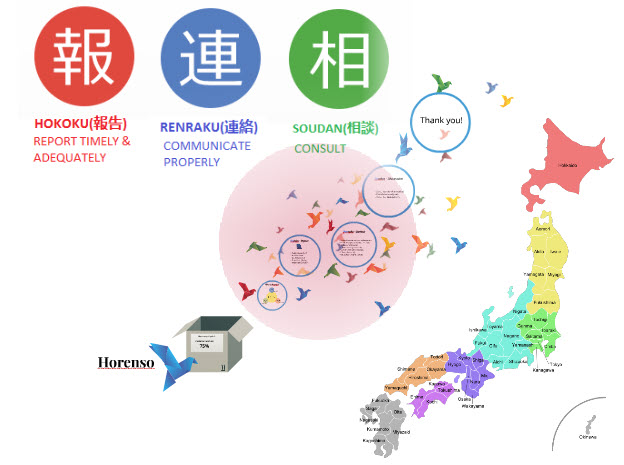
Horensou is one of the most famous business etiquettes practiced in Japan. It is short for Report, Contact, and Consult in Japanese Business
The meaning of HORENSO
The concept of ho-ren-so, which are Japanese abbreviations for report, update and consult respectively, was originally developed for use in the manufacturing industry. It assumed a strict hierarchy, and the concept was designed for factory-workers to send a continual stream of information up to their managers, to ensure that they could make decisions with full information.
Ho-ren-so is a strictly one-way process, with no information being passed back down the hierarchy. In that model, it is assumed that all decisions are made at the top and passed back down the chain of command, with little to no feedback to what factory workers communicated upwards. Another major weakness is that decisions are concentrated at the top, which often leads to slow decisions and a lack of empowerment among employees.
Things to keep in mind:
- HO – Keep Everyone Informed
- REN – Stay in Touch and Follow Up
- SO – Consulting
Ho-Hōkoku (報告) refers to reporting. Regular reporting from subordinates to their supervisors on the work progress is essential. Junior staff must keep their immediate boss or any affected co-workers informed on the status of the task including items such as how a job is going when a job is done, or whether there are any hiccups or issues. Specifically, when problems arise, they must be reported immediately as the senior colleagues are usually the ones who are responsible for them. Ren-Renraku (連絡) means communication. Proper communication of simple information between co-workers must be facilitated regardless of rank or status. Such information refers to important details that could affect the work of your team. In contrast to hokoku where you report to a senior colleague, renraku is free sharing of important information amongst all ranks. For instance, if there are any project delays, you should communicate this information to all affected colleagues so they can adapt accordingly to the new work situation and minimize disruptions as much as possible. So-Sōdan (相談) is simply consulting with senior colleagues. When you need to make work decisions, the Japanese approach is that advice should be sought from seniors in order to lessen the burden of having to deal with the situation alone. Consultations between junior and senior colleagues are essential for building trust and resolving issues as a team. While it is fine to make your own decisions if you feel confident to do so, you should still keep your superiors in the loop about your decision and the eventual outcome.
Applying Horenso to your work to facilitate communication
To apply Ho, the idea is that everyone should be informed on what’s going on in the company. Taking the chance to speak up and offer information, being an active listener, and participating more in daily meetings would strengthen the exchange of information within your organization, especially when conferences are mostly conducted online these days. If your company does not have many meetings, it may be worth pitching 5-minute group chats at the start or end of each working day to stay on top of things as a team.
Ren could be applied by staying in touch and following up with one another. Email may not be the best medium for communication so it could be better to schedule a video call to your co-workers or bosses if physical check-ins are not possible these days. If you do need to email someone, be sure to follow up with a call or in-person as your co-workers may be bombarded by so many emails each day that they may not have seen your messages.
Looking before you leap is the key to applying So. Double-check with your colleagues before you make any work decisions. They may offer suggestions to revisions regarding your decision to learn to take it in your stride. The collectivist culture of making a decision works to ensure that the very best decision is made in the interest of the company. Anyway, it doesn’t hurt to have an extra pair of eyes to check what you are doing before you take your next step in the decision-making process.
Wrapping
HORENSO can be a Japanese concept used in Japanese companies, but it can be easily applied to the work culture of any country. If you feel that your workplace has difficulty maintaining the flow of information, try to implement the HORENSO model with your colleagues.
 Explore more on these topics





















 Guest Blogging: The Definitive Guide

 Top Trending Topics
 Share This
 Link copied!
 Recently Updated News