

Difference between Kaizen and Innovation
Last updated: October 20, 2025 Read in fullscreen view


 Recommended for you
- 02 Nov 2023
 Unlocking Success with The Amoeba Management Model: Key Lessons, Pros & Cons, and Finding the Perfect Fit 369/1057
 - 09 Sep 2022 Kaizen, Kaikaku and Kakushin – what’s the difference? 357/3431
- 24 Nov 2022 Genba Genbutsu Genjitsu (3Gs), (Go to the Genba & see for yourself!) 268/3274
- 10 Nov 2021 5S methodology - the SECRET to Japanese SUCCESS 268/2015
- 01 Dec 2023 What is Amoeba Management? 257/1250
- 03 Jan 2024 What is the Ringi process? 200/1217
- 07 Mar 2023 Japan’s Unusual Farming Strategy: Renting Land and Leaving It Fallow for 5 Years — Here’s the Truth… 188/311
- 21 Sep 2023 Abraham Wald and the Missing Bullet Holes 184/886
- 18 Oct 2020 How to use the "Knowns" and "Unknowns" technique to manage assumptions 163/1257
- 01 Mar 2022 The Toyota Way Management Principles 148/960
- 01 Dec 2022 Difference between Set-based development and Point-based development 136/498
- 02 Feb 2022 Yokoten: Best Practice Sharing from a success 134/1558
- 01 Apr 2022 Ishikawa (fishbone) diagram in software project management 133/3322
- 21 May 2022 "Fail Fast, Fail Often, Fail Forward" is the answer to Agile practices of software success 132/1181
- 10 Apr 2022 Agile self-organizing teams: What are they? How do they work? 129/687
- 09 Sep 2022 What is 5 Whys (Five Whys)? 128/1103
- 06 Nov 2023 How do you streamline requirement analysis and modeling? 125/362
- 27 Oct 2020 8 principles of Agile Testing 124/1439
- 19 Sep 2022 Jidoka in Software Development and Odoo ERP/MRP 123/673
- 29 Jan 2026 Honne and Tatemae: Why Do Japanese People Seem Excessively Polite and Indirect? 120/144
- 11 Jan 2024 What are the Benefits and Limitations of Augmented Intelligence? 119/605
- 06 Jun 2022 HEIJUNKA: The art of leveling production 118/738
- 18 Aug 2022 What are the consequences of poor requirements with software development projects? 117/385
- 03 Jul 2022 Manifesto for Agile Software Development 117/387
- 13 Dec 2020 Move fast, fail fast, fail-safe 117/456
- 16 Jul 2022 What are disadvantages of Agile Methodology? How to mitigate the disadvantages ? 115/511
- 23 Sep 2021 INFOGRAPHIC: Top 9 Software Outsourcing Mistakes 115/538
- 20 Jan 2021 Fail early, fail often, fail cheap, fail safe but always fail forward 115/930
- 28 Nov 2023 Scrum Team Failure — Scrum Anti-Patterns Taxonomy 114/369
- 06 Feb 2021 Why fail fast and learn fast? 113/588
- 01 Oct 2020 Fail fast, learn faster with Agile methodology 112/1186
- 27 Aug 2022 Kaizen - Culture of Continuous Improvement and Lean Thinking 111/1003
- 19 Jul 2022 The 12 Principles of Continuous Process Improvement 106/645
- 15 Jul 2022 Hansei Methodology: Continuously Engaging People in Improvement 105/858
- 02 Nov 2021 [Case Study] Streamlined Data Reporting using Tableau 105/408
- 12 Mar 2022 The u-Japan concept 102/391
- 11 Nov 2021 What is an IT Self-service Portal? Why is it Important to Your Business? 101/548
- 01 Jan 2023 How To Use Poka-Yoke (Mistake Proofing) Technique To Improve Software Quality 100/760
- 14 Mar 2024 Why should you opt for software localization from a professional agency? 100/239
- 17 Mar 2023 Reduce waste in software development with 3M model: Muda, Mura, Muri 100/1070
- 04 Mar 2024 Tree Ring Management: Take the Long Term View and Grow Your Business Slowly 99/543
- 13 Jul 2022 Applying the business mantra "HORENSO" to Achieve 360-degree Communication 99/1059
- 15 Apr 2022 Total Quality Management (TQM) - Japanese-style management approach to quality improvement. 99/824
- 20 Nov 2022 Agile working method in software and football 95/435
- 14 Oct 2021 Advantages and Disadvantages of Time and Material Contract (T&M) 92/985
- 12 Dec 2024 Danshari: A Japanese Minimalist Philosophy for Cleaner Code and Leaner IT Operations 92/175
- 07 Oct 2020 How To Manage Expectations at Work (and Why It's Important) 88/421
- 08 Oct 2022 KPI - The New Leadership 87/694
- 28 Dec 2021 8 types of pricing models in software development outsourcing 87/521
- 11 Jul 2022 Lean software development - the game-changer in the digital age 87/378
- 01 Jun 2022 How Your Agile Development Team is Just Like a Football Team? 84/302
- 09 Sep 2024 How AI Rewriting Can Improve Your Content’s SEO Performance 83/280
- 01 Jan 2024 The pros and cons of the Centralized Enterprise Automation Operating model 81/305
- 02 Dec 2022 Success Story: Satsuki - Sales Management Software, back office app for School Subscription Management 79/318
- 10 Nov 2022 Poor Code Indicators and How to Improve Your Code? 79/296
- 19 Oct 2021 Is gold plating good or bad in project management? 78/909
- 09 Oct 2022 Key Advantages and Disadvantages of Agile Methodology 77/781
- 03 Apr 2021 How digital asset management streamlines your content workflow? 77/405
- 10 Dec 2023 Pain points of User Acceptance Testing (UAT) 77/535
- 20 Jan 2022 TIGO Self-Organization Practice: Change Management Workflow 76/547
- 17 Feb 2022 Prioritizing Software Requirements with Kano Analysis 75/379
- 03 Sep 2022 The secret of software success: Simplicity is the ultimate sophistication 74/279
- 01 Jun 2020 Japan Business Review (JBR) 73/408
- 19 Apr 2021 7 Most Common Time-Wasters For Software Development 72/617
- 12 Oct 2020 The Agile Manifesto - Principle #8 72/567
- 13 Feb 2021 Why is TIGOSOFT a software house for Enterprise Application Development? 70/450
- 01 Mar 2023 Bug Prioritization - What are the 5 levels of priority? 68/297
- 03 May 2024 The Iceberg of Ignorance 68/496
- 12 Mar 2024 How do you create FOMO in software prospects? 68/241
- 31 Oct 2021 Tips to Fail Fast With Outsourcing 65/456
- 05 Jan 2024 Easy ASANA tips & tricks for you and your team 60/258
- 21 Jun 2021 6 Useful Tips To Streamline Business Processes and Workflows 59/590
- 05 Oct 2021 Shiny Object Syndrome: Why Your Business Isn't "Going Digital" 59/440
- 26 Sep 2024 Successful Project Management Techniques You Need to Look Out For 57/454
- 16 Jun 2022 Rapid Application Development (RAD): Pros and Cons 57/938
- 01 Mar 2022 Why Does Scrum Fail in Large Companies? 54/318
- 26 Dec 2023 Improving Meeting Effectiveness Through the Six Thinking Hats 53/329
- 10 Oct 2022 Should Your Business Go Agile? (Infographic) 48/172
- 21 Oct 2022 Virtual meeting - How does TIGO save cost, reduce complexity and improve quality by remote communication? 47/237
- 11 Jan 2022 Lean Thinking and Lean Transformation 47/308
- 02 Nov 2022 Frequently Asked Questions about Agile and Scrum 43/440
- 06 Nov 2019 How to Access Software Project Size? 39/296
- 01 May 2023 Understanding Business as Usual (BAU) and How to Transition 38/1159
- 12 Sep 2024 Be Water, My Friend: Fluidity, Flow & Going With the Flow 29/198
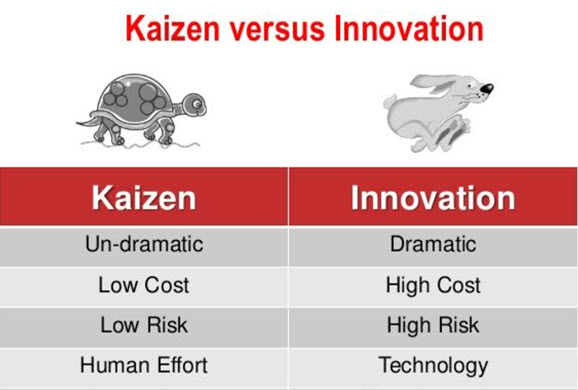
Kaizen is a Japanese word that roughly translates to Continuous Improvement or Continual Improvement. This is in contrast to Innovation which focuses on large improvements in Productivity or Quality through a drastic change either in the product or process.
While Kaizen and innovation both bring improvements in the company’s products and/or services, processes, and business models, they have big differences, especially in the way they are implemented and the results they are bringing to the company.
As a small business owner, you will always work on different types of improvements in your company. It doesn’t matter if you want to improve your products and services, or process. If you want to stay ahead of your competitors you will always work on improvements. Because of that, it is important to know about the difference between Kaizen and innovation.
Kaizen is characterized by the Kaizen mindset which believes that:
- The existing operations always have a lot of room for improvement
- The existing facilities and methods can always be improved by spending some efforts
- The accumulation of small improvements makes a big difference
- Kaizen is a broad concept under which many other concepts, tools and techniques fit in. Tools such as 5S, Quality circles, the PDCA Cycle, 5Ws and 1H, 3Ms, Poka-Yoke, SMED, Kanban (Just – in –Time), 7QC Tools, etc. came under the umbrella of Kaizen.
Kaizen versus Innovation
Kaizen, on the other hand, can lead to an excellent performance from old products, processes and machines sometimes even beyond that of new ones. In some cases, the need to go in for new products, processes and machines can be eliminated or delayed if such performance is not required by the market. In today’s world, most companies adopt a combination of both Kaizen and Innovation depending on the requirements of the market.
Masaaki Imai, the author of the Kaizen concept, differentiates two major management components: maintenance and improvement.
Maintenance requires activities such as maintaining the company’s current operations to technological, managerial, and operational standards. On the other hand, improvement can be broken down into Kaizen and innovation. It is logical because both concepts will lead to different improvements. Innovation is something totally new, while improvement is something existing that will give better results.
Combination of Kaizen and Innovation
Both concepts are important for your small business. The KAIZEN is something that you can make on an everyday basis. In such a way your company will be better each day. You will decrease costs, increase productivity, profitability, etc.
But still, after some period of time, you will need to implement innovation processes to bring high-rate improvement in your business operations. For example, you will need to innovate new processes, buy new modernized equipment, bring new products onto the market, etc.
So, combining the KAIZEN concept with innovation will be important for your success as an entrepreneur and your business overall.
As you can see, both concepts are important for your small business. The KAIZEN is something that you can make on an everyday basis. In such a way your company will be better each day. You will decrease costs, increase productivity, profitability, etc.
But still, after some period of time, you will need to implement innovation processes to bring high-rate improvement in your business operations. For example, you will need to innovate new processes, buy new modernized equipment, bring new products onto the market, etc.
So, combining the KAIZEN concept with innovation will be important for your success as an entrepreneur and your business overall.
 Explore more on these topics




















 Guest Blogging: The Definitive Guide

 Top Trending Topics
 Share This
 Link copied!
 Recently Updated News