



Transform Your Life with the Smallest Changes: A Summary of James Clear’s Atomic Habits
Last updated: October 21, 2025 Read in fullscreen view


 Recommended for you
- 18 Oct 2020
 How to use the "Knowns" and "Unknowns" technique to manage assumptions 168/1263
 - 19 Oct 2021 Software development life cycles 145/823
- 31 Dec 2025 26 Things You Should Do Now to Prepare for 2026 142/189
- 04 Oct 2021 Product Validation: The Key to Developing the Best Product Possible 134/442
- 13 Oct 2021 Outsourcing Software Development: MVP, Proof of Concept (POC) and Prototyping. Which is better? 130/608
- 23 Sep 2021 INFOGRAPHIC: Top 9 Software Outsourcing Mistakes 129/552
- 07 Oct 2025 Case Study: Using the “Messaging House” Framework to Build a Digital Transformation Roadmap 127/207
- 18 Aug 2022 What are the consequences of poor requirements with software development projects? 126/394
- 11 Jan 2024 What are the Benefits and Limitations of Augmented Intelligence? 120/606
- 13 Dec 2020 Move fast, fail fast, fail-safe 120/461
- 01 Oct 2020 Fail fast, learn faster with Agile methodology 119/1193
- 19 Sep 2023 PACER Thinking: Why Smart People Forget What They Read 118/208
- 28 Jul 2022 POC, Prototypes, Pilots and MVP: What Are the Differences? 117/859
- 06 Feb 2021 Why fail fast and learn fast? 116/594
- 12 Oct 2022 14 Common Reasons Software Projects Fail (And How To Avoid Them) 116/681
- 28 Nov 2025 Best Kentico CMS Development Practices for Agile Software Teams 113/168
- 12 Aug 2024 Understanding Google Analytics in Mumbai: A Beginner's Guide 112/219
- 01 Jan 2024 6 Japanese Life Principles That Quietly Transform You 110/235
- 10 Aug 2024 Odoo vs. Lark: A Comprehensive Comparison 109/939
- 14 Mar 2024 Why should you opt for software localization from a professional agency? 102/241
- 14 Oct 2021 Advantages and Disadvantages of Time and Material Contract (T&M) 99/997
- 12 Dec 2021 Zero Sum Games Agile vs. Waterfall Project Management Methods 98/512
- 31 Aug 2022 What are the best practices for software contract negotiations? 97/371
- 28 Dec 2021 8 types of pricing models in software development outsourcing 96/530
- 05 Sep 2023 The Cold Start Problem: How to Start and Scale Network Effects 95/293
- 05 Mar 2021 How do you minimize risks when you outsource software development? 93/426
- 17 Feb 2022 Prioritizing Software Requirements with Kano Analysis 90/394
- 19 Oct 2021 Is gold plating good or bad in project management? 88/919
- 08 Oct 2022 KPI - The New Leadership 87/696
- 10 Nov 2022 Poor Code Indicators and How to Improve Your Code? 85/302
- 06 Mar 2024 [SemRush] What Are LSI Keywords & Why They Don‘t Matter 85/287
- 10 Dec 2023 Pain points of User Acceptance Testing (UAT) 83/544
- 01 Dec 2023 Laws of Project Management 81/396
- 12 Mar 2024 How do you create FOMO in software prospects? 78/252
- 18 Jul 2021 How To Ramp Up An Offshore Software Development Team Quickly 76/668
- 01 Mar 2023 Bug Prioritization - What are the 5 levels of priority? 75/304
- 19 Apr 2021 7 Most Common Time-Wasters For Software Development 72/617
- 04 Oct 2022 Which ERP implementation strategy is right for your business? 71/432
- 31 Oct 2021 Tips to Fail Fast With Outsourcing 70/461
- 01 May 2024 Warren Buffett’s Golden Rule for Digital Transformation: Avoiding Tech Overload 70/278
- 05 Jan 2024 Easy ASANA tips & tricks for you and your team 63/262
- 28 Oct 2022 Build Operate Transfer (B.O.T) Model in Software Outsourcing 62/472
- 02 Sep 2024 Toolzoon Review: Features, Benefits, and Essential Tools for Enhanced Productivity 62/304
- 26 Dec 2023 Improving Meeting Effectiveness Through the Six Thinking Hats 54/330
- 06 Nov 2019 How to Access Software Project Size? 49/307
- 21 Oct 2024 Simplify Your Workflow with an AI Summary Generator 47/227
Tiny Changes, Remarkable Results – That’s the promise James Clear delivers in his global bestseller, Atomic Habits. This book isn’t about dramatic, sweeping changes; it’s about the extraordinary power of small, incremental habits that accumulate over time.
Let’s dive into the core concepts and actionable strategies you can start applying immediately!
1. What Are "Atomic Habits"?
Definition: Atomic habits are tiny, regular actions that may seem insignificant at first, but when practiced consistently, they create remarkable results.
The Power of 1% Improvement:Focus on improving just 1% each day.
After 365 days, the cumulative improvement is roughly 1365≈371^{365} \approx 371365≈37 times better than doing nothing or falling behind.
2. The 4 Laws of Behavior Change
This is the core framework for building good habits and breaking bad ones:
| To Build a Good Habit | To Break a Bad Habit |
|---|---|
| Make it Obvious | Make it Invisible |
| Make it Attractive | Make it Unattractive |
| Make it Easy | Make it Difficult |
| Make it Satisfying | Make it Unsatisfying |
3. Other Key Concepts & Strategies
A. The Plateau of Latent Potential
Concept: When starting a new habit, there’s often a long period where results aren’t immediately visible. This is when patience matters most.
Key Insight: Habits require patience because breakthroughs usually arrive slower than expected. Don’t quit during this “plateau”—the results are quietly building underneath.
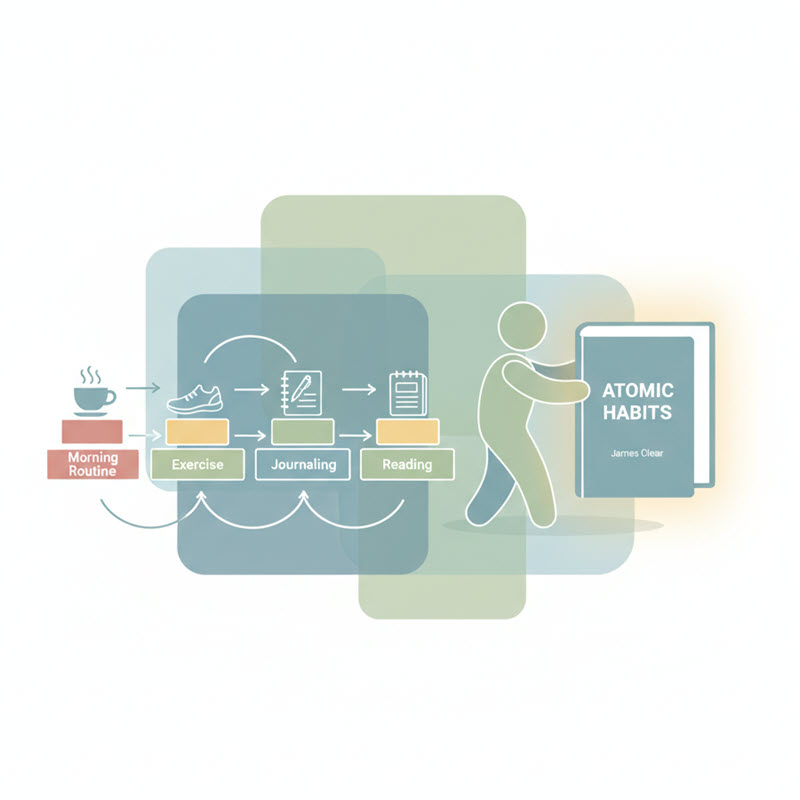
B. Habit Stacking
Strategy: Link a new habit you want to build to an existing habit that’s already deeply embedded in your routine.
Formula: “After [CURRENT HABIT], I will [NEW HABIT].”
Example: “After I brew my morning coffee (current habit), I will read one page of a book (new habit).”
C. Environment Design
Strategy: Shape your surroundings to make good habits easier and bad habits harder.
Example:
-
Want to practice guitar? Place it in the middle of your living room.
-
Want to eat healthier? Put fruit in plain sight and tuck away sweets in a cupboard.
D. The 2-Minute Rule
Strategy: Start a new habit with an action that takes less than two minutes. This helps overcome the initial resistance.
Goal: Standardize the habit before optimizing it.
Instead of: “Exercise for 30 minutes.”
Start with: “Put on my workout clothes.”
Instead of: “Write a chapter.”
Start with: “Write one sentence.”
E. Identity Change
Deepest Level of Change: The most sustainable habits come from creating a new identity, not just focusing on outcomes.
Priority Order: Identity → Processes → Outcomes
Instead of: “I want to lose 5kg” (Outcome)
Say: “I am someone who exercises every day” (Identity)
Key Insight: Act like the person you want to become. Habits will naturally follow.
In Summary
Success isn’t a single big event—it’s the product of daily habits. By applying the 4 Laws of Behavior Change and strategies like Habit Stacking or the 2-Minute Rule, you can fine-tune your system, overcome the Plateau of Latent Potential, and ultimately build an identity that delivers remarkable results from the tiniest changes.
 Explore more on these topics



























 Guest Blogging: The Definitive Guide

 Top Trending Topics
 Share This
 Link copied!
 Recently Updated News