



Are Expensive CRM Systems Really Worth It?
Last updated: October 23, 2025 Read in fullscreen view


 Recommended for you
- 05 Oct 2025
 The New Facebook Algorithm: A Paradigm Shift in Content Discovery 265/327
 - 14 Jan 2026 How to Evaluate the Business and Productivity Software Company Seismic on RFP AI Agent Use Cases 246/296
- 21 Dec 2023 Top 12 Low-Code Platforms To Use in 2024 208/1504
- 18 Oct 2020 How to use the "Knowns" and "Unknowns" technique to manage assumptions 163/1257
- 03 Oct 2025 Top CMS Trends 2026: The Future of Digital Content Management 162/191
- 25 Mar 2026 Token Bills: The "Cost Shock" After the AI Boom in Companies 152/172
- 31 Dec 2025 10 Skills to Make You "Irreplaceable" in the Next 3 Years (even if AI changes everything) 148/178
- 20 Dec 2025 The Future of IT Consulting: Key Trends for 2026–2030 146/187
- 19 Oct 2021 Software development life cycles 143/821
- 12 Jan 2026 Why YouTube Content Is the New Resume: Building Trust and Expertise Even Without Views 139/167
- 18 Jul 2024 The 8 Best ways to Innovate your SAAS Business Model in 2024 132/387
- 18 Sep 2025 Pilot Projects Explained: What They Are and How to Use Them Effectively 130/186
- 26 Mar 2026 What Is a System Integrator (SI)? Why the Software Subscription Model Is Becoming the New Standard 128/161
- 18 Dec 2025 EOS as a Business Operating System: Powerful, but Not Always Plug-and-Play 126/179
- 12 Apr 2025 How to Ask Powerful Questions Like Socrates 126/161
- 13 Oct 2021 Outsourcing Software Development: MVP, Proof of Concept (POC) and Prototyping. Which is better? 126/602
- 06 Nov 2023 How do you streamline requirement analysis and modeling? 125/362
- 04 Oct 2021 Product Validation: The Key to Developing the Best Product Possible 122/430
- 03 Jul 2022 What is the difference between Project Proposal and Software Requirements Specification (SRS) in software engineering? 121/1162
- 07 Oct 2025 Case Study: Using the “Messaging House” Framework to Build a Digital Transformation Roadmap 121/200
- 21 Jun 2022 Difference between Quality and Grade 119/948
- 11 Jan 2024 What are the Benefits and Limitations of Augmented Intelligence? 119/605
- 13 Dec 2020 Move fast, fail fast, fail-safe 117/456
- 18 Aug 2022 What are the consequences of poor requirements with software development projects? 116/384
- 04 Mar 2026 CRM Trends Shaping Customer Engagement in 2026 116/143
- 31 Dec 2025 The Curse of Knowledge in Pre-Project Requirements 113/169
- 20 Jan 2021 Fail early, fail often, fail cheap, fail safe but always fail forward 113/927
- 06 Feb 2021 Why fail fast and learn fast? 113/588
- 01 Oct 2020 Fail fast, learn faster with Agile methodology 112/1186
- 20 Feb 2025 How Machine Learning is Shaping the Future of Digital Advertising 110/232
- 12 Oct 2022 14 Common Reasons Software Projects Fail (And How To Avoid Them) 108/673
- 12 Aug 2024 Understanding Google Analytics in Mumbai: A Beginner's Guide 106/213
- 27 Jul 2024 Positive Psychology in the Digital Age: Future Directions and Technologies 105/533
- 16 Aug 2022 What is a Headless CMS? 105/391
- 01 Oct 2024 23 Overlooked Types of Non-Functional Requirements You Shouldn’t Ignore 105/147
- 02 Nov 2021 [Case Study] Streamlined Data Reporting using Tableau 103/406
- 11 Nov 2021 What is an IT Self-service Portal? Why is it Important to Your Business? 101/548
- 03 Jan 2024 Why Partnership is important for Growth? 101/259
- 02 Dec 2024 The Intersection of AI and Business Analytics: Key Concepts to Master in Your Business Analytics Course 101/396
- 14 Mar 2024 Why should you opt for software localization from a professional agency? 100/239
- 28 Jul 2022 POC, Prototypes, Pilots and MVP: What Are the Differences? 100/840
- 23 Sep 2021 INFOGRAPHIC: Top 9 Software Outsourcing Mistakes 98/521
- 16 Sep 2022 Examples Of Augmented Intelligence In Today’s Workplaces Shaping the Business as Usual 98/534
- 16 Mar 2023 10 Reasons to Choose a Best-of-Breed Tech Stack 98/310
- 31 Aug 2022 What are the best practices for software contract negotiations? 95/366
- 12 Dec 2021 Zero Sum Games Agile vs. Waterfall Project Management Methods 95/509
- 11 Oct 2022 Why choose Billable Viable Product (BVP) over Minimum Viable Product (MVP) 94/436
- 20 Aug 2025 What Is Agentic AI? The Next Phase of Artificial Intelligence 94/253
- 18 Jan 2024 Self-healing code is the future of software development 93/310
- 25 Sep 2024 Enhancing Decision-Making Skills with an MBA: Data-Driven Approaches for Business Growth 93/300
- 14 Oct 2021 Advantages and Disadvantages of Time and Material Contract (T&M) 92/985
- 05 Sep 2023 The Cold Start Problem: How to Start and Scale Network Effects 91/288
- 08 Apr 2026 Top AI Agent Development Companies for Manufacturing Industry (2026) 91/119
- 25 Jan 2025 The Decline of Traditional SaaS and the Rise of AI-first Applications 90/195
- 11 Jul 2022 Cost benefit analysis for software development 89/840
- 05 Mar 2021 How do you minimize risks when you outsource software development? 86/419
- 28 Dec 2021 8 types of pricing models in software development outsourcing 86/520
- 08 Oct 2022 KPI - The New Leadership 85/692
- 23 Jun 2025 AI Avatars in the Metaverse: How Digital Beings Are Redefining Identity and Social Interaction 85/272
- 01 Mar 2024 (AI) Artificial Intelligence Terms Every Beginner Should Know 84/418
- 24 Aug 2022 7 Ways to Improve Software Maintenance 82/385
- 01 Jan 2024 The pros and cons of the Centralized Enterprise Automation Operating model 81/305
- 30 Jul 2024 The Future of IT Consulting: Trends and Opportunities 80/290
- 06 Mar 2024 [SemRush] What Are LSI Keywords & Why They Don‘t Matter 80/282
- 10 Nov 2022 Poor Code Indicators and How to Improve Your Code? 79/296
- 19 Oct 2021 Is gold plating good or bad in project management? 78/909
- 01 Dec 2023 Laws of Project Management 78/393
- 02 Dec 2022 Success Story: Satsuki - Sales Management Software, back office app for School Subscription Management 78/317
- 10 Dec 2023 Pain points of User Acceptance Testing (UAT) 77/535
- 18 Aug 2024 The Future of Web Development: Emerging Trends and Technologies Every Developer Should Know 77/272
- 22 Nov 2024 The Role of AI in Enhancing Business Efficiency and Decision-Making 77/272
- 31 Dec 2022 The New Normal for Software Development 76/429
- 20 Jan 2022 TIGO Self-Organization Practice: Change Management Workflow 76/547
- 03 Apr 2021 How digital asset management streamlines your content workflow? 76/404
- 17 Feb 2022 Prioritizing Software Requirements with Kano Analysis 75/379
- 31 Dec 2023 Software Development Outsourcing Trends to Watch Out for in 2024 75/304
- 10 Sep 2024 Leading Remote Teams in Hybrid Work Environments 75/218
- 03 Sep 2022 The secret of software success: Simplicity is the ultimate sophistication 74/278
- 18 Jul 2021 How To Ramp Up An Offshore Software Development Team Quickly 73/665
- 27 Feb 2025 How AI Agents are Changing Software Development? 73/310
- 19 Apr 2021 7 Most Common Time-Wasters For Software Development 72/617
- 19 Dec 2023 How AI is Transforming Software Development? 72/365
- 03 Nov 2023 Why Is Billable Viable Product An Alternative To Minimum Viable Product? 71/262
- 04 Oct 2022 Which ERP implementation strategy is right for your business? 70/430
- 13 Feb 2021 Why is TIGOSOFT a software house for Enterprise Application Development? 70/450
- 04 Apr 2025 To Act or Not to Act – A Manager’s Persistent Dilemma 70/185
- 01 May 2024 Warren Buffett’s Golden Rule for Digital Transformation: Avoiding Tech Overload 69/277
- 01 Mar 2023 Bug Prioritization - What are the 5 levels of priority? 68/297
- 03 May 2024 The Iceberg of Ignorance 68/496
- 12 Mar 2024 How do you create FOMO in software prospects? 67/240
- 09 Oct 2024 Short-Form Video Advertising: The Secret to Captivating Your Audience 66/198
- 31 Oct 2021 Tips to Fail Fast With Outsourcing 65/456
- 05 Jan 2024 Easy ASANA tips & tricks for you and your team 60/258
- 21 Jun 2021 6 Useful Tips To Streamline Business Processes and Workflows 59/590
- 05 Oct 2021 Shiny Object Syndrome: Why Your Business Isn't "Going Digital" 59/440
- 28 Oct 2022 Build Operate Transfer (B.O.T) Model in Software Outsourcing 57/467
- 16 Jun 2022 Rapid Application Development (RAD): Pros and Cons 56/936
- 03 Jul 2022 Occam’s Razor and the Art of Software Design 54/556
- 08 Jan 2024 Ask Experts: Explicitation/Implicitation and Elicitation; two commonly used but barely unraveled concepts 53/434
- 26 Dec 2023 Improving Meeting Effectiveness Through the Six Thinking Hats 53/329
- 10 Sep 2024 AI in Email Marketing: Personalization and Automation 50/227
- 31 Dec 2022 Future of Software Development Trends and Predictions 46/197
- 06 Nov 2019 How to Access Software Project Size? 39/296
- 01 May 2023 Understanding Business as Usual (BAU) and How to Transition 35/1156
- 14 Feb 2024 Early BA Engagement: “Earning” Pre-Project Work 28/194
Brief: The CRM Cost Paradox
Why “affordable CRM” remains an illusion — and how smart businesses bridge the gap between cost, capability, and growth.
Key Challenge
Businesses want an affordable CRM that delivers enterprise-grade efficiency — but most options are either too expensive or too limited to scale.
Root Cause
The hidden gap lies not in software pricing, but in process maturity. Companies often overlook change management, post go-live costs, and the real AS-IS vs TO-BE transition.
Smart Direction
Treat CRM as a modular system, not a product.
Start lean with core modules (e.g. Odoo), then expand as you grow, combining offshore outsourcing for customization and AI-enabled automation to balance cost, scalability, and control.
A Strategic Look at ROI, GAPs, and the Hidden Costs Beneath the Surface
A deep dive into hidden costs, GAP Analysis, and the iceberg behind post go-live CRM operations.
In today’s business landscape, Customer Relationship Management (CRM) systems have evolved from “nice-to-have” to business-critical infrastructure. They promise efficiency, stronger sales pipelines, and data-driven decisions.
But the question remains: Do we really need to spend that much?
And if cheaper CRM options exist, why are they so hard to trust?
Let’s look beyond the price tag and explore what truly drives CRM value — and what many decision-makers overlook.
1. Understanding the CRM Value Proposition – and Its Real Cost
Premium CRM vendors charge what they do for a reason:
- Comprehensive functionality — from contact management, automation, analytics, and integration ecosystems.
- Scalability and customization — adapting to your business growth and evolving workflows.
- Security and reliability — protecting sensitive customer data with enterprise-grade infrastructure.
- Support and continuous innovation — training, onboarding, and regular feature updates.
Each of these layers represents not just a feature, but an operational commitment from the vendor — which naturally translates into cost.
2. GAP Analysis: Where Most Businesses Misjudge Their CRM Needs
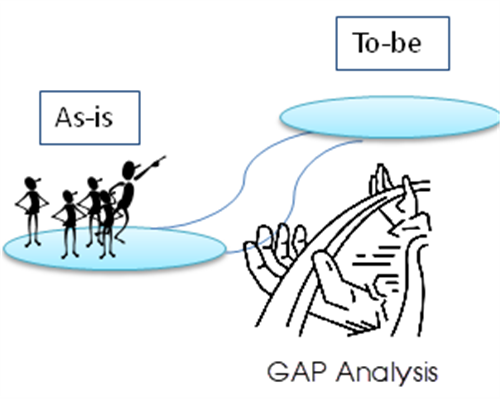
A GAP Analysis helps identify the distance between your AS-IS (current business process) and your TO-BE (desired future state).
When companies rush into CRM adoption without this analysis, they fall into two common traps:
| Stage | Description | Typical Mistake |
|---|---|---|
| AS-IS | How your business currently manages customers (manual spreadsheets, scattered data) | Underestimating process complexity |
| TO-BE | The ideal state where CRM automates and connects every touchpoint | Overestimating readiness or budget capacity |
| GAP | The real work needed to bridge AS-IS and TO-BE (data migration, process redesign, training) | Ignoring post-implementation adaptation cost |
3. The Iceberg Model: The Hidden (and Costly) Reality Beneath the Surface
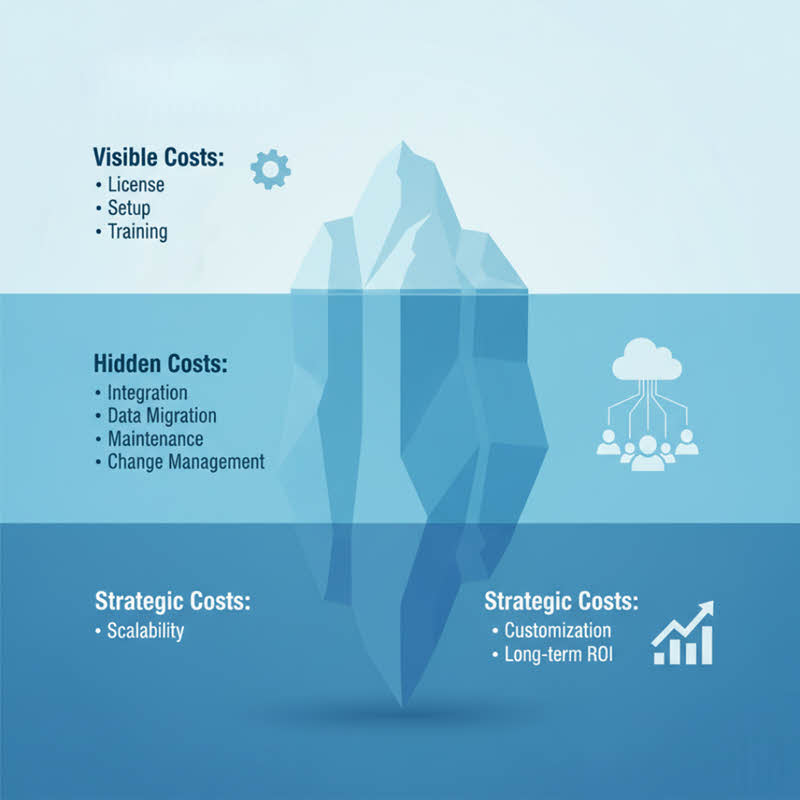
When buying CRM software, most executives only see the visible cost (license, setup fee). But beneath the surface lies a bigger chunk of hidden costs — much like the invisible part of an iceberg.
🟢 Visible Costs (Above Water)
- Software license / subscription
- Initial setup and configuration
- Basic user training
🔴 Hidden Costs (Below Water)
- Post go-live support and issue handling
- Data cleansing and migration
- Integration with legacy systems
- Custom module development
- Change management and retraining after staff turnover
- Downtime cost during transition or upgrades
4. The “Economy” CRM Dilemma – Why Affordable Doesn’t Mean Sustainable
There’s growing demand for budget-friendly CRM tools, but reliable options remain scarce. Why?
- Development costs are high even for “lite” versions.
- Profit margins shrink quickly under low-price models.
- Feature creep turns a simple CRM into an expensive one.
- Open-source competition (like Odoo or SuiteCRM) creates noise but requires strong internal IT.
- Brand trust still dictates buyer confidence.
Cheap CRMs exist, but they often fail to deliver sustainable value beyond the initial honeymoon phase.
5. Navigating the Grey Zone: Big Vendors vs Growth-Scale Strategy
Between enterprise-grade CRMs (Salesforce, HubSpot, Zoho Enterprise) and barebones open-source tools, there’s a grey zone — and this is where smart businesses win.
Option A: Go with Big Vendors
✅ Pros: Reliability, support, and proven scalability
❌ Cons: Expensive licenses, less flexibility, potential vendor lock-in
Option B: Growth-Scale Strategy ("Expand as You Grow")
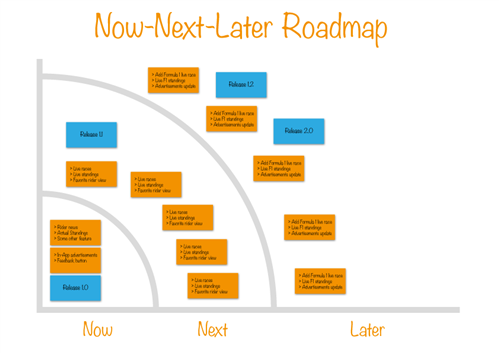
Start small with an open platform like Odoo CRM, focusing only on core modules (sales, contact, deals). Then gradually add advanced modules — automation, analytics, omnichannel integration — as your business scales.
This “core-first” model keeps your CAPEX low and shifts investment toward the areas that truly generate ROI.
Option C: Outsource Intelligently
You don’t have to buy everything off the shelf.
A hybrid strategy can be highly effective:
- Implement Odoo core modules in-house.
- Outsource development and customization to offshore teams in countries like Vietnam, the Philippines, or India, where technical quality is high but costs remain competitive.
- Keep system architecture open and well-documented for future migration flexibility.
→Design your CRM ecosystem as an evolving platform — a blend of core software, outsourced talent, and modular scalability.
6. Focus on ROI, Not Just Cost
The real question isn’t “how much does the CRM cost,” but “how much value will it generate over time?”
A well-implemented CRM improves:
- Conversion rates through better customer insight
- Retention via personalized engagement
- Productivity through automation
That’s your Return on Intelligence — not just investment.
7. The Future: Affordable, Modular, and AI-Augmented CRMs
As no-code/low-code platforms mature and AI assistants become embedded in CRMs, expect more “pay-for-what-you-use” models.
SMEs will soon have access to enterprise-grade capabilities without enterprise pricing — provided they know how to architect the system wisely from the start.
🔚 Conclusion: Think System, Not Software
CRM success isn’t about buying the most expensive or the cheapest tool — it’s about strategic alignment.
- Use GAP Analysis to define where you are and where you want to go.
- Apply the Iceberg Model to account for hidden costs.
- Navigate the grey zone wisely — don’t overpay for big names, but don’t underinvest in structure either.
At the end of the day, a CRM is not a product — it’s a business capability.
The smarter your architecture, the higher your ROI.
 Explore more on these topics

















 Guest Blogging: The Definitive Guide

 Top Trending Topics
 Share This
 Link copied!
 Recently Updated News