


Troubleshooting DX Failures: A Step-by-Step Fishbone Analysis
Last updated: October 24, 2025 Read in fullscreen view


 Recommended for you
- 21 Nov 2025
 Top 8 Cloud Transformation Companies in USA in 2026 164/220
 - 12 Jan 2026 Why YouTube Content Is the New Resume: Building Trust and Expertise Even Without Views 161/190
- 30 Oct 2022 How Much Does MVP Development Cost in 2023? 157/418
- 12 Apr 2025 How to Ask Powerful Questions Like Socrates 156/191
- 09 Jan 2022 How to Bridge the Gap Between Business and IT? 154/357
- 21 Nov 2025 The Pressure of Short-Term Funding on Small-Budget IT Projects 137/167
- 04 Feb 2026 Top Workflow Automation Services Driving Digital Transformation 135/170
- 01 Sep 2022 Facts Chart: Why Do Software Projects Fail? 134/729
- 18 Dec 2025 AI: Act Now or Wait Until You’re “Ready”? 125/165
- 10 Apr 2021 RFP vs POC: Why the proof of concept is replacing the request for proposal 124/452
- 21 Aug 2023 30 Must-Know IT Consulting Buzzwords Explained 115/146
- 06 Jan 2026 Risk & Change Management Through the 3P Model 113/158
- 07 Jul 2021 The 5 Levels of IT Help Desk Support 103/582
- 03 Dec 2025 IT Outsourcing Solutions Explained: What, How, Why, When 101/133
- 15 Dec 2025 What Does ERP-Friendly Mean? A Practical Guide for Modern Enterprises 99/143
- 08 Nov 2022 4 tips for meeting tough deadlines when outsourcing projects to software vendor 99/391
- 16 Feb 2021 Choose Outsourcing for Your Non Disclosure Agreement (NDA) 99/269
- 07 Aug 2022 Things to Consider When Choosing a Technology Partner 94/377
- 01 Mar 2024 (AI) Artificial Intelligence Terms Every Beginner Should Know 87/421
- 09 Feb 2023 The Challenge of Fixed-Bid Software Projects 85/334
- 10 Jul 2025 Building AI-Driven Knowledge Graphs from Unstructured Data 84/246
- 01 May 2023 Understanding Business as Usual (BAU) and How to Transition 75/1199
- 03 Nov 2022 Top questions and answers you must know before ask for software outsourcing 73/358
- 03 May 2024 The Iceberg of Ignorance 71/500
- 16 Apr 2021 Insightful Business Technology Consulting at TIGO 70/525
- 06 Mar 2021 4 things you need to do before getting an accurate quote for your software development 69/766
- 20 Nov 2022 Software Requirements Are A Communication Problem 69/312
- 07 Oct 2022 Digital Transformation: Become a Technology Powerhouse 65/312
- 05 Oct 2021 Shiny Object Syndrome: Why Your Business Isn't "Going Digital" 63/444
- 01 May 2023 CTO Interview Questions 60/395
- 08 Jan 2024 Ask Experts: Explicitation/Implicitation and Elicitation; two commonly used but barely unraveled concepts 58/439
- 03 Jul 2022 Occam’s Razor and the Art of Software Design 57/559
- 01 Mar 2023 How do you deal with disputes and conflicts that may arise during a software consulting project? 50/211
- 09 Mar 2022 Consultant Implementation Pricing 50/263
- 17 Mar 2025 IT Consultants in Digital Transformation 42/133
Digital transformation can be a game-changer, but many initiatives fail due to leadership gaps, process inefficiencies, and technology challenges. To succeed, organizations must streamline your business operations, keep it simple, but significant, and embrace agile transformation principles. In this article, we explore the common causes of digital transformation failure and provide actionable strategies to overcome them, ensuring your business thrives in the digital era.
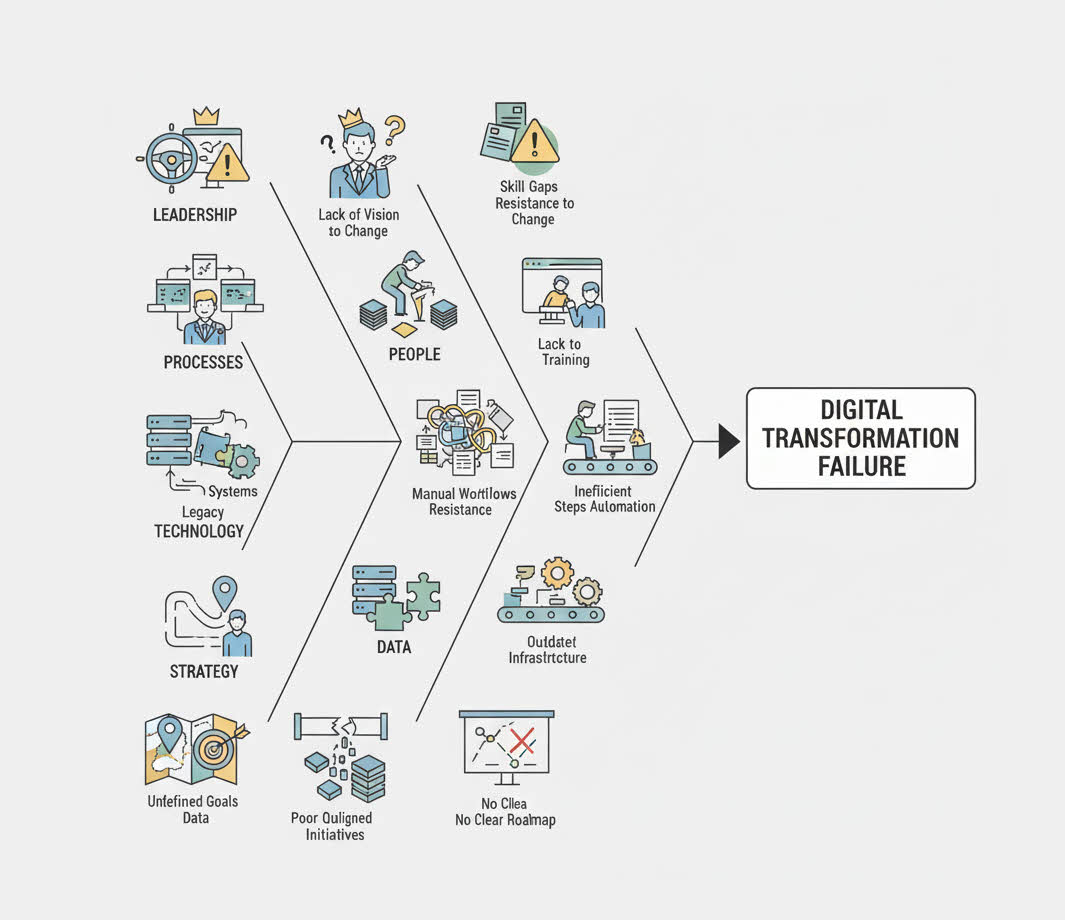
A Fishbone (Ishikawa) Diagram is a visual tool used to systematically identify the causes of a specific problem. In this example, we analyze the causes of digital transformation failures in organizations.
Main Causes of Digital Transformation Failure
1. LEADERSHIP VISION
-
Lack of leadership commitment
-
Short-term priorities: Focus on immediate benefits, ignoring long-term investment.
-
No resource allocation: Insufficient budget, personnel, or time for projects.
-
-
Unclear objectives
-
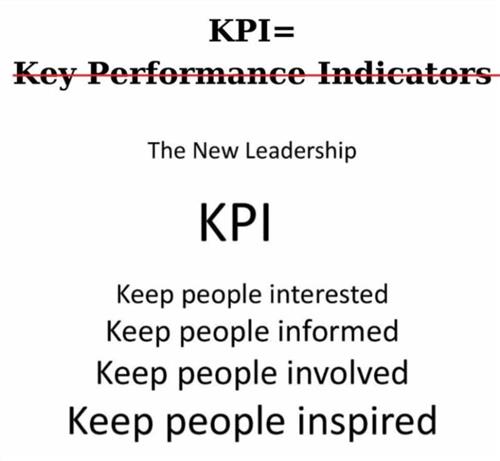
Undefined KPIs: Lack of measurable performance indicators for digital transformation.
-
No roadmap: Missing a step-by-step plan for initiatives.
-
2. HUMAN RESOURCES
-
Lack of digital skills / training
-
No training: End-users lack in-depth training on new processes.
-
Wrong hiring: Missing personnel with experience in digital technologies or change management.
-
-
Resistance to change
-
Poor communication: Middle management does not support the project or encourage system adoption.
-
Lack of motivation: Low morale, unclear reward or penalty system.
-
3. PROCESSES
-
Old processes simply digitized
-
No process redesign: Digitizing old processes without optimization.
-
-
Manual processes
-
No automation: Many manual steps remain.
-
Excessive steps: Processes are cumbersome and not lean.
-
-
Lack of BPM (Business Process Management)
-
No process modeling: Lack of clear management and process modeling.
-
-
Poor governance
-
Unclear authority: Missing management structure and responsibilities.
-
No guidelines: Absence of clear SOPs.
-
No quality control: Output of digitized processes is not controlled.
-
4. TECHNOLOGY PLATFORM
-
Legacy systems
-
No APIs: Old systems cannot connect via APIs.
-
Incompatibility: Old and new systems use different technologies.
-
-
Poor integration
-
Data silos: Data is scattered and not seamlessly integrated.
-
No ETL/ELT: Lack of extract, transform, and load tools.
-
-
Wrong technology choice
-
Not suitable for business: Chosen platform does not fit company scale or industry.
-
5. DATA
-
Poor quality data
-
No quality checks: Data is incorrect, duplicated, or inconsistent.
-
No standardization: Lack of unified rules and standards.
-
-
Lack of analysis
-
No BI usage: Business Intelligence tools are not utilized.
-
Not data-driven decisions: Decisions are still based on intuition.
-
6. STRATEGY / PLANNING
-
Unclear strategy
-
Not linked to business goals: Digital transformation is not aligned with company objectives.
-
-
Scope Creep
-
Uncontrolled changes: Continuous change requests expand scope without control.
-
 Explore more on these topics























 Guest Blogging: The Definitive Guide

 Top Trending Topics
 Share This
 Link copied!
 Recently Updated News