

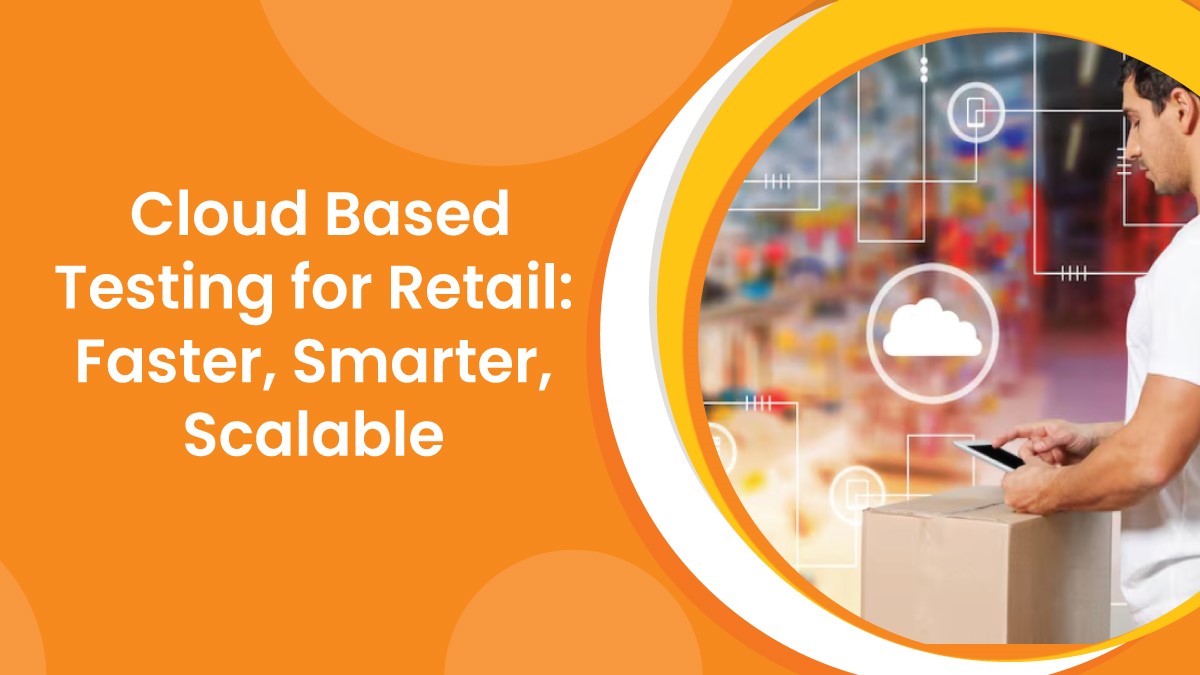
Cloud-Based Testing for Retail: Faster, Smarter, Scalable
Last updated: November 04, 2025 Read in fullscreen view


 Recommended for you
- 15 Feb 2024
 What is a Cut-Over in Software Development? 207/1536
 - 02 Nov 2023 Differences between software walkthrough, review, and inspection 179/2329
- 19 Oct 2021 Software development life cycles 145/823
- 10 Dec 2021 What is a Kano Analysis? 138/1062
- 04 Oct 2021 Product Validation: The Key to Developing the Best Product Possible 134/442
- 13 Oct 2021 Outsourcing Software Development: MVP, Proof of Concept (POC) and Prototyping. Which is better? 130/608
- 06 Nov 2023 How do you streamline requirement analysis and modeling? 129/366
- 20 Jan 2021 Fail early, fail often, fail cheap, fail safe but always fail forward 127/946
- 07 Oct 2025 Case Study: Using the “Messaging House” Framework to Build a Digital Transformation Roadmap 127/207
- 12 Oct 2022 14 Common Reasons Software Projects Fail (And How To Avoid Them) 116/681
- 28 Jul 2022 POC, Prototypes, Pilots and MVP: What Are the Differences? 116/858
- 12 Aug 2024 Understanding Google Analytics in Mumbai: A Beginner's Guide 112/219
- 02 May 2022 What Is RAID in Project Management? (With Pros and Cons) 110/963
- 02 Nov 2021 [Case Study] Streamlined Data Reporting using Tableau 110/413
- 11 Nov 2021 What is an IT Self-service Portal? Why is it Important to Your Business? 106/557
- 16 Mar 2023 10 Reasons to Choose a Best-of-Breed Tech Stack 106/320
- 10 Oct 2023 Exploratory Testing: A Creative and Adaptive Approach to Software Quality 101/183
- 12 Dec 2021 Zero Sum Games Agile vs. Waterfall Project Management Methods 98/512
- 31 Aug 2022 What are the best practices for software contract negotiations? 97/371
- 05 Sep 2023 The Cold Start Problem: How to Start and Scale Network Effects 95/293
- 07 Dec 2023 The Myths Of Requirements 94/356
- 05 Mar 2021 How do you minimize risks when you outsource software development? 93/426
- 20 Oct 2025 How to Automate API Testing for Faster Release Cycles? 93/192
- 21 Oct 2025 Cloud-Native Development: Why It’s the Future of Enterprise IT 93/182
- 01 Jan 2024 The pros and cons of the Centralized Enterprise Automation Operating model 91/315
- 24 Aug 2022 7 Ways to Improve Software Maintenance 88/391
- 04 Mar 2023 [Medium] Box-Ticking: The Management Strategy That’s Killing your Productivity 87/754
- 06 Mar 2024 [SemRush] What Are LSI Keywords & Why They Don‘t Matter 85/287
- 01 Feb 2024 How long does it take to develop software? 85/295
- 10 Nov 2021 Automated QA Outsourcing – Hire a Professional Software Testing Team 84/670
- 03 Apr 2021 How digital asset management streamlines your content workflow? 83/414
- 01 Dec 2023 Laws of Project Management 80/395
- 02 Dec 2022 Success Story: Satsuki - Sales Management Software, back office app for School Subscription Management 80/320
- 20 Jan 2022 TIGO Self-Organization Practice: Change Management Workflow 79/551
- 18 Jul 2021 How To Ramp Up An Offshore Software Development Team Quickly 76/668
- 03 Sep 2022 The secret of software success: Simplicity is the ultimate sophistication 75/280
- 13 Feb 2021 Why is TIGOSOFT a software house for Enterprise Application Development? 73/453
- 17 Dec 2025 Unaligned Escalation Logic: A Silent Risk in Complex Organizations 73/97
- 04 Oct 2022 Which ERP implementation strategy is right for your business? 71/432
- 01 May 2024 Warren Buffett’s Golden Rule for Digital Transformation: Avoiding Tech Overload 70/278
- 02 Apr 2022 Productivity vs. Efficiency – What Are the Differences? 64/273
- 21 Jun 2021 6 Useful Tips To Streamline Business Processes and Workflows 63/594
- 16 Jun 2022 Rapid Application Development (RAD): Pros and Cons 63/945
- 28 Oct 2022 Build Operate Transfer (B.O.T) Model in Software Outsourcing 62/472
- 13 Jul 2026 Why Every AI Initiative Needs Regular Audits 34/39
Introduction
The prevailing retail industry is evolving at lightning speed. Retailers have to operate in highly complex digital ecosystems. Retail testing has undergone a major shift due to several trends, such as the integration of Generative AI and machine learning, and the use of Edge computing. There are a number of key things that retailers need to bear in mind when it comes to retail testing.
- Faster releases - Cloud-native CI/CD integration can accelerate deployment cycles across digital channels.
- Peak-sale resilience – Scalable testing environments simulate millions of transactions to ensure stability during seasonal surges.
- Lower costs - Pay-as-you-go infrastructure eliminates idle environments and reduces total testing spend.
- Better coverage - Unified cloud platforms enable comprehensive testing across web, mobile, POS, as well as IoT interfaces.
- Compliance confidence - Built-in audit trails, data masking, and regional hosting support evolving data protection mandates.
There are certain quick wins that retailers can act on this quarter. Retailers can achieve immediate gains by migrating regression test suites to the cloud. They can adopt AI-driven test automation tools and establish performance baselines before the holiday rush.
Why Retail Needs Cloud Testing Now?
Market Pressures & Patterns
Retailers operate in a highly dynamic environment today. They are exposed to market pressures in the form of flash-sale spikes and seasonal traffic. Downtime can lead to serious consequences for businesses. Cloud testing is vital since it can enable rapid and large-scale load simulations. Thus, retailers can validate performance under real-world peak conditions.
The omnichannel customer journeys of customers span mobile apps, websites, in-store POS systems, and self-service kiosks. In order to offer them a seamless experience, there is a need for synchronized validation across platforms. Cloud environments simplify end-to-end testing of these interconnected experiences. Moreover, they ensure consistency and reliability wherever customers interact.
The rise of microservices and headless commerce architectures has been transforming how retail systems are built and deployed. They require continuous updates. And modular integration. Furthermore, API-driven ecosystems demand flexible, automated, and scalable test setups, which only the cloud can truly support.
Business Outcomes to Target
The adoption of cloud-based testing delivers tangible business outcomes that go beyond technical efficiency. Retailers can achieve faster launches with fewer failures. This is possible by leveraging scalable and automated test environments that enable continuous integration and deployment. This can accelerate time-to-market while minimizing post-release defects.
With smoother performance coupled with consistent quality across apps, web, and in-store systems, retail brands can see improved conversion rates. It can also lead to stronger customer trust. Reliable digital experiences of customers can reduce cart abandonment and enhance their loyalty towards the business.
Cloud testing can ensure predictable costs with measurable ROI. The pay-as-you-go pricing model can eliminate the expense of maintaining idle infrastructure. Similarly, analytics-driven dashboards can provide clear visibility into testing efficiency and value. To enjoy these advantages, you need to consider top retail e-commerce application testing for your retail business.
Omnichannel Test Scope
Commerce Fronts
The success of modern retail depends on delivering seamless and consistent experiences across every customer touchpoint. An effective omnichannel test scope can ensure that all commerce fronts, including web and mobile app storefronts, PWAs, in-store kiosks, and third-party marketplaces, have been validated for performance and usability.
Software testing for retail extends beyond functionality to include accessibility as well as localisation. Retailers must ensure compliance with accessibility standards so that their digital stores can be used by everyone, including customers with disabilities. Localisation testing is key since it validates region-specific factors such as currencies, taxes, date formats, etc. With the right retail testing services, shoppers around the world can enjoy personalized experiences.
End-to-End Journeys
Modern shoppers expect to have frictionless experiences, from browsing to post-purchase. It makes end-to-end journey testing essential for the success of retail businesses. It is key to prioritize comprehensive validation since it covers every stage of the customer lifecycle, starting from cart and checkout to payment, fulfilment, and returns. Thus, it ensures that each step functions in a seamless manner across diverse touchpoints.
The hybrid shopping models of today demand testing for click-and-collect, curbside pickup, and ship-from-store scenarios. These journeys involve complex coordination between online orders, in-store systems, and logistics networks. Testing in scalable cloud environments allows retailers to simulate real-world conditions to ensure smooth operations.
Modern Cloud Test Stack
Performance & Resilience
In the fast-moving retail landscape of today, retailers need to ensure consistent performance at all times. A modern cloud test stack is key as it can empower retailers to validate system stability, speed, and scalability through continuous performance testing. Comprehensive performance testing encompasses not only load and stress tests but also spike and soak tests. These are essential for achieving true festival readiness.
With top software testing in the retail domain, retailers can rest assured about chaos tests. These types of tests are well-suited for real-world failures. Chaos testing introduces intentional disruptions to assess how resilient applications are under unexpected conditions.
Security & Compliance
In the prevailing times, top-notch security along with compliance are basic necessities in the retail setting. Payment systems have become a prime target for breaches, which makes PCI DSS compliance a foundational requirement. Retail businesses also need to prioritize encryption and tokenization to strengthen their security posture.
Retailers have the option to embed Static Application Security Testing and Dynamic Application Security Testing into their CI/ CD pipeline. This measure can facilitate ongoing detection as well as remediation of loopholes. Software Bill of Materials (SBOM) scanning can add another layer of protection. This measure is critical since it can help in locating probable risks in open-source or 3rd-party dependencies. You must choose top retail software testing solutions to rest assured about the security and compliance aspects.
AI-Augmented Cloud Testing
The integration of AI technology in cloud testing has opened up a new dimension in retail domain testing. AI-augmented cloud testing has the potential to empower retailers to move beyond conventional automation. This is because such testing introduces intelligence that can continuously learn, adapt, and optimize the testing workflows.
A major advancement lies in the use of self-healing locators. This technique can help to automatically detect as well as adjust to UI or code changes. As a result, it can drastically reduce flaky tests that slow down the release of software apps. This can ensure more stable automation even as storefronts evolve with new layouts and personalization features.
Generative AI further enhances retail software testing by creating realistic edge-case scenarios along with high-quality test data that is capable of mirroring complex customer behaviors. It can help strengthen test coverage and locate probable user experience issues before they affect the experience of real-life shoppers.
Machine learning -driven prioritization can analyze defect history and code changes. It can enable retail businesses to automatically decide which tests to run first. This smart sequencing reduces execution time while strengthening QA efforts where they matter most.
Shift-Left / Shift-Right in Practice
In the modern retail context, speed as well as reliability need to go hand in hand. Retail software testing services play a vital role in achieving both through shift-left and shift-right testing practices. These approaches bring quality assurance closer to development and real-world operations, thereby ensuring faster feedback and fewer production issues. Thus, they can help continuously improve customer experience.
Shifting left enables retailers to embed testing early within CI/CD pipelines. This measure facilitates early detection of defects prior to the deployment stage. Moreover, automated builds, coupled with unit tests and integration checks, ensure that every feature meets quality standards from the very start. Similarly, feature flag testing allows teams to release new capabilities gradually and validate performance in live environments. In case issues arise, they focus on instant rollback to minimize disruption during peak sales.
When it comes to the shift-right side, deep insights into user behavior are provided by observability-driven QA. It can improve reliability after the deployment of the app. Metrics such as checkout SLOs can help monitor conversion-critical flows in real time, thereby ensuring that transactions remain fast and fault-free.
Implementation Roadmap (90 Days)
Retailers need to adopt a structured approach while focusing on retail domain software testing so that the transition to a modern cloud-based testing ecosystem will not be disruptive. A methodical and structured approach can enable retailers to see tangible benefits within just three months. The 90-day roadmap outlines how to progressively build and optimize a scalable testing foundation that is aligned with digital commerce goals.
Days 0–30
In the initial phase, you must prioritize setting up a solid foundation. Retailers should evaluate as well as select cloud-based testing platforms that perfectly align with their existing tech stacks. This phase encompasses defining the scope of automation, choosing AI-powered tools for regression and performance testing, and setting up secure, scalable cloud environments. A wise thing to do involves establishing test data management policies specifically around compliance and masking. Early wins at this stage can include migrating select regression suites to the cloud for the purpose of validating tool fit and performance.
Days 31–60
During the next month, retailers need to prioritize integration as well as expansion. Retail domain software testing should be fully embedded into CI/CD pipelines. It can enable continuous validation as code moves through different development stages. The teams can expand automated test coverage in order to include key omnichannel journeys such as checkout, payment, and fulfilment. At this stage, implementing parallel testing in the cloud can reduce cycle times and support faster feedback loops. Collaboration between QA, DevOps, and business teams is key as it can ensure that retail-specific KPIs are included in quality metrics.
Days 61–90
The final month of the implementation phase is about optimization as well as resilience. Retailers need to introduce chaos testing so that they can simulate real-world disruptions such as API latency or server downtime. This specific testing is important since it focuses on the robustness of the system under stressful conditions. It is vital to adopt risk-based testing for prioritizing critical retail workflows that directly impact revenue and customer trust.
Towards the end of 90 days, retailers can certainly have a mature, cloud-enabled QA framework that supports faster releases and stronger performance. Retailers need to leverage retail domain software testing best practices in order to ensure that quality becomes continuous, as well as data-driven capability. It can help empower brands in order to innovate confidently while offering flawless omnichannel experiences to their customers.
Common Pitfalls to Avoid
It is true that cloud-based testing unlocks speed and scalability in the retail setting. However, many retailers struggle to realize its full value, which is due to a number of avoidable blunders or mistakes.
- Relying only on emulators, ignoring POS flows - A common mistake that is committed involves relying solely on emulators and virtual devices and ignoring POS and in-store flows. One cannot deny that emulators are important for early-stage testing. However, they fail to replicate hardware dependencies and customer behavior at physical touchpoints. Retailers should complement virtual testing with real device and POS environment validation. This is a critical thing to do, which can ensure seamless omnichannel consistency for retail businesses.
- Weak payment edge-case coverage - Another major pitfall committed by retailers is weak payment edge-case coverage. While standard transaction paths are well-tested, rare but critical cases such as partial authorizations or payment timeouts are typically overlooked. Such issues surface during high-traffic events. They can directly impact conversion rates as well as customer trust. It is vital for retail businesses to incorporate GenAI-driven test data as well as scenario generation, as they can strengthen test depth and resilience in such areas.
- Skipping compliance & data masking – Skipping compliance and data masking gives rise to significant legal as well as security risks. When retailers use live customer data in test environments, it violates privacy regulations such as GDPR and CCPA. Retailers need to understand the importance of data anonymization. Moreover, encryption needs to be built into each stage of the testing lifecycle, specifically in the cloud.
Retail businesses need to avoid these pitfalls. This is because it can ensure that cloud-based testing delivers what retail demands most, which includes speed, reliability, and trust. It is a must to combine rigorous test design with robust compliance practices by retailers. This practice can empower retailers to build a quality foundation for their application that scales perfectly with innovation.
FAQs (Decision-Maker Focus)
How much device/browser coverage do we need?
The ideal coverage mainly depends on the customer base and digital footprint of retail businesses. For a majority of retailers, 80 – 90 % of user traffic coverage across top devices, browsers, and operating systems is the practical benchmark. It typically includes the latest versions of major browsers such as Chrome, Edge, etc, along with a mix of high-usage Android and iOS devices across screen sizes. You must remember that coverage should not come to an end on the web or mobile. They also need to include POS terminals, kiosks, and tablets if they are a part of their omnichannel strategy.
What’s the minimum viable cloud test stack?
A minimum viable cloud test stack for a retail business needs to strike a balance between speed, security, and scalability. It must include a cloud-based test execution platform at its core for device/ browser coverage. It needs to even involve an automation framework along with CI/ CD integration in order to support validation on an ongoing basis. For compliance purposes, it must be layered in API and performance testing tools and test data management. Retailers also need to add SAST/DAST scanning and analytics dashboards for security and observability. Such a lean setup is essential as it provides the agility along with the visibility that is needed for effective retail software testing services.
How to align QA budgets with peak traffic?
It is critical for retailers to remember that aligning QA budgets with peak retail traffic starts with scalable cloud infrastructure coupled with data-driven forecasting. It is not advisable to maintain costly, always-on environments. Instead, retailers are advised to adopt a pay-as-you-go model where the testing capacity can be scaled up before key events and scaled down afterward. They need to use performance analytics for the purpose of identifying which systems or journeys require the most testing investment. It is key to prioritize risk-based testing in order to focus spending on high-impact areas. Retailers need to partner with the best retail software testing services that offer elastic cloud resources.
Ready to Scale Retail Without Glitches?
We’ve Got the Testing Solution
Cloud-based testing undoubtedly empowers modern retailers to meet current-day digital demands with speed, reliability, and confidence. You need to adopt scalable retail software testing services so that you will be well-equipped to deliver flawless omnichannel experiences and handle peak traffic with ease. These services can also help accelerate innovation without compromising quality.
You can partner with us as we will get you covered and meet all your retail software testing needs. Starting from flash sales to daily checkouts, our cloud-based testing solutions can keep your systems smarter and efficient without downtime.
You need to partner with us today so that seamless testing can be transformed into retail success for your business.
| About the Author | Niranjan Limbachiya | Software Quality Enthusiast | Continuous Improvement Advocate |
Niranjan Limbachiya, CEO of KiwiQA.com, is a leader in software testing. He focuses on helping businesses deliver error-free software with reliable testing solutions. Niranjan’s expertise includes automation, performance, and security testing, making him a trusted name in the industry. |
 Explore more on these topics


























 Guest Blogging: The Definitive Guide

 Top Trending Topics
 Share This
 Link copied!
 Recently Updated News