




How to Ask Powerful Questions Like Socrates
Last updated: November 02, 2025 Read in fullscreen view


 Recommended for you
- 12 Jan 2026
 Why YouTube Content Is the New Resume: Building Trust and Expertise Even Without Views 146/174
 - 03 Jul 2022 Occam’s Razor and the Art of Software Design 54/556
Most bad decisions, pointless arguments, and failed projects all stem from one simple cause: we don’t know how to ask the right questions.
Socrates developed a method of questioning that filters out vague thinking, exposes flaws in reasoning, and uncovers the truth hidden behind assumptions.
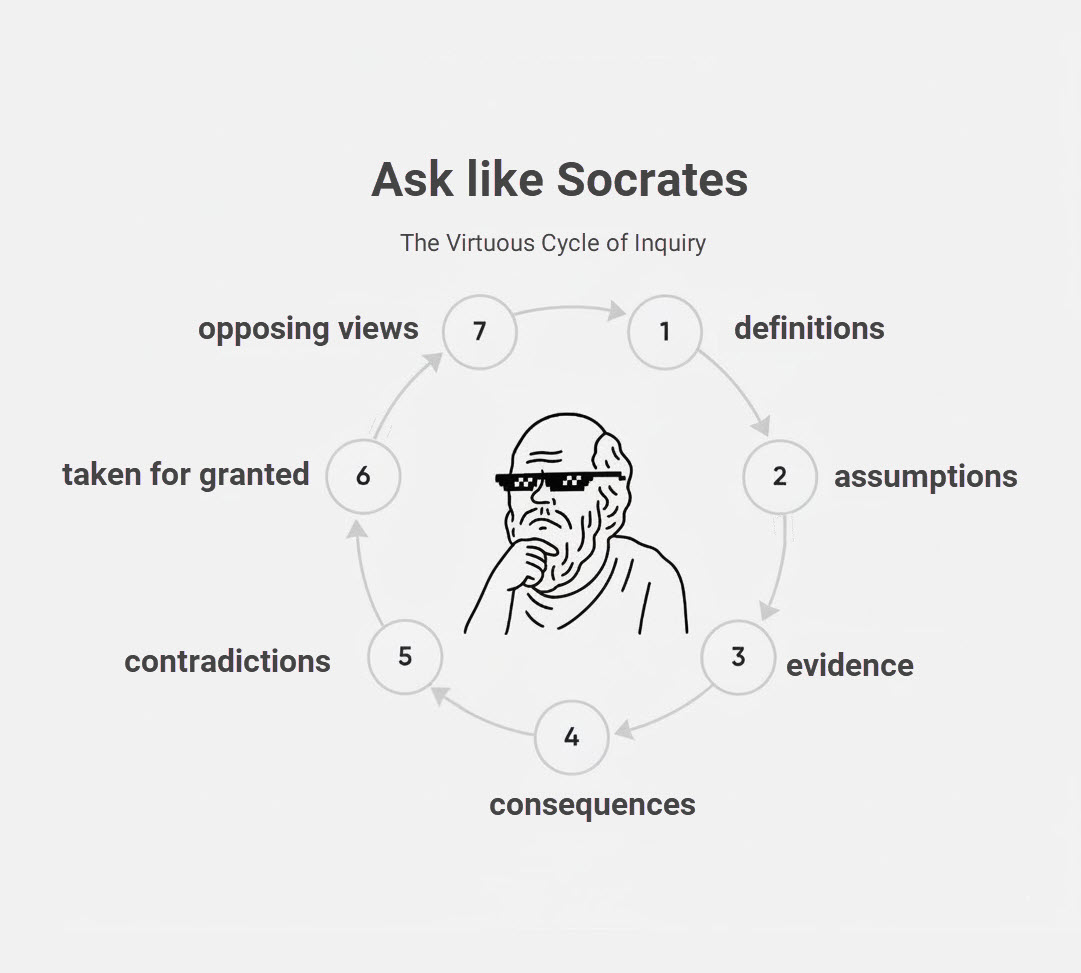
Here are 7 types of questions distilled from Socratic dialogues and his students’ writings:
Ask about definitions
When a friend says, “I need work-life balance,” pause and ask: What do you mean by “balance”?
Many debates become heated because each person defines a concept differently—while assuming they’re talking about the same thing.
A simple question could have saved hours of pointless discussion:
Ask about hidden assumptions
Behind every opinion lies a stack of unspoken assumptions.
When someone says, “I’ll buy a house in the suburbs for my family,” the statement hides many beliefs: that the suburbs are better for kids, commuting isn’t too stressful, housing is cheaper, and the family prefers quiet over convenience.
Ask for concrete evidence
An opinion without examples is hollow.
If someone claims, “This project is delayed because the team isn’t efficient,” ask for specifics: Which tasks are delayed?
By how many days? Who’s responsible? What exactly went wrong?
This question turns vague feelings into tangible data—distinguishing facts from subjective impressions.
Ask about real-world consequences
An idea may sound great on paper—but what happens when it’s executed?
Before quitting your job to go freelance, ask yourself: How long can I sustain my income? Are my monthly expenses covered? What about health insurance? What if I have no projects for three months?
Questions about consequences help filter out risky ideas before they cause damage.
Ask about logical contradictions
Words and actions must align.
If a company claims, “Customers come first,” but refuses to issue refunds for defective products—something’s off.
If they truly valued customers, refunds should be a given.
Ask about the obvious (take for granted)
The most dangerous assumptions are those we never think to question.
In the workplace, the phrase “We’ve always done it this way” is an invitation to ask:
What if the old way no longer works?
Every breakthrough begins with a simple act of doubt —
challenging what others take for granted.
Ask about opposing views
Asking, “What would someone who disagrees say?” is the fastest way to escape your thinking bubble.
Before making a major family decision, try adopting another perspective—look for cracks in your reasoning.
Before choosing a school for your child, ask: If I were my child, how would I feel about this decision?
These seven questioning styles help you collect clearer information and think more critically.
A word of caution: when applying these methods, I (Hoàng) often get misunderstood as judgmental, difficult, or confrontational.
In truth, my motivation is simply to seek the truth—but such probing can easily make others uncomfortable.
Perhaps this was also Socrates’ curse; he wasn’t very popular in Athens either.
So when you ask questions, mind your tone and attitude—let people feel your curiosity, not your criticism.
A good question matters, but how you ask it sometimes matters even more.
 Explore more on these topics


























 Guest Blogging: The Definitive Guide

 Top Trending Topics
 Share This
 Link copied!
 Recently Updated News