

The Cone of Uncertainty in Scrum & Requirement Definition
Last updated: December 22, 2023 Read in fullscreen view


 Recommended for you
- 01 Aug 2024
 The Standish Group report 83.9% of IT projects partially or completely fail 788/2605
 - 13 Apr 2024 Lessons on Teamwork and Leadership from Chinese story book "Journey to the West" 251/1337
- 15 Feb 2024 What is a Cut-Over in Software Development? 194/1521
- 02 Nov 2021 What is Terms of Reference (ToR)? 166/1743
- 18 Oct 2020 How to use the "Knowns" and "Unknowns" technique to manage assumptions 165/1259
- 02 Nov 2023 Differences between software walkthrough, review, and inspection 161/2303
- 30 Oct 2022 How Much Does MVP Development Cost in 2023? 154/413
- 09 Jan 2022 How to Bridge the Gap Between Business and IT? 148/351
- 19 Oct 2021 Software development life cycles 143/821
- 08 Dec 2021 What Are The 4 Types of Maintenance Strategies? 140/1330
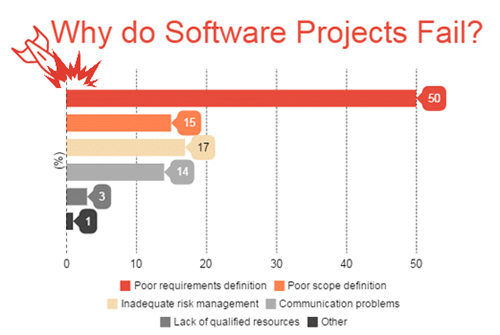
- 01 Sep 2022 Facts Chart: Why Do Software Projects Fail? 128/721
- 13 Oct 2021 Outsourcing Software Development: MVP, Proof of Concept (POC) and Prototyping. Which is better? 127/603
- 11 Oct 2021 10 Myths About Low-End Project Management Software 126/465
- 04 Oct 2021 Product Validation: The Key to Developing the Best Product Possible 125/433
- 06 Nov 2023 How do you streamline requirement analysis and modeling? 125/362
- 23 Sep 2021 INFOGRAPHIC: Top 9 Software Outsourcing Mistakes 123/546
- 13 Oct 2021 What is Bug Convergence? Why is it important for User Acceptance Testing (UAT)? 122/890
- 07 Oct 2025 Case Study: Using the “Messaging House” Framework to Build a Digital Transformation Roadmap 121/201
- 02 Jan 2024 What is User Provisioning & Deprovisioning? 120/712
- 11 Jan 2024 What are the Benefits and Limitations of Augmented Intelligence? 119/605
- 20 Jan 2021 Fail early, fail often, fail cheap, fail safe but always fail forward 118/933
- 13 Dec 2020 Move fast, fail fast, fail-safe 118/457
- 18 Aug 2022 What are the consequences of poor requirements with software development projects? 118/386
- 28 Oct 2023 The GOLDEN Rules of Software Engineering 118/692
- 06 Feb 2021 Why fail fast and learn fast? 114/590
- 23 Jun 2024 Best Practices for Managing Project Escalations 114/319
- 01 Oct 2020 Fail fast, learn faster with Agile methodology 113/1187
- 10 Apr 2021 RFP vs POC: Why the proof of concept is replacing the request for proposal 111/438
- 12 Oct 2022 14 Common Reasons Software Projects Fail (And How To Avoid Them) 109/674
- 12 Aug 2024 Understanding Google Analytics in Mumbai: A Beginner's Guide 108/215
- 02 Nov 2021 [Case Study] Streamlined Data Reporting using Tableau 106/409
- 02 Dec 2022 3 Levels of Quality in KANO Analysis Model 105/1282
- 13 May 2022 IT Training and Development: The most effective options for upskilling IT staff 105/1355
- 02 May 2022 What Is RAID in Project Management? (With Pros and Cons) 105/948
- 02 May 2022 What Is RAID in Project Management? (With Pros and Cons) 105/948
- 01 Mar 2024 10 Project Management Myths 104/278
- 03 Apr 2022 Microsoft Solutions Framework (MSF) 103/1445
- 07 Jul 2021 The 5 Levels of IT Help Desk Support 102/578
- 11 Nov 2021 What is an IT Self-service Portal? Why is it Important to Your Business? 102/549
- 28 Jul 2022 POC, Prototypes, Pilots and MVP: What Are the Differences? 102/843
- 12 Aug 2022 What is End-to-end project management? 102/608
- 14 Mar 2024 Why should you opt for software localization from a professional agency? 101/240
- 03 Dec 2025 IT Outsourcing Solutions Explained: What, How, Why, When 97/129
- 31 Aug 2022 What are the best practices for software contract negotiations? 97/369
- 08 Nov 2022 4 tips for meeting tough deadlines when outsourcing projects to software vendor 97/387
- 03 Jan 2023 Organizing your agile teams? Think about M.A.T (Mastery, Autonomy, Purpose) 96/493
- 16 Feb 2021 Choose Outsourcing for Your Non Disclosure Agreement (NDA) 95/265
- 12 Dec 2021 Zero Sum Games Agile vs. Waterfall Project Management Methods 95/509
- 14 Oct 2021 Advantages and Disadvantages of Time and Material Contract (T&M) 95/988
- 02 Nov 2022 Difference between Change Management and Project Management 92/324
- 05 Sep 2023 The Cold Start Problem: How to Start and Scale Network Effects 92/289
- 21 Oct 2025 Cloud-Native Development: Why It’s the Future of Enterprise IT 92/181
- 05 May 2021 TIGO Magic Scale - PoC tool for you to apply dichotomous thinking before submitting RFP 88/420
- 07 Aug 2022 Things to Consider When Choosing a Technology Partner 88/371
- 08 Oct 2022 KPI - The New Leadership 87/694
- 28 Dec 2021 8 types of pricing models in software development outsourcing 87/521
- 05 Mar 2021 How do you minimize risks when you outsource software development? 86/419
- 09 May 2022 Build one to throw away vs Second-system effect: What are differences? 86/397
- 10 Apr 2024 The Parking Lot Method: Unlocking a Simple Secret to Supercharge Your Productivity 84/603
- 01 Aug 2022 Is planning "set it and forget it" or "set it and check it"? 84/381
- 09 Feb 2023 The Challenge of Fixed-Bid Software Projects 83/332
- 01 Jan 2024 The pros and cons of the Centralized Enterprise Automation Operating model 83/307
- 22 May 2022 What are common mistakes that new or inexperienced managers make? 83/364
- 10 Nov 2022 Poor Code Indicators and How to Improve Your Code? 81/298
- 17 Oct 2021 Does Fast Tracking increase project cost? 80/456
- 06 Mar 2024 [SemRush] What Are LSI Keywords & Why They Don‘t Matter 80/282
- 02 Dec 2022 Success Story: Satsuki - Sales Management Software, back office app for School Subscription Management 79/319
- 10 Dec 2023 Pain points of User Acceptance Testing (UAT) 79/537
- 19 Oct 2021 Is gold plating good or bad in project management? 79/910
- 03 Apr 2021 How digital asset management streamlines your content workflow? 78/409
- 01 Dec 2023 Laws of Project Management 78/393
- 07 Dec 2023 12 project management myths to avoid 77/269
- 01 Feb 2024 How long does it take to develop software? 77/287
- 20 Jan 2022 TIGO Self-Organization Practice: Change Management Workflow 77/548
- 14 Oct 2021 Stream Story - Low land stream or fast moving stream? 77/703
- 14 Jun 2022 Example and Excel template of a RACI chart in Software Development 76/949
- 07 Jul 2022 Managing Project Execution Terms 75/482
- 17 Feb 2022 Prioritizing Software Requirements with Kano Analysis 75/379
- 18 Jul 2021 How To Ramp Up An Offshore Software Development Team Quickly 75/667
- 18 Oct 2021 Key Elements to Ramping Up a Large Team 74/1333
- 03 Sep 2022 The secret of software success: Simplicity is the ultimate sophistication 74/279
- 18 Feb 2026 "Hit and Run" Project Management: Balancing Speed with Sustainability 74/100
- 03 Nov 2022 Top questions and answers you must know before ask for software outsourcing 73/358
- 19 Apr 2021 7 Most Common Time-Wasters For Software Development 72/617
- 13 Feb 2021 Why is TIGOSOFT a software house for Enterprise Application Development? 70/450
- 04 Oct 2022 Which ERP implementation strategy is right for your business? 70/430
- 12 Mar 2024 How do you create FOMO in software prospects? 70/243
- 01 Mar 2023 Bug Prioritization - What are the 5 levels of priority? 69/298
- 01 May 2024 Warren Buffett’s Golden Rule for Digital Transformation: Avoiding Tech Overload 69/277
- 16 Apr 2021 Insightful Business Technology Consulting at TIGO 69/523
- 10 Jul 2025 Building AI-Driven Knowledge Graphs from Unstructured Data 68/230
- 27 Jan 2020 Should a project manager push developers to work more hours due to mistakes of manager schedule setting? 67/508
- 31 Oct 2021 Tips to Fail Fast With Outsourcing 66/457
- 15 May 2022 20 Common Mistakes Made by New or Inexperienced Project Managers 63/345
- 20 Nov 2022 Software Requirements Are A Communication Problem 63/305
- 02 Dec 2021 3 Ways to Avoid Scope Creep in IT Consulting 62/271
- 06 Mar 2021 4 things you need to do before getting an accurate quote for your software development 61/758
- 01 Oct 2020 Handling tight project deadlines as a business analyst 61/390
- 24 Nov 2023 The project management paradox: Achieving MORE by doing LESS 61/291
- 05 Jan 2024 Easy ASANA tips & tricks for you and your team 60/258
- 01 May 2023 CTO Interview Questions 60/395
- 05 Jun 2023 Fractional, Part-Time (virtual) or Interim CTO: Who Will Cover Your Business Needs? 60/203
- 20 Jul 2022 Software Myths and Realities 60/1001
- 06 Jun 2022 Change Management at the Project Level 60/366
- 07 Oct 2022 Digital Transformation: Become a Technology Powerhouse 59/306
- 21 Jun 2021 6 Useful Tips To Streamline Business Processes and Workflows 59/590
- 02 Jun 2024 Reviving Ancient Wisdom: The Spiritual Side of Project Management 58/316
- 26 Sep 2024 Successful Project Management Techniques You Need to Look Out For 58/455
- 28 Oct 2022 Build Operate Transfer (B.O.T) Model in Software Outsourcing 57/467
- 16 Jun 2022 Rapid Application Development (RAD): Pros and Cons 57/939
- 13 Jan 2020 Quiz: Test your understanding project cost management 55/701
- 10 May 2022 Levels of Teamwork 54/249
- 26 Dec 2023 Improving Meeting Effectiveness Through the Six Thinking Hats 53/329
- 30 Nov 2023 Project Managers, Focus on Outcomes — Not Deliverables 52/213
- 09 Mar 2022 Consultant Implementation Pricing 49/261
- 03 Nov 2022 Questions and answers about Kano Model 48/943
- 21 Jun 2024 Dead Horses and the Escalation of Commitment 47/185
- 01 Mar 2023 How do you deal with disputes and conflicts that may arise during a software consulting project? 47/207
- 06 Nov 2019 How to Access Software Project Size? 42/299
- 17 Mar 2025 IT Consultants in Digital Transformation 41/131
In project management, the Cone of Uncertainty describes the evolution of the amount of best case uncertainty during a project. At the beginning of a project, comparatively little is known about the product or work results, and so estimates are subject to large uncertainty. As more research and development is done, more information is learned about the project, and the uncertainty then tends to decrease, reaching 0% when all residual risk has been terminated or transferred. This usually happens by the end of the project i.e. by transferring the responsibilities to a separate maintenance group.
In software development, the Cone of Uncertainty is used to manage projects where the requirements and tasks are changing constantly, including business requirements and technologies used in product development.
“The primary purpose of software estimation is not to predict a project’s outcome; it is to determine whether a project’s targets are realistic enough to allow the project to be controlled to meet them” — Steve McConnell.
The term Cone of Uncertainty is used in software development where the technical and business environments change very rapidly. However, the concept, under different names, is a well-established basic principle of cost engineering. Most environments change so slowly that they can be considered static for the duration of a typical project, and traditional project management methods therefore focus on achieving a full understanding of the environment through careful analysis and planning. Well before any significant investments are made, the uncertainty is reduced to a level where the risk can be carried comfortably. In this kind of environment the uncertainty level decreases rapidly in the beginning and the cone shape is less obvious. The software business however is very volatile and there is an external pressure to decrease the uncertainty level over time. The project must actively and continuously work to reduce the uncertainty level.
The Cone of Uncertainty is narrowed both by research and by decisions that remove the sources of variability from the project. These decisions are about scope, what is included and not included in the project. If these decisions change later in the project then the cone will widen.
Original research for engineering and construction in the chemical industry demonstrated that actual final costs often exceeded the earliest "base" estimate by as much as 100% (or underran by as much as 50%). Research in the software industry on the Cone of Uncertainty stated that in the beginning of the project life cycle (i.e. before gathering of requirements) estimates have in general an uncertainty of factor 4 on both the high side and the low side. This means that the actual effort or scope can be 4 times or 1/4 of the first estimates. This uncertainty tends to decrease over the course of a project, although that decrease is not guaranteed.
 Explore more on these topics






















 Guest Blogging: The Definitive Guide

 Top Trending Topics
 Share This
 Link copied!
 Recently Updated News