

Manufacturing 4.0: AI Agents Enabling Self-Optimizing Production Systems
Last updated: December 08, 2025 Read in fullscreen view


 Recommended for you
- 06 Mar 2026
 Next-Generation AI Agents Explained: OpenClaw, NanoClaw, IronClaw and the Rise of Agent Architectures 362/402
 - 05 Oct 2025 The New Facebook Algorithm: A Paradigm Shift in Content Discovery 297/359
- 14 Jan 2026 How to Evaluate the Business and Productivity Software Company Seismic on RFP AI Agent Use Cases 251/303
- 21 Dec 2023 Top 12 Low-Code Platforms To Use in 2024 224/1525
- 23 Dec 2025 Microsoft Power Automate vs. n8n: What’s the Real Difference? 219/350
- 02 Oct 2022 The Real Factors Behind Bill Gates’ Success: Luck, Skills, or Connections? 196/571
- 29 Oct 2024 Top AI Tools and Frameworks You’ll Master in an Artificial Intelligence Course 189/594
- 02 Dec 2025 The Question That Shook Asia: What Happens When We Ask AI to Choose Between a Mother and a Wife? 179/220
- 31 Dec 2025 10 Skills to Make You "Irreplaceable" in the Next 3 Years (even if AI changes everything) 174/208
- 05 Jun 2025 How AI-Driven Computer Vision Is Changing the Face of Retail Analytics 172/296
- 25 Mar 2026 Token Bills: The "Cost Shock" After the AI Boom in Companies 170/196
- 09 Jul 2024 What Is Artificial Intelligence and How Is It Used Today? 169/429
- 20 Dec 2025 The Future of IT Consulting: Key Trends for 2026–2030 169/212
- 23 Dec 2024 Garbage In, Megabytes Out (GIMO): How to Rise Above AI Slop and Create Real Signal 168/222
- 03 Oct 2025 Top CMS Trends 2026: The Future of Digital Content Management 167/201
- 16 Oct 2025 AI Inference Explained Simply: What Developers Really Need to Know 163/197
- 24 Mar 2026 AI for Financial Reconciliation: Automating Finance Operations in 2026 161/192
- 26 Mar 2026 What Is a System Integrator (SI)? Why the Software Subscription Model Is Becoming the New Standard 155/189
- 06 Dec 2025 Enterprise Operations 2.0: Why AI Agents Are Replacing Traditional Automation 153/197
- 06 Nov 2025 DataOps: The Next Frontier in Agile Data Management 142/201
- 18 Jul 2024 The 8 Best ways to Innovate your SAAS Business Model in 2024 138/395
- 25 Nov 2025 How AI Agents Are Redefining Enterprise Automation and Decision-Making 134/192
- 31 Jul 2025 Top WooCommerce Pre-Order Plugins with Countdown & Discounts 132/229
- 25 Dec 2025 What Is Algorithmic Fairness? Who Determines the Value of Content: Humans or Algorithms? 129/174
- 29 Jan 2026 Why Headless Commerce Is Shaping the Future of the Online Store 125/152
- 15 Apr 2024 Weights & Biases: The AI Developer Platform 121/312
- 22 Dec 2025 The Role of Automotive Software in Building Smarter Vehicles 118/163
- 04 Mar 2026 CRM Trends Shaping Customer Engagement in 2026 117/148
- 01 Jul 2025 The Hidden Costs of Not Adopting AI Agents: Risk of Falling Behind 117/266
- 20 Feb 2025 How Machine Learning is Shaping the Future of Digital Advertising 117/239
- 16 Aug 2022 What is a Headless CMS? 115/401
- 16 Aug 2022 What is a Headless CMS? 115/401
- 08 Apr 2026 Top AI Agent Development Companies for Manufacturing Industry (2026) 115/144
- 17 Oct 2025 MLOps vs AIOps: What’s the Difference and Why It Matters 114/226
- 27 Jul 2024 Positive Psychology in the Digital Age: Future Directions and Technologies 112/541
- 02 Dec 2024 The Intersection of AI and Business Analytics: Key Concepts to Master in Your Business Analytics Course 108/404
- 16 Dec 2025 Reducing Cognitive Friction in Software Development: A Guide to Faster, Happier Teams 107/181
- 10 Nov 2025 Multi-Modal AI Agents: Merging Voice, Text, and Vision for Better CX 105/219
- 27 Aug 2025 How AI Consulting Is Driving Smarter Diagnostics and Hospital Operations 105/205
- 12 Jan 2026 Companies Developing Custom AI Models for Brand Creative: Market Landscape and Use Cases 104/137
- 21 Nov 2025 The Rise of AgentOps: How Enterprises Are Managing and Scaling AI Agents 103/160
- 03 Jan 2024 Why Partnership is important for Growth? 103/261
- 16 Sep 2022 Examples Of Augmented Intelligence In Today’s Workplaces Shaping the Business as Usual 99/536
- 11 Oct 2022 Why choose Billable Viable Product (BVP) over Minimum Viable Product (MVP) 99/441
- 24 Dec 2024 Artificial Intelligence and Cybersecurity: Building Trust in EFL Tutoring 99/269
- 15 May 2025 AI Consulting for Small Businesses: How to Leverage AI for Growth & Efficiency 99/292
- 21 Aug 2024 What is Singularity and Its Impact on Businesses? 99/561
- 16 Sep 2022 Examples Of Augmented Intelligence In Today’s Workplaces Shaping the Business as Usual 99/536
- 09 Sep 2025 Aligning BI Dashboards with KPIs: A Business + Data Collaboration Guide 98/186
- 20 Aug 2025 What Is Agentic AI? The Next Phase of Artificial Intelligence 98/258
- 07 Nov 2025 Online vs. Offline Machine Learning Courses in South Africa: Which One Should You Pick? 97/169
- 18 Jan 2024 Self-healing code is the future of software development 97/314
- 25 Sep 2024 Enhancing Decision-Making Skills with an MBA: Data-Driven Approaches for Business Growth 95/302
- 23 Jun 2025 AI Avatars in the Metaverse: How Digital Beings Are Redefining Identity and Social Interaction 95/282
- 06 May 2025 How Machine Learning Is Transforming Data Analytics Workflows 94/291
- 25 Jan 2025 The Decline of Traditional SaaS and the Rise of AI-first Applications 93/198
- 30 Jul 2024 The Future of IT Consulting: Trends and Opportunities 89/301
- 31 Dec 2023 Software Development Outsourcing Trends to Watch Out for in 2024 89/319
- 24 Oct 2025 AI Agents in SaaS Platforms: Automating User Support and Onboarding 89/160
- 28 Nov 2025 How AI Will Transform Vendor Onboarding and Seller Management in 2026 88/218
- 22 Sep 2025 Why AI Is Critical for Accelerating Drug Discovery in Pharma 82/197
- 03 Nov 2023 Why Is Billable Viable Product An Alternative To Minimum Viable Product? 82/273
- 22 Nov 2024 The Role of AI in Enhancing Business Efficiency and Decision-Making 82/277
- 04 Oct 2023 The Future of Work: Harnessing AI Solutions for Business Growth 81/362
- 18 Aug 2024 The Future of Web Development: Emerging Trends and Technologies Every Developer Should Know 79/274
- 31 Dec 2022 The New Normal for Software Development 76/430
- 10 Sep 2024 Leading Remote Teams in Hybrid Work Environments 76/220
- 27 Feb 2025 How AI Agents are Changing Software Development? 74/313
- 19 Dec 2023 How AI is Transforming Software Development? 74/367
- 21 Apr 2025 Agent AI in Multimodal Interaction: Transforming Human-Computer Engagement 72/267
- 09 Oct 2024 Short-Form Video Advertising: The Secret to Captivating Your Audience 69/201
- 05 Aug 2024 Affordable Tech: How Chatbots Enhance Value in Healthcare Software 64/295
- 15 Aug 2025 Quantum Technology: Global Challenges and Opportunities for Innovators 63/200
- 29 Aug 2025 How AI Is Transforming Modern Management Science 60/128
- 10 Sep 2024 AI in Email Marketing: Personalization and Automation 59/236
- 25 Jun 2026 Vercel: The "Secret Weapon" for Modern, High-Performance Web Deployment 49/57
- 31 Dec 2022 Future of Software Development Trends and Predictions 48/199
- 06 Nov 2025 Top AI Development Companies in the USA to Watch in 2026 31/272
| About the Author | Anand Subramanian | Technology expert and AI enthusiast |
Anand Subramanian is a technology expert and AI enthusiast currently leading the marketing function at Intellectyx, a Data, Digital, and AI solutions provider with over a decade of experience working with enterprises and government departments. |
Manufacturing is entering a pivotal era. Global supply chains are unstable, demand fluctuations are unpredictable, labor availability is shrinking, and compliance mandates are tightening. Traditional automation PLC-driven workflows, predefined machine rules, SCADA operations, and robotics have carried the industry forward for decades. But today, leaders face a sobering reality:
Factories are more automated than ever, yet operational inefficiencies remain stubbornly high.
According to McKinsey:
- 65% of manufacturers still experience unplanned downtime every month
- Over 40% of production decisions are made using incomplete data
- Manufacturers lose $3M per hour on average due to downtime (IDC)
The root cause? Traditional automation was built for fixed processes, not the dynamic, multi-variable, unpredictable environments that define modern manufacturing.
As plants become more digital, interconnected, and complex, the limitations of deterministic systems are becoming impossible to ignore. Manufacturers no longer need more automation; they need intelligent autonomy. They need AI Agents.
This is the foundation of Manufacturing 4.0, where factories become self-optimizing, self-correcting, and increasingly self-sufficient.
Why Traditional Automation Can No Longer Carry the Weight
Before we explore the rise of AI Agents, it’s important to understand why the old model is breaking down.
1. Static Rules in a Dynamic Environment
Automation systems depend on fixed logic and parameters. But manufacturing conditions, machine wear, temperature fluctuations, input variability are rarely static.
When a sensor drifts or an input material changes quality, systems fail, production slows, or operators must manually intervene.
2. Siloed Data Sources
Production data lives in:
- MES
- SCADA
- PLC logs
- Quality systems
- ERP
- Maintenance systems
None of these ecosystem components speak to each other in real-time.
AI Agents unify and interpret all of these data streams to operate holistically.
3. Rising Maintenance and Integration Costs
Adding more automation does not simplify operations, it complicates them.
Manufacturers are spending:
- 30 50% of automation budgets on maintenance and patching
- Millions per year on integration contracts
AI Agents reduce maintenance drastically by adapting autonomously.
4. Human Expertise Bottleneck
Skilled technicians and operators are becoming harder to find and retain.
AI Agents preserve operational knowledge and independently execute tasks previously requiring expert judgment.
AI Agents: The Engine Behind Self-Optimizing Production Systems
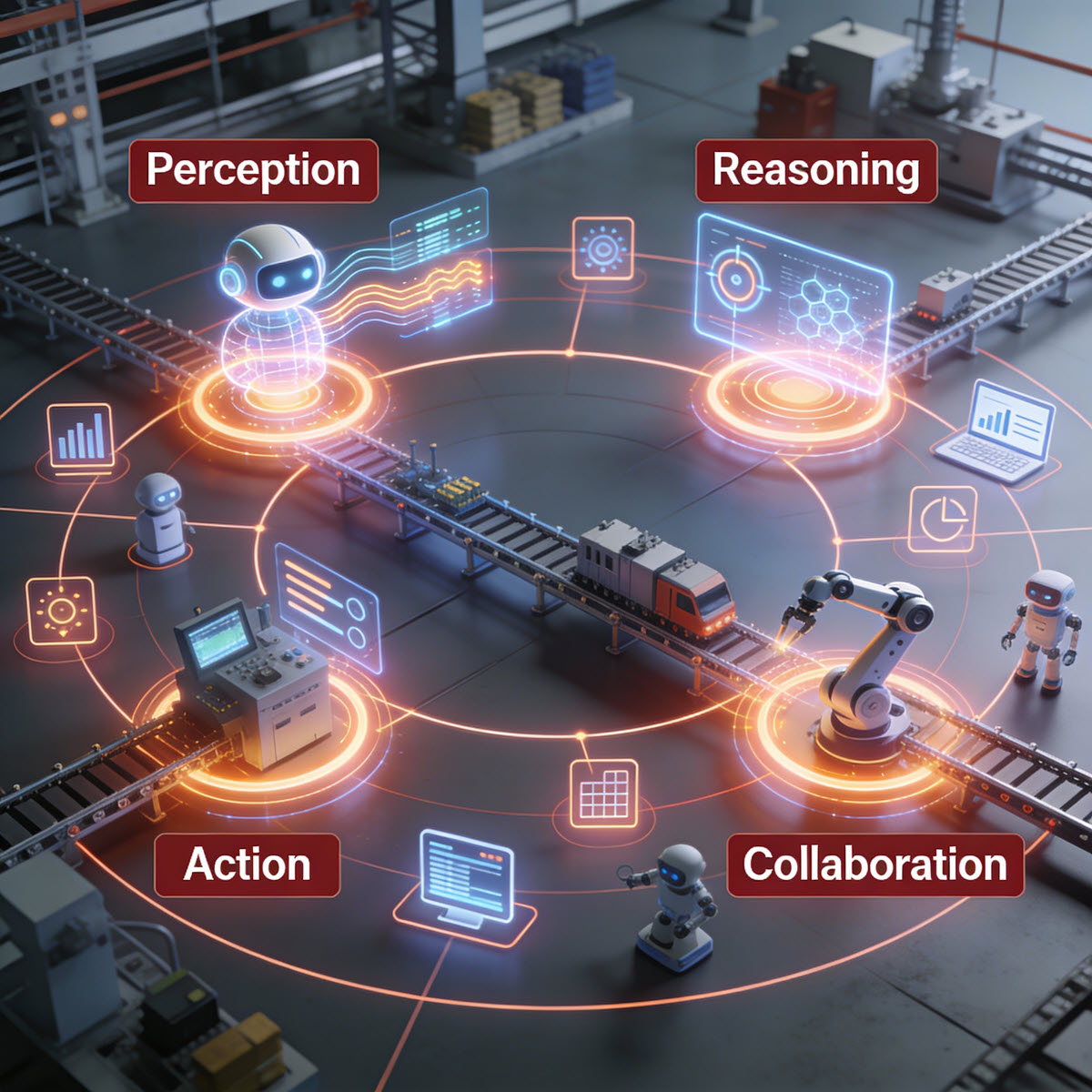
Unlike traditional automation, AI Agents are dynamic, autonomous decision-making entities that can perceive, reason, and act across production environments.
They operate with four foundational capabilities:
1. Perception
Understand structured and unstructured data from sensors, logs, documents, and machine interfaces.
2. Reasoning
Interpret conditions, identify patterns, diagnose root causes, and plan actions.
3. Action
Execute tasks autonomously adjust machine parameters, modify schedules, trigger maintenance workflows, instruct robots, update MES.
4. Collaboration
Coordinate with other AI agents to optimize production holistically.
This is the backbone of self-optimizing systems factories that continuously monitor, learn, predict, and adjust without human intervention.
The Manufacturing 4.0 AI Agent Stack
Imagine this as a vertical stack (textual form):
Layer 1: Multimodal AI Perception
AI agents read and interpret:
- Sensor streams
- SCADA/PLC data
- Vision data
- Maintenance logs
- Quality inspection images
- Supply chain feeds
- Operator notes
Layer 2: Cognitive Manufacturing Intelligence
Agents use:
- LLM reasoning
- Predictive models
- Digital twins
- Anomaly detection
- Root-cause algorithms
- Domain-specific rule engines
Layer 3: Autonomous Execution
Agents autonomously control:
- Machine parameters
- Work order sequencing
- Energy consumption
- Predictive maintenance actions
- Quality adjustments
- Production rescheduling
Layer 4: Governance & Human-in-the-Loop
Ensures:
- Safety compliance
- Supervisory control
- Escalation workflows
- Audit logs
- Policy adherence
This stack forms the architecture of intelligent, resilient Manufacturing 4.0 operations.
Where AI Agents Outperform Traditional Automation (Table)
| Attribute | Traditional Automation | AI Agents |
|---|---|---|
| Logic | Rule-based | Adaptive, context-aware |
| Reaction to Variability | Low | High |
| Handling unstructured data | No | Yes |
| Decision-making | None | Strong |
| Cross-line coordination | Limited | Collaborative |
| Anomaly detection | Reactive | Predictive & proactive |
| Energy optimization | Manual | Autonomous |
| Maintenance | Scheduled | Predictive |
| Scalability | Hard | Exponential |
| Workforce augmentation | Minimal | High |
The data is clear: AI Agents do not replace automation, they transcend it.
How AI Agents Create a Self-Optimizing Factory
Below are the core pillars that define self-optimizing production systems.
1. Autonomous Quality Control
Traditional QC is reactive. AI Agents shift it to continuous, real-time intelligence.
Agents can:
- Analyze visual feeds using vision AI
- Detect microscopic defects
- Compare outputs against digital twin baselines
- Adjust machine parameters without human intervention
Manufacturers using AI-driven QC report:
- Up to 90% reduction in quality escapes
- 30–50% fewer false rejects
2. Predictive and Autonomous Maintenance
AI Agents combine sensor data, machine logs, and historical patterns to:
- Predict failures weeks in advance
- Identify root causes
- Trigger work orders
- Coordinate parts procurement
- Reassign workloads to other machines
This shift cuts downtime by:
- 30–60%
- Extends machine lifespan by 20–40%
- Reduces maintenance costs by 25–35%
3. Dynamic Production Scheduling
Demand fluctuations, machine breakdowns, and supply delays make fixed scheduling obsolete.
AI agents continually:
- Reprioritize jobs
- Reallocate resources
- Coordinate between work cells
- Optimize changeovers
- Account for labor availability
This enables:
- 10–30% throughput improvement
- Faster line recovery during disruptions
4. Autonomous Energy Optimization
Energy is one of manufacturing’s biggest cost drivers.
AI agents optimize:
- Machine run cycles
- Idle time
- Peak-load patterns
- HVAC and utility consumption
Plants adopting energy AI see:
- 8–15% energy savings within 90 days
- 20–30% long-term reductions
5. Supply Chain Synchronization
Agents predict:
- Material shortages
- Lead time variations
- Supplier performance degradation
- Logistics disruptions
They automatically adjust inventory strategies, reorder materials, and re-plan production around constraints.
This minimizes:
- Stockouts
- Line stoppages
- Excess inventory
- Supply chain volatility
The Multi-Agent Factory: A Collaboration Ecosystem
Manufacturing 4.0 is not powered by a single AI agent but a collaborative system of AI agents.
Examples of multi-agent roles:
- Quality Agent: Monitors visual feeds, adjusts tolerances, analyzes rejects.
- Maintenance Agent: Predicts failures, triggers repairs, optimizes spare parts.
- Production Agent: Schedules work orders, manages line balancing.
- Energy Agent: Controls utilities and load balancing.
- Supply Chain Agent: Manages procurement, forecasts shortages.
- Compliance Agent: Ensures SOP adherence, audit trails, safety checks.
Each agent specializes, but they coordinate like a digital operations team creating a unified, self-optimizing ecosystem.
Real Use Cases Driving 20–70% Efficiency Gains
1. Automotive Manufacturing
AI agents detect micro-defects during body fabrication and autonomously recalibrate equipment.
Impact:
- 30% reduction in rework
- 60% drop in defect escapes
2. Electronics Assembly
Vision agents detect solder quality issues and adjust reflow oven settings in real time.
Impact:
- 40% yield improvement
- 25% reduction in scrap
3. Food & Beverage Production
AI agents optimize temperature, conveyor speeds, and dosing processes based on real-time variability.
Impact:
- 15–25% output improvement
- Significant reduction in spoilage
4. Metals & Heavy Industry
AI-driven predictive maintenance extends equipment life and prevents catastrophic failures.
Impact:
- Millions saved in avoided downtime
- 20–40% longer machine life
Technical Architecture for Manufacturing Leaders
Below is a deeper look at the underlying system design that powers Manufacturing 4.0.
AI Models
- LLMs for reasoning
- Vision transformers for QC
- Time-series models for anomaly detection
- RL models for scheduling optimization
Data Fabric
- Industrial IoT
- Edge computing
- OPC-UA integrations
- Real-time data lakes
- Digital twins
Execution Layer
- APIs
- OPC-UA commands
- MES/MOM integrations
- Robotics controllers
- Alerting and control systems
Governance
- Access role models
- Safety protocols
- Human override modes
- Ethical compliance frameworks
This ensures the system is both autonomous and safe.
Why AI Agents Are the Future Operating System of Smart Factories
Traditional automation controls machines. AI Agents control outcomes.
Traditional systems follow rules. AI Agents learn, predict, optimize, and self-correct.
This transition is as significant as the shift from manual workshop production to industrial automation.
Leaders that deploy AI Agents now will build factories that:
- Never stop learning
- Never stop improving
- Never rely on static rules
- Operate with unmatched resilience and precision
A Practical Adoption Roadmap for Manufacturers
1. Identify high-friction workflows
Focus on QC, downtime-heavy assets, or unpredictable scheduling.
2. Deploy a focused AI Agent pilot
Start with a single line or equipment unit.
3. Create a unified data layer
Integrate SCADA, MES, PLC, maintenance, and quality data.
4. Expand to multi-agent collaboration
Add QC, maintenance, and scheduling agents.
5. Integrate digital twins
Enable predictive, simulation-driven optimization.
6. Scale plant-wide
Expand across production lines and global facilities.
Most manufacturers see measurable ROI in 8–14 weeks, with compounding benefits thereafter.
Final Call to Action
Manufacturers are discovering a critical truth: Industry 4.0 will not be defined by automation but by intelligent, autonomous production systems.
AI Agents turn factories into self-optimizing entities capable of outperforming traditional automation in accuracy, adaptability, efficiency, and uptime.
The question is no longer if AI Agents will reshape manufacturing the question is Will you lead the transformation or be disrupted by those who do?
Anand Subramanian
Technology expert and AI enthusiast
Anand Subramanian is a technology expert and AI enthusiast currently leading the marketing function at Intellectyx, a Data, Digital, and AI solutions provider with over a decade of experience working with enterprises and government departments.
 Explore more on these topics



























 Guest Blogging: The Definitive Guide

 Top Trending Topics
 Share This
 Link copied!
 Recently Updated News
 thực chiến - Kiến tạo tương lai cho các nhà sáng tạo nội dung.