

Enterprise Operations 2.0: Why AI Agents Are Replacing Traditional Automation
Last updated: December 08, 2025 Read in fullscreen view


 Recommended for you
- 06 Mar 2026
 Next-Generation AI Agents Explained: OpenClaw, NanoClaw, IronClaw and the Rise of Agent Architectures 361/401
 - 14 Jan 2026 How to Evaluate the Business and Productivity Software Company Seismic on RFP AI Agent Use Cases 251/303
- 14 Aug 2024 From Steel to Software: The Reluctant Evolution of Japan's Tech Corporates 205/751
- 02 Oct 2022 The Real Factors Behind Bill Gates’ Success: Luck, Skills, or Connections? 195/570
- 29 Oct 2024 Top AI Tools and Frameworks You’ll Master in an Artificial Intelligence Course 189/594
- 01 Dec 2025 Manufacturing 4.0: AI Agents Enabling Self-Optimizing Production Systems 181/242
- 02 Dec 2025 The Question That Shook Asia: What Happens When We Ask AI to Choose Between a Mother and a Wife? 178/219
- 05 Jun 2025 How AI-Driven Computer Vision Is Changing the Face of Retail Analytics 171/295
- 09 Jul 2024 What Is Artificial Intelligence and How Is It Used Today? 168/428
- 23 Dec 2024 Garbage In, Megabytes Out (GIMO): How to Rise Above AI Slop and Create Real Signal 168/222
- 16 Oct 2025 AI Inference Explained Simply: What Developers Really Need to Know 163/197
- 24 Mar 2026 AI for Financial Reconciliation: Automating Finance Operations in 2026 160/191
- 06 Nov 2025 DataOps: The Next Frontier in Agile Data Management 142/201
- 21 Apr 2026 Vibe Coding vs. Expert Shopify Development: What AI Tools Can (and Can't) Do? 141/166
- 25 Nov 2025 How AI Agents Are Redefining Enterprise Automation and Decision-Making 134/192
- 25 Dec 2025 What Is Algorithmic Fairness? Who Determines the Value of Content: Humans or Algorithms? 129/174
- 15 Apr 2024 Weights & Biases: The AI Developer Platform 121/312
- 01 Jul 2025 The Hidden Costs of Not Adopting AI Agents: Risk of Falling Behind 116/265
- 08 Apr 2026 Top AI Agent Development Companies for Manufacturing Industry (2026) 115/144
- 16 Aug 2022 What is a Headless CMS? 115/401
- 17 Oct 2025 MLOps vs AIOps: What’s the Difference and Why It Matters 114/226
- 27 Aug 2025 How AI Consulting Is Driving Smarter Diagnostics and Hospital Operations 105/205
- 10 Nov 2025 Multi-Modal AI Agents: Merging Voice, Text, and Vision for Better CX 105/219
- 12 Jan 2026 Companies Developing Custom AI Models for Brand Creative: Market Landscape and Use Cases 103/135
- 21 Nov 2025 The Rise of AgentOps: How Enterprises Are Managing and Scaling AI Agents 102/159
- 15 May 2025 AI Consulting for Small Businesses: How to Leverage AI for Growth & Efficiency 99/292
- 24 Dec 2024 Artificial Intelligence and Cybersecurity: Building Trust in EFL Tutoring 99/269
- 16 Sep 2022 Examples Of Augmented Intelligence In Today’s Workplaces Shaping the Business as Usual 99/536
- 21 Aug 2024 What is Singularity and Its Impact on Businesses? 98/560
- 09 Sep 2025 Aligning BI Dashboards with KPIs: A Business + Data Collaboration Guide 97/185
- 07 Nov 2025 Online vs. Offline Machine Learning Courses in South Africa: Which One Should You Pick? 97/169
- 05 Aug 2024 Revisiting the Mistake That Halted Japan's Software Surge 97/444
- 06 May 2025 How Machine Learning Is Transforming Data Analytics Workflows 94/291
- 24 Oct 2025 AI Agents in SaaS Platforms: Automating User Support and Onboarding 88/159
- 28 Nov 2025 How AI Will Transform Vendor Onboarding and Seller Management in 2026 88/218
- 22 Sep 2025 Why AI Is Critical for Accelerating Drug Discovery in Pharma 82/197
- 04 Oct 2023 The Future of Work: Harnessing AI Solutions for Business Growth 81/362
- 21 Apr 2025 Agent AI in Multimodal Interaction: Transforming Human-Computer Engagement 72/267
- 05 Aug 2024 Affordable Tech: How Chatbots Enhance Value in Healthcare Software 64/295
- 29 Aug 2025 How AI Is Transforming Modern Management Science 60/128
- 06 Nov 2025 Top AI Development Companies in the USA to Watch in 2026 24/265
| About the Author | Anand Subramanian | Technology expert and AI enthusiast |
Anand Subramanian is a technology expert and AI enthusiast currently leading the marketing function at Intellectyx, a Data, Digital, and AI solutions provider with over a decade of experience working with enterprises and government departments. |
For over a decade, enterprises have relied on RPA, BPM tools, and workflow automation to scale operations. These systems reduced manual work, improved compliance, and created efficiencies. But today, a growing sense of stagnation is sweeping across enterprise operations teams.
Executives are asking the same questions:
Why are our automations breaking so often? Why do we still need humans in the loop for 40–60% of workflows? Why do exceptions keep derailing our processes? Why are our operational costs rising instead of shrinking?
The answer is simple: traditional automation was designed for predictable, rule-based environments something modern enterprises no longer have.
According to Gartner, 54% of enterprise automations break within 12 months due to rule changes, UI updates, or data inconsistencies. Another industry analysis shows that companies spend 2.5–3x more on maintaining RPA bots than deploying them. In an environment defined by unstructured data, rapid market changes, and complex decision-making needs, rule-based automation is no longer enough.
→ This is where Enterprise Operations 2.0, powered by AI agents, is emerging as the next leap forward.
The Shift From Static Automation to Intelligent Autonomy
Enterprise Operations 2.0 represents a foundational shift: away from static, deterministic, step-by-step automation toward adaptive, goal-driven AI agents that can understand, reason, and act across complex workflows.
Instead of merely automating tasks, AI agents autonomously manage business outcomes, a fundamental difference that separates them from earlier automation technologies.
Traditional Automation: Follow rules.
AI Agents:
Understand goals, analyze context, and execute actions to achieve outcomes.
This evolution mirrors the shift from old GPS devices (fixed rules) to modern navigation apps (dynamic, real-time, adaptive intelligence). One simply followed a map. The other analyzes traffic, learns driver habits, predicts congestion, and re-routes in milliseconds.
→ Enterprises now need the latter.
The Real Problem With Traditional Automation
1. It breaks under real-world variability
If an invoice changes format or a web page moves a button, the bot fails.
RPA bots are estimated to break every 2–3 weeks on average, and every failure creates operational bottlenecks.
2. It can’t process unstructured data
Emails, PDFs, screenshots, contracts, images, and logs make up over 80% of enterprise data (IDC). Traditional automation cannot interpret this without heavy engineering.
3. It cannot reason or take decisions
Bots execute steps. AI agents interpret context, weigh options, and decide the next action intelligently.
4. Maintenance is painfully expensive
Companies spend millions patching scripts and workflows. AI agents reduce maintenance by learning from interactions and adapting autonomously.
5. It cannot scale horizontally
Each bot automates one task. AI agents automate entire workflows and coordinate with other agents.
Why AI Agents Are the Core Engine of Enterprise Operations 2.0
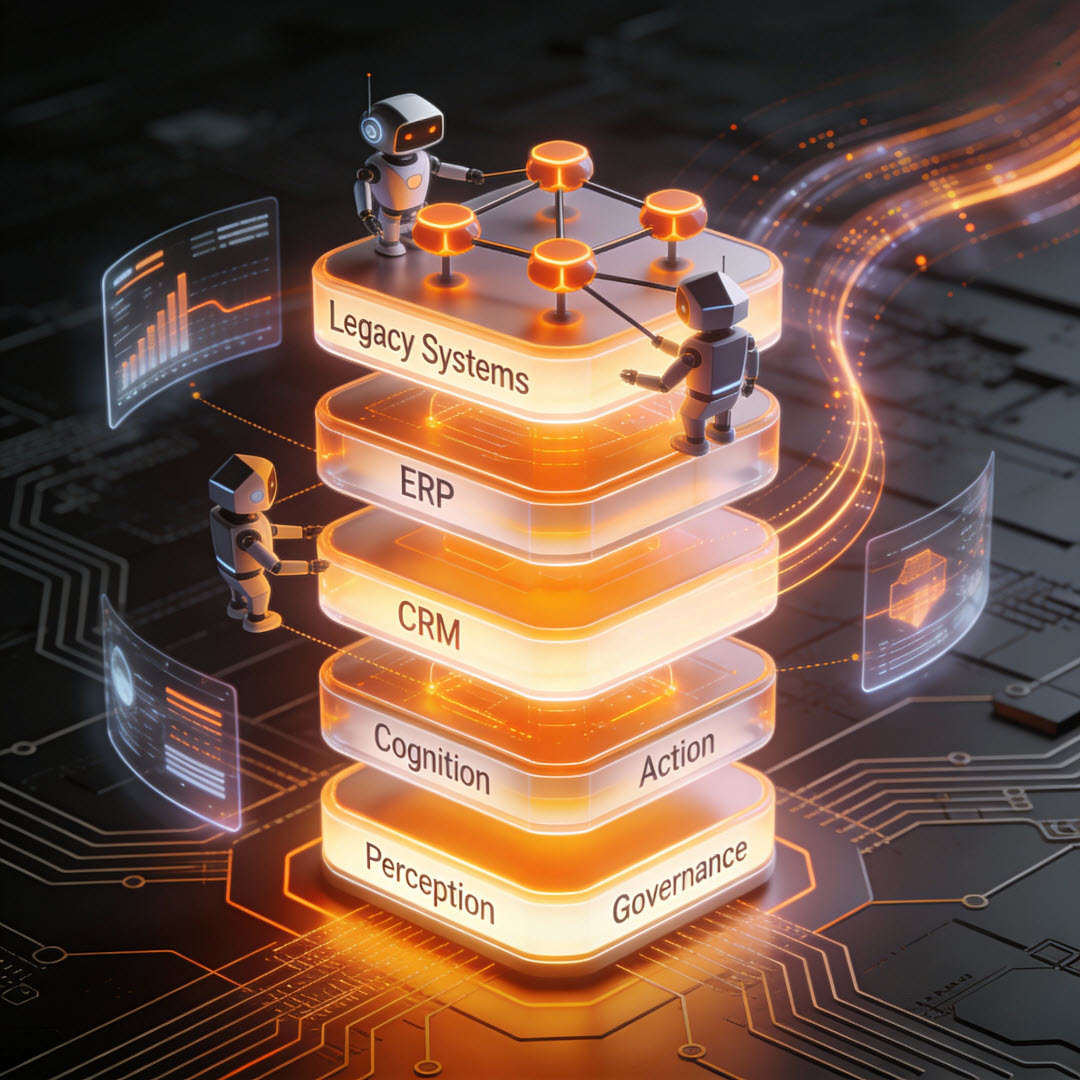
AI agents solve the very gaps that make traditional automation brittle. They bring perception, cognition, action, and governance into one unified system capable of autonomous decisioning.
Below is a high-level narrative-driven view of how they transform operations.
1. They Understand Unstructured Information
AI agents use:
- Large Language Models
- Vision models
- Multimodal analytics
→ This enables them to read documents, interpret conversations, analyze screenshots, and understand business logic the same way a human back-office analyst would.
2. They Make Contextual Decisions
Instead of following static scripts, AI agents:
- Evaluate real-time data
- Cross-reference enterprise knowledge
- Understand business rules
- Predict outcomes
- Recommend or execute optimal actions
This makes them ideal for complex processes like:
- Claims adjudication
- Dispute resolution
- Compliance checks
- Fraud flagging
- Customer escalations
3. They Handle Exceptions Autonomously
In traditional automation, exceptions are failure points. For AI agents, exceptions are learning opportunities.
When they encounter a new pattern say a vendor changes invoice formatting the agent:
- Reads the new structure
- Identifies fields
- Updates its internal schema
- Completes the task
- Documents the change
→ Zero breakage. Zero downtime.
4. They Collaborate Across Systems
AI agents work across:
- ERP
- CRM
- HRIS
- ITSM
- Legacy UIs
- APIs
- Data lakes
- Email and communication channels
This eliminates the integration-heavy, brittle dependency model of old automation stacks.
Infographic-Style Breakdown: The Anatomy of an AI Agent
Imagine this as a vertical stack diagram:
Perception Layer (Input Cognition)
- Reads documents, emails, chats
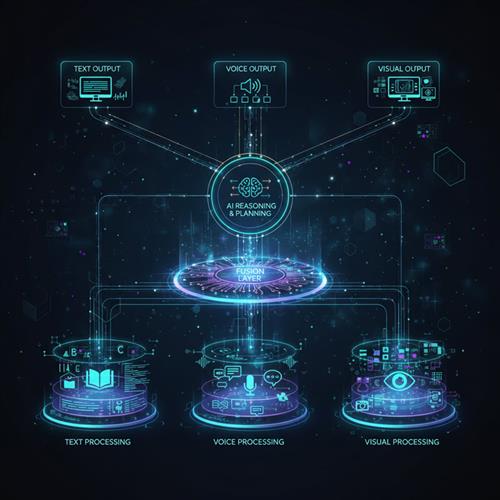
- Processes voice, images, logs
- Extracts context in real time
Cognitive Layer (Business Reasoning)
- Applies LLM intelligence
- Retrieves enterprise knowledge
- Runs rule-based and probabilistic reasoning
- Predicts next actions
Action Layer (Execution Engine)
- Executes tasks in ERP/CRM
- Sends emails, updates systems
- Works with other AI agents
- Provides human-in-the-loop escalation
Governance Layer (Safety & Compliance)
- Access controls
- Audit logs
- Outcome tracking
- Compliance workflows
This structure enables enterprise-grade autonomy with built-in controls.
Comparing Traditional Automation vs AI Agents
Below is a table you can include in your guest post.
| Capability | Traditional Automation (RPA/Workflows) | AI Agents (Enterprise Operations 2.0) |
| Adaptability | Very low | Very high |
| Handles unstructured data | No | Yes |
| Decision making | None | Strong contextual reasoning |
| Scaling | Hard, linear | Easy, exponential |
| Maintenance | High | Low |
| Exception handling | Breaks | Learns and adapts |
| Workflow coverage | Task-level | End-to-end |
| Cross-system orchestration | Limited | Seamless |
| Cost efficiency | Reduces cost initially | Reduces cost and increases throughput continuously |
| Ideal for | Simple, stable processes | Complex, dynamic, high-variance workflows |
Real Use Cases: Where AI Agents Deliver 30–70% Efficiency Gains
These examples are based on real-world implementations across financial services, telecom, manufacturing, and global enterprises.
1. Finance Operations (Record-to-Report, Procure-to-Pay)
AI agents manage:
- Reconciliations
- GL validation
- Invoice processing
- Cost allocation
- Compliance checks
Enterprises report:
- 50% faster month-end close
- 60–70% reduction in manual workloads
2. Customer Operations & Support
AI agents manage:
- Ticket triage
- Refund approvals
- Knowledge retrieval
- Back-office processing
- SLA monitoring
Results include:
- 25% reduction in AHT (Average Handling Time)
- 15–20% increase in CSAT
3. Supply Chain & Logistics
Agents autonomously handle:
- Shipment exceptions
- ETA predictions
- Inventory rebalancing
- Vendor coordination
- SLA enforcement
This delivers:
- 20–40% reduction in operational costs
- 10–30% reduction in disruptions
4. IT Operations & Infrastructure
AI agents act as L2/L3 analysts by:
- Diagnosing incidents
- Understanding logs
- Resolving tickets
- Triggering automation scripts
Leading to:
- 35% reduction in incident resolution time
- 40% fewer escalations
The Architecture Behind Enterprise Operations 2.0
Below is a more technical yet digestible breakdown for expert readers.
1. Multi-Agent System (MAS)
Agents collaborate:
- Task agents handle micro tasks
- Process agents orchestrate workflows
- Strategy agents optimize outcomes
- QA agents monitor behavior
2. Knowledge Integration
Agents interact with:
- Vector databases
- Enterprise knowledge graphs
- Compliance dictionaries
- Role-based access models
3. Decision Models
Use:
- LLM reasoning
- Reinforcement learning
- Predictive analytics
- Rule-based systems where needed
4. Supervisory Layer
Ensures:
- Guardrails
- Data governance
- Regulatory compliance
- Comprehensive audit logs
What Leaders Must Know: AI Agents Change the Operating Model
This is not a tooling upgrade, it is an operating model shift.
CIOs and COOs now prioritize:
- Outcome-first workflows
- AI-driven orchestration
- Exception-free operations
- Knowledge-based decision systems
- Workforce augmentation, not replacement
With AI agents, enterprises reduce manual dependency and unlock scalable intelligence across departments.
A Proven Roadmap to Start
Enterprises adopting AI agents typically follow a 6-stage maturity path:
- Identify 3–5 high-friction workflows
- Deploy task-level agents
- Establish an enterprise knowledge store
- Introduce orchestrator agents
- Deploy multi-agent collaboration pods
- Scale horizontally across functions
Companies following this roadmap report 20–60% efficiency gains within 90 days.
Final Call to Action
Enterprises are discovering a hard truth: traditional automation cannot keep up with modern operational complexity. AI agents are not an incremental improvement, they are an operational breakthrough.
- They adapt.
- They reason.
- They self-improve.
- They eliminate exceptions.
- They scale without limits.
This is the new engine of Enterprise Operations 2.0. The question for every transformation leader is now clear. Will you upgrade your automation stack or will your competitors outpace you with autonomous operations?
Anand Subramanian
Technology expert and AI enthusiast
Anand Subramanian is a technology expert and AI enthusiast currently leading the marketing function at Intellectyx, a Data, Digital, and AI solutions provider with over a decade of experience working with enterprises and government departments.
 Explore more on these topics




























 Guest Blogging: The Definitive Guide

 Top Trending Topics
 Share This
 Link copied!
 Recently Updated News