



Reducing Cognitive Friction in Software Development: A Guide to Faster, Happier Teams
Last updated: December 24, 2025 Read in fullscreen view


 Recommended for you
- 01 Aug 2024
 The Standish Group report 83.9% of IT projects partially or completely fail 788/2605
 - 06 Mar 2026 Next-Generation AI Agents Explained: OpenClaw, NanoClaw, IronClaw and the Rise of Agent Architectures 344/381
- 13 Apr 2024 Lessons on Teamwork and Leadership from Chinese story book "Journey to the West" 249/1334
- 13 Oct 2025 Mastering the Dynamic Squad Model: A Modern Approach to Agile Teams 204/408
- 23 Dec 2025 Microsoft Power Automate vs. n8n: What’s the Real Difference? 203/327
- 15 Feb 2024 What is a Cut-Over in Software Development? 190/1517
- 29 Oct 2024 Top AI Tools and Frameworks You’ll Master in an Artificial Intelligence Course 183/587
- 02 Nov 2021 What is Terms of Reference (ToR)? 166/1742
- 01 Dec 2025 Manufacturing 4.0: AI Agents Enabling Self-Optimizing Production Systems 166/225
- 09 Jul 2024 What Is Artificial Intelligence and How Is It Used Today? 163/416
- 05 Jun 2025 How AI-Driven Computer Vision Is Changing the Face of Retail Analytics 159/282
- 23 Dec 2024 Garbage In, Megabytes Out (GIMO): How to Rise Above AI Slop and Create Real Signal 159/212
- 02 Nov 2023 Differences between software walkthrough, review, and inspection 157/2299
- 16 Oct 2025 AI Inference Explained Simply: What Developers Really Need to Know 156/190
- 02 Dec 2025 The Question That Shook Asia: What Happens When We Ask AI to Choose Between a Mother and a Wife? 152/188
- 19 Oct 2021 Software development life cycles 143/821
- 06 Nov 2025 Top 10 AI Development Companies in the USA to Watch in 2026 142/218
- 12 Jan 2026 Why YouTube Content Is the New Resume: Building Trust and Expertise Even Without Views 139/167
- 06 Dec 2025 Enterprise Operations 2.0: Why AI Agents Are Replacing Traditional Automation 138/182
- 06 Nov 2025 DataOps: The Next Frontier in Agile Data Management 135/194
- 12 Apr 2025 How to Ask Powerful Questions Like Socrates 126/161
- 18 Dec 2025 EOS as a Business Operating System: Powerful, but Not Always Plug-and-Play 126/179
- 25 Nov 2025 How AI Agents Are Redefining Enterprise Automation and Decision-Making 126/184
- 24 Mar 2026 AI for Financial Reconciliation: Automating Finance Operations in 2026 126/152
- 13 Oct 2021 Outsourcing Software Development: MVP, Proof of Concept (POC) and Prototyping. Which is better? 126/602
- 04 Oct 2021 Product Validation: The Key to Developing the Best Product Possible 122/430
- 31 Jul 2025 Top WooCommerce Pre-Order Plugins with Countdown & Discounts 122/218
- 07 Oct 2025 Case Study: Using the “Messaging House” Framework to Build a Digital Transformation Roadmap 121/200
- 22 Dec 2025 The Role of Automotive Software in Building Smarter Vehicles 116/158
- 25 Dec 2025 What Is Algorithmic Fairness? Who Determines the Value of Content: Humans or Algorithms? 114/157
- 15 Apr 2024 Weights & Biases: The AI Developer Platform 113/304
- 23 Jun 2024 Best Practices for Managing Project Escalations 113/318
- 01 Jul 2025 The Hidden Costs of Not Adopting AI Agents: Risk of Falling Behind 112/260
- 12 Oct 2022 14 Common Reasons Software Projects Fail (And How To Avoid Them) 108/673
- 12 Aug 2024 Understanding Google Analytics in Mumbai: A Beginner's Guide 106/213
- 16 Aug 2022 What is a Headless CMS? 105/391
- 01 Mar 2024 10 Project Management Myths 104/276
- 02 May 2022 What Is RAID in Project Management? (With Pros and Cons) 104/947
- 02 May 2022 What Is RAID in Project Management? (With Pros and Cons) 104/947
- 03 Apr 2022 Microsoft Solutions Framework (MSF) 103/1445
- 27 Aug 2025 How AI Consulting Is Driving Smarter Diagnostics and Hospital Operations 102/202
- 12 Aug 2022 What is End-to-end project management? 102/608
- 28 Jul 2022 POC, Prototypes, Pilots and MVP: What Are the Differences? 100/840
- 12 Jan 2026 Companies Developing Custom AI Models for Brand Creative: Market Landscape and Use Cases 99/131
- 16 Sep 2022 Examples Of Augmented Intelligence In Today’s Workplaces Shaping the Business as Usual 98/534
- 21 Nov 2025 The Rise of AgentOps: How Enterprises Are Managing and Scaling AI Agents 98/153
- 10 Nov 2025 Multi-Modal AI Agents: Merging Voice, Text, and Vision for Better CX 97/210
- 17 Oct 2025 MLOps vs AIOps: What’s the Difference and Why It Matters 97/208
- 09 Oct 2024 Are Expensive CRM Systems Really Worth It? 97/191
- 03 Jan 2023 Organizing your agile teams? Think about M.A.T (Mastery, Autonomy, Purpose) 96/493
- 12 Dec 2021 Zero Sum Games Agile vs. Waterfall Project Management Methods 95/509
- 31 Aug 2022 What are the best practices for software contract negotiations? 95/366
- 21 Aug 2024 What is Singularity and Its Impact on Businesses? 94/553
- 06 May 2025 How Machine Learning Is Transforming Data Analytics Workflows 92/289
- 24 Dec 2024 Artificial Intelligence and Cybersecurity: Building Trust in EFL Tutoring 92/262
- 05 Sep 2023 The Cold Start Problem: How to Start and Scale Network Effects 91/288
- 21 Oct 2025 Cloud-Native Development: Why It’s the Future of Enterprise IT 91/180
- 09 Sep 2025 Aligning BI Dashboards with KPIs: A Business + Data Collaboration Guide 90/178
- 07 Nov 2025 Online vs. Offline Machine Learning Courses in South Africa: Which One Should You Pick? 89/157
- 02 Nov 2022 Difference between Change Management and Project Management 88/320
- 05 Mar 2021 How do you minimize risks when you outsource software development? 86/419
- 09 May 2022 Build one to throw away vs Second-system effect: What are differences? 85/396
- 10 Apr 2024 The Parking Lot Method: Unlocking a Simple Secret to Supercharge Your Productivity 84/603
- 18 Dec 2023 The Cone of Uncertainty in Scrum & Requirement Definition 80/814
- 28 Nov 2025 How AI Will Transform Vendor Onboarding and Seller Management in 2026 80/210
- 06 Mar 2024 [SemRush] What Are LSI Keywords & Why They Don‘t Matter 79/281
- 01 Aug 2022 Is planning "set it and forget it" or "set it and check it"? 79/376
- 01 Dec 2023 Laws of Project Management 78/393
- 17 Oct 2021 Does Fast Tracking increase project cost? 78/451
- 22 May 2022 What are common mistakes that new or inexperienced managers make? 78/359
- 04 Oct 2023 The Future of Work: Harnessing AI Solutions for Business Growth 77/356
- 06 Oct 2025 AI Agents in DevOps: From Automated Runbooks to Self-Healing Pipelines 77/193
- 07 Dec 2023 12 project management myths to avoid 75/267
- 14 Jun 2022 Example and Excel template of a RACI chart in Software Development 75/947
- 07 Jul 2022 Managing Project Execution Terms 74/481
- 18 Oct 2021 Key Elements to Ramping Up a Large Team 74/1331
- 18 Feb 2026 "Hit and Run" Project Management: Balancing Speed with Sustainability 74/100
- 18 Jul 2021 How To Ramp Up An Offshore Software Development Team Quickly 73/665
- 22 Sep 2025 Why AI Is Critical for Accelerating Drug Discovery in Pharma 73/188
- 01 Feb 2024 How long does it take to develop software? 73/283
- 04 Oct 2022 Which ERP implementation strategy is right for your business? 70/430
- 01 May 2024 Warren Buffett’s Golden Rule for Digital Transformation: Avoiding Tech Overload 69/277
- 24 Oct 2025 AI Agents in SaaS Platforms: Automating User Support and Onboarding 68/139
- 27 Jan 2020 Should a project manager push developers to work more hours due to mistakes of manager schedule setting? 67/508
- 21 Apr 2025 Agent AI in Multimodal Interaction: Transforming Human-Computer Engagement 66/261
- 15 May 2022 20 Common Mistakes Made by New or Inexperienced Project Managers 63/345
- 02 Dec 2021 3 Ways to Avoid Scope Creep in IT Consulting 62/271
- 20 Jul 2022 Software Myths and Realities 60/1001
- 05 Aug 2024 Affordable Tech: How Chatbots Enhance Value in Healthcare Software 60/290
- 24 Nov 2023 The project management paradox: Achieving MORE by doing LESS 59/289
- 06 Jun 2022 Change Management at the Project Level 58/364
- 05 Jun 2023 Fractional, Part-Time (virtual) or Interim CTO: Who Will Cover Your Business Needs? 58/200
- 26 Nov 2024 Harnessing Time Management Skills for Remote Team Effectiveness 58/276
- 02 Jun 2024 Reviving Ancient Wisdom: The Spiritual Side of Project Management 58/314
- 29 Aug 2025 How AI Is Transforming Modern Management Science 57/124
- 26 Sep 2024 Successful Project Management Techniques You Need to Look Out For 57/454
- 28 Oct 2022 Build Operate Transfer (B.O.T) Model in Software Outsourcing 57/467
- 13 Jan 2020 Quiz: Test your understanding project cost management 55/701
- 10 May 2022 Levels of Teamwork 54/249
- 03 Jul 2022 Occam’s Razor and the Art of Software Design 54/556
- 30 Nov 2023 Project Managers, Focus on Outcomes — Not Deliverables 52/213
- 21 Jun 2024 Dead Horses and the Escalation of Commitment 45/183
- 25 Jun 2026 Vercel: The "Secret Weapon" for Modern, High-Performance Web Deployment 45/50
Unlocking Velocity: How Tech Teams Improve Delivery by Reducing Cognitive Friction
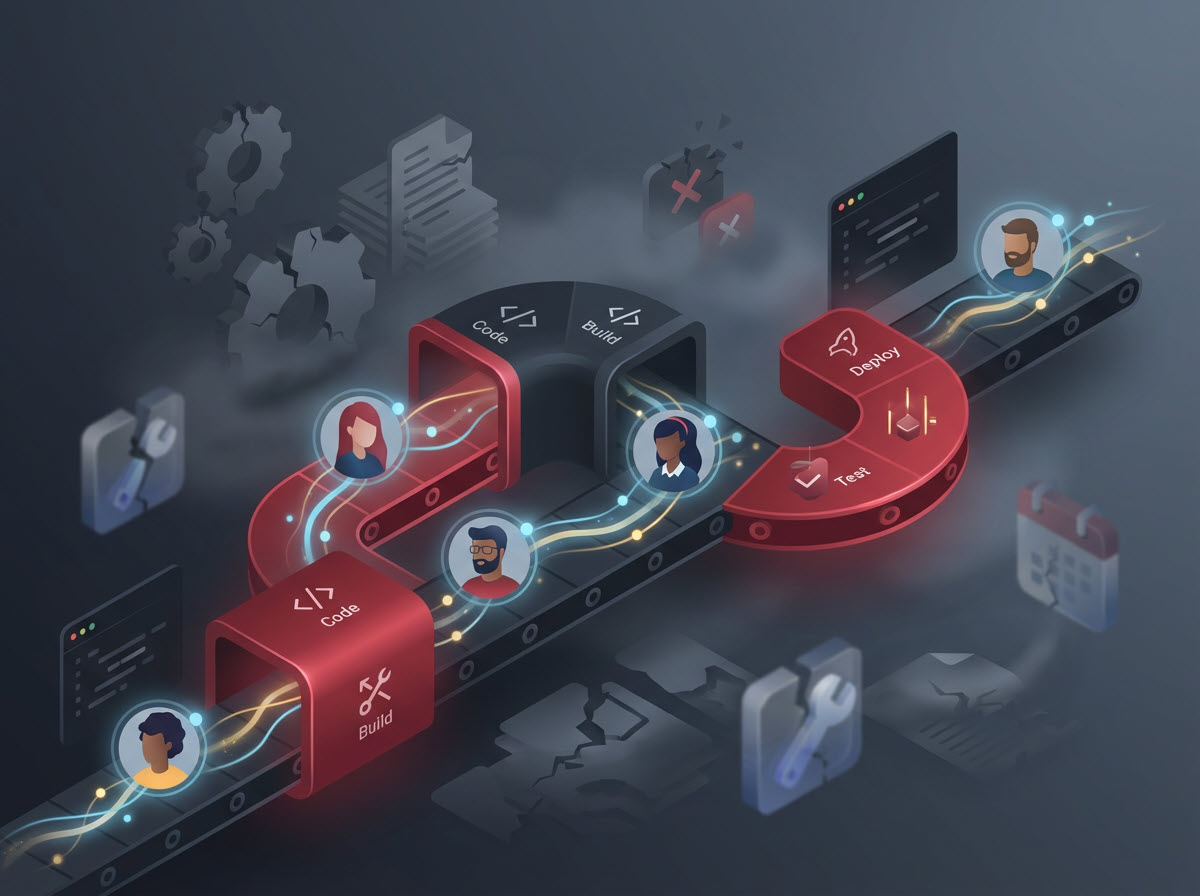
You’re in the zone. The code is flowing, the architecture is elegant, and you’re solving complex problems with grace. Then, a barrage of Slack pings, a cryptic JIRA ticket, a convoluted deployment process, and a meeting about a meeting shatter your focus. Suddenly, you’re stuck. This isn’t just frustration-it’s cognitive friction, the silent killer of software delivery speed and team morale.
For engineering leaders, the pressure to deliver features faster is relentless. But the answer isn’t simply hiring more developers or mandating overtime. The true bottleneck is often invisible: the excessive cognitive load in tech teams caused by fragmented tools, unclear priorities, and constant interruptions. By intentionally designing workflows to reduce cognitive friction, you don’t just improve team delivery speed; you unlock sustainable innovation and create a thriving developer culture. This post explores how.
What is Cognitive Friction in Software Development?
Cognitive friction is the mental resistance encountered when interacting with a system-be it a tool, a process, or even team communication. In software development, it’s the energy-draining gap between a developer’s intent and the action required to achieve it.
Think of it as the mental "drag coefficient" for your team. High friction results from:
- Context Switching: Jumping between tasks, projects, and tools.
- Unclear Requirements: Ambiguous tickets that require detective work.
- Complex Build/Deploy Processes: Memorizing a dozen CLI commands to get code to production.
- Tool Sprawl: Logging into 10 different platforms to complete one piece of work.
- Decision Fatigue: Constant minor choices about branching strategies, naming conventions, or approval workflows.
This friction directly increases cognitive load, overwhelming the working memory and leaving little mental capacity for the deep, creative work of solving hard engineering problems.
The Heavy Cost: How Cognitive Load Cripples Delivery
Why should you care? The impact of unmanaged cognitive load is quantifiable and severe.
- Slower Delivery: A study by the Harvard Business Review highlights that constant interruptions and context switching for developers can cause a 40% loss in productivity. What looks like "work" is often just recovering from disruption.
- More Bugs & Errors: Overloaded minds make mistakes. Cognitive fatigue leads to poorer code quality, security oversights, and production incidents.
- Burnout & Attrition: Gallup consistently finds that role clarity and the right tools are key to employee engagement. Chronic friction is a primary driver of developer frustration and turnover.
- Stifled Innovation: When all mental energy is spent navigating process hurdles, there’s none left for the creative problem-solving that drives business value.
The goal isn’t to work harder, but to think less about the how and more about the what. This is the essence of developer productivity optimization.
Strategies for Reducing Cognitive Friction and Streamlining Workflows
1. Standardize and Simplify Development Environments
Onboarding a new developer shouldn’t take a week. Use containerized (Docker) or scripted (Vagrant) environments and unified toolchains. This eliminates the "it works on my machine" saga and reduces setup cognitive load to nearly zero.
2. Architect for Clear Ownership and Flow
Adopt patterns like microservices or clearly bounded monoliths with explicit module ownership. This reduces decision fatigue in tech by clarifying who owns what and limiting the scope of context needed for any change.
3. Optimize for "Flow State" and Minimize Interruptions
- Implement "Maker" Schedules: Protect large blocks of uninterrupted time (3-4 hours) for deep work.
- Batch Communications: Encourage asynchronous communication for non-urgent matters and set clear norms for synchronous channels.
- Refine Sprint Ceremonies: Keep meetings sharp, time-boxed, and relevant.
4. Invest in Developer Experience (DX) and Automation
Developer Experience (DX) improvement is your highest-leverage investment. Automate everything tedious:
- CI/CD pipelines that run tests and deploy on a single command/merge.
- Automated code formatting and linting.
- Self-service infrastructure provisioning.
- Automated dependency updates and security scans.
Every automated step is a point of friction removed.
5. Ruthlessly Clarify Goals and Priorities
Unclear objectives are a major source of mental tax. When priorities conflict or are vague, developers waste cycles trying to guess what's most important.
Case Study: The Clarity Dividend
A compelling McKinsey study on organizational health and performance provides a powerful parallel. They found that companies where employees report a clear understanding of organizational direction and priorities are 1.7x more likely to be top performers.
While not exclusively a tech case, this principle translates directly to engineering team efficiency. A Deloitte insights report on high-performing teams emphasizes that "clarity of mission" reduces energy-sapping ambiguity, allowing technical talent to focus their cognitive resources on execution rather than interpretation.
The act of reducing decision fatigue in tech by providing absolute strategic clarity isn’t soft management-it’s a hard, quantifiable accelerator for delivery speed and quality. Teams that know precisely what to build and why can channel their full intellectual power into the "how," dramatically improving team delivery speed.
Conclusion: From Friction to Flow with Strategic Alignment
Reducing cognitive friction in software development is the ultimate force multiplier. It’s about creating an ecosystem where brilliant engineers can apply their brilliance to building-not battling their environment. The result is faster delivery, higher-quality products, and a team that’s engaged, innovative, and resilient.
However, achieving this state requires more than just technical automation; it requires strategic clarity. This is where aligning day-to-day work with company objectives becomes critical. When every developer understands how their tasks ladder up to key business outcomes, it eliminates the friction of working on the "wrong" thing.
This strategic alignment-connecting execution to vision-is exactly what Worxmate’s integrated OKR & Performance Management System (PMS) is designed to do.
Worxmate helps engineering leaders:
- Cascade Strategic Goals: Visibly connect company OKRs to team and individual technical initiatives.
- Eliminate Priority Ambiguity: Provide a single source of truth for what matters most, reducing decision fatigue.
- Streamline Reviews: Simplify performance conversations with integrated feedback and progress tracking, streamlining development workflows.
By bringing clarity and focus to your team’s mission, Worxmate removes the highest-level cognitive friction, allowing your team to achieve true flow.
Frequently Asked Questions (FAQs)
Q1: What’s the difference between cognitive load and cognitive friction?
A: Cognitive load is the total amount of mental effort being used in working memory. Cognitive friction is the specific source of resistance or difficulty within a system that causes unnecessary cognitive load. Friction creates load.
Q2: How does context switching specifically hurt developer productivity?
A: Each switch requires the brain to unload the context of one task and reload the context of another, a process that can take over 20 minutes to regain deep focus. This constant reloading fragments workdays, increases error rates, and leads to mental exhaustion.
Q3: Can tools actually reduce cognitive friction, or do they add to tool sprawl?
A: The right tools, integrated and chosen deliberately, are the primary antidote to friction. The key is consolidation and integration-seeking platforms that combine multiple functions (e.g., code, plan, track, deploy) to create a seamless workflow, rather than adding more disjointed point solutions.
Q4: How do I measure cognitive friction on my team?
A: Use qualitative and quantitative methods. Survey developers on their experience (e.g., SPACE or DORA metrics focus on satisfaction and efficiency). Quantitatively, track cycle time, deployment frequency, and the number of tools/steps required for a standard task. A rise in cycle time or bug rates can indicate increasing friction.
Q5: Where should I start to reduce friction on my team?
A: Begin with a developer experience audit. Interview your team: "What is the most frustrating, repetitive, or confusing part of your daily workflow?" The highest-impact starting point is often fixing the local development environment or simplifying the deployment process.
| About the Author | Madhusudan Nayak | CEO & Co-Founder, Worxmate.ai | Madhusudan Nayak is an experienced leader in performance management and OKRs, with decades of expertise guiding organizations through strategy-to-execution transformations across APAC, the Middle East, and Europe. He has partnered with IT, SaaS, finance, retail, and manufacturing sectors to help leaders align goals, accelerate growth, and develop high-performing teams. LinkedIn: https://www.linkedin.com/in/madhusudan-nayak-4527bb14 |
 Explore more on these topics























 Guest Blogging: The Definitive Guide

 Top Trending Topics
 Share This
 Link copied!
 Recently Updated News