

Event Marketing vs. Field Marketing: What’s the Difference and Why It Matters for Modern Businesses
Last updated: December 18, 2025 Read in fullscreen view


 Recommended for you
- 12 Jun 2025
 Rule-Based vs. Data-Driven Decision Making: The Critical Shift in Fintech and AI 210/331
 - 17 Oct 2022 What is the difference between low-end, mid-end and high-end solutions of project management software? 183/1657
- 01 Dec 2025 Manufacturing 4.0: AI Agents Enabling Self-Optimizing Production Systems 166/225
- 20 Jan 2022 Difference between Bug, Defect, Error, Fault & Failure 157/1516
- 18 Mar 2022 Difference between Project Management and Management Consulting 157/517
- 03 Aug 2022 What Are OLAs? SLAs vs OLAs vs UCs: What’s The Difference? 146/1235
- 06 Nov 2025 DataOps: The Next Frontier in Agile Data Management 135/194
- 06 Nov 2025 DataOps: The Next Frontier in Agile Data Management 135/194
- 07 Dec 2021 What's the difference between soft freeze, hard freeze and customization freeze? 132/1401
- 18 Dec 2025 EOS as a Business Operating System: Powerful, but Not Always Plug-and-Play 126/179
- 10 Apr 2022 Difference Between Forward and Backward Reasoning in AI 119/1854
- 21 Jun 2022 Difference between Quality and Grade 119/948
- 15 Aug 2024 Digital Governance vs IT Governance: What’s the Difference and Why It Matters 114/189
- 18 Sep 2024 What is Cognitive Friction? 113/191
- 15 Sep 2022 CRM vs CDP: What's the difference? 110/411
- 02 May 2022 Difference between CapEx vs. OpEx: Two Ways to Finance Your Software Project 109/1731
- 15 Aug 2023 Production-Ready vs Feature-Complete: What’s the Difference? 108/360
- 16 Aug 2022 What is a Headless CMS? 105/391
- 05 May 2022 DAM vs. CMS: What's the difference? 101/597
- 06 Jun 2024 Software Upgrade vs Software Update: What is the difference? 100/356
- 02 Nov 2021 Difference between an ESTIMATE and a QUOTE 99/454
- 16 Sep 2022 Examples Of Augmented Intelligence In Today’s Workplaces Shaping the Business as Usual 98/534
- 09 Oct 2024 Are Expensive CRM Systems Really Worth It? 97/191
- 09 Dec 2021 Customer Service vs Technical Support: What’s The Difference? 96/417
- 18 Oct 2024 IT Governance, IT Management and IT Outsourcing: What’s the Difference? 94/149
- 09 Sep 2025 Aligning BI Dashboards with KPIs: A Business + Data Collaboration Guide 90/178
- 25 Jan 2022 What is the difference between Outsourcing and Outstaffing? 90/456
- 18 Sep 2024 11 Psychological Defense Mechanisms and How to Recognize Them 87/283
- 24 Nov 2021 What is the difference between off-the-shelf software and customized software? 85/566
- 10 Nov 2021 PoC vs. Prototype vs. MVP: What’s the difference? 85/920
- 01 Apr 2022 Dedicated Team vs. Extended Team: What’s the difference? 71/397
- 03 Feb 2024 "Kham Nhẫn" in Business: A Guide to Patience and Resilience 71/234
- 01 Feb 2022 Outstaffing Vs. Outsourcing: What’s The Difference? 69/657
- 03 Oct 2021 Five long-lasting trends in Chinese Marketing 66/449
- 15 Aug 2025 Quantum Technology: Global Challenges and Opportunities for Innovators 60/190
- 02 Jun 2026 How Product Videos Improve Buyer Confidence in WooCommerce Stores 48/66
- 01 Aug 2024 Red vs. Blue Oceans in Software Development 37/238
In an era where digital channels dominate and automation is everywhere, many businesses question whether face-to-face marketing still matters. Yet in complex B2B and technology markets, trust, relationships, and human interaction remain decisive factors in buying decisions. This article explores the real differences between event marketing and field marketing, why they serve distinct roles in the buyer journey, and how modern organizations can strategically combine both approaches to drive growth, improve marketing ROI, and align sales with marketing more effectively.
In today’s digital-first world, many organizations assume that face-to-face marketing has lost its relevance. Yet despite automation, AI-driven personalization, and remote work, human interaction continues to play a decisive role in building trust and influencing purchasing decisions. This is particularly true in software development, IT services, and B2B technology, where buying cycles are complex, and relationships matter.
Two strategies often used to create these human connections are event marketing and field marketing. While the terms are sometimes used interchangeably, they serve very different purposes. Understanding the distinction helps businesses design more effective go-to-market strategies, optimize marketing ROI, and align sales and marketing teams.
Understanding Event Marketing
Event marketing is a strategic approach that focuses on creating curated experiences where brands engage audiences in a structured environment. These experiences can be physical, virtual, or hybrid and are planned well in advance with clear objectives.
In the technology and software ecosystem, event marketing often takes the form of conferences, product launches, webinars, industry summits, or user meetups. Its purpose is not only to promote products but also to educate audiences, share insights, and position the organization as a trusted authority.
Event marketing scales engagement effectively. One industry survey found that 88% of businesses report a positive return on investment from their event marketing efforts, demonstrating its measurable impact. Another study revealed that 77% of marketers consider events the most effective marketing channel, highlighting their value in building relationships and driving engagement.
By delivering consistent messaging and immersive experiences, event marketing supports long-term brand positioning and thought leadership-key differentiators in competitive technology markets.
Understanding Field Marketing
Field marketing emphasizes direct, localized engagement with prospects and customers. Instead of bringing audiences to a central event, field marketing brings the brand to the audience. It is often closely aligned with sales teams and focuses on high-impact interactions.
Common field marketing activities in IT and B2B SaaS include on-site product demonstrations, partner enablement sessions, regional roadshows, account-based marketing, and community outreach programs. These interactions are smaller in scale but often deeper in engagement, making them critical for influencing purchasing decisions.
Field marketing excels where trust, personalization, and adaptability are required. Teams can respond to local market dynamics, tailor messaging to individual accounts, and gather immediate feedback that informs product or marketing strategy. Unlike event marketing, which is largely centralized, field marketing is decentralized and highly agile.
Key Differences Between Event Marketing and Field Marketing
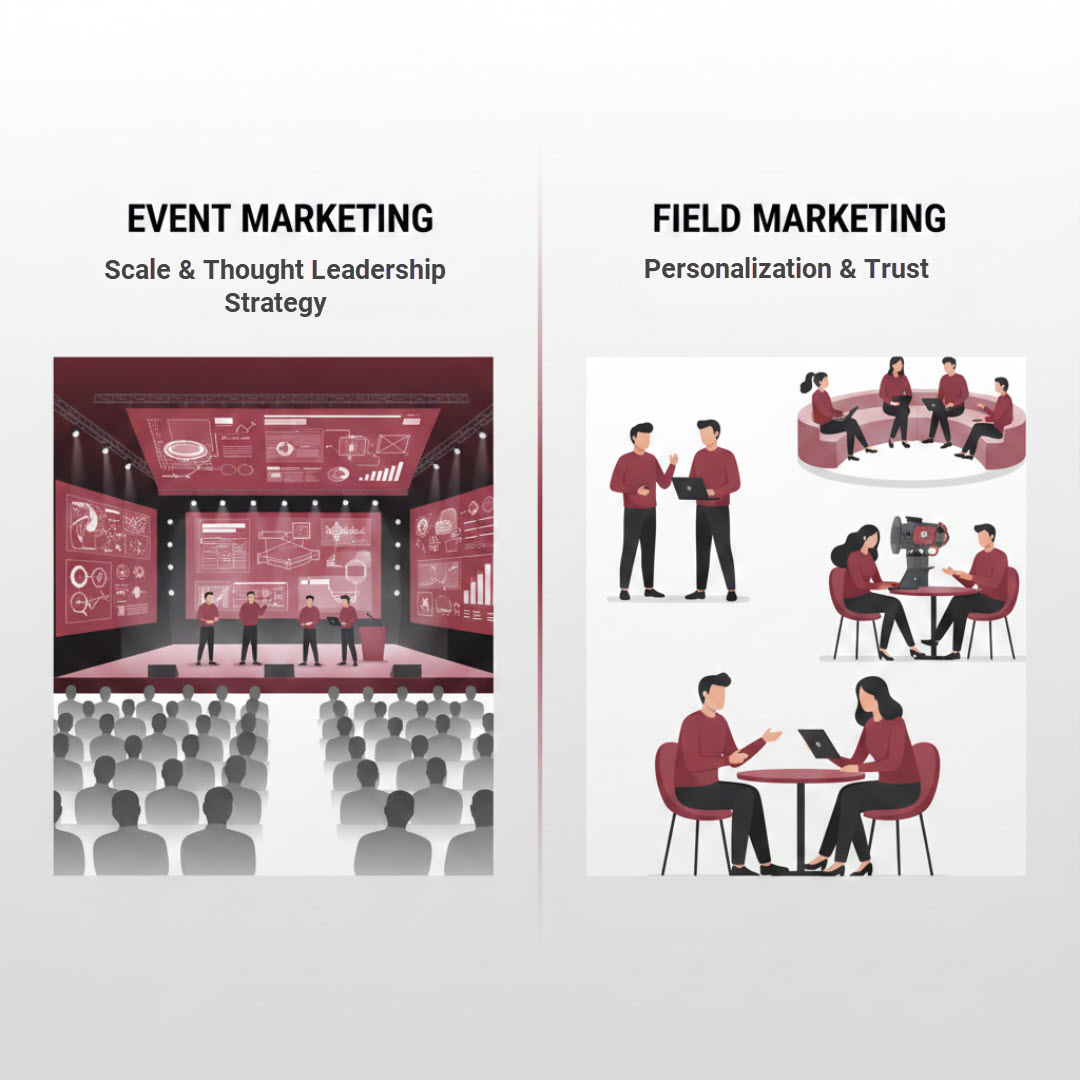
The main difference lies in execution and intent. Event marketing is structured and predictable, with campaigns designed months in advance to deliver a consistent narrative to a broad audience. Its goal is to build awareness, educate, and position the brand strategically.
Field marketing, by contrast, is responsive and situational. It prioritizes direct, personalized engagement that moves prospects closer to conversion. Metrics also differ event marketing is measured through attendance, engagement, and brand impact, while field marketing is evaluated based on leads influenced, pipeline acceleration, and sales conversion.
Despite these differences, both approaches increasingly rely on digital tools and cross-functional collaboration to succeed in modern marketing.
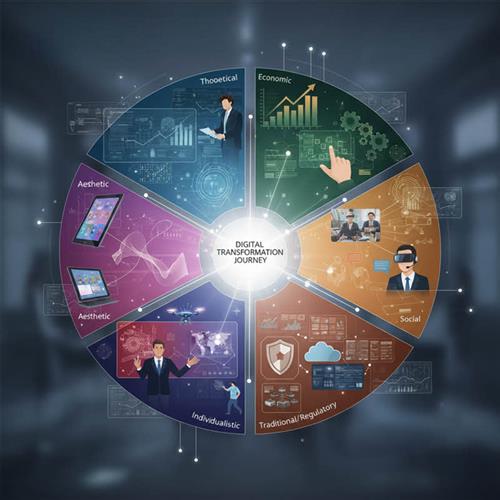
Role of Digital Transformation
Digital transformation has reshaped both event and field marketing. Event marketing now uses event management platforms, virtual engagement tools, CRM systems, and analytics dashboards to track the full attendee journey and tie engagement back to revenue outcomes.
Field marketing leverages mobile CRM access, cloud-based lead capture, and real-time performance tracking to align field teams with central marketing and sales strategies. These technologies allow both approaches to contribute to a unified customer view, enabling data-driven decision-making.
The Psychology Behind Both Approaches
Event marketing leverages social proof and authority bias-when prospects see industry experts and peers engaging with a brand, trust is naturally reinforced. Field marketing relies on familiarity and reciprocity bias, where one-to-one interactions create personal trust and increase the likelihood of follow-up engagement.
Understanding these cognitive drivers enables marketers to design experiences that resonate both emotionally and logically, improving overall effectiveness.
When to Use Event Marketing
Event marketing is ideal when the goal is to educate, inspire, and establish brand presence at scale. Use it for:
- Launching new products or services
- Showcasing innovation or thought leadership
- Building community around a brand
- Entering new markets
For technology companies, events provide a platform to demonstrate product value, share use cases, and foster industry relationships that digital channels alone cannot replicate.
When to Use Field Marketing
Field marketing works best in complex sales environments where personalized engagement influences decisions. Its effectiveness shines in situations like:
- Account-based marketing
- Regional sales acceleration
- Partner and channel support
- Localized customer outreach
Field marketing supports sales teams by creating deeper connections, capturing feedback, and moving prospects closer to purchase.
Integration: The Future of Marketing
With hybrid engagement becoming standard, the line between event and field marketing continues to blur. Virtual events expand the reach of physical experiences, while field marketing amplifies digital campaigns through personal interaction.
The most successful organizations treat these strategies as complementary components of a unified customer experience supported by technology, data, and human insight.
Final Thoughts
Event marketing and field marketing are not competing strategies-they are complementary tools designed for different stages of the buyer journey. Event marketing builds awareness and authority at scale, while field marketing drives personalized engagement that accelerates conversions.
Modern businesses navigating digital transformation can maximize impact by strategically integrating both approaches, ensuring meaningful, measurable, and human-centered customer experiences.
| About the Author | Ebenezer R | Marketing expert and writer | The author is a marketing and technology professional with expertise in event marketing, event management solutions, virtual and hybrid events, and digital transformation strategies. They focus on helping organizations deliver seamless, engaging, and measurable event experiences. With experience in streamlining registration, engagement, and analytics, they share insights on maximizing event impact. For more information, visit - https://samaaro.com |
 Explore more on these topics















 Guest Blogging: The Definitive Guide
 Top Trending Topics
 Share This
 Link copied!
 Recently Updated News