




The Hidden Rules of IT Project Tendering: Laws, Principles, and Caveats You Must Know
Last updated: January 29, 2026 Read in fullscreen view


 Recommended for you
- 15 Feb 2024
 What is a Cut-Over in Software Development? 194/1521
 - 17 Jul 2023 What Is SSL? A Simple Explanation Even a 10-Year-Old Can Understand 188/283
- 20 Mar 2022 What is a Multi-Model Database? Pros and Cons? 169/1393
- 18 Oct 2020 How to use the "Knowns" and "Unknowns" technique to manage assumptions 165/1259
- 02 Nov 2023 Differences between software walkthrough, review, and inspection 161/2303
- 23 Oct 2024 The Achilles Heel of Secure Software: When “Best-in-Class” Security Still Leads to System Collapse 143/193
- 18 Sep 2025 Pilot Projects Explained: What They Are and How to Use Them Effectively 133/189
- 21 Nov 2025 The Pressure of Short-Term Funding on Small-Budget IT Projects 130/160
- 03 Jul 2022 What is the difference between Project Proposal and Software Requirements Specification (SRS) in software engineering? 124/1165
- 05 Jul 2020 What is Sustaining Software Engineering? 124/1469
- 03 Jul 2022 What is the difference between Project Proposal and Software Requirements Specification (SRS) in software engineering? 124/1165
- 23 Sep 2021 INFOGRAPHIC: Top 9 Software Outsourcing Mistakes 123/546
- 13 Nov 2021 What Is Bleeding Edge Technology? Are bleeding edge technologies cheaper? 123/691
- 11 Jan 2024 What are the Benefits and Limitations of Augmented Intelligence? 119/605
- 18 Aug 2022 What are the consequences of poor requirements with software development projects? 118/386
- 13 Dec 2020 Move fast, fail fast, fail-safe 118/457
- 31 Dec 2025 The Curse of Knowledge in Pre-Project Requirements 117/173
- 06 Feb 2021 Why fail fast and learn fast? 114/590
- 01 Oct 2020 Fail fast, learn faster with Agile methodology 113/1187
- 18 Dec 2025 AI: Act Now or Wait Until You’re “Ready”? 111/149
- 10 May 2023 Distinguishing Between Best Fit, Worst Fit, First Fit, and Last Fit 106/173
- 01 Oct 2024 23 Overlooked Types of Non-Functional Requirements You Shouldn’t Ignore 106/148
- 02 May 2022 What Is RAID in Project Management? (With Pros and Cons) 105/948
- 22 Sep 2022 Why is it important to have a “single point of contact (SPoC)” on an IT project? 103/1095
- 14 Mar 2024 Why should you opt for software localization from a professional agency? 102/241
- 10 Apr 2022 What is predictive analytics? Why it matters? 96/277
- 30 Jan 2022 What Does a Sustaining Engineer Do? 96/731
- 14 Oct 2021 Advantages and Disadvantages of Time and Material Contract (T&M) 95/988
- 31 Dec 2021 What is a Data Pipeline? 92/297
- 21 Oct 2025 Cloud-Native Development: Why It’s the Future of Enterprise IT 92/181
- 19 Sep 2025 The Paradoxes of Scrum Events: When You “Follow the Ritual” but Lose the Value 92/137
- 25 Apr 2021 What is outstaffing? 90/360
- 28 Dec 2021 8 types of pricing models in software development outsourcing 87/521
- 08 Oct 2022 KPI - The New Leadership 87/694
- 10 Nov 2022 Poor Code Indicators and How to Improve Your Code? 81/298
- 10 Dec 2023 Pain points of User Acceptance Testing (UAT) 79/537
- 19 Oct 2021 Is gold plating good or bad in project management? 79/910
- 13 Jan 2024 The “Rule of Law” in Software Projects: Engineering Principles That Govern Successful Development 78/100
- 01 Mar 2023 What is Unit Testing? Pros and cons of Unit Testing? 77/503
- 01 Feb 2024 How long does it take to develop software? 77/287
- 17 Feb 2022 Prioritizing Software Requirements with Kano Analysis 75/379
- 19 Apr 2021 7 Most Common Time-Wasters For Software Development 72/617
- 12 Mar 2024 How do you create FOMO in software prospects? 70/243
- 01 Mar 2023 Bug Prioritization - What are the 5 levels of priority? 69/298
- 31 Oct 2021 Tips to Fail Fast With Outsourcing 66/457
- 15 Aug 2025 Quantum Technology: Global Challenges and Opportunities for Innovators 60/191
- 05 Jan 2024 Easy ASANA tips & tricks for you and your team 60/258
- 26 Dec 2023 Improving Meeting Effectiveness Through the Six Thinking Hats 53/329
- 06 Nov 2019 How to Access Software Project Size? 42/299
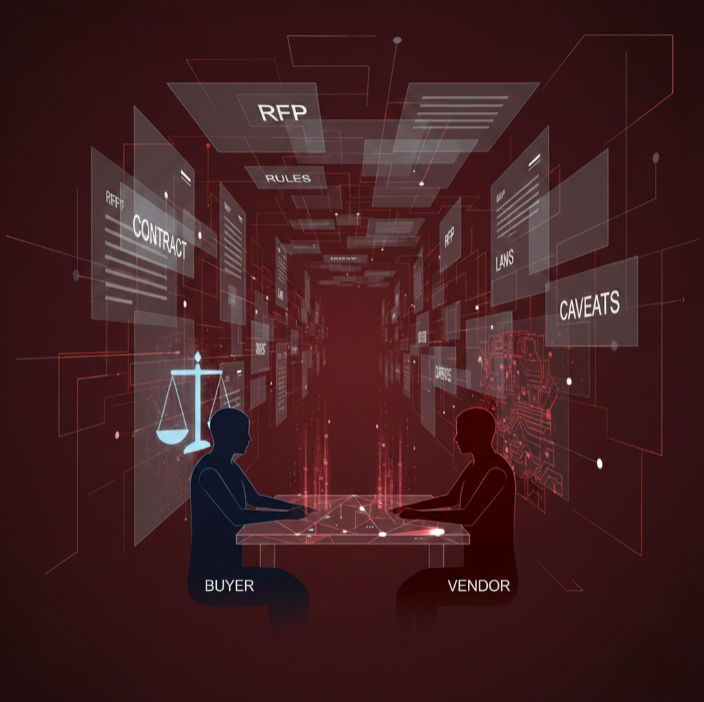
IT project tendering is not merely a procurement exercise - it is a complex socio-technical, legal, and economic system governed by explicit regulations and implicit laws.
Ignoring these principles often leads to cost overruns, disputes, failed vendors, or litigation.
Below is a curated list of key laws, rules, and tendering caveats that silently shape the success - or failure - of IT procurement.
1. The Law of Incomplete Requirements
What
No IT tender ever contains fully complete, unambiguous, and future-proof requirements.
How
Business stakeholders describe needs based on current understanding, while technical feasibility and edge cases remain unknown until execution.
Why
- Bounded rationality
- Information asymmetry between business and vendors
- Organizational silos
When it applies
- RFP drafting
- Fixed-price bidding
- Early-stage digital transformation projects
Implication: Over-specifying early often backfires; under-specifying creates legal ambiguity.
2. The Fixed-Price Illusion Rule
What
Fixed-price contracts create an illusion of certainty rather than actual risk elimination.
How
Vendors price in:
- Risk buffers
- Change penalties
- Conservative assumptions
Why
Risk is not removed - it is reallocated, usually inefficiently.
When it applies
- Government tenders
- Waterfall-based procurement
- Compliance-heavy industries
Paradox: The more uncertain the scope, the more expensive a “fixed” price becomes.
3. Goodhart’s Law in Vendor Evaluation
What
“When a measure becomes a target, it ceases to be a good measure.”
How
Vendors optimize proposals to score well on evaluation criteria rather than deliver real value.
Why
- Score-based tender matrices
- Over-weighted compliance checklists
- Lowest-bid bias
When it applies
- Public tenders
- Price-heavy scoring models
- Rigid procurement frameworks
Result: The best proposal on paper may be the worst in execution.
4. The Lowest Bidder Fallacy
What
Selecting the lowest bid rarely leads to the lowest total cost of ownership (TCO).
How
Hidden costs emerge through:
- Change requests
- Quality debt
- Schedule slippage
- Vendor churn
Why
IT systems are living systems, not commodities.
When it applies
- Cost-driven tenders
- Commoditization mindset in software projects
5. The Adverse Selection Principle
What
Tender processes tend to attract vendors most willing to accept unfavorable or risky contracts.
How
Strong vendors avoid:
- Unrealistic SLAs
- One-sided penalty clauses
- Ill-defined scopes
Why
High-quality vendors protect long-term viability over short-term wins.
When it applies
- Aggressive legal terms
- “Take-it-or-leave-it” RFPs
Irony: The safer the contract looks for the buyer, the riskier the vendor pool becomes.
6. Parkinson’s Law of Scope Consumption
What
Work expands to fill the scope, budget, and timeline provided.
How
If requirements are loosely defined, vendors will:
- Interpret scope defensively
- Expand effort where ambiguity exists
Why
Commercial incentives favor scope maximization under fixed contracts.
When it applies
- Vague SOWs
- Feature-based pricing without outcome metrics
7. The Change Request Inevitability Rule
What
Change Requests (CRs) are not a failure - they are mathematically inevitable.
How
New information emerges only during:
- User testing
- Integration
- Real-world usage
Why
Complex systems cannot be fully specified upfront.
When it applies
- Software development
- ERP / Core system replacement
- AI / Data platforms
Best practice: Plan CR governance, not CR avoidance.
8. Conway’s Law in Tendered Solutions
What
System architecture mirrors the organizational structure of the vendor.
How
- Siloed vendors produce fragmented systems
- Weak governance yields brittle integrations
Why
Communication pathways define design decisions.
When it applies
- Large SI-led projects
- Multi-vendor tenders
9. The Vendor Lock-In Caveat
What
Tender outcomes often embed long-term dependency, intentionally or not.
How
- Proprietary frameworks
- Limited IP ownership
- Opaque documentation
Why
Switching costs are underestimated during procurement.
When it applies
- Platform-based solutions
- SaaS + customization models
Mitigation: Escrow, IP clauses, exit strategies.
10. The Escalation of Commitment Trap
What
Organizations continue investing in failing vendors to justify past decisions.
How
- Sunk cost fallacy
- Political protection of procurement outcomes
Why
Admitting tender failure has reputational and career costs.
When it applies
- Long-term IT contracts
- Executive-sponsored vendor selections
11. The Legal–Delivery Misalignment Law
What
Contracts are written for disputes; projects are delivered through collaboration.
How
Overly legalistic contracts:
- Reduce trust
- Increase defensive behavior
- Slow decision-making
Why
Legal risk optimization conflicts with delivery agility.
When it applies
- Litigation-driven procurement cultures
- Highly regulated sectors
12. The “Compliance ≠ Capability” Rule
What
A compliant proposal is not necessarily a capable one.
How
Vendors can meet documentation requirements without real execution strength.
Why
Paper compliance is easier than operational excellence.
When it applies
- Documentation-heavy RFPs
- Vendor self-declared capabilities
Closing Thought
IT tendering is governed as much by economic laws, behavioral paradoxes, and organizational dynamics as by formal procurement rules.
Successful buyers do not attempt to eliminate uncertainty - they design tender processes that acknowledge and manage it.
 Explore more on these topics
























 Guest Blogging: The Definitive Guide

 Top Trending Topics
 Share This
 Link copied!
 Recently Updated News