


To Act or Not to Act – A Manager’s Persistent Dilemma
Last updated: July 26, 2025 Read in fullscreen view


 Recommended for you
- 05 Oct 2025
 The New Facebook Algorithm: A Paradigm Shift in Content Discovery 301/363
 - 21 Dec 2023 Top 12 Low-Code Platforms To Use in 2024 226/1527
- 21 Sep 2023 Abraham Wald and the Missing Bullet Holes 192/898
- 31 Dec 2025 10 Skills to Make You "Irreplaceable" in the Next 3 Years (even if AI changes everything) 177/211
- 25 Mar 2026 Token Bills: The "Cost Shock" After the AI Boom in Companies 170/196
- 20 Dec 2025 The Future of IT Consulting: Key Trends for 2026–2030 169/212
- 07 Nov 2025 When Merit Becomes a Threat: What Liu Bang Teaches Us About “Overqualified” Professionals in Modern Organizations 169/217
- 03 Oct 2025 Top CMS Trends 2026: The Future of Digital Content Management 168/202
- 26 Mar 2026 What Is a System Integrator (SI)? Why the Software Subscription Model Is Becoming the New Standard 155/189
- 01 Dec 2022 Difference between Set-based development and Point-based development 149/515
- 19 Oct 2021 Software development life cycles 148/828
- 27 Oct 2020 8 principles of Agile Testing 143/1459
- 18 Jul 2024 The 8 Best ways to Innovate your SAAS Business Model in 2024 140/397
- 21 May 2022 "Fail Fast, Fail Often, Fail Forward" is the answer to Agile practices of software success 139/1188
- 04 Oct 2021 Product Validation: The Key to Developing the Best Product Possible 136/444
- 10 Apr 2022 Agile self-organizing teams: What are they? How do they work? 135/696
- 13 Oct 2021 Outsourcing Software Development: MVP, Proof of Concept (POC) and Prototyping. Which is better? 132/613
- 10 Nov 2023 The "Cat Theory" of Deng Xiaoping Applied to Software Product Development 131/627
- 06 Nov 2023 How do you streamline requirement analysis and modeling? 129/366
- 07 Oct 2025 Case Study: Using the “Messaging House” Framework to Build a Digital Transformation Roadmap 128/208
- 20 Jan 2021 Fail early, fail often, fail cheap, fail safe but always fail forward 127/946
- 16 Jul 2022 What are disadvantages of Agile Methodology? How to mitigate the disadvantages ? 123/519
- 03 Jul 2022 Manifesto for Agile Software Development 122/392
- 28 Jul 2022 POC, Prototypes, Pilots and MVP: What Are the Differences? 122/866
- 28 Nov 2023 Scrum Team Failure — Scrum Anti-Patterns Taxonomy 120/375
- 20 Feb 2025 How Machine Learning is Shaping the Future of Digital Advertising 117/239
- 12 Oct 2022 14 Common Reasons Software Projects Fail (And How To Avoid Them) 116/682
- 16 Aug 2022 What is a Headless CMS? 115/401
- 02 Nov 2021 [Case Study] Streamlined Data Reporting using Tableau 112/415
- 27 Jul 2024 Positive Psychology in the Digital Age: Future Directions and Technologies 112/541
- 12 Aug 2024 Understanding Google Analytics in Mumbai: A Beginner's Guide 112/219
- 11 Nov 2021 What is an IT Self-service Portal? Why is it Important to Your Business? 111/562
- 02 Dec 2024 The Intersection of AI and Business Analytics: Key Concepts to Master in Your Business Analytics Course 108/404
- 05 Aug 2024 Debunking 10 Myths About Change Management 107/385
- 20 Feb 2026 The School of Life of the Chinese: Timeless Business Lessons for Success and Leadership 103/132
- 03 Jan 2024 Why Partnership is important for Growth? 103/261
- 11 Oct 2022 Why choose Billable Viable Product (BVP) over Minimum Viable Product (MVP) 99/441
- 16 Sep 2022 Examples Of Augmented Intelligence In Today’s Workplaces Shaping the Business as Usual 99/536
- 20 Nov 2022 Agile working method in software and football 98/438
- 12 Dec 2021 Zero Sum Games Agile vs. Waterfall Project Management Methods 98/512
- 20 Aug 2025 What Is Agentic AI? The Next Phase of Artificial Intelligence 98/259
- 31 Aug 2022 What are the best practices for software contract negotiations? 97/371
- 18 Jan 2024 Self-healing code is the future of software development 97/314
- 09 Sep 2024 How AI Rewriting Can Improve Your Content’s SEO Performance 97/295
- 05 Sep 2023 The Cold Start Problem: How to Start and Scale Network Effects 96/294
- 23 Jun 2025 AI Avatars in the Metaverse: How Digital Beings Are Redefining Identity and Social Interaction 96/284
- 25 Sep 2024 Enhancing Decision-Making Skills with an MBA: Data-Driven Approaches for Business Growth 95/304
- 07 Oct 2020 How To Manage Expectations at Work (and Why It's Important) 94/432
- 05 Mar 2021 How do you minimize risks when you outsource software development? 94/427
- 01 Jan 2024 The pros and cons of the Centralized Enterprise Automation Operating model 93/317
- 25 Jan 2025 The Decline of Traditional SaaS and the Rise of AI-first Applications 93/198
- 30 Jul 2024 The Future of IT Consulting: Trends and Opportunities 91/305
- 06 Mar 2024 [SemRush] What Are LSI Keywords & Why They Don‘t Matter 89/293
- 31 Dec 2023 Software Development Outsourcing Trends to Watch Out for in 2024 89/319
- 01 Mar 2024 (AI) Artificial Intelligence Terms Every Beginner Should Know 88/422
- 01 Jun 2022 How Your Agile Development Team is Just Like a Football Team? 88/306
- 03 Apr 2021 How digital asset management streamlines your content workflow? 83/414
- 17 Jun 2021 What is IT-business alignment? 83/455
- 03 Nov 2023 Why Is Billable Viable Product An Alternative To Minimum Viable Product? 83/274
- 22 Nov 2024 The Role of AI in Enhancing Business Efficiency and Decision-Making 82/277
- 01 Dec 2023 Laws of Project Management 81/396
- 02 Dec 2022 Success Story: Satsuki - Sales Management Software, back office app for School Subscription Management 80/320
- 18 Aug 2024 The Future of Web Development: Emerging Trends and Technologies Every Developer Should Know 80/275
- 09 Oct 2022 Key Advantages and Disadvantages of Agile Methodology 80/784
- 20 Jan 2022 TIGO Self-Organization Practice: Change Management Workflow 79/551
- 18 Jul 2021 How To Ramp Up An Offshore Software Development Team Quickly 76/668
- 10 Sep 2024 Leading Remote Teams in Hybrid Work Environments 76/220
- 31 Dec 2022 The New Normal for Software Development 76/430
- 02 Oct 2022 [Medium] The Importance of Being Able to Pivot 75/350
- 03 Sep 2022 The secret of software success: Simplicity is the ultimate sophistication 75/280
- 19 Dec 2023 How AI is Transforming Software Development? 74/367
- 27 Feb 2025 How AI Agents are Changing Software Development? 74/313
- 04 Oct 2022 Which ERP implementation strategy is right for your business? 73/434
- 13 Feb 2021 Why is TIGOSOFT a software house for Enterprise Application Development? 73/454
- 12 Oct 2020 The Agile Manifesto - Principle #8 73/568
- 09 Oct 2024 Short-Form Video Advertising: The Secret to Captivating Your Audience 70/202
- 01 May 2024 Warren Buffett’s Golden Rule for Digital Transformation: Avoiding Tech Overload 70/278
- 16 Jun 2022 Rapid Application Development (RAD): Pros and Cons 65/950
- 28 Oct 2022 Build Operate Transfer (B.O.T) Model in Software Outsourcing 64/474
- 21 Jun 2021 6 Useful Tips To Streamline Business Processes and Workflows 63/595
- 26 Sep 2024 Successful Project Management Techniques You Need to Look Out For 63/460
- 10 Sep 2024 AI in Email Marketing: Personalization and Automation 60/237
- 08 Jan 2024 Ask Experts: Explicitation/Implicitation and Elicitation; two commonly used but barely unraveled concepts 59/440
- 01 Mar 2022 Why Does Scrum Fail in Large Companies? 57/321
- 21 Oct 2022 Virtual meeting - How does TIGO save cost, reduce complexity and improve quality by remote communication? 51/241
- 10 Oct 2022 Should Your Business Go Agile? (Infographic) 51/175
- 02 Nov 2022 Frequently Asked Questions about Agile and Scrum 49/446
- 31 Dec 2022 Future of Software Development Trends and Predictions 48/199
- 12 Sep 2024 Be Water, My Friend: Fluidity, Flow & Going With the Flow 34/204
- 04 Mar 2026 CRM Trends Shaping Customer Engagement in 2026 /149
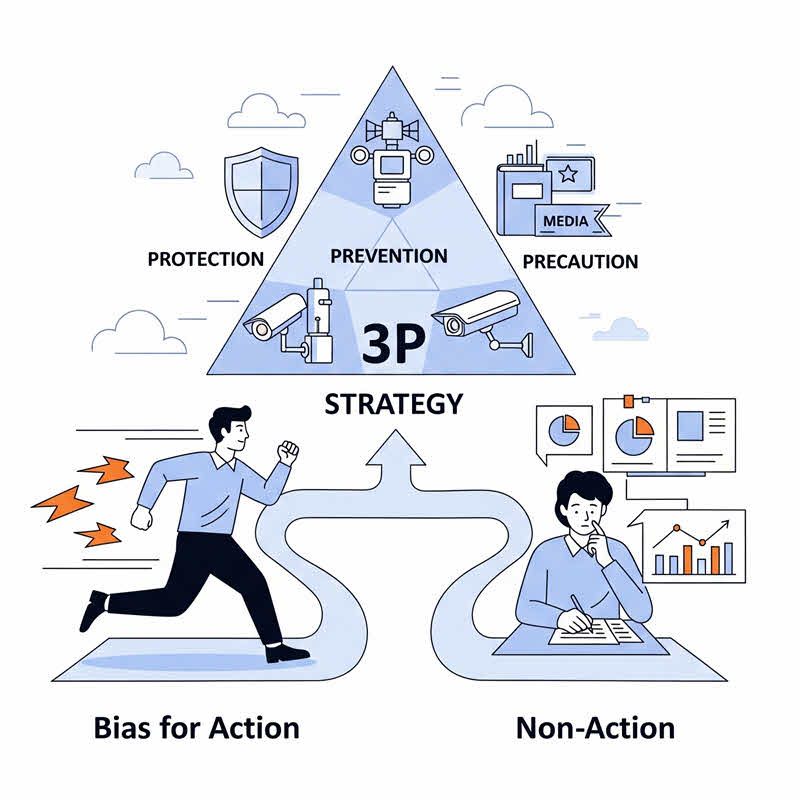
In a fast-paced and competitive era, the phrase "bias for action" is often praised as a golden trait of leadership. However, action is not always the best choice. Sometimes, non-action — choosing to do nothing — is actually the wisest decision.
Modern management thinking is not about always responding quickly, but about being able to distinguish when to act, when to observe and wait, or when to influence indirectly.
A Brief Definition: Two Opposing Mindsets
| Concept | Description | Risk | Benefit |
|---|---|---|---|
| Bias for Action | Taking action early, even with incomplete information | High chance of mistakes, wasted resources | Speed, competitive edge, momentum |
| Non-Action | Delaying action until the right conditions are met | Perceived as slow or indecisive | Reduced mistakes, optimized timing, risk prevention |
Cognitive Framing: System 1 and System 2 Thinking in Action
This dilemma between action and non-action closely relates to the concept of System 1 and System 2 thinking, introduced by psychologist Daniel Kahneman. System 1 is fast, intuitive, and emotionally driven—similar to the instinctive "bias for action." In contrast, System 2 is slow, deliberate, and analytical—aligned with thoughtful non-action and strategic delay. Effective leadership is not about favoring one system over the other, but about knowing when to trust your instincts and when to slow down and think critically. By integrating the 3P model with an awareness of these two cognitive systems, managers can better match their decisions to the context—balancing urgency with wisdom.
The Gray Zone Between Action and Non-Action
In reality, there is often a gray zone—a space where no choice is absolutely right or wrong. At such times, managers must analyze several factors:
- Level of urgency and risk
- Complexity and uncertainty of available information
- Reversibility of the decision
- Willingness to take responsibility
Example: In an IT project, a client suddenly demands urgent changes to the interface.
- If the PM chooses bias for action: They immediately ask the UX team to make changes to please the client.
- If the PM chooses non-action: They pause to assess the impact, request more information from the client, and consult the technical team.
The challenge: Acting too quickly can delay the timeline or introduce errors. But inaction may cause the client to become impatient.
Roadmap: When to Act, When to Wait
| Situation | Recommended Action |
|---|---|
| Crisis (system crash, major error) | Respond immediately with a temporary fix |
| Short-term opportunities | Launch a small test, learn from feedback |
| Low-risk, reversible decisions | Take action to experiment in real conditions |
| Self-Assessment Question | Action Suggestion |
|---|---|
| Do I have at least 70% of the needed data? | If yes, consider controlled bias for action |
| What are the risks if I'm wrong? | Estimate the cost of failure before proceeding |
| Is the team ready and capable? | If unsure, delay and prepare further |
| Situation | Recommended Action |
|---|---|
| Lack of data or internal conflict | Hold a meeting, gather diverse perspectives |
| High impact if wrong (irreversible outcomes) | Conduct deeper analysis, wait for more input |
| Politically sensitive decision, may cause rift | Delay and use a neutral or bridging strategy |
The 3P Method: A Best Practice to Balance Action and Inaction
An effective tool for managers to navigate between the two extremes is the 3P model:
🔴 1. Protection – Emergency Defense (Planned Bias for Action)
Prepare predefined processes and emergency response systems.
Example: In case of a cyberattack, the system immediately isolates the affected area.
→ Suitable for urgent situations that cannot be delayed.
🟡 2. Prevention – Proactive Risk Mitigation (Reducing Need for Action)
Set up regular monitoring systems and early warning alerts.
Example: DevOps installs performance monitoring to detect slowdowns before users notice.
→ Minimizes risk and reduces the need for rushed decisions.
🟢 3. Precaution – Indirect Education (Strategic Non-Action)
Communicate, train, and educate users to prevent risks themselves.
Example: Google regularly sends security tips encouraging users to enable two-factor authentication.
→ Subtle but sustainable impact, without requiring immediate action.
3P Summary Table
| Method | Type of Decision | Action Level | Typical Application |
|---|---|---|---|
| Protection | Reactive decisions | High | Crisis response, security breaches |
| Prevention | Preventive decisions | Medium | Monitoring, routine checkups |
| Precaution | Communication decisions | Low | Education, raising awareness |
Conclusion: Acting Wisely Is Better Than Acting Fast
Speed is not always good, and standing still is not always wise. Maturity in management comes from choosing the right type of action, at the right time, in the right context.
Final advice: Use the 3P model as your strategic map—not only to react fast, but to take control of the long-term game.
| About the Author | Pham Dinh Truong | Technical Writer, TIGO Solutions | PMO Coach, Senior Business Analyst, Software Architect |
 Explore more on these topics
























 Guest Blogging: The Definitive Guide

 Top Trending Topics
 Share This
 Link copied!
 Recently Updated News
 thực chiến - Kiến tạo tương lai cho các nhà sáng tạo nội dung.