


Total Quality Management (TQM) - Japanese-style management approach to quality improvement.
Last updated: October 21, 2025 Read in fullscreen view


 Recommended for you
- 02 Nov 2023
 Unlocking Success with The Amoeba Management Model: Key Lessons, Pros & Cons, and Finding the Perfect Fit 387/1079
 - 09 Sep 2022 Kaizen, Kaikaku and Kakushin – what’s the difference? 372/3454
- 24 Nov 2022 Genba Genbutsu Genjitsu (3Gs), (Go to the Genba & see for yourself!) 297/3308
- 01 Dec 2023 What is Amoeba Management? 284/1279
- 10 Nov 2021 5S methodology - the SECRET to Japanese SUCCESS 274/2023
- 07 Mar 2023 Japan’s Unusual Farming Strategy: Renting Land and Leaving It Fallow for 5 Years — Here’s the Truth… 211/338
- 03 Jan 2024 What is the Ringi process? 207/1228
- 21 Sep 2023 Abraham Wald and the Missing Bullet Holes 190/894
- 18 Oct 2020 How to use the "Knowns" and "Unknowns" technique to manage assumptions 167/1262
- 01 Mar 2022 The Toyota Way Management Principles 164/978
- 29 Jan 2026 Honne and Tatemae: Why Do Japanese People Seem Excessively Polite and Indirect? 149/173
- 01 Dec 2022 Difference between Set-based development and Point-based development 144/508
- 01 Apr 2022 Ishikawa (fishbone) diagram in software project management 144/3338
- 02 Feb 2022 Yokoten: Best Practice Sharing from a success 142/1569
- 21 May 2022 "Fail Fast, Fail Often, Fail Forward" is the answer to Agile practices of software success 139/1188
- 27 Oct 2020 8 principles of Agile Testing 139/1455
- 09 Sep 2022 What is 5 Whys (Five Whys)? 137/1112
- 10 Dec 2021 What is a Kano Analysis? 136/1058
- 10 Apr 2022 Agile self-organizing teams: What are they? How do they work? 131/690
- 29 Aug 2022 Difference between Kaizen and Innovation 129/1036
- 23 Sep 2021 INFOGRAPHIC: Top 9 Software Outsourcing Mistakes 127/550
- 19 Sep 2022 Jidoka in Software Development and Odoo ERP/MRP 126/676
- 18 Aug 2022 What are the consequences of poor requirements with software development projects? 123/391
- 06 Jun 2022 HEIJUNKA: The art of leveling production 123/745
- 16 Jul 2022 What are disadvantages of Agile Methodology? How to mitigate the disadvantages ? 120/516
- 03 Jul 2022 Manifesto for Agile Software Development 120/390
- 11 Jan 2024 What are the Benefits and Limitations of Augmented Intelligence? 119/605
- 27 Aug 2022 Kaizen - Culture of Continuous Improvement and Lean Thinking 119/1014
- 13 Dec 2020 Move fast, fail fast, fail-safe 119/460
- 01 Oct 2020 Fail fast, learn faster with Agile methodology 118/1192
- 28 Nov 2023 Scrum Team Failure — Scrum Anti-Patterns Taxonomy 118/373
- 06 Feb 2021 Why fail fast and learn fast? 116/593
- 01 Jan 2023 How To Use Poka-Yoke (Mistake Proofing) Technique To Improve Software Quality 115/775
- 15 Jul 2022 Hansei Methodology: Continuously Engaging People in Improvement 109/866
- 13 Jul 2022 Applying the business mantra "HORENSO" to Achieve 360-degree Communication 108/1070
- 12 Mar 2022 The u-Japan concept 104/393
- 04 Mar 2024 Tree Ring Management: Take the Long Term View and Grow Your Business Slowly 104/549
- 14 Mar 2024 Why should you opt for software localization from a professional agency? 102/241
- 17 Mar 2023 Reduce waste in software development with 3M model: Muda, Mura, Muri 102/1073
- 20 Nov 2022 Agile working method in software and football 98/438
- 14 Oct 2021 Advantages and Disadvantages of Time and Material Contract (T&M) 98/994
- 07 Dec 2023 The Myths Of Requirements 94/356
- 12 Dec 2024 Danshari: A Japanese Minimalist Philosophy for Cleaner Code and Leaner IT Operations 93/178
- 28 Dec 2021 8 types of pricing models in software development outsourcing 93/527
- 09 Sep 2024 How AI Rewriting Can Improve Your Content’s SEO Performance 92/290
- 07 Oct 2020 How To Manage Expectations at Work (and Why It's Important) 91/428
- 17 Feb 2022 Prioritizing Software Requirements with Kano Analysis 88/392
- 08 Oct 2022 KPI - The New Leadership 87/696
- 19 Oct 2021 Is gold plating good or bad in project management? 87/918
- 01 Jun 2022 How Your Agile Development Team is Just Like a Football Team? 86/304
- 10 Nov 2022 Poor Code Indicators and How to Improve Your Code? 83/300
- 10 Nov 2021 Automated QA Outsourcing – Hire a Professional Software Testing Team 82/667
- 10 Dec 2023 Pain points of User Acceptance Testing (UAT) 82/543
- 09 Oct 2022 Key Advantages and Disadvantages of Agile Methodology 80/784
- 12 Mar 2024 How do you create FOMO in software prospects? 76/250
- 01 Jun 2020 Japan Business Review (JBR) 75/410
- 12 Oct 2020 The Agile Manifesto - Principle #8 73/568
- 01 Mar 2023 Bug Prioritization - What are the 5 levels of priority? 73/302
- 19 Apr 2021 7 Most Common Time-Wasters For Software Development 72/617
- 31 Oct 2021 Tips to Fail Fast With Outsourcing 68/459
- 02 Apr 2022 Productivity vs. Efficiency – What Are the Differences? 64/273
- 05 Jan 2024 Easy ASANA tips & tricks for you and your team 62/260
- 26 Sep 2024 Successful Project Management Techniques You Need to Look Out For 62/459
- 01 Mar 2022 Why Does Scrum Fail in Large Companies? 55/319
- 26 Dec 2023 Improving Meeting Effectiveness Through the Six Thinking Hats 54/330
- 10 Oct 2022 Should Your Business Go Agile? (Infographic) 51/175
- 21 Oct 2022 Virtual meeting - How does TIGO save cost, reduce complexity and improve quality by remote communication? 51/241
- 02 Nov 2022 Frequently Asked Questions about Agile and Scrum 47/444
- 06 Nov 2019 How to Access Software Project Size? 45/303
- 12 Sep 2024 Be Water, My Friend: Fluidity, Flow & Going With the Flow 31/201
The history of total quality management (TQM) began initially as a term coined by the Naval Air Systems Command to describe its Japanese-style management approach to quality improvement. An umbrella methodology for continually improving the quality of all processes, it draws on a knowledge of the principles and practices of:
- The behavioral sciences
- The analysis of quantitative and nonquantitative data
- Economics theories
- Process analysis
During the global recession of the late ’70s and early ’80s, the United States (and the rest of the world) faced stiff competition from Japan. The Japanese had captured the world automotive and electronics markets because they found a way to produce high-quality goods at lower prices. And as a result, corporations in the U.S. looked more closely at the quality of Japanese goods and services, trying to find ways to improve production and recapture market share.
Their solution was Total Quality Management.
If your organization has just decided to incorporate TQM, or if you want to see whether this process improvement methodology can help you improve production, this blog post will cover Total Quality Management principles and techniques you can start using now.
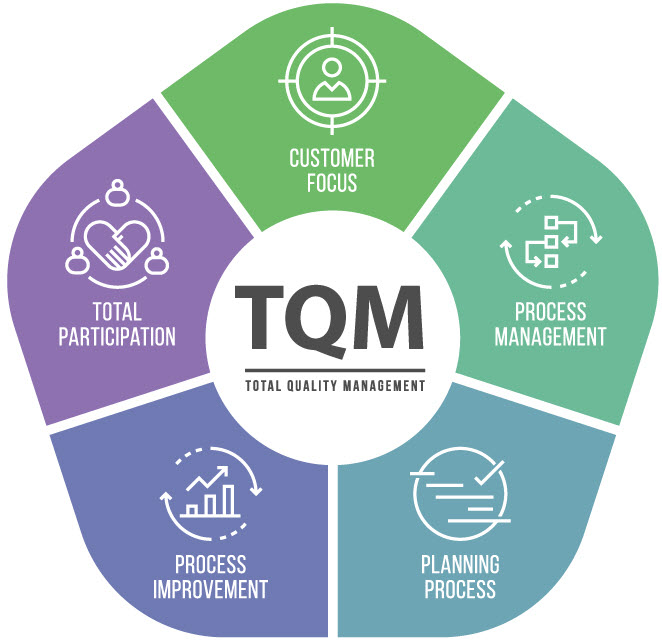
Total Quality Management (TQM) is a management approach focusing on the improvement of quality and performance in all functions, departments, and processes across the company to provide quality services which exceed customer expectations. TQM expands the scope of quality of every department from top management to lower level employees. It enables management to adopt a strategic approach to quality and put more effort on prevention rather than on inspection. Through TQM, all employees are trained in a professional manner and encouraged to make decisions on their own to improve the overall quality and attain higher standards. This is key to achieving the TQM results desired, because without your employees on board and feeling empowered, you might as well be swimming upstream.
Through TQM, companies increase customer satisfaction, reduce costs, and foster team work. Companies can also gain higher returns on sales and investment. The ability to provide quality services allow for higher prices to be charged. Total quality means better access to global markets, greater customer loyalty, wider recognition as a quality brand, etc.
TQM is broadly based on the following principles:
Customer Centric Approach
Consumers are the ultimate judge to determine whether products or services are of superior quality or not. No matter how many resources are pooled in training employees, upgrading machines and computers, incorporating quality design process and standards, bringing new technology, etc.; at the end of the day, it is the customers who have the final say in judging your company. Companies must remember to implement TQM across all fronts keeping in mind the customers.
Employee Involvement
Ensuring total employee involvement in achieving goals and business objectives will lead to employee empowerment and active participation from the employees in decision making and addressing quality related problems. Employee empowerment and involvement can be increased by making the workspace more open and devoid of fear.
Continual Improvement
A major component of TQM is continual improvement. Continual improvement will lead to improved and higher quality processes. Continual improvement will ensure companies will find new ways and techniques in producing better quality products, production, be more competitive, as well as exceed customer expectations.
Strategic Approach to Improvement
Businesses must adopt a strategic approach towards quality improvement to achieve their goals, vision, and mission. A strategic plan is very necessary to ensure quality becomes the core aspect of all business processes.
Integrated System
Businesses comprise of various departments with different functionality purposes. These functionalities are interconnected with various horizontal processes TQM focuses on. Everyone in the company should have a thorough understanding of the quality policies, standards, objectives, and important processes. It is very important to promote a quality work culture as it helps to achieve excellence and surpass customer expectations. An integrated system ensures continual improvement and helps companies achieve a competitive edge.
Decision Making
Data from the performance measurement of processes indicates the current health of the company. For efficient TQM, companies must collect and analyze data to improve quality, decision making accuracy, and forecasts. The decision making must be statistically and situational based in order to avoid any room for emotional based decisions.
Communications
Communication plays a crucial role in TQM as it helps to motivate employees and improve their morale during routine daily operations. Employees need to be involved as much as possible in the day to day operations and decision making process to really give them a sense of empowerment. This creates the environment of success and unity and helps drive the results the TQM process can achieve.
It requires immense efforts, time, courage, and patience to successfully implement TQM. Businesses successfully implementing TQM can witness improved quality across all major processes and departments, higher customer retention, higher revenue due to improved sales, and global brand recognition.
 Explore more on these topics























 Guest Blogging: The Definitive Guide

 Top Trending Topics
 Share This
 Link copied!
 Recently Updated News