




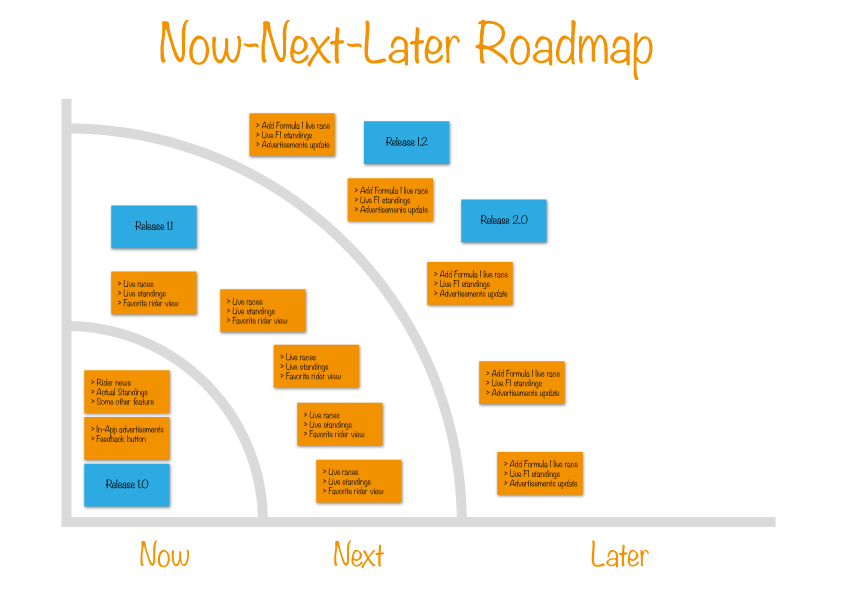
What is NOW-NEXT-LATER roadmap?
Last updated: December 01, 2025 Read in fullscreen view


 Recommended for you
- 15 Feb 2024
 What is a Cut-Over in Software Development? 190/1517
 - 02 Nov 2023 Differences between software walkthrough, review, and inspection 157/2299
- 30 Oct 2022 How Much Does MVP Development Cost in 2023? 149/406
- 09 Jan 2022 How to Bridge the Gap Between Business and IT? 144/347
- 28 Oct 2025 The Future of Real Estate: Key Trends and Essential Lessons in Digital Transformation 131/202
- 18 Sep 2025 Pilot Projects Explained: What They Are and How to Use Them Effectively 130/186
- 01 Sep 2022 Facts Chart: Why Do Software Projects Fail? 127/720
- 06 Nov 2023 How do you streamline requirement analysis and modeling? 124/361
- 10 Dec 2021 What is a Kano Analysis? 122/1041
- 03 Jul 2022 What is the difference between Project Proposal and Software Requirements Specification (SRS) in software engineering? 121/1162
- 02 Jan 2024 What is User Provisioning & Deprovisioning? 116/707
- 31 Dec 2025 The Curse of Knowledge in Pre-Project Requirements 113/169
- 20 Jan 2021 Fail early, fail often, fail cheap, fail safe but always fail forward 113/927
- 10 Apr 2021 RFP vs POC: Why the proof of concept is replacing the request for proposal 111/438
- 01 Oct 2024 23 Overlooked Types of Non-Functional Requirements You Shouldn’t Ignore 105/147
- 02 May 2022 What Is RAID in Project Management? (With Pros and Cons) 104/947
- 02 Nov 2021 [Case Study] Streamlined Data Reporting using Tableau 103/406
- 29 Nov 2021 Memorandum of Understanding (MOU) for Partnership Agreements 102/670
- 07 Jul 2021 The 5 Levels of IT Help Desk Support 102/578
- 11 Nov 2021 What is an IT Self-service Portal? Why is it Important to Your Business? 101/548
- 20 Dec 2021 What is Hybrid Mobile App Development? 98/497
- 08 Nov 2022 4 tips for meeting tough deadlines when outsourcing projects to software vendor 97/387
- 03 Dec 2025 IT Outsourcing Solutions Explained: What, How, Why, When 96/128
- 07 Nov 2022 Why Design Thinking can save the outsourcing industry 95/286
- 16 Feb 2021 Choose Outsourcing for Your Non Disclosure Agreement (NDA) 93/263
- 21 Oct 2025 Cloud-Native Development: Why It’s the Future of Enterprise IT 91/180
- 07 Dec 2023 The Myths Of Requirements 90/348
- 07 Aug 2022 Things to Consider When Choosing a Technology Partner 84/367
- 01 Jan 2024 The pros and cons of the Centralized Enterprise Automation Operating model 81/305
- 09 Feb 2023 The Challenge of Fixed-Bid Software Projects 80/329
- 02 Dec 2022 Success Story: Satsuki - Sales Management Software, back office app for School Subscription Management 78/317
- 03 Apr 2021 How digital asset management streamlines your content workflow? 76/404
- 20 Jan 2022 TIGO Self-Organization Practice: Change Management Workflow 76/547
- 10 Nov 2021 Automated QA Outsourcing – Hire a Professional Software Testing Team 75/660
- 03 Sep 2022 The secret of software success: Simplicity is the ultimate sophistication 74/278
- 01 Feb 2024 How long does it take to develop software? 73/283
- 03 Nov 2022 Top questions and answers you must know before ask for software outsourcing 72/357
- 13 Feb 2021 Why is TIGOSOFT a software house for Enterprise Application Development? 70/450
- 16 Apr 2021 Insightful Business Technology Consulting at TIGO 69/523
- 10 Jul 2025 Building AI-Driven Knowledge Graphs from Unstructured Data 68/230
- 02 Apr 2022 Productivity vs. Efficiency – What Are the Differences? 62/271
- 20 Nov 2022 Software Requirements Are A Communication Problem 61/303
- 06 Mar 2021 4 things you need to do before getting an accurate quote for your software development 60/757
- 15 Aug 2025 Quantum Technology: Global Challenges and Opportunities for Innovators 60/190
- 06 Dec 2024 Steps For Integrating Sustainable Practices Into Business Operations 60/209
- 01 May 2023 CTO Interview Questions 59/394
- 21 Jun 2021 6 Useful Tips To Streamline Business Processes and Workflows 59/590
- 07 Oct 2022 Digital Transformation: Become a Technology Powerhouse 59/306
- 16 Jun 2022 Rapid Application Development (RAD): Pros and Cons 56/936
- 09 Mar 2022 Consultant Implementation Pricing 49/261
- 01 Mar 2023 How do you deal with disputes and conflicts that may arise during a software consulting project? 47/207
- 17 Mar 2025 IT Consultants in Digital Transformation 41/131
- 03 Dec 2025 Templafy Features Explained: The Ultimate Guide to Streamlined Content Management 4/173
What is a Now/Next/Later roadmap?
The Now/Next/Later roadmap is a product management tool that organizes work into three-time horizons, from immediate to long term, starting with the most urgent problems to solve. This roadmap format conveys the overall product vision, as each element of work is tied back to a business objective.
Now”, “Next”, “Later” is a great flexible framework that can be applied to many different types of situations or initiatives.
The core benefit of roadmapping is to visualize your business strategy, making it easier to communicate with all stakeholders and align to business outcomes. Designing your roadmap to be visually attractive is key for engagement and the level of buy-in from stakeholders.
You should use the Now Next Later view when you need a high-level way to visualize and communicate your product plans. Since this visualization is super easy to understand and does not offer too many details it is the perfect view to use when you want to communicate with large groups of people – like a company-wide meeting or a webinar.
Divide your items into one of 3 time buckets – Now, Next and Later. Just like it sounds, you should put your high priority items in Now, and those that are a bit less important in Next. Later items are pushed off until they become a priority. Do not add too many details to Next and Later items as the purpose of this view is to provide a high-level overview of the company’s current priorities.
This view is great for external audiences or internal ones that do not usually get to see the product roadmap as it offers a general perspective on the product’s upcoming objectives.
Remember to keep your roadmap as realistic as possible. Don’t commit to deadlines you can’t meet and keep implementation details away from your roadmap.
When to use this roadmap?
Now-Next-Later Roadmap is good for
- Communicating with large audiences (e.g. an All-Hands or Town Hall meeting). Simple, streamlined layout reduces noise and is easy for everyone to understand.
- Communicating broad plans without committing your team to specific deadlines.
We do not recommend Now-Next-Later Roadmap for
- Communicating with executives. If your audience needs any kind of detail – deadlines, teams, or company objectives, for example, consider an Objectives timeline roadmap.
- Communicating within the Product organization. Hopefully, your Product team already understands what’s being worked on now, next and later! Consider a Sprint planning roadmap.
Conclusion
Now Next Later is a professional and modern template that contains seven stylish and fully editable slides. If necessary, you can change all elements of the slide in accordance with your corporate requirements. This template will be useful for project managers, startups, company leaders. Now Next Later template will seamlessly complement your presentations and will be a great addition to your collection of professional presentations.
Frequently Asked Questions
Is roadmap same as timeline?
- Roadmap: A roadmap is a document that communicates the goals that the company (or product) is aiming for.
- Timeline: A timeline is a visual that sequences chronological events with firm start and end dates. Deadline: A deadline is a set due date for a project or event.
How do you create a now next later roadmap?
- Build Roadmaps. Connect your backlog with always up-to-date and easy-to-share roadmaps.
- Prioritize Features. Know what to build next based on user insights and company priorities.
- Centralize Feedback. Capture and collect all your customer feedback in one place.
- Validate Ideas.
What is difference between Output and Outcome?
Both outputs and outcomes are the result of the project. Therefore, we usually use these words interchangeably. However, there are distinct differences between output and outcome. Below are some key differences:
- Output is linked to activities. Outcome is linked to objectives.
- The outputs are the actions or items that contribute to achieving an outcome.
- Outputs are the steps an organization or business takes to reach a desired outcome.
- Outputs are achieved immediately. Outcomes are not achieved right after the implementation of activities or projects/programs.
What is an outcome based roadmap?
An outcome-driven roadmap provides context for specific items on the roadmap and their prioritization while simultaneously ensuring that the product strategy is both communicated and consistently pursued. Everything is there for a reason, the reason is well understood, and the goal is measurable.
Why "Now, Next, Later" roadmaps are better for OKRs
Objectives and Key Results (OKRs) are meant to be guideposts and benchmarks for the company at large, so you know where you are aiming and how well you are getting there.
Initiatives are the actions you are actually taking to achieve results and hit goals. Initiatives are the game plan. These are items you’ve spelled out on the Now/Next/Later roadmap. This is why NNL are better for OKRs. Your business objectives are baked into the product roadmap, so your team works toward outcomes – not just output.
Does measuring outputs help or hinder the outcome?
With outputs, there are a couple of things to note. There is no competition between outcomes and outputs, so they both go towards the same thing. This is important because most outputs are not tightly defined. An input that helps to reach the desired outcome might seem insignificant, but may not actually be crucial if it is not captured in the outcome document. If you measure outputs, you must include them in the outcome document, or risk looking less important, so there’s no incentive for people to improve your output. A measuring mechanism with no visibility makes the outputs less important because they’re not included in the outcome document, and people will forget about them, not noticing if they improved. On the other hand, measuring outputs can create the same issue.
 Explore more on these topics





















 Guest Blogging: The Definitive Guide

 Top Trending Topics
 Share This
 Link copied!
 Recently Updated News