





What Programmers Can Learn from Buddhist Philosophy?
Last updated: August 04, 2025 Read in fullscreen view


 Recommended for you
- 05 Oct 2025
 The New Facebook Algorithm: A Paradigm Shift in Content Discovery 219/280
 - 21 Dec 2023 Top 12 Low-Code Platforms To Use in 2024 164/1456
- 03 Oct 2025 Top CMS Trends 2026: The Future of Digital Content Management 140/167
- 25 Mar 2026 Token Bills: The "Cost Shock" After the AI Boom in Companies 137/156
- 18 Oct 2020 How to use the "Knowns" and "Unknowns" technique to manage assumptions 132/1224
- 01 Dec 2022 Difference between Set-based development and Point-based development 127/486
- 18 Jul 2024 The 8 Best ways to Innovate your SAAS Business Model in 2024 120/375
- 21 May 2022 "Fail Fast, Fail Often, Fail Forward" is the answer to Agile practices of software success 120/1169
- 10 Apr 2022 Agile self-organizing teams: What are they? How do they work? 114/660
- 21 Sep 2023 Abraham Wald and the Missing Bullet Holes 114/810
- 20 Dec 2025 The Future of IT Consulting: Key Trends for 2026–2030 113/152
- 27 Oct 2020 8 principles of Agile Testing 111/1423
- 03 Jul 2022 Manifesto for Agile Software Development 109/376
- 11 Jan 2024 What are the Benefits and Limitations of Augmented Intelligence? 108/591
- 13 Dec 2020 Move fast, fail fast, fail-safe 108/440
- 20 Feb 2025 How Machine Learning is Shaping the Future of Digital Advertising 104/225
- 06 Feb 2021 Why fail fast and learn fast? 103/571
- 01 Oct 2020 Fail fast, learn faster with Agile methodology 101/1174
- 18 Aug 2022 What are the consequences of poor requirements with software development projects? 101/364
- 04 Mar 2026 CRM Trends Shaping Customer Engagement in 2026 101/122
- 31 Dec 2025 10 Skills to Make You "Irreplaceable" in the Next 3 Years (even if AI changes everything) 98/126
- 16 Jul 2022 What are disadvantages of Agile Methodology? How to mitigate the disadvantages ? 98/492
- 26 Mar 2026 What Is a System Integrator (SI)? Why the Software Subscription Model Is Becoming the New Standard 96/128
- 27 Jul 2024 Positive Psychology in the Digital Age: Future Directions and Technologies 95/519
- 28 Nov 2023 Scrum Team Failure — Scrum Anti-Patterns Taxonomy 95/346
- 03 Jan 2024 Why Partnership is important for Growth? 94/252
- 14 Mar 2024 Why should you opt for software localization from a professional agency? 93/232
- 16 Aug 2022 What is a Headless CMS? 91/375
- 19 Jul 2022 The 12 Principles of Continuous Process Improvement 91/625
- 23 Sep 2021 INFOGRAPHIC: Top 9 Software Outsourcing Mistakes 88/511
- 18 Jan 2024 Self-healing code is the future of software development 87/301
- 02 Dec 2024 The Intersection of AI and Business Analytics: Key Concepts to Master in Your Business Analytics Course 86/381
- 20 Nov 2022 Agile working method in software and football 85/425
- 14 Aug 2025 How to Do Charity Without Legal Trouble, Social Backlash, or Negative Karma 85/125
- 25 Sep 2024 Enhancing Decision-Making Skills with an MBA: Data-Driven Approaches for Business Growth 84/288
- 05 Feb 2024 Ego and Attachment: Simplify Your Life Today 78/356
- 25 Jan 2025 The Decline of Traditional SaaS and the Rise of AI-first Applications 78/182
- 20 Aug 2025 What Is Agentic AI? The Next Phase of Artificial Intelligence 78/234
- 28 Dec 2021 8 types of pricing models in software development outsourcing 77/511
- 08 Oct 2022 KPI - The New Leadership 77/684
- 14 Oct 2021 Advantages and Disadvantages of Time and Material Contract (T&M) 75/960
- 01 Jun 2022 How Your Agile Development Team is Just Like a Football Team? 74/292
- 16 Sep 2022 Examples Of Augmented Intelligence In Today’s Workplaces Shaping the Business as Usual 74/510
- 11 Oct 2022 Why choose Billable Viable Product (BVP) over Minimum Viable Product (MVP) 73/415
- 23 Jun 2025 AI Avatars in the Metaverse: How Digital Beings Are Redefining Identity and Social Interaction 73/255
- 11 Jul 2022 Lean software development - the game-changer in the digital age 72/357
- 18 Sep 2024 11 Psychological Defense Mechanisms and How to Recognize Them 71/263
- 18 Sep 2021 Dependent Origination: Letting Go 71/438
- 07 Oct 2020 How To Manage Expectations at Work (and Why It's Important) 71/403
- 18 Aug 2024 The Future of Web Development: Emerging Trends and Technologies Every Developer Should Know 70/264
- 31 Dec 2022 The New Normal for Software Development 70/423
- 09 Sep 2024 How AI Rewriting Can Improve Your Content’s SEO Performance 69/263
- 30 Jul 2024 The Future of IT Consulting: Trends and Opportunities 68/275
- 02 Feb 2024 Infusing Buddhism into Daily Work Practices: A Path Towards Mindfulness and Harmony 68/239
- 10 Sep 2024 Leading Remote Teams in Hybrid Work Environments 67/208
- 10 Dec 2023 Pain points of User Acceptance Testing (UAT) 67/521
- 22 Nov 2024 The Role of AI in Enhancing Business Efficiency and Decision-Making 66/258
- 09 Oct 2022 Key Advantages and Disadvantages of Agile Methodology 65/769
- 27 Feb 2025 How AI Agents are Changing Software Development? 65/282
- 03 Nov 2023 Why Is Billable Viable Product An Alternative To Minimum Viable Product? 64/254
- 12 Oct 2020 The Agile Manifesto - Principle #8 62/556
- 19 Dec 2023 How AI is Transforming Software Development? 62/355
- 03 Feb 2024 "Kham Nhẫn" in Business: A Guide to Patience and Resilience 61/222
- 03 Feb 2024 "Kham Nhẫn" in Business: A Guide to Patience and Resilience 61/222
- 19 Apr 2021 7 Most Common Time-Wasters For Software Development 61/606
- 09 Oct 2024 Short-Form Video Advertising: The Secret to Captivating Your Audience 60/190
- 31 Dec 2023 Software Development Outsourcing Trends to Watch Out for in 2024 59/288
- 10 Nov 2022 Poor Code Indicators and How to Improve Your Code? 59/276
- 19 Oct 2021 Is gold plating good or bad in project management? 57/888
- 01 Mar 2023 Bug Prioritization - What are the 5 levels of priority? 57/283
- 31 Oct 2021 Tips to Fail Fast With Outsourcing 56/447
- 05 Jan 2024 Easy ASANA tips & tricks for you and your team 55/252
- 11 Oct 2023 Zen Startup: Bridging Eastern and Western Philosophies in Business 55/165
- 12 Mar 2024 How do you create FOMO in software prospects? 53/222
- 17 Feb 2022 Prioritizing Software Requirements with Kano Analysis 52/356
- 03 Oct 2022 Purity, Impurity, and the Five Elements 50/310
- 26 Sep 2024 Successful Project Management Techniques You Need to Look Out For 49/445
- 10 Sep 2024 AI in Email Marketing: Personalization and Automation 47/222
- 01 Mar 2022 Why Does Scrum Fail in Large Companies? 44/308
- 31 Dec 2022 Future of Software Development Trends and Predictions 42/193
- 26 Dec 2023 Improving Meeting Effectiveness Through the Six Thinking Hats 42/314
- 10 Oct 2022 Should Your Business Go Agile? (Infographic) 41/165
- 11 Jan 2022 Lean Thinking and Lean Transformation 41/301
- 21 Oct 2022 Virtual meeting - How does TIGO save cost, reduce complexity and improve quality by remote communication? 40/224
- 02 Nov 2022 Frequently Asked Questions about Agile and Scrum 35/432
- 06 Nov 2019 How to Access Software Project Size? 34/291
- 12 Sep 2024 Be Water, My Friend: Fluidity, Flow & Going With the Flow 28/197
This article explores a unique and thought-provoking perspective: the profound similarity between Buddhist philosophy and the mindset of a programmer.
Buddhism is not a blind belief system; it is a path of awakening, of personal observation and self-experience. It is a framework of thought that helps individuals find balance and harmony within the mind. As the teaching goes, “Each person must light their own torch and walk the path,” this spirit closely resonates with today’s younger generation. They do not passively accept given knowledge; instead, they actively explore, learn, and verify through their own efforts.
The saying “Buddhism is a path to see, not a path to believe” emphasizes the experiential and personal nature of Buddhist practice. It suggests that Buddhism is not simply a belief system to be followed blindly, but a journey where each individual discovers and verifies the truth through their own practice and insight.
In the era of AI, where knowledge is abundant and rapidly accessible, the act of “lighting one’s own torch” becomes more important than ever. Naturally, core principles of Buddhism—such as mindfulness, dependent origination, and the law of cause and effect—serve as valuable guiding principles. They not only help programmers solve complex problems but also assist in maintaining inner peace amidst the matrix of code.
What is particularly interesting is the number of parallels between Buddhism and programming. Both fields place great importance on focus, awareness of change, and the process of debugging in order to achieve optimal results.
Let’s now explore these shared principles.
Impermanence and Change
Just as all things in Buddhism are impermanent and subject to change, software is never static. Code is constantly being updated, refactored, or becoming obsolete to meet new requirements.
Mindfulness and Focus
The practice of mindfulness in Buddhism helps the mind focus on the present moment. Similarly, an effective programmer needs to be "in the zone," concentrating on a single task to avoid errors and work efficiently.
Karma and Debugging
The law of karma in Buddhism teaches that every action has a consequence. In programming, debugging is the process of finding the cause (the bug) and understanding the consequence (the error) it has on the program.
Acceptance and Improvement
Buddhism teaches the practice of accepting reality without judgment to find the path to liberation. Likewise, one must accept that code is never perfect and can always be improved and optimized.
Systems Thinking and Dependent Origination
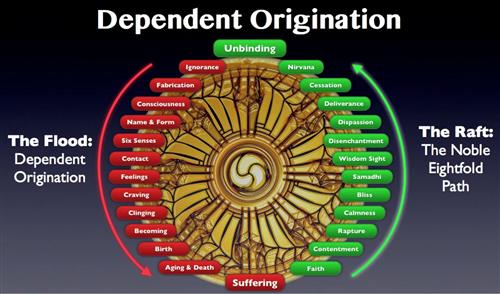
Buddhism explains that all things are interconnected and interdependent through the theory of Dependent Origination. Similarly, in programming, a software system is a complex web of interdependent components. Changing one component can have ripple effects on others.
Simplicity and The Middle Way
Buddhism advocates for the Middle Way, avoiding extremes to achieve balance. In programming, optimizing code, removing unnecessary parts, and avoiding overly complex design (over-engineering) is a way to achieve simplicity and efficiency.
Self-inquiry and Testing
The Buddha encouraged everyone to investigate and verify his teachings for themselves. Similarly, a good programmer doesn't just believe in theory; they must write code and run tests to verify that the program works correctly.
Self-creation, Self-destruction and Object Lifecycle
In Buddhism, all phenomena are impermanent, arising from causes and conditions and ceasing when those conditions expire. In programming, objects or processes have a similar lifecycle: they are created (born) when needed and are released (destroyed) when they are no longer in use, especially in memory management.
 Explore more on these topics






















 Guest Blogging: The Definitive Guide

 Top Trending Topics
 Share This
 Link copied!
 Recently Updated News