

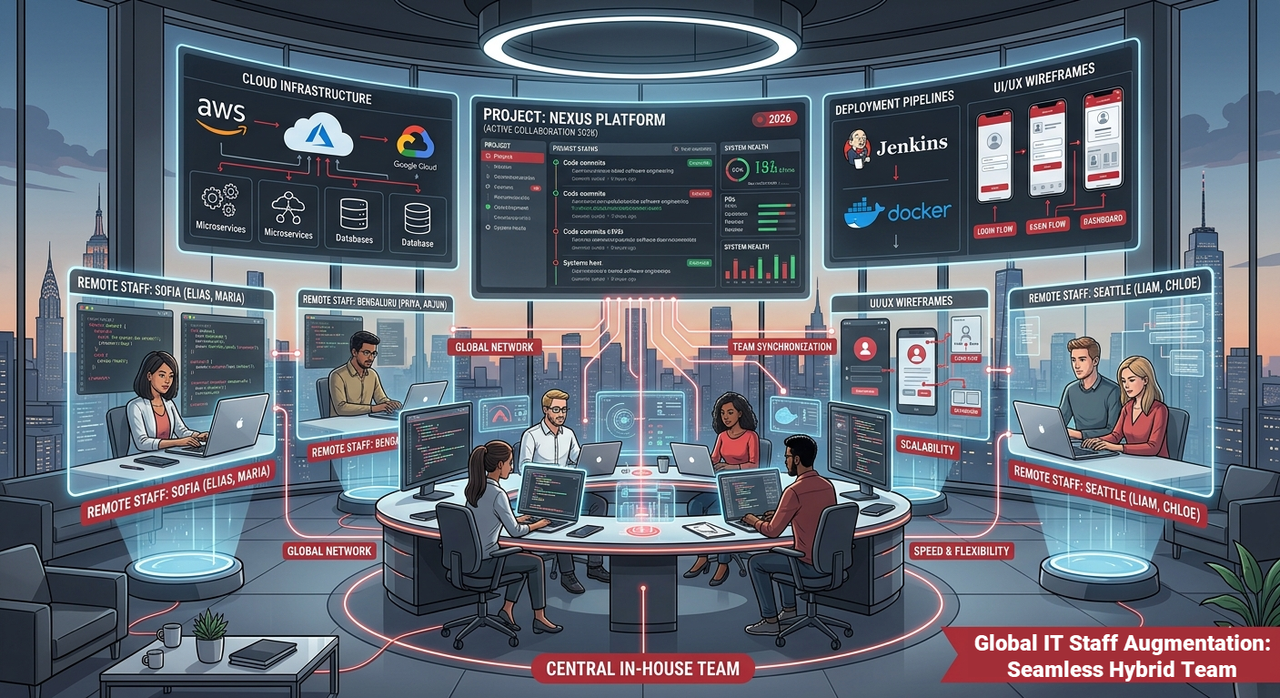



Why Microservices Matter for Modern eCommerce Platforms
Last updated: December 12, 2025 Read in fullscreen view


 Recommended for you
- 25 Jan 2025
 Why Is Kafka So Fast? 206/228
 - 01 Dec 2025 Manufacturing 4.0: AI Agents Enabling Self-Optimizing Production Systems 185/246
- 25 Jun 2024 What Is Apache Pulsar? 170/210
- 09 Jan 2022 How to Bridge the Gap Between Business and IT? 166/371
- 30 Oct 2022 How Much Does MVP Development Cost in 2023? 160/421
- 19 Oct 2021 Software development life cycles 148/828
- 06 Nov 2025 DataOps: The Next Frontier in Agile Data Management 144/204
- 04 Oct 2021 Product Validation: The Key to Developing the Best Product Possible 137/446
- 01 Sep 2022 Facts Chart: Why Do Software Projects Fail? 135/731
- 13 Oct 2021 Outsourcing Software Development: MVP, Proof of Concept (POC) and Prototyping. Which is better? 134/615
- 06 Nov 2023 How do you streamline requirement analysis and modeling? 131/369
- 07 Oct 2025 Case Study: Using the “Messaging House” Framework to Build a Digital Transformation Roadmap 130/210
- 20 Jan 2021 Fail early, fail often, fail cheap, fail safe but always fail forward 129/950
- 10 Apr 2021 RFP vs POC: Why the proof of concept is replacing the request for proposal 127/455
- 28 Jul 2022 POC, Prototypes, Pilots and MVP: What Are the Differences? 123/870
- 07 Jul 2021 The 5 Levels of IT Help Desk Support 117/597
- 12 Oct 2022 14 Common Reasons Software Projects Fail (And How To Avoid Them) 117/683
- 16 Aug 2022 What is a Headless CMS? 116/402
- 02 Nov 2021 [Case Study] Streamlined Data Reporting using Tableau 114/417
- 11 Nov 2021 What is an IT Self-service Portal? Why is it Important to Your Business? 112/564
- 12 Aug 2024 Understanding Google Analytics in Mumbai: A Beginner's Guide 112/219
- 16 Mar 2023 10 Reasons to Choose a Best-of-Breed Tech Stack 111/325
- 03 Dec 2025 IT Outsourcing Solutions Explained: What, How, Why, When 105/137
- 16 Feb 2021 Choose Outsourcing for Your Non Disclosure Agreement (NDA) 101/271
- 08 Nov 2022 4 tips for meeting tough deadlines when outsourcing projects to software vendor 100/392
- 18 Dec 2025 Cognitive Load in Software Development: Why Simplicity Matters More Than Cleverness 100/145
- 16 Sep 2022 Examples Of Augmented Intelligence In Today’s Workplaces Shaping the Business as Usual 100/537
- 09 Sep 2025 Aligning BI Dashboards with KPIs: A Business + Data Collaboration Guide 99/187
- 05 Sep 2023 The Cold Start Problem: How to Start and Scale Network Effects 99/297
- 12 Dec 2021 Zero Sum Games Agile vs. Waterfall Project Management Methods 98/513
- 31 Aug 2022 What are the best practices for software contract negotiations? 98/372
- 05 Mar 2021 How do you minimize risks when you outsource software development? 95/428
- 07 Aug 2022 Things to Consider When Choosing a Technology Partner 94/377
- 01 Jan 2024 The pros and cons of the Centralized Enterprise Automation Operating model 94/318
- 10 Jul 2025 Building AI-Driven Knowledge Graphs from Unstructured Data 94/256
- 24 Aug 2022 7 Ways to Improve Software Maintenance 90/393
- 06 Mar 2024 [SemRush] What Are LSI Keywords & Why They Don‘t Matter 89/293
- 09 Feb 2023 The Challenge of Fixed-Bid Software Projects 86/335
- 03 Apr 2021 How digital asset management streamlines your content workflow? 83/414
- 20 Jan 2022 TIGO Self-Organization Practice: Change Management Workflow 83/555
- 01 Dec 2023 Laws of Project Management 81/396
- 02 Dec 2022 Success Story: Satsuki - Sales Management Software, back office app for School Subscription Management 80/320
- 18 Jul 2021 How To Ramp Up An Offshore Software Development Team Quickly 77/669
- 03 Sep 2022 The secret of software success: Simplicity is the ultimate sophistication 76/281
- 03 Nov 2022 Top questions and answers you must know before ask for software outsourcing 75/360
- 04 Oct 2022 Which ERP implementation strategy is right for your business? 74/436
- 13 Feb 2021 Why is TIGOSOFT a software house for Enterprise Application Development? 73/454
- 16 Apr 2021 Insightful Business Technology Consulting at TIGO 71/526
- 20 Nov 2022 Software Requirements Are A Communication Problem 70/313
- 01 May 2024 Warren Buffett’s Golden Rule for Digital Transformation: Avoiding Tech Overload 70/278
- 06 Mar 2021 4 things you need to do before getting an accurate quote for your software development 69/767
- 07 Oct 2022 Digital Transformation: Become a Technology Powerhouse 68/315
- 16 Jun 2022 Rapid Application Development (RAD): Pros and Cons 65/951
- 15 Aug 2025 Quantum Technology: Global Challenges and Opportunities for Innovators 65/204
- 28 Oct 2022 Build Operate Transfer (B.O.T) Model in Software Outsourcing 64/475
- 21 Jun 2021 6 Useful Tips To Streamline Business Processes and Workflows 64/597
- 17 Mar 2025 Integrating Salesforce with Yardi: A Guide to Achieving Success in Real Estate Business 61/270
- 01 May 2023 CTO Interview Questions 60/396
- 09 Mar 2022 Consultant Implementation Pricing 52/267
- 01 Mar 2023 How do you deal with disputes and conflicts that may arise during a software consulting project? 50/211
- 17 Mar 2025 IT Consultants in Digital Transformation 43/135
- 13 Jul 2026 Why Every AI Initiative Needs Regular Audits 42/51
Modern eCommerce demands speed, flexibility, and systems that can keep up with constant change. As brands scale, monolithic platforms struggle with integrations, performance, and release cycles—creating bottlenecks that slow growth. This article explores how microservices reshape the eCommerce landscape, offering a lighter, more scalable, API-first foundation that empowers teams to innovate faster, streamline operations, and build digital experiences that stay resilient in a rapidly evolving market.
Modern eCommerce moves fast. Customer expectations change quickly. Brands update their catalogs every day. They integrate new APIs. They launch new channels. They handle high volumes of orders. Most systems powering these operations still run on monolithic architecture. Everything is tightly connected. A small update in one part slows down the entire platform. This becomes a real bottleneck as businesses scale.
Microservices are changing this. They are not just a trend. They are becoming the foundation for enterprise eCommerce systems. Organizations want systems that move faster. They want platforms that integrate better. They need stable systems as they grow. Microservices make this easier by breaking large applications into smaller parts. Each part works on its own. This gives eCommerce teams more freedom to innovate. It also prevents new changes from breaking existing workflows.
To understand why microservices matter, let us look at how they change the way modern eCommerce platforms operate.
1. Faster and Cleaner Integrations
Most eCommerce platforms rely on dozens of third-party integrations. These include ERPs, CRMs, WMS, payment gateways, shipping carriers, marketing tools, and custom APIs.
Monolithic platforms make these integrations slow and risky. A small mapping change can affect multiple modules. Microservices simplify this completely.
Each microservice exposes its own API. This allows integrations to connect directly to the specific service they need. There is no need to touch the entire system. It lowers the risk of downtime and reduces development effort.
Microservices help brands:
- Add new integrations faster
- Update API logic without breaking other features
- Test small changes safely
- Scale individual integration-heavy services
This leads to cleaner workflows and more predictable API behavior.
2. Better Performance During Traffic Peaks
Traffic spikes are common in eCommerce. Flash sales, festival periods, influencer campaigns, and product launches can put huge pressure on the system.
Monolithic systems struggle here because they must scale the entire application at once. This is expensive and slow.
Microservices fix this. Each service scales independently. If checkout traffic spikes, only the checkout service expands. If catalog requests increase, the catalog service scales accordingly.
This helps brands:
- Maintain uptime during peaks
- Reduce latency
- Balance loads automatically
- Serve global customers without delay
It gives ecommerce platforms the capacity to handle growth without heavy infrastructure costs.
3. Faster Release Cycles and Cleaner Deployments
Ecommerce teams update their systems constantly. They add features, fix bugs, optimize APIs, and experiment with pricing or personalization. With monolithic architecture, these updates slow down because everything is connected. Deploying a small update requires full system testing.
Microservices allow teams to deploy changes to individual services. This reduces risk and supports continuous development.
Benefits include:
- Faster engineering cycles
- Safer deployments
- Smaller codebases
- Quick rollback in case of issues
This is especially helpful for global platforms that cannot afford downtime.
4. Higher System Stability and Fewer Breakdowns
A monolithic eCommerce system is like a single machine. If one part breaks, the entire machine stops working. A small payment issue can bring the whole site down.
Microservices isolate failures. Each service runs independently. If the payment service slows down, the checkout stays functional. If the inventory service faces delays, the storefront remains online.
This improves:
- Uptime
- Reliability
- Error recovery
- Debugging
It protects revenue during high-demand periods.
5. Real-Time Inventory and Order Flow Management
Inventory and order management are core functions of eCommerce. These processes require constant syncing across multiple channels. Monolithic systems cannot ingest real-time updates fast enough.
Microservices support:
- Real time stock visibility
- Multi warehouse routing
- Region specific inventory logic
- High frequency API calls
- Faster order confirmations
Inventory stays accurate and orders flow smoothly without delays.
This is important for businesses selling on marketplaces, D2C sites, and offline stores at the same time.
6. Better Support for Headless and Composable Commerce
More brands are shifting to headless architecture. They want to build frontends using React, Vue, mobile apps, kiosks, and new digital experiences. This requires a backend that is flexible.
Microservices are ideal for this because they are API first. Each service communicates through clean APIs. This makes it easy to power multiple frontends from the same backend.
Composable commerce also becomes easier. Brands can pick the tools they want and integrate them service by service. They do not have to depend on a single platform for everything.
7. Clearer Team Ownership and Easier Collaboration
Large eCommerce teams often struggle to manage a monolithic codebase. Developers step on each other’s changes. Testing takes too long. One bug can block multiple teams.
Microservices create ownership. Each team manages one service. They deploy updates independently. They monitor their own performance metrics.
This increases velocity and reduces dependency between departments.
8. More Secure and Compliant Architecture
Security is important in eCommerce because platforms store customer data, payment information, and sensitive business workflows.
Microservices provide better control. Brands can enforce access rules for each service. They can monitor API traffic separately. They can detect unusual patterns and isolate the affected service immediately.
This makes compliance with PCI DSS, GDPR, CCPA, and SOC 2 more manageable.
9. Better Support for AI and Data-Driven Commerce
AI requires clean, structured data. Monolithic systems mix everything together, which makes it difficult to extract accurate signals.
Microservices generate cleaner data streams because each service handles one function. This helps AI models receive precise inputs from:
- Order services
- Inventory services
- Pricing services
- Customer activity services
Businesses can activate AI workflows such as:
- Predictive routing
- Dynamic pricing
- Demand forecasting
- Fraud detection
- Personalized recommendations
All without touching the main system.
10. Lower Operational Load for Engineering Teams
Maintenance of monolithic systems becomes difficult over time. Codebases grow. Integrations break. Minor changes create ripple effects.
Microservices reduce operational load because:
- Each service stays small
- Debugging becomes easier
- Updates affect only one part
- Deployment cycles are shorter
Most enterprise teams find microservices more manageable in the long term.
11. Key Benefits of Using Microservices in Modern eCommerce
Here is a simple table summarizing how microservices support API driven commerce.
| Benefit | How Microservices Help |
|---|---|
| Faster Integrations | Independent APIs for each service. No risk of breaking the full system. |
| Higher Scalability | Services scale based on demand. Ideal for peak traffic. |
| Better Stability | Failures stay isolated. Rest of the system runs smoothly. |
| Real Time Data | Faster syncing for inventory, orders, and routing. |
| Clean API Workflows | Easy version control and safer updates. |
| Faster Development | Teams deploy small changes without delays. |
| Lower Engineering Load | Smaller codebases reduce long-term complexity. |
| Ready for AI | Clean service-level data improves AI accuracy. |
| Supports Headless | API first design supports multiple frontends. |
| Strong Security | Isolated services improve compliance and monitoring. |
12. Conclusion
Microservices are transforming how modern eCommerce platforms operate. They help brands scale faster. They support smooth integrations. They maintain real-time accuracy across every function. When large systems are broken into smaller services, teams gain more control. This also gives businesses more flexibility in building their digital operations.
This shift does not replace engineering teams. It reduces repetitive work and gives them the freedom to innovate. As eCommerce becomes more API driven, more automated, and more global, microservices will become the default architecture for enterprise growth.
| About the Author | Kajal Yadav | Digital content strategist | Kajal Yadav is a digital content strategist who crafts clear, engaging narratives for e-commerce and tech brands. She focuses on topics like customer experience, digital growth, and e-Commerce automation, helping businesses communicate value in a way that drives real outcomes. |
 Explore more on these topics























 Guest Blogging: The Definitive Guide

 Top Trending Topics
 Share This
 Link copied!
 Recently Updated News
 thực chiến - Kiến tạo tương lai cho các nhà sáng tạo nội dung.