
Building Flexible IT Infrastructure to Support Your Business Growth
Last updated: September 28, 2026 Read in fullscreen view


 Recommended for you
- 14 Jan 2026
 How to Evaluate the Business and Productivity Software Company Seismic on RFP AI Agent Use Cases 264/350
- 18 Dec 2025 EOS as a Business Operating System: Powerful, but Not Always Plug-and-Play 202/277
- 27 Oct 2020 8 principles of Agile Testing 170/1537
- 01 Dec 2022 Difference between Set-based development and Point-based development 167/573
- 10 Apr 2022 Agile self-organizing teams: What are they? How do they work? 149/735
- 21 May 2022 "Fail Fast, Fail Often, Fail Forward" is the answer to Agile practices of software success 148/1214
- 16 Jul 2022 What are disadvantages of Agile Methodology? How to mitigate the disadvantages ? 136/548
- 28 Nov 2023 Scrum Team Failure — Scrum Anti-Patterns Taxonomy 135/401
- 08 Apr 2026 Top AI Agent Development Companies for Manufacturing Industry (2026) 134/188
- 19 Jul 2022 The 12 Principles of Continuous Process Improvement 132/705
- 03 Jul 2022 Manifesto for Agile Software Development 128/407
- 11 Jul 2022 Lean software development - the game-changer in the digital age 115/418
- 20 Nov 2022 Agile working method in software and football 112/465
- 01 Jun 2022 How Your Agile Development Team is Just Like a Football Team? 112/340
- 07 Oct 2020 How To Manage Expectations at Work (and Why It's Important) 109/472
- 05 Jun 2023 Bespoke Solution: Annual Maintenance Contract (AMC) Software 101/310
- 17 Jun 2021 What is IT-business alignment? 95/479
- 09 Oct 2022 Key Advantages and Disadvantages of Agile Methodology 92/804
- 27 May 2026 Best 5 Software Development Companies Ideal for Early-Stage Startups 91/143
- 12 Oct 2020 The Agile Manifesto - Principle #8 84/596
- 01 Mar 2022 Why Does Scrum Fail in Large Companies? 69/344
- 05 Feb 2024 Bespoke Solution: Visitor Management System for Corporate 67/345
- 21 Oct 2022 Virtual meeting - How does TIGO save cost, reduce complexity and improve quality by remote communication? 66/271
- 02 Nov 2022 Frequently Asked Questions about Agile and Scrum 65/468
- 10 Oct 2022 Should Your Business Go Agile? (Infographic) 59/191
- 11 Jan 2022 Lean Thinking and Lean Transformation 56/334
- 20 Jul 2026 Why Enterprises Are Embracing Microsoft Copilot and Agentic AI in 2026 45/63
- 09 Oct 2024 Are Expensive CRM Systems Really Worth It? 7/220
- 26 Dec 2025 Compliance Cost: How to Reduce It Without Risking Non-Compliance 1/281
- 31 Aug 2026 How Custom Software Is Reducing Downtime in Manufacturing 1/5
For business leaders and IT decision-makers at growing companies, the hardest part of expansion is that success puts the most stress on the tech stack. New sites, new machines, more users, and more data can turn rigid systems into bottlenecks, creating delays, inconsistent performance, and costly workarounds. The core tension is simple: business growth challenges demand speed and reliability, while many environments were built for a smaller, slower operation. With scalable IT infrastructure and flexible IT systems, growth becomes something the business can plan for and sustain. The payoff is steadier operations that support long-term business growth.
Cut Latency with Edge Computing on the Factory Floor
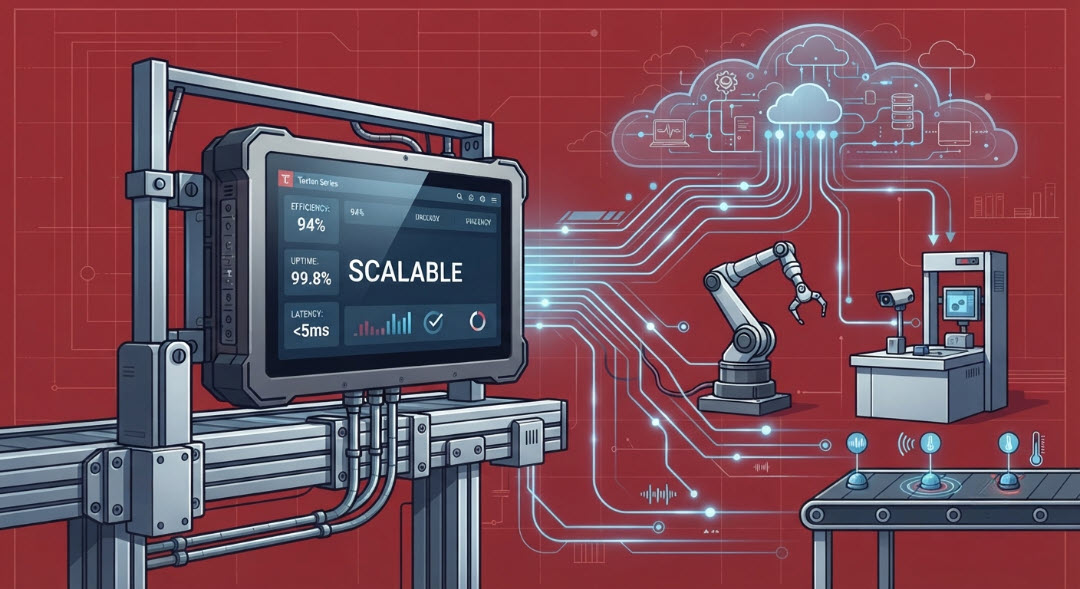
When growth pushes more machines, sensors, and operators onto your network, sending every signal back to a central system can create delays right where speed matters most. Edge computers help by processing and analyzing data closer to its source, so factory-floor and facility systems can stay responsive even as your business expands. By handling work locally, near manufacturing lines, automation equipment, or machine-control stations, you reduce latency and maintain fast performance without overloading centralized resources.
In industrial environments, the edge hardware often needs to do double duty as both compute and interface. The Tacton Series panel PCs combine industrial-grade computing with integrated touchscreen displays to deliver an all-in-one human-machine interface solution, designed for manufacturing, automation, and machine control environments. Options like the Tacton industrial panel PC support streamlined installation while fitting into a scalable architecture, and they’re built as a "rugged panel computer with durable performance" for demanding workflows. Their rugged design and flexible configuration options make it easier to standardize deployments across multiple lines or sites as needs change.
Build Scalable IT in 5 Practical Steps
This sequence turns “we’re growing fast” into a clear infrastructure plan you can execute without guesswork. It helps general readers avoid slowdowns, surprise costs, and security gaps as more people, devices, and sites come online.
- Audit what you have and what growth demands
Inventory users, devices, critical apps, and where performance slows down today, then map expected growth over the next few years. A simple worksheet and a few stakeholder interviews beat buying new hardware blindly. Start with assessment as your baseline so every later decision ties back to real constraints. - Design the network for expansion, not perfection
Choose a modular layout where you can add locations, production lines, or teams by repeating a proven “building block” instead of redesigning the whole network each time. Separate traffic types (business apps, operations systems, guest access) so one spike does not slow everything down. Plan for local processing where speed matters, and backhaul only what must be centralized. - Integrate cloud services with clear boundaries
Decide which workloads belong locally (latency sensitive or must stay onsite) and which can move to the cloud (elastic demand, shared access, backups). Connect them with standard identity, consistent naming, and predictable data flows so troubleshooting stays simple. Keep migrations phased so daily work continues while capabilities improve. - Build security in as you scale
Apply basic rules everywhere: least-privilege access, multi-factor login, timely patching, and segmented networks for high-risk equipment. Treat security tools as part of your scaling plan since cloud-based security is growing quickly and can help you standardize protection across sites. Make responsibilities explicit so “who owns this alert?” never becomes a growth bottleneck. - Future-proof with standards, monitoring, and repeatable rollouts
Standardize a small set of approved configurations (devices, images, policies) so new deployments look the same and support is faster. Add monitoring that tracks capacity and performance trends, not just outages, so you can expand before users feel pain. Review the plan quarterly and adjust priorities as the business changes.
Modernize Without Chaos: What Scalability Enables
In many businesses, scalable growth depends on expertise that isn’t always realistic to keep fully in-house. Migrating and modernizing existing workloads, especially when legacy systems are involved, often takes specialized planning and hands-on execution. The same is true when you need your ERP, CRM, and other essential software to work as a single, reliable system: integrations have to be designed carefully to avoid data silos, fragile connections, and broken processes. And when product demand spikes, scaling development capacity quickly can be hard if your only option is hiring full-time roles you may not need long-term.
TIGO Solutions is one resource that supports these needs with IT consulting, cloud migration and modernization, ERP and CRM integration, custom software development, and flexible outsourcing/outstaffing services, so you can grow capability and delivery speed without adding unnecessary complexity.
Scalable IT Infrastructure Questions, Answered
Q: What does “scalable infrastructure” really mean for a growing business?
A: In practical terms, it means your systems can take on more users, data, and transactions without slowdowns or service issues. The ability of a system, handle increasing amounts, without compromising performance is the goal. A good first step is to define what “more” looks like for you: peak traffic, new locations, or heavier reporting.
Q: What are the most common pitfalls when scaling IT?
A: The big ones are scaling one layer while ignoring others, like adding app servers but leaving the database underpowered. Another frequent issue is brittle integrations that break when volumes increase. Start with an end-to-end capacity review across app, data, network, and identity.
Q: How do we improve performance without disrupting daily operations?
A: Use phased changes with canary releases, feature flags, and clear rollback plans. Build a staging environment that mirrors production, then load test before you cut over. Schedule high-risk moves during low-usage windows.
Q: How can we tell whether slowness is CPU, memory, or storage related?
A: Watch your monitoring dashboards for bottlenecks that line up with latency spikes. If you are CPU-bound, adding more RAM or faster disks will not fix the core constraint. Confirm by profiling the hottest services and tracing the slowest requests.
Q: Should we fix our legacy systems first or migrate to the cloud?
A: It depends on risk and dependency chains. If a legacy app is business-critical, stabilize it with better observability and backups before moving pieces around. A practical approach is to migrate what is low-risk first, then modernize the parts that limit growth.
Turn a Scalable IT Plan Into This Week’s Next Moves
Fast-growing businesses often hit the same friction point: today’s IT works fine until demand spikes, and then fixes pile up faster than progress. The way through is the mindset this guide has reinforced, treating scalability as a long-term IT strategy, guided by a scalable IT summary that prioritizes clear ownership, repeatable decisions, and measured change. Done well, infrastructure implementation becomes steady and predictable, so business technology growth doesn’t come with constant fire drills. Scale by standardizing decisions, not by stacking quick fixes.
 Explore more on these topics





 Guest Blogging: The Definitive Guide

 Top Trending Topics
 Share This
 Link copied!

 Recently Updated News
 thực chiến - Kiến tạo tương lai cho các nhà sáng tạo nội dung.